Best Epoxy for Cold Weather (2026): We Compared
The best epoxy for cold weather is West System G/flex 650 for most wood-repair and bonding jobs because it is the most versatile winter pick in this lineup: toughened, flexible, and better suited to cold-condition cure risk than a standard fast-set repair epoxy. Bad temperature matching wastes glue joints, repairs, and time. This guide shows how to choose epoxy by project type, ambient temperature, and cure risk so you can avoid winter bond failures.
Quick comparison
| Product | Badge | Best for | Price | ||
|---|---|---|---|---|---|
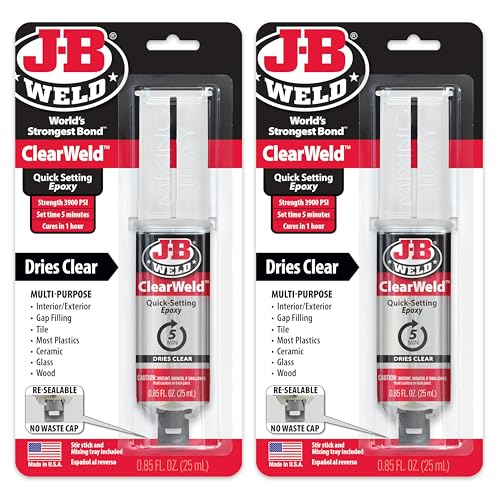 |
J-B Weld ClearWeld 5 Minute EpoxyJ-B Weld Store | Our pick | 2 pack · 5 minute epoxy · clear | $11.04
Price as of 3 Nov 2026
|
View |
 |
West System 655-8 G/Flex Epoxy AdhesiveWest System | Also great | 2 x 4.5 oz · epoxy adhesive · flexible | $36.55
Price as of 3 Nov 2026
|
View |
Use the table to match the project to the epoxy type first, then check whether your shop, part, and cure window are realistic. The right choice depends on whether you need a small bond line, a paste that stays put, or a fast indoor fix.
How we chose
We compared the products by winter project fit, label clarity, and how well the stated product type matches cold-weather repair needs for wood. We also separated ambient air, substrate, and product temperature so the selection rule is practical rather than generic.
Cold weather changes epoxy behavior in predictable ways. Below 50°F, many standard epoxy formulations become sluggish, and below 40°F the cure can stall altogether; for every 18°F drop, cure time roughly doubles.
The other filter was risk. A product can work in winter and still be wrong for a deep void, a vertical repair, or an unheated shop where the temperature will swing during cure.
West System G/flex 650: best for small repairs
- Reliable cure in cold conditions
- Bonds difficult materials well
- Extended working time at 72°F
West System G/flex 650 is presented as a strong overall winter pick for small repairs and mixed-material bonds. Based on the manufacturer’s product details and buyer feedback, it suits wood, metal, and fiberglass, and its toughened, flexible character helps when a repair has to tolerate movement as temperatures change.
This is a good fit for tight glue lines, edge chips, and small structural fixes where you want a dependable bond and some forgiveness in cold conditions. It is also the clearest choice when the repair crosses materials, since wood-to-metal or wood-to-fiberglass joints often need more toughness than a general-purpose syringe epoxy can provide.
The drawback is simple: it is not a paste. If you need to bridge a wide void, hold a sagging edge, or fill a deep missing corner, a thicker epoxy filler is usually the better choice.
PC-Woody: best for gap filling
Product marker unavailable in supplied data. The gap-filling pick should be a paste-style epoxy wood repair compound, because viscosity matters more in cold weather than many shoppers expect. Thick fillers stay where you place them on edges, corners, and vertical spots, while thin epoxy can run or starve the joint before cure starts.
For winter work, paste helps when the repair must bridge voids, rebuild a rotted corner, or hold shape on a vertical face. That makes it the right category for exterior trim repairs and small rebuilds where the repair line is not a tight, clean glue joint.
The tradeoff is working speed and finish quality. Paste products are less suited to invisible glue joints, and cold can make any epoxy harder to spread, so you still need a stable substrate and a realistic cure window.
J-B Weld ClearWeld: best for fast indoor fixes
- Sets in 5 minutes
- Works on many surfaces
- Clear finish for repairs
J-B Weld ClearWeld is the best fit when you need a quick indoor repair and can keep the parts warm enough for a short set window. The 5 minute set time is useful for small, enclosed, low-load fixes where you want a clear finish and fast handling.
It fits best for small, clean repairs in a heated room or a temporary warm setup. For that kind of job, the short set time can reduce the time the parts spend exposed to dust, movement, or temperature drift.
The drawback is the same reason it is fast: short working time leaves little room for cold, thickened components, slow mixing, or a tricky fit. In an unheated shop, a 5 minute epoxy can become difficult to position before it starts to grab.
Which one should you buy?
Pick by project type first. For small repairs, choose West System G/flex 650. For gap filling or rebuilding a corner, a paste-style repair compound such as PC-Woody is commonly used. For a fast indoor fix with a clear bond line, choose J-B Weld ClearWeld.
Pick by shop temperature next. If your air and substrate are near the lower edge of the label range, favor the product that is explicitly suited to colder cure conditions. Standard epoxies can work only when the substrate, ambient air, and product temperature are all in range and stable through cure.
Pick by cure-risk tolerance last. If the repair cannot tolerate a gummy surface, poor wet-out, or a temperature drop overnight, wait or heat the work area. A repair in an unheated shop is not the time for guesswork.
Say your repair is a 3-inch chip on a chair leg in a 48°F room. A flexible small-bond epoxy is the safer call than a fast-set formula that may thicken too much to wet the wood cleanly. Suppose the same repair sits on a vertical exterior trim board; then a paste-style filler is the better fit because it stays put while curing.
Cold weather epoxy selection table
| Project type | Minimum workable temperature | Recommended epoxy type | Warming method | Cure-risk warning | Go/no-go decision |
|---|---|---|---|---|---|
| Small repair | At or above the label minimum for the exact product; if the shop sits below 50°F, many standard formulas slow sharply | Toughened, flexible epoxy for small bonds | Bring resin and hardener to room temperature with gentle warming, then mix thoroughly | Cold makes resin more viscous and reduces wet-out, so a tiny glue line can starve | Go if the substrate is dry, above dew point, and stable through cure |
| Gap fill | Prefer a formula that stays workable at your actual substrate temperature, not just the room air | Paste-style epoxy wood filler | Warm the sealed package in a controlled warm space before opening | Deep fills can trap cold material and cure unevenly, especially if the temperature drops overnight | Go if the void is shallow enough for the product and the repair can stay warm |
| Exterior bond | Use a cold-weather formula if the site is near 35°F to 50°F; standard systems often underperform below 50°F | Cold-weather epoxy formula with modified hardener or lower-viscosity chemistry | Pre-warm components gently and keep the part protected from wind and moisture | Outdoor air can cool the substrate faster than the room air suggests | Go only if the dew point margin is safe and the cure window stays stable |
| Vertical repair | Only when the part and air stay within the product’s winter-use range | Paste or thickened repair epoxy | Warm enough for spreadability, not enough to thin the paste | Thin mixes sag; cold can also make spreading uneven and leave dry pockets | Go if the filler can hold shape without slipping |
| Unheated-shop use | Use a formula labeled for low-temperature application; otherwise wait for warmer conditions | Cold-weather epoxy system or postpone the repair | Use a warm water bath of 125°F to 140°F for crystallized resin, or a controlled warm box before mixing | Do not start if the temperature will drop within 24 hours | No-go unless you can control substrate temperature and cure stability |
Will epoxy crack in cold weather?
Epoxy can crack in cold weather if the bond cures poorly, shrinks against a cold substrate, or is asked to cure after the temperature falls out of range. The more common winter failures are gummy cure, weak wet-out, and bond loss, but crack risk rises when the substrate and ambient air swing during cure.
That risk is why product choice matters. Standard epoxy systems may not reach optimal hardness and strength in cold conditions, so a bond that looks set can still fail later under stress or movement.
How cold changes the job
Cold weather thickens epoxy resin and hardener, making the mix harder to spread and harder to wet into wood pores. It also lengthens cure time; with major temperature drops, that can roughly double the wait, and in severe cold the cure can stall.
That is why the project itself matters. A small repair may still work with a winter-friendly system, while a wide, exposed exterior bond may need warmer conditions or a different product.
Minimum workable temperature
There is no single universal number for every epoxy. Many standard systems become sluggish below 50°F, a minimum substrate temperature of 50°F is typically required, and some cold-weather systems can cure as low as 35°F.
Use this rule instead: check the label, then confirm the substrate, ambient air, and product temperature separately. The substrate should stay at least 5°F above the dew point, and the temperature should remain stable through the cure period.
What is the minimum temperature to apply epoxy?
The practical minimum is the label minimum for the exact system, not just the room temperature. For many standard epoxies, 50°F substrate temperature is the usual floor, while some cold-weather formulas are rated to cure at 35°F; below 40°F, the cure may stall altogether.
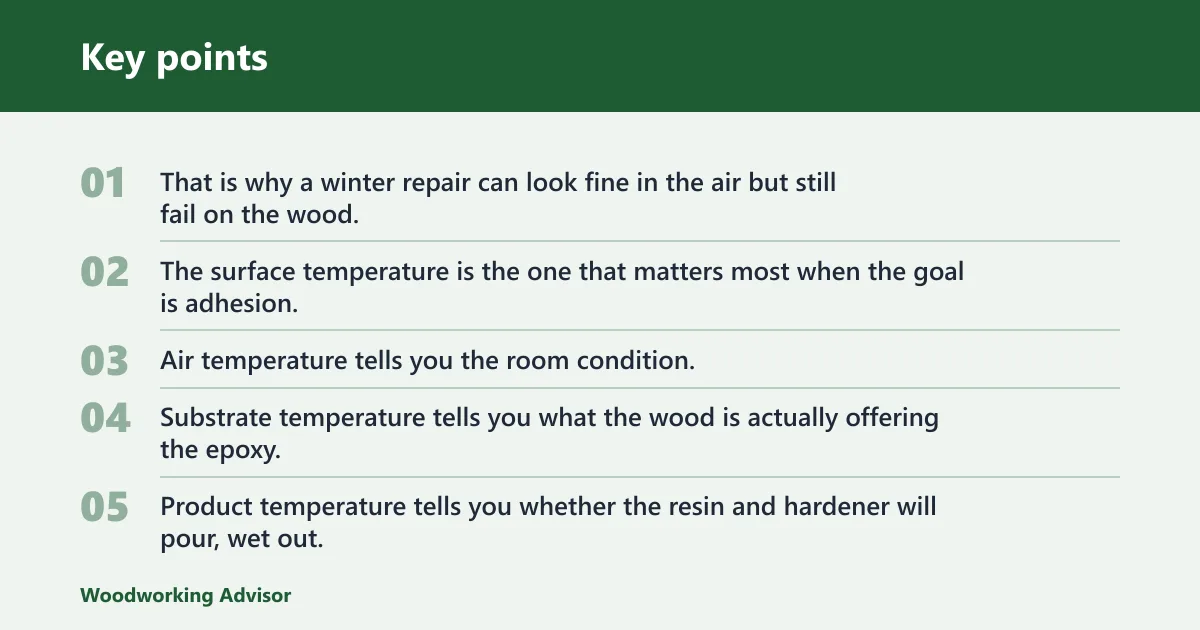
That is why a winter repair can look fine in the air but still fail on the wood. The surface temperature is the one that matters most when the goal is adhesion.
Air, substrate, and product are not the same
Air temperature tells you the room condition. Substrate temperature tells you what the wood is actually offering the epoxy. Product temperature tells you whether the resin and hardener will pour, wet out, and mix cleanly.
Measure all three separately. A cold board can rob heat from the mix and slow cure even if the room feels workable.
When not to start
Do not start if the surface is damp, the dew point margin is too tight, or the temperature will swing down hard during cure. A repair that has to cure through a cold night has a much higher chance of staying soft or losing adhesion.
Can epoxy cure below 50°F?
Yes, some epoxies can cure below 50°F, but only if the product is labeled for low-temperature use. Standard systems often slow sharply below 50°F, and many cold-weather epoxy systems are built with modified hardeners or lower-viscosity chemistry so they can cure as low as 35°F.
Even then, the cure window matters. Temperature drops within 24 hours should be avoided, because the reaction needs a stable environment to finish cleanly.
Fast-set versus slow-set in winter
Fast-set products can be useful in a heated room, but they give you less time to mix and position parts after the components thicken in cold storage. Slow-set products usually buy more working time, yet they still need enough warmth to stay mobile and cure fully.
If the bond line is complex, the longer window can help. If the shop is cold and you need a quick clamp-up, a fast formula can become too stubborn too soon.
What happens if epoxy freezes during cure?
If epoxy freezes or gets too cold during cure, the reaction can stop or leave the bond undercured. The result is often a gummy surface, soft interior, poor adhesion, or a joint that never reaches its intended hardness.
That is also why warmth during cure matters as much as warmth before mixing. A heat pad or hot box can help retain exothermic heat in a controlled setup and reduce dust exposure while the bond sets.
How do you warm epoxy before mixing in winter?
Warm epoxy gently before mixing so the resin flows and the hardener can blend evenly. A warm water bath of 125°F to 140°F can return crystallized resin to liquid, and a controlled warm space or hot box can bring components up to a more usable temperature without overheating them.
Keep it gentle and controlled. The goal is to lower viscosity, not to cook the components or create a temperature swing that changes cure behavior.
Safe warming steps
- Check whether the resin has turned cloudy or crystalline in storage.
- Warm the sealed container in a controlled 125°F to 140°F water bath if the resin has crystallized.
- Dry the container fully before opening it.
- Bring the hardener to a similar room-friendly temperature if it has thickened.
- Mix thoroughly, scraping the sides and bottom of the cup.
- Apply only to a dry substrate that is above the dew point margin.
What not to do
Do not overheat the components or place them near an open flame. Do not assume a warmer mix will fix a cold, damp, or oily substrate. And do not warm only one part of the system while leaving the other cold, because that can make metering and blending uneven.
Does cold weather make epoxy thicker and harder to mix?
Yes. Cold epoxy becomes thicker and harder to work with, and both resin and hardener can thicken enough to slow mixing and reduce wet-out. That change affects spreadability, squeeze-out, and how well the adhesive penetrates the wood surface.
This is why cold storage can cause trouble even before the repair starts. Some epoxy components can crystallize or turn cloudy in storage, and that is a sign the material needs gentle warming before use.
How viscosity affects wet-out
Thicker epoxy does not flow into surface pores as well. On wood, that can leave dry spots or thin bond lines that look covered but are not fully wetted.
If the repair depends on a thin, clean joint, lower viscosity helps. If the repair depends on staying put on a vertical edge, a paste or thicker system is usually safer.
How long does epoxy take to cure in cold weather?
Cold weather lengthens cure time, sometimes by a lot. A common rule of thumb is that for every 18°F drop, cure time roughly doubles, and full cure can extend from hours to days depending on the product and temperature.
That longer timeline matters because the bond can stay vulnerable to dust, movement, and moisture for much longer than expected. A repair that looks fine after a few hours may still be far from full strength.
Working time and cure time are different
Working time is the window you have to mix and place the epoxy. Cure time is how long it takes to harden enough for service and, later, full strength. Cold shortens flow and mixing ease while stretching the cure window.
Fast-set and slow-set products react differently in the cold, but neither is immune to a cold substrate or a dropping room temperature.
Should I use a cold-weather epoxy formula or standard epoxy?
Use a cold-weather formula when the shop or substrate will stay near the lower edge of the label range, especially if the repair must cure in an unheated space. Use standard epoxy only when the product, air, and substrate temperatures all stay comfortably in range and stable.
The safer choice is the one labeled for the conditions you actually have. If the temperature is near 35°F to 50°F, a winter formula is the better bet; if the environment is warmer and steady, a standard system is usually fine.
Buyer cues to look for on the label
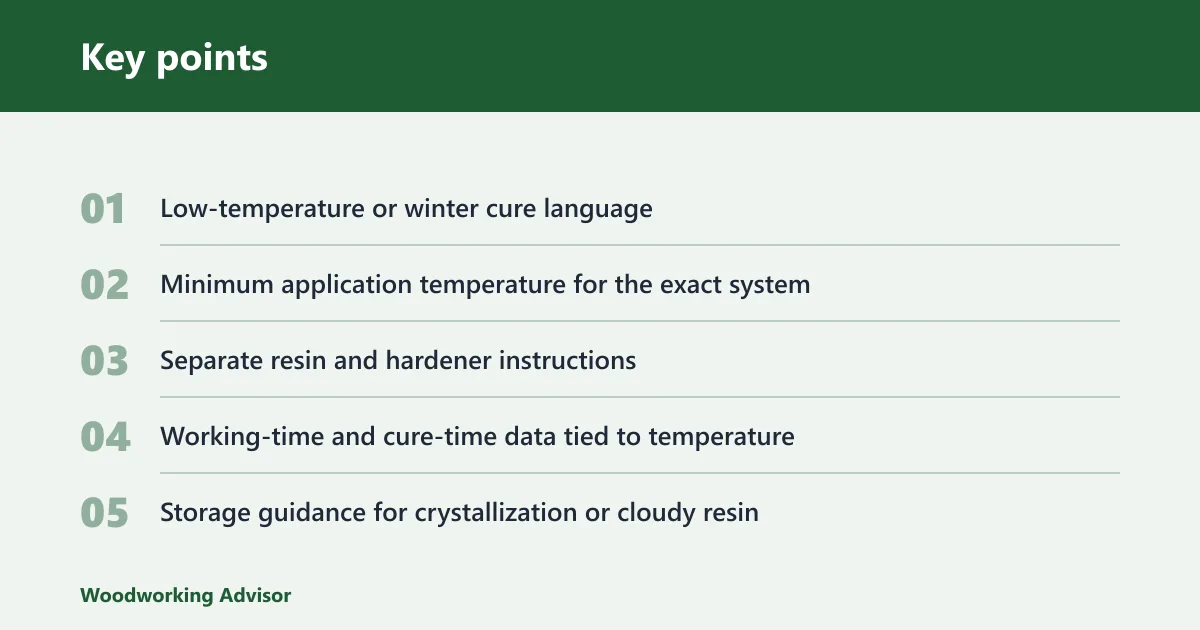
- Low-temperature or winter cure language
- Minimum application temperature for the exact system
- Separate resin and hardener instructions
- Working-time and cure-time data tied to temperature
- Storage guidance for crystallization or cloudy resin
Troubleshooting winter failures
| Symptom | Likely cause | What to check | Practical response |
|---|---|---|---|
| Gummy cure | Temperature too low or cure window interrupted | Air, substrate, and product temperature | Warm the area and wait only if the label allows recovery; otherwise remove and redo the bond |
| Poor wet-out | Epoxy too thick or surface too cold | Substrate temperature and viscosity | Warm components gently and re-evaluate the surface prep |
| Crystallized resin | Cold storage | Cloudiness or crystals in the resin | Use a 125°F to 140°F warm water bath to return resin to liquid |
| Failed adhesion | Condensation, wrong temperature, or movement during cure | Dew point margin and cure stability | Wait for a drier window and keep the part warm until cure is complete |
A common first-timer mistake is warming the room to 55°F and assuming the board is ready. If the wood itself is still near the dew point, the surface can look dry but still carry enough moisture to hurt adhesion.
Sponsored / affiliate links. As an Amazon Associate I earn from qualifying purchases. I may earn additional commission from eligible campaigns.