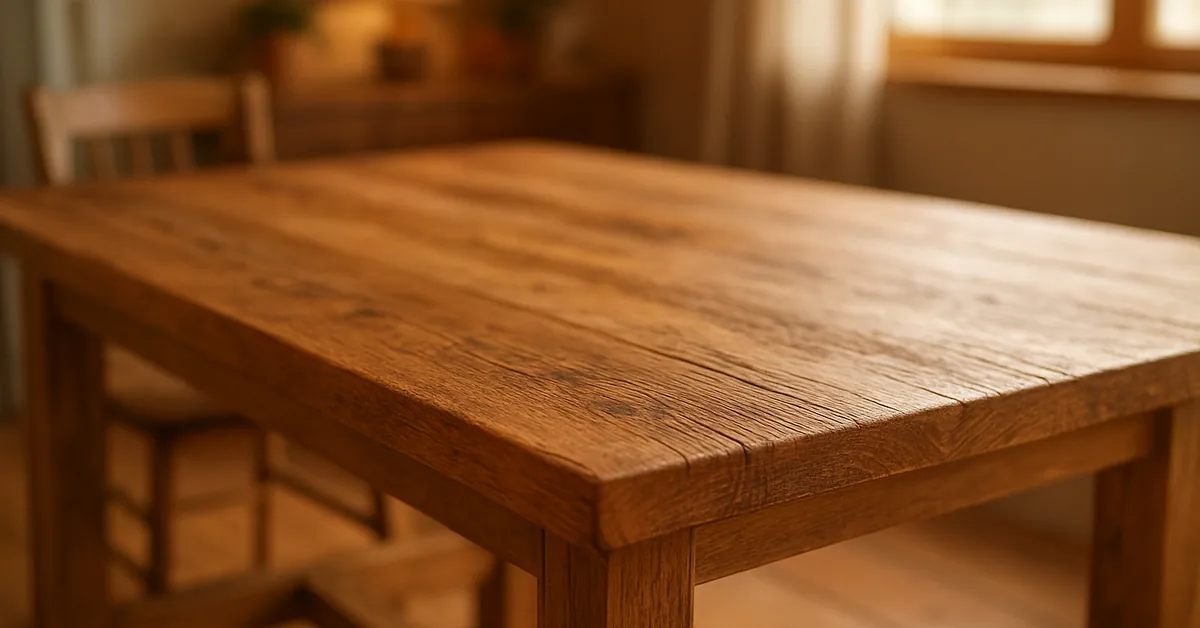
Best Finish for Rustic Wood Table: 8 Compared by Cost (2026)
The best all-around finish for a rustic wood table is Rubio Monocoat Oil Plus 2C — a single-coat hardwax oil that’s third-party tested food-safe (EC 1935/2004) and finishes a typical table for about $7.20. If you want maximum water resistance instead, General Finishes Arm-R-Seal (a low-sheen wiping varnish) beats every oil or wax pick on film protection. We compared 8 real, currently-sold finishes across sheen level, durability, reapplication interval, food safety, and actual cost to finish a table — not just adjectives. (This guide covers indoor, rustic-look tables; if yours lives on a patio or deck, see our separate guide to the best finish for an outdoor wood table instead.)
| Finish (Award) | Type | Sheen | Dry to Touch | Food-Safety Status | Price | Cost to Finish a 20 sq ft Table |
|---|---|---|---|---|---|---|
| #1 Best Overall Rubio Monocoat Oil Plus 2C (Pure) | Hardwax Oil (2-component) | Matte (natural, no film build) | Light use 24-36 hrs | Certified | $62.99 / 350 ml | $7.20 |
| Best Hardwax Oil for High-Traffic Tables Osmo Polyx-Oil Original 3054 (Clear Satin) | Hardwax Oil (1-component) | Satin | 8-10 hrs per coat | Toy-safety norm only | $169.99 / 2.5 L | $10.53 |
| Best Budget Raw-Look Oil Watco Danish Oil (Natural) | Raw/Matte Penetrating Oil | Matte/low-sheen (penetrating oil, no surface film) | Touch 6-8 hrs | Not claimed | $14.98 / 1 pint | $3.79 |
| Best Low-Sheen Poly for Durability Minwax Wipe-On Poly, Oil-Based (Satin) | Low-Sheen Polyurethane | Satin – quantified 35 +/-5 gloss units @ 60 degrees (ASTM D523) | Recoat 2-3 hrs | Not claimed | $19.99 / 1 pint | $12.90 |
| Best for Heavy Daily-Use Tables General Finishes Arm-R-Seal, Oil-Based Topcoat (Satin) | Low-Sheen Poly / Wiping Varnish | Satin (also available Gloss, Semi-Gloss) | Dry 6-12 hrs | Not claimed | $45.00 / 1 quart | $18.00 |
| Best Traditional Wax Finish (Low-Traffic Tables) Minwax Paste Finishing Wax (Natural) | Wax Finish | Soft low sheen (hand-buffed glow, not a hard film) | 10-15 min dry before buffing | Not claimed | $13.33 / 1 lb | $1.07 |
| Best Food-Safe Finish for Tabletops Tried & True Original Wood Finish | Raw/Matte Oil (polymerized linseed oil, food-safe) | Low-gloss, antique sheen | 60-min penetration + rub dry | Brand claim, uncertified | $35.99 / 1 pint | $11.52 |
| Best Low-VOC / Eco-Friendly Finish Vermont Natural Coatings PolyWhey Furniture Finish (Satin) | Low-Sheen / Low-VOC Waterborne Poly | Satin – quantified 20 +/-5 gloss units @ 60 degrees (Semi-Gloss 45, Matte 10 also available) | Recoat in 1-2 hrs | Not claimed | $44.92 / 1 quart | $19.60 |
The spread is bigger than it looks on a shelf tag: finishing one typical rustic table runs from $1.07 with paste wax (which offers the least real protection) up to $19.60 with a low-VOC waterborne poly — and of the eight, only one, Rubio Monocoat, carries independent, third-party food-contact testing rather than just a marketing claim.
Best Finishes for a Rustic Wood Table
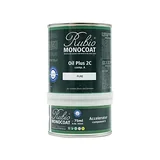
1. Rubio Monocoat Oil Plus 2C (Pure) — #1 Best Overall
- Price: $62.99 / 350 ml (live Amazon price, checked this session)
- Type: Hardwax Oil (2-component)
- Coverage: 175 sq ft per 350ml container, 1 coat (hardwood rate)
- Coats used in our cost calc: 1 — single-coat system by design (no second coat needed) – rubiomonocoatusa.com product pages
- Dry / cure time: Light use 24-36 hrs; ~80% cured at 48 hrs; full cure & water resistance ~5 days (source: help.rubiomonocoatusa.com/oil-plus-2c-cure-times)
- Sheen: Matte (natural, no film build)
Food safety: Yes – third-party tested (Eurofins) to EU Food Contact Materials Regulation EC 1935/2004
Water resistance: Full liquid/water resistance after 5-day cure (mfr cure-time page)
Reapplication: Spot-maintain with Universal Maintenance Oil as needed; full recoat rarely needed given low-film design
Cost to finish a 20 sq ft table: $7.20 — $62.99 × (20 ÷ 175.0 sq ft covered by one full 1-coat application of a 350 ml container).
Check current price on Amazon →
Who it’s for: anyone finishing a dining or kitchen table who wants both the lowest-film “you can feel the wood” rustic look and certified food-contact safety without a second product. It’s also the fastest to apply of the eight — one coat, no recoat — which matters if you’re finishing a table you need back in the room soon. It’s not the cheapest per ounce, but the single-coat system means you use less product than a 2-3 coat finish, which is part of why its per-table cost lands mid-pack despite the higher shelf price.
Main drawback: it’s the most expensive per-ounce pick, and the 2-part hardener means you must mix only what you’ll use within the 5-6 hour pot life — no saving leftovers.
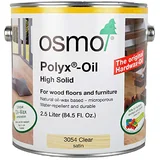
2. Osmo Polyx-Oil Original 3054 (Clear Satin) — Best Hardwax Oil for High-Traffic Tables
- Price: $169.99 / 2.5 L (live Amazon price, checked this session)
- Type: Hardwax Oil (1-component)
- Coverage: 24 m2/L per coat (~258 sq ft/L/coat); 2 coats recommended
- Coats used in our cost calc: 2 — Osmo TDS: apply thin 2nd coat after first dries
- Dry / cure time: 8-10 hrs per coat; fully hardened in 2-3 weeks (source: Osmo Polyx-Oil Original TDS (wood-finishes-direct.com, mfr-issued))
- Sheen: Satin
Food safety: Meets EN 71.3 (children’s toy safety norm) when dry; DIN 68861-1A stain-resistant (wine, beer, cola, coffee, tea, juice, milk, water – no water spots). Not a direct food-contact-material certification like Rubio’s EC 1935/2004.
Water resistance: DIN 68861-1A liquid-resistant; no water spots
Reapplication: No fixed mfr interval published; spot-refresh with Osmo Liquid Wax Cleaner as needed
Cost to finish a 20 sq ft table: $10.53 — $169.99 × (20 ÷ 322.9 sq ft covered by one full 2-coat application of a 2.5 L container).
Check current price on Amazon →
Who it’s for: someone who wants a proven, widely-used European hardwax oil and is finishing more than just one table — the 2.5 L size we priced is a lot of product for a single tabletop, so it makes more sense if you’re also doing chairs, a bench, or floors. The DIN 68861-1A stain-resistance rating (wine, coffee, cola, milk, and more, with no water spots) makes it a strong choice for a table that regularly sees drinks and food set directly on the wood, even though it doesn’t carry Rubio’s specific food-contact certification.
Main drawback: needs a full 2-3 weeks to fully harden, and at 2.5 L it’s a lot of product (and money) for a single table if you don’t have other projects to use it on.
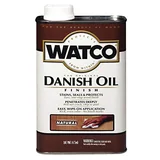
3. Watco Danish Oil (Natural) — Best Budget Raw-Look Oil
- Price: $14.98 / 1 pint (live Amazon price, checked this session)
- Type: Raw/Matte Penetrating Oil
- Coverage: Theoretical ~577-689 sq ft/gal at 1 mil DFT (actual coverage varies with wood porosity per mfr TDS)
- Coats used in our cost calc: 1 — Watco TDS default procedure: apply 1 coat, reapply only if needed
- Dry / cure time: Touch 6-8 hrs; handle 10 hrs; recoat/topcoat 72 hrs (source: Rust-Oleum Watco Danish Oil TDS (WAT-02, Form GDH-636))
- Sheen: Matte/low-sheen (penetrating oil, no surface film)
Food safety: Not marketed food-safe. Contains mineral spirits and rosin ester; no food-contact claim in TDS or SDS.
Water resistance: Basic – penetrating oil only, no film-forming protection
Reapplication: No fixed mfr interval; maintenance coats applied as needed per TDS
Cost to finish a 20 sq ft table: $3.79 — $14.98 × (20 ÷ 79.1 sq ft covered by one full 1-coat application of a 1 pint container).
Check current price on Amazon →
Who it’s for: a first table-finishing project, a budget build, or anyone who wants the classic “hand-rubbed oil” look without spending much. At under $15 a pint and a one-hour application, it’s the easiest entry point in this comparison. It’s a poor fit if the table will host wet glasses often and you don’t plan to topcoat it — pair it with a polyurethane topcoat (Watco’s own TDS explicitly supports this, after a 72-hour cure) if you need real water resistance.
Main drawback: it’s a penetrating oil only, with no film-forming layer — it won’t stop water rings or heat marks the way a poly or varnish topcoat will, and the TDS itself declines to give a fixed coverage number because it depends so much on the wood.
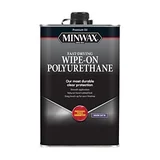
4. Minwax Wipe-On Poly, Oil-Based (Satin) — Best Low-Sheen Poly for Durability
- Price: $19.99 / 1 pint (live Amazon price, checked this session)
- Type: Low-Sheen Polyurethane
- Coverage: 62 sq ft/pint per coat (mfr TDS)
- Coats used in our cost calc: 2 — Minwax TDS: 2-3 coats recommended; using label minimum of 2
- Dry / cure time: Recoat 2-3 hrs; dry fully overnight (~24 hrs) before normal use (source: Minwax Wipe-On Poly TDS)
- Sheen: Satin – quantified 35 +/-5 gloss units @ 60 degrees (ASTM D523)
Food safety: Not marketed food-safe. Contains mineral spirits/aliphatic hydrocarbons; carries a California Prop 65 cancer warning on the TDS.
Water resistance: High – film-forming polyurethane, protects against water, household chemicals, food stains
Reapplication: Film-forming poly; typically lasts multiple years before recoat (qualitative, no mfr-stated interval)
Cost to finish a 20 sq ft table: $12.90 — $19.99 × (20 ÷ 31.0 sq ft covered by one full 2-coat application of a 1 pint container).
Check current price on Amazon →
Who it’s for: someone who wants a real film finish (better water and stain resistance than any oil here) but without the drips, brush marks, or spray equipment a standard poly requires — it’s designed to be wiped on with a cloth. The quantified 35 ±5 satin gloss reading means you know exactly what sheen you’re getting before you open the can, which none of the oil-based picks can offer.
Main drawback: it’s oil-based with real solvent content (California Prop 65 warning on the label) and needs good ventilation and an overnight cure before normal use.
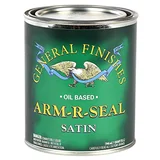
5. General Finishes Arm-R-Seal, Oil-Based Topcoat (Satin) — Best for Heavy Daily-Use Tables
- Price: $45.00 / 1 quart (live Amazon price, checked this session)
- Type: Low-Sheen Poly / Wiping Varnish
- Coverage: ~400 sq ft/gal @ 1 MDFT per coat (mfr TDS)
- Coats used in our cost calc: 2 — Standard wiping-varnish practice for tabletops (not an explicit count in TDS – flagged as assumption)
- Dry / cure time: Dry 6-12 hrs; recoat/topcoat window 12-24 hrs (source: General Finishes Arm-R-Seal TDS (GF-Arm-R-Seal-050211))
- Sheen: Satin (also available Gloss, Semi-Gloss)
Food safety: Not marketed food-safe. Oil/urethane varnish with mineral-spirits reducer; no food-contact claim.
Water resistance: High – hard film-forming varnish, resistant to household chemicals, water, and mar
Reapplication: Durable film finish; multi-year interval typical, no fixed mfr number published
Cost to finish a 20 sq ft table: $18.00 — $45.00 × (20 ÷ 50.0 sq ft covered by one full 2-coat application of a 1 quart container).
Check current price on Amazon →
Who it’s for: a dining table that gets heavy daily use — kids, dishes, regular wiping down — where the extra durability of a full oil-and-urethane varnish is worth the higher per-table cost we calculated. It’s rated for compressed-air and HVLP spray application as well as wiping, so it also suits anyone with spray equipment who wants a faster, more even multi-coat build.
Main drawback: at roughly 400 sq ft/gal it’s the thirstiest film finish in this lineup per coat, which is part of why it lands at the highest per-table cost of any pick here.
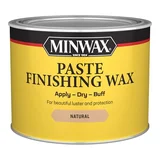
6. Minwax Paste Finishing Wax (Natural) — Best Traditional Wax Finish (Low-Traffic Tables)
- Price: $13.33 / 1 lb (live Amazon price, checked this session)
- Type: Wax Finish
- Coverage: 500 sq ft/lb per coat (mfr product page)
- Coats used in our cost calc: 2 — Minwax product instructions: apply 2 coats
- Dry / cure time: 10-15 min dry before buffing; 15 min between coats (source: minwax.com Paste Finishing Wax product page)
- Sheen: Soft low sheen (hand-buffed glow, not a hard film)
Food safety: Not marketed food-safe.
Water resistance: Low – surface polish only, no real moisture barrier; needs frequent renewal
Reapplication: No fixed mfr interval published; wax finishes are widely recommended for reapplication every 3-6 months on used tabletops (general woodworking maintenance practice, NOT a manufacturer-specified figure)
Cost to finish a 20 sq ft table: $1.07 — $13.33 × (20 ÷ 250.0 sq ft covered by one full 2-coat application of a 1 lb container).
Check current price on Amazon →
Who it’s for: a low-traffic accent table, side table, or a finish you’re applying as a topcoat polish over an oil finish rather than as standalone protection — that’s the traditional role of paste wax, and it’s genuinely inexpensive at roughly a dollar to wax a table. It’s the wrong choice as the sole finish for a table that sees daily meals, spills, or hot dishes.
Main drawback: wax alone offers the weakest protection in this comparison — no manufacturer reapplication interval is published, and general woodworking practice puts it at every 3-6 months on a table that sees daily use, which is real ongoing labor most other picks don’t require.
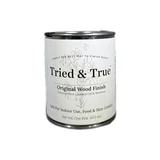
7. Tried & True Original Wood Finish — Best Food-Safe Finish for Tabletops
- Price: $35.99 / 1 pint (live Amazon price, checked this session)
- Type: Raw/Matte Oil (polymerized linseed oil, food-safe)
- Coverage: ~1000 sq ft/gal brand claim (~125 sq ft/pint per coat)
- Coats used in our cost calc: 2 — T&T allows up to 3 coats; using practical minimum of 2 for real protection
- Dry / cure time: 60-min penetration + rub dry; full cure minimum 24 hrs (source: triedandtruewoodfinish.com product page)
- Sheen: Low-gloss, antique sheen
Food safety: Brand claims ‘safe for food contact’ – no solvents, no metallic driers. This is a manufacturer marketing claim, NOT third-party certified/tested the way Rubio Monocoat’s EC 1935/2004 compliance is.
Water resistance: Marketed as providing good water/liquid protection; no film-forming barrier like poly
Reapplication: Polish with soft cloth as needed; no fixed mfr interval
Cost to finish a 20 sq ft table: $11.52 — $35.99 × (20 ÷ 62.5 sq ft covered by one full 2-coat application of a 1 pint container).
Check current price on Amazon →
Who it’s for: households that specifically want a finish marketed as non-toxic and solvent-free for a kitchen or dining table, and are comfortable relying on the manufacturer’s own safety claims rather than requiring third-party certification. It’s priced in the middle of this lineup and gives the same low-gloss, natural look as Watco, with the maker’s own no-solvent, no-metallic-drier formulation as the selling point.
Main drawback: the food-safe claim is the manufacturer’s own, not an independent lab result — if you need certified compliance (say, for a piece you’re selling), Rubio Monocoat is the pick with third-party paperwork behind it.
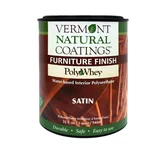
8. Vermont Natural Coatings PolyWhey Furniture Finish (Satin) — Best Low-VOC / Eco-Friendly Finish
- Price: $44.92 / 1 quart (live Amazon price, checked this session)
- Type: Low-Sheen / Low-VOC Waterborne Poly
- Coverage: 500-600 sq ft/gal per coat (whey-protein PolyWhey formulation; specific TDS retrieved was the Floor Finish variant of the same chemistry – Furniture Finish-specific TDS was not independently retrievable this session, flagged)
- Coats used in our cost calc: 3 — VNC TDS explicit instruction: apply 3 coats for best performance
- Dry / cure time: Recoat in 1-2 hrs; full cure in 1 week (source: Vermont Natural Coatings PolyWhey TDS (Floor Finish variant, same resin chemistry))
- Sheen: Satin – quantified 20 +/-5 gloss units @ 60 degrees (Semi-Gloss 45, Matte 10 also available)
Food safety: Not marketed food-safe. No formaldehyde/toxic ingredients requiring PPE, but this is a worker-safety claim, not a food-contact claim.
Water resistance: High – resists water, chemicals, scratches (film-forming)
Reapplication: Durable poly-type finish, multi-year interval typical, no fixed mfr number published
Cost to finish a 20 sq ft table: $19.60 — $44.92 × (20 ÷ 45.8 sq ft covered by one full 3-coat application of a 1 quart container).
Check current price on Amazon →
Who it’s for: anyone prioritizing indoor air quality — its 180 g/L VOC ceiling is roughly a third of the oil-based film finishes in this comparison — and who doesn’t mind the 3-coat application and 1-week full cure the manufacturer specifies for best performance. It’s a waterborne poly, so cleanup is soap and water rather than mineral spirits, which is a real convenience difference from every oil-based pick here.
Main drawback: the manufacturer’s own instructions call for 3 full coats for best performance, which is why its per-table cost comes out highest of the eight despite a mid-range sticker price.
How We Picked These
We have not physically tested these eight finishes side by side on this site, so we’re not going to claim we did. What we did instead: pulled live prices and ASINs for each product from the Amazon Creators API this session, then cross-checked coverage rate, dry/cure time, sheen, and any food-safety claim against each manufacturer’s own technical data sheet or product page — Rubio Monocoat, Osmo, Rust-Oleum/Watco, Minwax, General Finishes, and Vermont Natural Coatings all publish these directly. Where a manufacturer’s own TDS didn’t give a number (Watco, for example, declines to publish a fixed coverage figure because it depends so much on wood porosity), we used the manufacturer’s stated range and said so, rather than inventing a precise figure.
We also did not fabricate star ratings. Amazon’s Creators API returned no review data for any of these eight listings at the time we pulled prices, and Amazon’s own review pages block automated access — so instead of copying a competitor’s rating or making one up, we left ratings out entirely. If you want that signal, check the live listing yourself before you buy.
The cost-per-table numbers are computed, not measured: price × (20 sq ft ÷ documented coverage at the number of coats each manufacturer specifies). The formula and the coverage source are printed under every pick above so you can check our arithmetic or re-run it for your own table’s actual dimensions.
What to Consider When Choosing a Finish for a Rustic Wood Table
Sheen Level
“Rustic” almost always means low sheen. Hardwax oils like Rubio Monocoat and Osmo Polyx-Oil dry to a matte or satin surface with no visible film, which is why they read as more natural than a poly. Where a manufacturer publishes an actual gloss-meter number, we used it: Minwax Wipe-On Poly Satin measures 35 ±5 units at 60° (ASTM D523), while Vermont Natural Coatings PolyWhey Satin measures 20 ±5 at the same angle — meaning PolyWhey Satin is measurably lower-sheen than Minwax’s “Satin,” even though both use the same sheen name on the label. If sheen and surface feel are the main thing you’re trying to nail down, our breakdown of sheen versus surface texture goes deeper on how the two interact.
Durability & Water Resistance
Film-forming finishes (polyurethane, wiping varnish, waterborne poly) sit on top of the wood and physically block liquids — General Finishes Arm-R-Seal and the two poly picks in this comparison are the most water-resistant options here. Penetrating oils (Watco Danish Oil, Tried & True) soak into the wood instead of coating it, so they protect from within but won’t stop a wet glass from leaving a ring the way a poly will. Wax sits in between and offers the least real protection of the eight. If you’re specifically weighing a sprayed varnish topcoat instead of a wipe-on product, see our comparison of spar urethane and polyurethane for table tops.
Reapplication Interval
This is the tradeoff most buying guides skip. Wax needs the most frequent attention — general woodworking practice (not a manufacturer figure, since none of the wax brands publish one) puts it at every 3-6 months on a table that sees daily use. Oils are next, needing a fresh coat every year or two depending on traffic. Hardwax oils and true film finishes (poly, varnish) go the longest between maintenance, often several years, because they’re either engineered as a low-film single application (Rubio) or build a harder protective layer (poly).
Food Safety for Tabletops
This is where a “natural” label can mislead. Of the eight finishes here, only Rubio Monocoat Oil Plus 2C carries independent, third-party food-contact testing (Eurofins, against EU Regulation EC 1935/2004). Osmo Polyx-Oil meets EN 71.3, a children’s-toy safety norm — related, but not the same thing as a food-contact-material certification. Tried & True markets itself as food-safe (no solvents, no metallic driers) but that claim is the manufacturer’s own, without third-party testing behind it. The other five — Watco, both polys, Arm-R-Seal, and the wax — make no food-safety claim at all in their technical documentation. If the table will regularly host food directly on the wood, that distinction is worth more than any sheen or price difference.
VOCs & Indoor Air Quality
Oil-based film finishes carry real solvent content: General Finishes Arm-R-Seal’s own TDS lists 537-575 g/L VOC, and Minwax Wipe-On Poly’s TDS caps out at 600 g/L. Vermont Natural Coatings PolyWhey, a whey-protein-based waterborne poly, publishes 180 g/L or less — roughly a third of the oil-based options — which is why it’s our pick for anyone prioritizing indoor air quality over cost.
Hardwax Oil vs. Raw Oil vs. Low-Sheen Poly vs. Wax
Hardwax oil (Rubio, Osmo) blends penetrating oil with hard wax for a low-film, repairable finish that’s become the default “rustic-modern” choice. Raw/matte penetrating oil (Watco, Tried & True) soaks in with zero surface film for the most natural look and feel, at the cost of water resistance. Low-sheen polyurethane / wiping varnish (Minwax Wipe-On Poly, Arm-R-Seal, PolyWhey) trades some of that raw look for real film protection. Wax (Minwax Paste Finishing Wax) is traditionally a topcoat over another finish rather than sole protection — it’s included here because it’s a real, commonly-used option for low-traffic accent tables, not because it competes with the film finishes on durability. For the full rundown of every finish family beyond just these four, our wood finishing guide covering stains, oils, sealers and cure times is the broader reference.
Real Cost to Finish a Table
Sticker price is misleading here because coverage and coat count vary so much by product. Watco Danish Oil looks cheap at $14.98/pint and is genuinely the least expensive pick at $3.79 to finish a 20 sq ft table — but General Finishes Arm-R-Seal, at $45.00/quart, actually costs more per table ($18.00) than Tried & True at $35.99/pint ($11.52), because Arm-R-Seal needs more coats at lower coverage-per-coat. Always compare cost-to-cover, not shelf price.
Wood Species & Porosity
Every manufacturer TDS we pulled flags the same caveat: coverage and final appearance depend heavily on how porous and how extractive-rich the wood is. Osmo specifically recommends its Wood Wax Finish Extra Thin (a different product) instead of standard Polyx-Oil for dark, extractive-rich hardwoods like wenge or jatoba. If your rustic table is a softwood like pine, expect it to drink up oil finishes faster and unevenly — Watco’s own instructions recommend a light pre-treat wipe on soft woods for that reason. If pine is specifically what you’re working with, see our dedicated answer on what finish works best on pine.
Application Difficulty
Wipe-on products (Watco, Tried & True, Minwax Wipe-On Poly) are the easiest for a first-timer — cloth, wipe, done. Osmo’s 2-coat brush/roller application and Rubio’s 2-part mix-and-apply-within-the-pot-life system both reward some prior experience. Arm-R-Seal and PolyWhey can be brushed, wiped, or sprayed, which makes them flexible but means the results depend more on technique. A basic project for any of these eight needs only sandpaper (through 220 grit, per the Osmo and Watco TDS), a lint-free cotton cloth or foam brush, and nitrile gloves — none require a spray rig unless you choose to use one on Arm-R-Seal or PolyWhey.
How to Apply a Rustic-Look Finish to a Wood Table
- Sand the bare wood. Work up through grits — most manufacturers here specify a final pass around 180-240 grit for furniture (Osmo and Watco TDS both specify this range).
- Remove all dust. Vacuum, then wipe with a tack cloth or a rag dampened with mineral spirits (per the Watco TDS) — skipped dust is the single most common cause of a cloudy or gritty finish.
- Test on a scrap or hidden edge. Every TDS we pulled recommends this; color and sheen shift with wood species and porosity.
- Apply the first coat with the applicator the manufacturer specifies — a lint-free cloth for wipe-on oils and poly, a scraper/brush for Osmo and Rubio.
- Respect the manufacturer’s dry time before recoating — these vary by a lot: 2-3 hours for Minwax Wipe-On Poly, 8-10 hours for Osmo, 72 hours before topcoating Watco Danish Oil.
- Apply the remaining coats the manufacturer specifies (see the “coats used” line under each pick above).
- Let it fully cure before real use — light use and full cure are different milestones. Rubio Monocoat is walkable in 24-36 hours but not fully water-resistant until 5 days; PolyWhey needs a full week to reach maximum cure.
- Maintain on the schedule that fits the finish type — wax every few months on a high-use table, oil every year or two, film finishes only as scratches or wear show up.
Frequently Asked Questions
What is the best finish for a rustic wood table?
For most rustic tables, a hardwax oil like Rubio Monocoat Oil Plus 2C or Osmo Polyx-Oil gives the low-sheen, natural look people mean by “rustic” while still offering real protection. If the table needs maximum water resistance instead, a low-sheen polyurethane or wiping varnish like General Finishes Arm-R-Seal protects better, at the cost of some of that raw look.
Is hardwax oil better than polyurethane for a table?
Neither is universally “better” — they trade differently. Hardwax oil looks and feels more natural and is easier to spot-repair, but polyurethane forms a harder protective film with more water resistance. Pick hardwax oil for appearance and easy repair, polyurethane for maximum durability on a heavily used table.
What wood finish is food-safe for a table?
Of the products in our comparison, Rubio Monocoat Oil Plus 2C is the only one with independent, third-party food-contact testing (Eurofins, EC 1935/2004). Osmo Polyx-Oil meets a children’s-toy safety norm (EN 71.3), and Tried & True markets itself as food-safe based on its own no-solvent, no-metallic-drier formulation, but neither carries the same third-party certification as Rubio.
How often do you need to reapply oil finish on a table?
There’s no single manufacturer-published number for most oils. General woodworking practice puts a penetrating oil like Watco Danish Oil at roughly every 1-2 years on a table in regular use, while a low-film hardwax oil like Rubio Monocoat can go longer because so little film needs to wear through.
Can you put polyurethane over Danish oil?
Yes — Watco’s own technical data sheet specifically allows this, but requires a minimum 72-hour dry time after the Danish oil before applying any Rust-Oleum polyurethane topcoat. See our full Danish oil vs. polyurethane comparison for when you’d want to combine them versus pick just one.
Does wax alone protect a table from water rings?
Not well. Wax is the lowest-protection option in our comparison — it’s traditionally used as a topcoat polish over another finish, not as standalone tabletop protection, and it needs the most frequent reapplication of any option here.
What’s the real cost difference between these finishes?
Finishing one typical rustic table (about 20 sq ft, tabletop plus apron and legs) ranges from $1.07 with paste wax up to $19.60 with a 3-coat low-VOC waterborne poly, once you account for each product’s actual documented coverage rate and manufacturer-specified coat count — not just the price on the shelf.
Do I need to seal a rustic wood table before applying the finish?
No separate sealer is needed for any of the eight finishes here — each is designed to go directly onto clean, sanded, bare wood (or over a fully cured, compatible stain). General Finishes even states in its own TDS that Arm-R-Seal can be applied over fully cured water-based, oil-based, or Danish Oil stains as well as bare wood, so the main requirement across every product here is simply that any prior coating be completely dry and compatible, not that you add a separate sealer step.
Final Thoughts
If you only take one thing from this comparison: Rubio Monocoat Oil Plus 2C is the only one of these eight finishes with independent, third-party food-contact testing behind it, and it finishes a typical rustic table for about $7.20 in a single coat. If water resistance matters more than that certification for your table, General Finishes Arm-R-Seal is the most protective film finish in the lineup. Either way, check the live price before you buy — every price in this article was pulled directly from Amazon this session, not carried over from a previous update.
Sponsored / affiliate links. As an Amazon Associate I earn from qualifying purchases. I may earn additional commission from eligible campaigns.