Cabinet Refinishing Cost vs Repainting: Which Saves More?
Cabinet repainting usually costs less upfront, while cabinet refacing changes more of the visible cabinet surface and can avoid a future repaint if the old finish would need substantial repair or replacement later. This guide compares upfront price, lifespan, maintenance, downtime, and resale value so you can judge which option fits your needs.
| Decision factor | Cabinet Refinishing Cost | Repainting | Winner |
|---|---|---|---|
| Upfront cost | Typically $4,300 to $9,980, with some comparisons listing $4,000 to $10,000. | Estimates range from $1,500 to $5,000, with one comparison listing $1,000 to $3,500. | Repainting |
| Durability and rework risk | Usually lasts longer because new doors, drawer fronts, or new facing materials take the wear. | Paint quality depends heavily on prep, primer, and use level. One source puts painted cabinet durability at 10 to 15 years, while another says repainting may be needed in 3 to 5 years. | Cabinet Refinishing Cost |
| Timeline and disruption | Usually 3 to 5 business days, with one source saying up to four days and another listing 2 to 4 days or 3 to 7 days depending on scope. | Commonly 2 to 5 days, with one source listing 2 to 4 days and another 3 to 5 days. | Repainting |
| Resale signal | Often reads as newer because buyers see updated doors and fronts. | Can improve appearance, but usually makes a smaller home value impression than refacing. | Cabinet Refinishing Cost |
Which option saves more over time?
Repainting usually wins on day-one cost, but Cabinet Refinishing Cost can win over the full ownership period when a painted finish would need a redo. If your cabinets are in good structural shape and you expect heavy use, refacing can avoid a second project that makes the cheaper option expensive in hindsight.
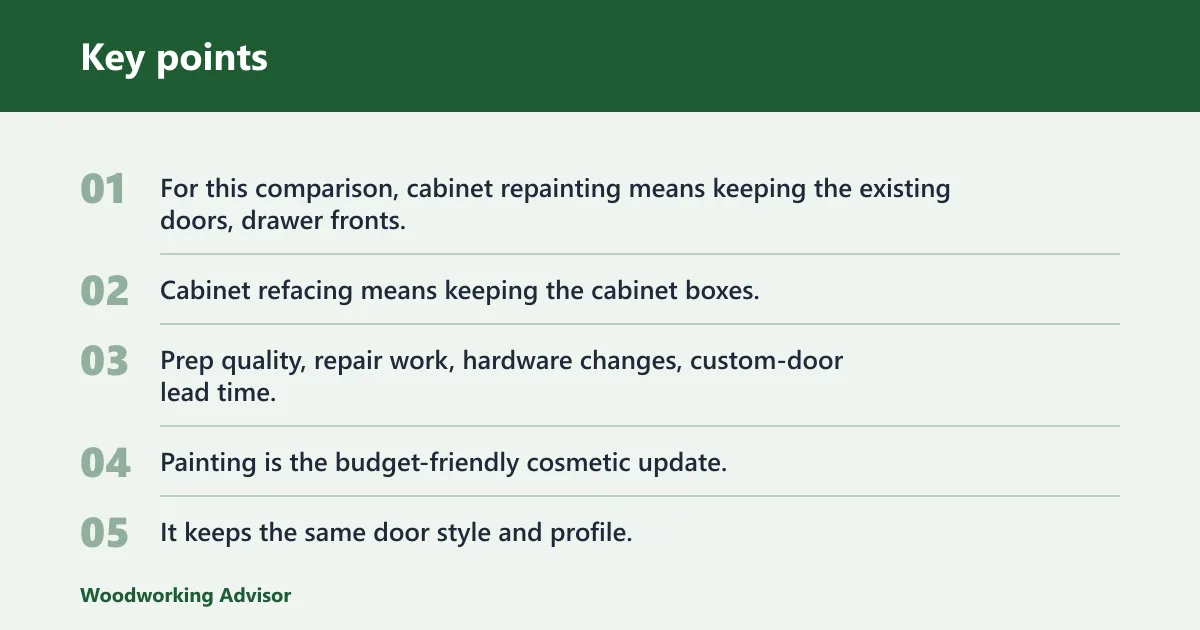
For this comparison, cabinet repainting means keeping the existing doors, drawer fronts, and cabinet boxes, then cleaning, sanding, priming, and applying new finish coats. Cabinet refacing means keeping the cabinet boxes, then replacing doors and drawer fronts or applying veneer or laminate to the visible faces.
The full cost reaches beyond the invoice. Prep quality, repair work, hardware changes, custom-door lead time, and how hard the kitchen is used all affect whether a cheap repaint stays cheap.
Cabinet painting vs refacing at a glance
Painting is the budget-friendly cosmetic update. It keeps the same door style and profile, so the main gain is color change and a fresher finish. Refacing changes the visible face of the kitchen more completely, which is why it usually costs more and can look newer.
Both options depend on sound cabinet boxes. If the boxes are warped, damaged, or poorly built, neither choice makes sense for long. Refacing also cannot fix a bad layout, because it keeps the existing cabinet footprint.
What drives cabinet painting cost
Painting cost is built from labor, materials, prep, and any repair work needed before primer and topcoats. The prep step matters most: degreasing, sanding, filling dents or chipped edges, then choosing the right primer so the finish bonds to the old surface.
The number of doors, drawers, and cabinet boxes matters because each face needs handling and drying time. A small kitchen costs less than a large one, and a grease-heavy kitchen with worn previous coatings often needs more prep than a lightly used one.
Finish quality also changes the price. A pro job may use a controlled booth or shop setup for sprayed parts, while a lower-budget job may rely on site prep and brush or roller work. DIY can reduce cash outlay, but it raises the risk of visible brush marks, weak adhesion, and early chipping if the prep is rushed.
What drives cabinet refacing cost
Refacing cost is driven by new doors and drawer fronts, veneer or laminate materials, hardware, labor, and the wait for custom parts. Common facing materials include laminate, wood veneer, rigid thermofoils, and 3D laminate, and those choices can affect both durability and price.
Hardware can be part of the job too. Hinges, pulls, and handles may be updated for a more complete change in appearance and easier daily use. Because the new fronts are usually made to order, lead time can add to the real schedule even when the hands-on labor is short.
Damaged cabinet boxes can block the job altogether. If the boxes are soft from moisture, out of square, or breaking at the hinge points, refacing is a poor fit because it depends on the existing structure staying in place.
How much does cabinet refacing cost compared with painting?
Painting is usually cheaper upfront. Cabinet painting estimates range from $1,500 to $5,000, while cabinet refacing typically falls between $4,300 and $9,980. That gap is big enough that repainting often looks like the obvious budget choice, but the total bill changes if paint fails early.
The price gap also grows with cabinet count. More doors, drawers, and linear footage mean more labor and materials for both options, yet refacing usually stays several times more expensive because new fronts and facing materials are part of the package.
| Kitchen type | 3-year total | 5-year total | 10-year total | 15-year total | Break-even note |
|---|---|---|---|---|---|
| Low-use kitchen | Repainting: $1,500 to $5,000 Cabinet Refinishing Cost: $4,300 to $9,980 |
Repainting: $1,500 to $5,000 Cabinet Refinishing Cost: $4,300 to $9,980 |
Repainting: $3,000 to $10,000 Cabinet Refinishing Cost: $4,300 to $9,980 |
Repainting: $3,000 to $15,000 Cabinet Refinishing Cost: $4,300 to $9,980 |
If the finish holds close to the long-life end of the published range, repainting stays cheaper for many owners. |
| Average-family kitchen | Repainting: $1,500 to $5,000 Cabinet Refinishing Cost: $4,300 to $9,980 |
Repainting: $3,000 to $10,000 Cabinet Refinishing Cost: $4,300 to $9,980 |
Repainting: $3,000 to $15,000 Cabinet Refinishing Cost: $4,300 to $9,980 |
Repainting: $4,500 to $20,000 Cabinet Refinishing Cost: $4,300 to $9,980 |
By the 10 to 15 year mark, one or two repaint cycles can erase the upfront savings. |
| High-traffic kitchen | Repainting: $1,500 to $5,000 Cabinet Refinishing Cost: $4,300 to $9,980 |
Repainting: $3,000 to $10,000 Cabinet Refinishing Cost: $4,300 to $9,980 |
Repainting: $4,500 to $15,000 Cabinet Refinishing Cost: $4,300 to $9,980 |
Repainting: $6,000 to $20,000 Cabinet Refinishing Cost: $4,300 to $9,980 |
This is where the cheaper paint job can become the costlier path within a few years. |
How to read the table: the painting side can require a full rework if wear shows early, while refacing is more likely to stay in service without a second major project. The table uses the cost ranges above and shows why a lower first invoice does not always mean lower lifetime cost.
Say your kitchen gets daily use from a family of five, and the cabinet fronts near the sink and trash pull-out are already worn. A repaint may look right at first, but if the finish starts breaking down again in a few years, the second project can push total spend past refacing.
Picture a small, low-use kitchen in a home that will be sold in two years. In that case, the owner may value the lower upfront bill more than the longer-life option, especially if the cabinets are already sound and the goal is a clean, neutral update rather than a full visual reset.
How long does each option last?
Painted cabinet life depends on prep quality, the old finish, and how hard the kitchen is used. Cabinet paint can last many years, but some repaint projects need attention much sooner depending on wear and preparation.
Refacing usually lasts longer because the wear surface is a new door, drawer front, veneer, or laminate face. The boxes stay in place, but the visible parts are replaced or renewed, so normal scuffs and handle wear are less likely to break through as fast as paint on an older surface.
Paint failure shows first in wear zones
High-touch spots reveal problems first. Handles, corners, sink bases, and the edges of doors near appliances take more contact, cleaning, and moisture. If the old finish was greasy, glossy, or patched poorly, those areas often show chips or adhesion failure before the rest of the kitchen.
That is why prep is so important. Degreasing removes residue that blocks adhesion, sanding gives the primer something to grip, filling repairs damage, and primer creates the base that helps the finish coat stay put.
Refaced cabinets hold up differently
Refacing shifts the wear burden to new facing materials. Laminate and rigid thermofoils often cost less than real wood veneer, while wood veneer can read more like a painted or stained cabinet face depending on the finish choice. Material quality matters because a cheaper face may ding or peel sooner in hard-use kitchens.
If the underlying boxes are solid, refacing can hold up well because the new doors and fronts take the daily contact. The layout does not change, though, so a poor workflow or awkward cabinet placement remains the same after the job.
How long does cabinet refacing take to complete?
Painting is usually the faster project on paper, with common timelines of about 2 to 5 days. Refacing often takes 3 to 5 business days, and some timelines run 2 to 4 days or 3 to 7 days depending on scope. Custom parts can add lead time even when the job itself is short.
That schedule difference matters because kitchen downtime has its own cost. A shorter project reduces the days you live around open boxes, dust, and limited access to sinks and storage. If you cook at home often, a few extra days can matter as much as the invoice.
Painting can look faster because the parts already exist and stay in place. Refacing can move quickly on site, but new doors and fronts may need ordering before work starts, so the calendar can stretch beyond the hands-on labor window.
Choose Cabinet Refinishing Cost if… / Choose Repainting if…
Choose refacing if your cabinet boxes are solid, you want a newer-looking result, and you plan to stay in the home long enough for the higher upfront cost to make sense. Choose repainting if the boxes are sound, the budget is tight, and the kitchen is low to moderate use or is being updated mainly for a near-term sale.
- Choose refacing if the boxes are structurally sound but the doors look dated or worn.
- Choose refacing if you want a stronger visual update and can pay more now.
- Choose repainting if the doors and drawer fronts are still in decent shape and you mainly want a color change.
- Choose repainting if you need the lowest upfront spend and can accept more maintenance risk later.
For a seller, refacing can create a stronger visual update because new fronts tend to read as newer to buyers. Paint can still help a listing, but the effect is usually smaller when the underlying doors stay the same. Neither option should be treated like a full remodel, so keep expectations modest.
Can I DIY cabinet painting or do I need a pro?
DIY painting makes sense when the cabinets are in decent shape, the finish is simple, and you can spend time on cleaning, sanding, filling, priming, and curing between coats. A pro is the safer pick for greasy kitchens, damaged finish layers, or anyone who wants fewer sanding marks and better edge detail.
Refacing usually belongs with a pro because it involves fit, alignment, and custom parts. If the box dimensions are off or the hinges do not line up cleanly, the final result can look uneven even when the face materials are good.

Frequently asked questions
Is it cheaper to repaint cabinets or reface them?
Repainting is cheaper upfront. The catch is that a paint job with weak prep or hard wear may need touch-ups or a full redo, which can erase the initial savings.
How long does painted cabinet finish usually last?
Cabinet paint durability can vary widely. Prep quality, grease exposure, moisture, and daily handling all change how long the finish lasts before repainting or touch-ups are needed.
When should I paint cabinets instead of refacing them?
Paint instead of refacing when the boxes are solid, the cabinet layout works, and you want the lowest upfront cost. It is also a sensible choice when the kitchen gets lighter use, the current door style is acceptable, and you are not trying to create a buyer-facing premium finish.
Does cabinet refacing increase home value more than painting?
Refacing often creates a stronger visual change for buyers because it updates the doors and fronts as well as the finish. Painting can improve appearance and help a listing, but the resale signal is smaller when the underlying doors stay the same. Neither option should be treated like a full remodel, so keep expectations modest.
What factors change the cost of cabinet painting or refacing?
Cabinet count, repair work, surface condition, hardware changes, and material choice all change the bill. Painting is most sensitive to prep and finish quality, while refacing is most sensitive to new-front material choice and the lead time for custom parts.
Which option is better if my cabinet boxes are still in good shape?
If the boxes are sound, both options stay on the table. Paint is better when budget matters most and the current door style still works. Refacing is better when you want a stronger visual update, better durability, and a result that reads newer without replacing the entire cabinet system.
Sponsored / affiliate links. As an Amazon Associate I earn from qualifying purchases. I may earn additional commission from eligible campaigns.