Best Garage Insulation for a Woodworking Shop (2026): We Compared
For many garage woodworking shops, closed-cell spray foam on the roofline is often a strong choice in cold or mixed climates, and rigid foam plus sealed framing can suit dry or budget builds, because assembly details and moisture control can matter as much as R-value alone. Poor choices can trap condensation, waste headroom, and leave your shop hard to heat or cool. This guide compares the best garage insulation for a woodworking shop by climate zone, garage assembly, budget, and moisture risk.
Quick comparison
| Product | Badge | Best for | Price | ||
|---|---|---|---|---|---|
 |
FONUNO Bubble Insulation Sheet, Reflective Insulation Roll,FONUNO | Our pick | 47in x 10ft · Roll · Garage Door | $23.99
Price as of 18 Oct 2026
|
View |
 |
Wamlente 4 Pcs Rock Wool Insulation Board 16 x 12 x 1.57Wamlente | Also great | 4 Pcs · 16x12x1.57in · Rock Wool | $47.99
Price as of 18 Oct 2026
|
View |
 |
Professional Expanding Foam Spray Gun, 2 Insulation Guns +Luft Werkzeuge | Pair with it | Guns + Extenders · Professional · Foam Tool | $33.99
Price as of 18 Oct 2026
|
View |
 |
ECOHomes Window Weather Sealing Tape (2 Inch Wide x 90 Ft,ECOHomes | Budget pick | 2in x 90ft · Clear · Sealing Tape | $8.08
Price as of 18 Oct 2026
|
View |
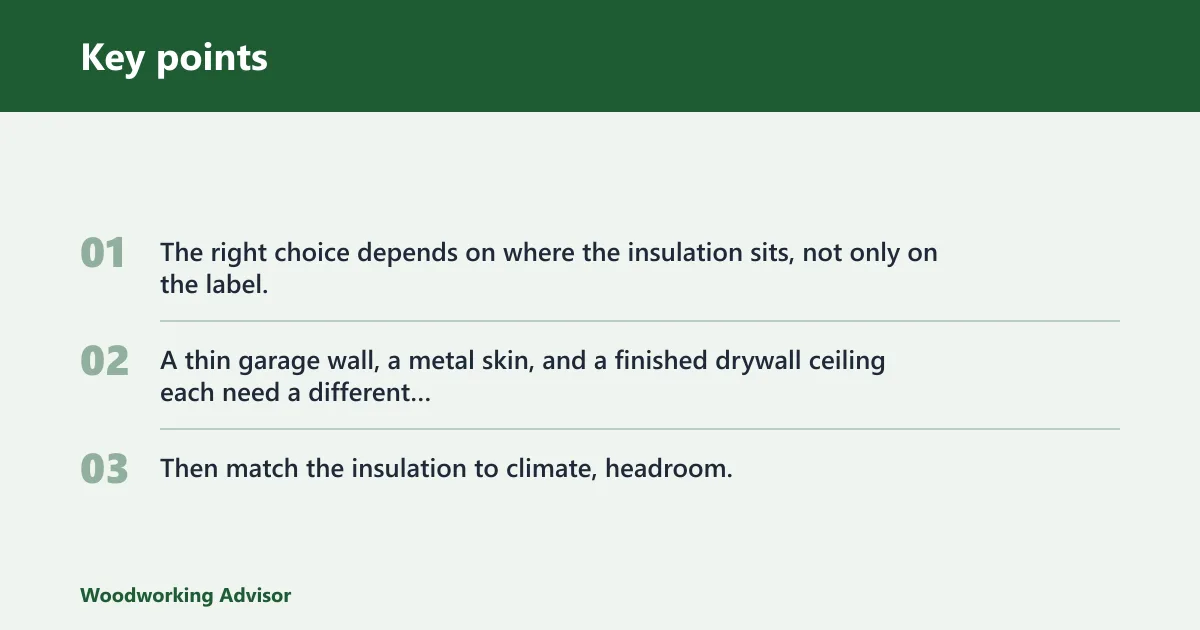
The right choice depends on where the insulation sits, not only on the label. A thin garage wall, a metal skin, and a finished drywall ceiling each need a different moisture strategy and a different R-target.
Start with the assembly you already have. Then match the insulation to climate, headroom, and whether the shop is heated all winter or only sometimes.
How we chose
This comparison weighs four things: assembly fit, moisture behavior, thickness, and shop safety. It also separates walls, ceilings, doors, and floors, because they do not fail the same way.
R-value per inch matters, but only inside a workable assembly. A high-R product can still be a poor pick if it steals headroom, creates a condensation trap, or pushes foam plastic into a code problem.
Cost matters too. The cheapest fill is no help if gaps, compression, or weak air sealing wipe out the gain.
What is the best garage insulation for a woodworking shop?
For most woodworking shops, the best all-around setup is closed-cell spray foam where you need air sealing and moisture control most, plus rigid foam or batts where the framing allows it. In cold or mixed climates, a roofline or ceiling strategy usually matters more than wall fill alone, because warm indoor air rises and finds leaks first.
Best overall by common shop setup
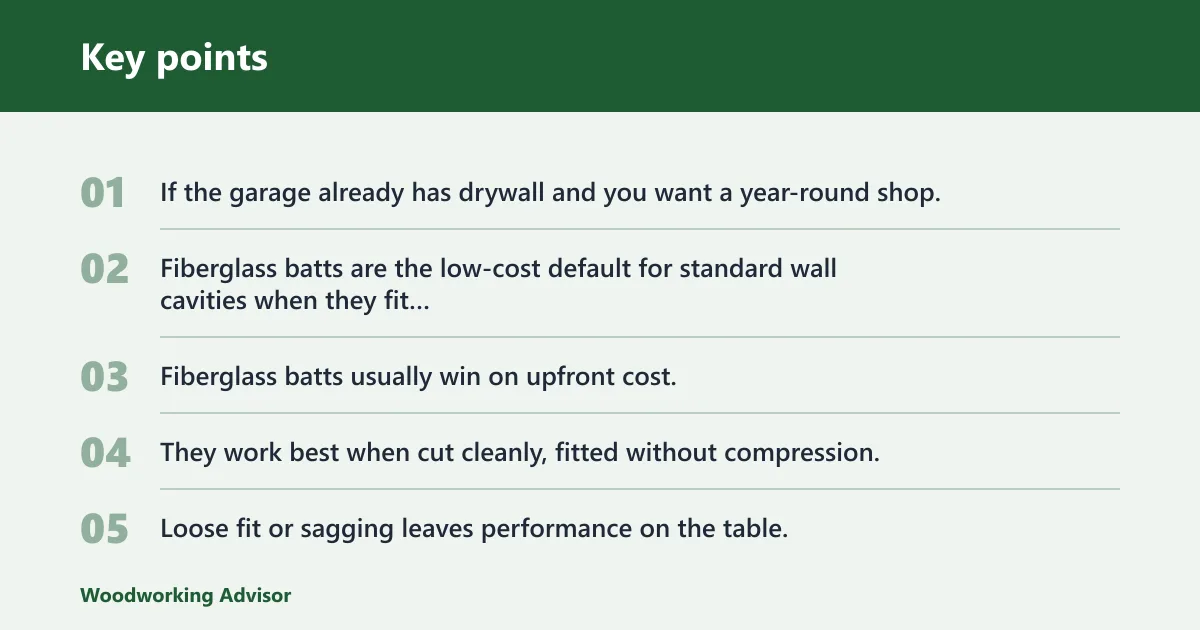
If the garage already has drywall and you want a year-round shop, use a careful wall-and-ceiling package rather than a single product everywhere. Fiberglass batts are the low-cost default for standard wall cavities when they fit tightly and the cavities are air-sealed, while rigid foam works better where depth is limited.
Best by budget
Fiberglass batts usually win on upfront cost. They work best when cut cleanly, fitted without compression, and backed by sealing at plates, corners, and penetrations. Loose fit or sagging leaves performance on the table.
Best by moisture risk
Closed-cell spray foam is the strongest moisture and air-sealing option of the common choices. It also costs more, and foam plastic may need an approved ignition or thermal barrier in attached or occupied garage applications, depending on the code path and local requirements.
Best by sound control
Rockwool and open-cell spray foam both help with noise, which matters in a shop with planers, dust collectors, and compressors. Rockwool also adds fire-minded value in a sawdust-heavy space, while open-cell foam gives air sealing and sound control at about R-3.6 per inch.
Fiberglass batts: best for budget walls
Fiberglass batts fit standard stud walls well when the cavity is drywalled, accessible, and close to standard depth. Their listed R-value per inch is 3.1-4.3, and they remain the low-cost default when you can install them neatly and keep air movement from bypassing the insulation.
Where batts fit well
Use batts in framed walls with consistent cavity depth, especially when you can add a proper air seal at outlets, plates, and seams first. They work best in dry garages with enough thickness to avoid over-compressing the batt.
Where batts fail
Batts lose real performance when they are stuffed, torn, or left with gaps around wiring and framing irregularities. They are also a weaker choice where moisture exposure is likely, because the assembly needs the right vapor strategy to avoid condensation in cold conditions.
Vapor barrier and air-sealing notes
Do not treat batts as the vapor solution. In cold climates, vapor control often belongs on the warm side of the assembly, but that rule changes with continuous exterior insulation and local code details. The safer rule is to match vapor control to the whole wall, not to the batt alone.
Closed-cell spray foam: best for air sealing
Closed-cell spray foam is the highest-performance choice when you need air sealing, moisture resistance, and high R-value in a thin cavity. Its listed R-value per inch is 6.5-7.0, which helps in short framing bays, roof decks, and places where every inch matters.
Where high R-value per inch helps
This foam makes sense in narrow walls, sloped rooflines, rim joists, and other spots where deeper insulation would steal usable shop space. It also reduces drafts better than a batt-only wall because the cured foam fills and seals irregularities.
Moisture and vapor behavior
Closed-cell foam behaves like a vapor retarder in many assemblies, which can help in damp or mixed climates. It can also create a trap if the rest of the wall is not designed to dry in the right direction, so the wall layers matter as much as the foam itself.
Fire-barrier and code checks before you buy
Foam plastic does not get a pass on fire safety. In attached or occupied garage applications, foam may need an approved ignition or thermal barrier, and ASTM E84 or a Class A surface rating is not proof of code-compliant fire resistance for the whole assembly. Check the exact garage use, not just the product label.
Do you need a vapor barrier in a garage shop?
Maybe, but not everywhere and not in the same way. Vapor control depends on climate, wall type, and whether the wall can dry to one side or both. A blanket “warm side everywhere” rule is too simple for garage assemblies with exterior foam, metal skins, or intermittent heat.
Cold-climate wall assemblies
In cold climates, the warm side often needs vapor control because indoor moisture wants to move into cold wall cavities and condense. That becomes more important in heated shops with large temperature swings, especially if you only heat the garage part-time.
Mixed and warm climates
In mixed and warm climates, the wrong vapor barrier can block drying and create a hidden damp layer. A smart assembly may use air sealing, a vapor retarder, or continuous exterior insulation instead of a simple interior polyethylene layer.
When continuous exterior insulation changes the answer
Exterior rigid foam changes the dew point inside the wall. That means the correct vapor strategy can shift away from the interior face, because the foam keeps the sheathing warmer and reduces condensation risk.
Rigid foam board: best for thin assemblies
Rigid foam board is a strong choice when you need more R per inch and some moisture resistance. XPS and polyiso are common choices, with a listed R-value per inch of 5.0-6.5, making them useful for walls, roof decks, and places where a thinner build has to do more work.
XPS versus polyiso use cases
Use rigid foam where you want continuous insulation across framing, or where standard batts would leave too much thermal bridging. It can also help improve older garage assemblies without rebuilding the whole wall.
Garage doors and roof decks
Rigid foam can fit garage doors and ceilings better than fluffy fill when the space is shallow. A 95% reflective layer can also help on doors and ceilings if it has the needed air gap; without that gap, the reflective layer loses much of its value.
Air gaps, seams, and tape
Seal seams carefully. Air leaks around taped foam boards can erase the benefit, and the board itself is only part of the air-control layer. For a garage door, check spring balance and panel clearance before adding thickness.
Rockwool and cellulose: when sound matters
Rockwool and cellulose are useful when noise control matters as much as temperature stability. Rockwool has a listed R-value per inch of 3.0-4.2 and gives useful sound dampening, while cellulose is a budget-friendly ceiling fill with a listed R-value per inch of 3.2-3.8.
Rockwool for fire-conscious walls
Rockwool suits shops with sawdust, solvents, and a need for a little extra fire-minded margin in the cavity. It is usually pricier than fiberglass, but it resists sagging and handles irregular framing better than some batts.
Cellulose for attics and ceilings
Cellulose is a practical attic or ceiling fill when the goal is low cost plus sound control. It is especially useful above a flat garage ceiling where depth is available and the attic can be insulated without crowding the shop below.
Noise control tradeoffs
Neither product is a substitute for air sealing. They damp sound better than bare framing, but gaps around penetrations still leak both noise and conditioned air.
Garage shop decision matrix
This matrix maps the assembly first, then the insulation. That avoids the common mistake of buying one material and forcing it into every garage type.
| Garage type | Recommended insulation | Vapor strategy | Approximate R-target | Common failure risks |
|---|---|---|---|---|
| Drywalled garage | Fiberglass batts or rigid foam where depth is tight | Climate-specific vapor control; do not assume one rule for all zones | Walls near R-19, ceiling near R-38 in cold climates | Gaps at outlets, compressed batts, trapped moisture behind the wrong vapor layer |
| Open-stud garage | Closed-cell spray foam for high performance; rockwool or batts for budget builds | Depends on assembly; air sealing matters before vapor control | Enough thickness to approach the target without leaving cavities leaky | Air bypass, exposed foam without required barrier, poor drying path |
| Metal building | Rigid foam board with sealed seams; spray foam where metal condensation is severe | Strong attention to condensation control and thermal bridging | As much continuous insulation as the framing allows | Condensation on metal skin, skipped air gap, fasteners bridging cold and warm surfaces |
| Unheated shop | Rigid foam or reflective barrier where heat gain is the main issue | Usually minimal, but assembly still needs drying potential | Moderate wall and door improvement, ceiling if solar gain is high | Overinsulating a space that is not conditioned, wasted spend on the wrong layer |
| Intermittently heated shop | Closed-cell spray foam or a hybrid wall with foam plus batt fill | Careful vapor strategy to avoid condensation after heat-up and cool-down cycles | Wall performance near R-19, ceiling near R-38 in cold climates | Moisture spikes during warm-up, hidden condensation, uneven comfort |
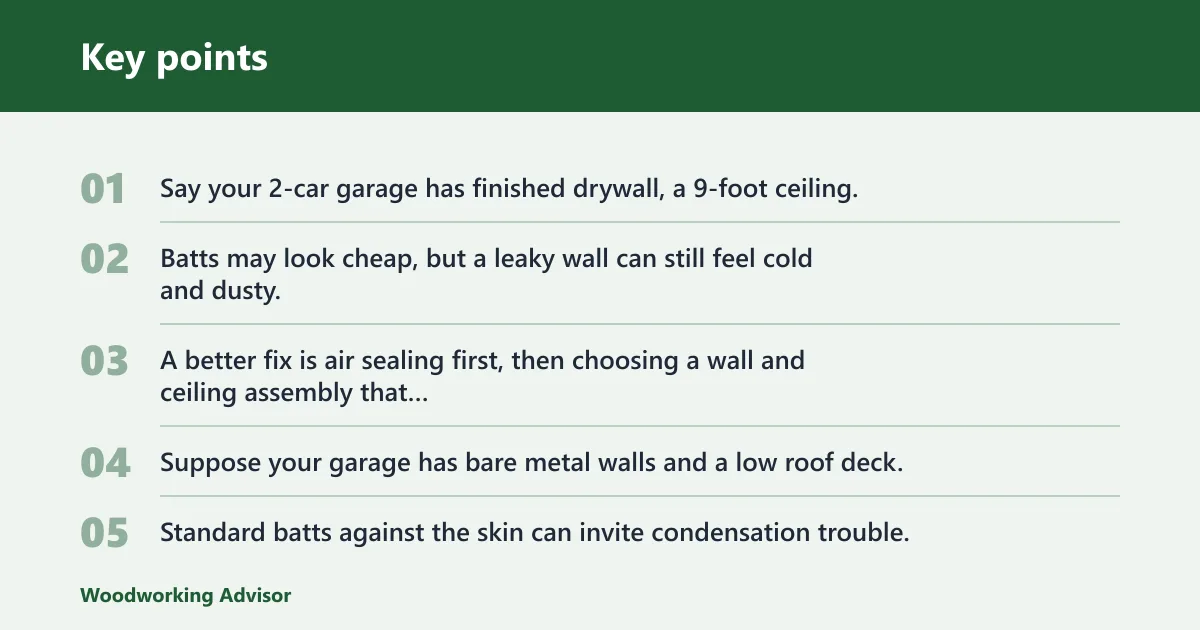
Say your 2-car garage has finished drywall, a 9-foot ceiling, and you heat it only on weekends. Batts may look cheap, but a leaky wall can still feel cold and dusty. A better fix is air sealing first, then choosing a wall and ceiling assembly that matches the climate.
Suppose your garage has bare metal walls and a low roof deck. Standard batts against the skin can invite condensation trouble. Continuous rigid foam or closed-cell foam with the right barrier layer is usually the safer starting point.
How much R-value do you need for garage walls and ceilings?
In cold climates, a practical target is R-19 for walls and R-38 for the ceiling. That does not mean every garage needs the same number, but it gives a useful benchmark for year-round comfort and lower temperature swings in a woodworking shop.
Wall targets by climate
Colder zones usually need more wall insulation or better air sealing to keep the shop usable in winter. Mild zones can often stop earlier if the garage is not conditioned daily and the wall assembly already limits drafts.
Ceiling and roof deck targets
The ceiling often gives the biggest comfort gain because heat rises. If the attic or roof deck is part of the thermal boundary, that layer usually deserves the highest R-target in the garage.
Why the garage door usually limits the final comfort level
Even a well-insulated wall package can be dragged down by a bare or lightly insulated door. That is why garage-door insulation, weatherstripping, and air sealing often matter more than people expect when the goal is stable shop temperature.
FONUNO bubble insulation sheet: best for garage doors
This reflective roll fits garage doors, walls, and other thin surfaces where a quick radiant layer makes sense. Based on the listed product details, it is easy to cut and install, and it can help on doors where deep cavity insulation is not practical.
The drawback is simple: reflective layers need an air gap to work as intended, and they do not replace real cavity insulation in a cold garage wall. Use it as a supplement, not as the only layer where heat loss is serious.
Wamlente rock wool board: best for sound control
This mineral-fiber board is aimed at high-heat and fire-conscious uses, which makes the material family relevant in a shop with noise and heat concerns. It is the kind of pick to consider when sound damping matters and you want a non-combustible cavity fill approach.
The drawback is that the listed board format is small and awkward for full wall cavities, so it is not a drop-in substitute for standard garage insulation. It also costs more than fiberglass, so it is easier to justify in targeted sections than across every wall.
Luft Werkzeuge foam gun: best for sealing gaps
This tool is useful when you need controlled foam placement around seams, penetrations, and rim areas. The listed extenders help reach awkward spots, which matters in a garage where air leaks often hide behind framing, pipes, and electrical boxes.
The drawback is that it is an applicator, not insulation by itself. You still need the right foam canisters, and careless use can leave messy gaps or overfill that needs trimming.
ECOHomes weather sealing tape: best for draft control
This clear tape is a simple way to seal light leaks and drafts around doors, windows, and temporary overlaps. In a garage shop, that can make a noticeable difference before you commit to larger insulation work.
The drawback is that tape is only a surface seal. It will not fix a poorly insulated wall, and it is best used as part of a broader air-sealing plan rather than as the main thermal layer.
Which one should you buy?
Choose fiberglass batts if you want the cheapest workable wall insulation and you have standard stud bays that are easy to fit. Choose rigid foam if wall depth is tight, if you need continuous insulation, or if the assembly needs more moisture resistance.
Choose closed-cell spray foam if you need the strongest air sealing and the least thickness, but check the thermal or ignition-barrier requirement before buying. Choose rockwool if sound control and fire-minded material choice matter more than the lowest price.
If your garage is metal, start with condensation control and continuous insulation, not with a batt package meant for drywall. If the door is the leakiest part of the shop, fix the door first; the rest of the insulation cannot overcome a cold, drafty panel.
For a tight budget, batts plus good air sealing is still the sensible starting point. For the highest performance in a small space, closed-cell foam usually wins. For minimal thickness, rigid foam is often the cleaner compromise.
Choose fiberglass batts if… / Choose closed-cell spray foam if…
Choose fiberglass batts if the walls are standard depth, the garage is dry, and you need a lower-cost build that still reaches a reasonable wall target. They also fit better when you can inspect every cavity and avoid compression.
Choose closed-cell spray foam if the garage is intermittently heated, the climate is cold or mixed, the cavities are shallow, or condensation is a real risk. Also choose it when air sealing matters more than upfront cost, provided the required fire barrier is addressed.
A common first-timer mistake is insulating only the walls and leaving the ceiling and door weak. The shop still swings hot and cold, dust moves through the leaks, and the owner blames the wrong layer.
Frequently asked questions
What kind of insulation is best for a garage workshop?
The best insulation depends on the garage assembly and climate, not only on the product name. For many workshops, closed-cell spray foam or a rigid-foam hybrid is the strongest path, while fiberglass batts remain the budget default for standard dry walls with good air sealing.
What is the best type of insulation for a garage wall?
For a typical finished garage wall, fiberglass batts are the cheapest workable choice, but only when they fit tightly and the wall is sealed well. If the cavity is shallow or moisture risk is higher, rigid foam or closed-cell foam is usually the better wall strategy.
Should I use fiberglass, rigid foam, or spray foam in a garage shop?
Use fiberglass if the budget is tight and the wall cavity is standard. Use rigid foam when thickness is limited or you want continuous insulation. Use closed-cell spray foam when air sealing and moisture control matter most, but verify the barrier requirements before installation.
What insulation works best for a metal garage building?
Metal buildings usually need the most attention to condensation. Rigid foam and closed-cell spray foam are stronger choices than loose cavity fill because they help limit moisture on the skin and reduce thermal bridging. The final assembly still needs a drying path and careful seam sealing.
Do I need a vapor barrier in a garage workshop?
Sometimes, but the answer depends on climate and wall design. Cold climates often need vapor control on the warm side, while mixed and warm climates may need a different strategy. If continuous exterior insulation changes the dew point, the old one-layer rule may no longer fit.
Sponsored / affiliate links. As an Amazon Associate I earn from qualifying purchases. I may earn additional commission from eligible campaigns.