Best Plywood for Outdoor Storage Shed Walls: A Guide
For outdoor shed walls, use exterior-rated plywood: 1/2-inch CDX for fully sided walls, 5/8-inch if studs are 24 inches on center or the shed sees wind-driven rain, and skip interior-grade sheets. Pick the wrong sheet, and swollen edges, fastener failure, and mold can make repairs cost more than the material saved. This guide compares plywood grades, thickness, and siding choices by exposure so you can choose the right wall sheathing.
This guide is part of our Plywood Thickness Chart: Which Size For Which Project series.
The best sheet is the one matched to exposure. Exterior plywood is the best all-around choice because its glue line is made for outdoor moisture, while veneer quality affects how well it paints and how likely it is to stay flat. If the wall will be covered quickly by house wrap and siding, CDX often makes sense. If the face may stay visible, ACX is usually the cleaner finish option.
Best plywood for outdoor storage shed walls
Quick picks by shed condition
- Fully sided shed: 1/2-inch CDX on 16-inch studs; 5/8-inch if studs are 24 inches on center or wind exposure is high.
- Partially exposed shed: ACX or exterior plywood, especially if the wall will remain visible for a while before siding goes on.
- Temporary unfinished build: Exterior plywood or ACX; avoid leaving OSB uncovered for long.
- Damp site or splash zone: Exterior plywood with a pressure-treated bottom plate, good clearance above grade, and a weather-resistive barrier.
- Paint-grade finish: ACX or a smoother exterior plywood face under primer, caulk, and paint.
Why the wall setup matters more than sheet price
Sheath the wall for the exposure it will actually see. A shed under wide eaves with lap siding and house wrap can use a lower-cost sheet than a shed with shallow overhangs, open gables, or board-and-batten that leaves more of the wall exposed. The siding system changes the plywood choice.
OSB is usually cheaper than plywood, but edge swelling is the tradeoff. That may be acceptable under wrap and siding on a dry site. It is a poor fit where splashback, delayed siding, or recurring dampness are part of the plan.
Can you use CDX plywood for shed walls?
Yes, CDX plywood is commonly used for shed wall sheathing when the wall will be covered with house wrap and siding soon after installation. It is a construction-grade panel, usually sold in 1/2-inch and 5/8-inch thicknesses, and it has enough outdoor durability for limited exposure. Its weak point is not the name; it is how long the wall stays open.
What CDX is good at
CDX works well behind siding because the outside face does not need cabinet-level appearance. The “C” and “D” grades refer to face quality, not moisture rating. The “X” indicates exterior glue, which is what gives the panel its outdoor-use rating. That glue line is durable, but the face veneer can still check, patch, or telegraph imperfections under paint.
For fully sided walls, CDX often gives the best balance of cost and function. It is also easy to source in standard sheet sizes, which helps when you need to sheath a simple rectangular shed quickly.
Where CDX runs out of margin
CDX is not the best choice if the wall will sit exposed through multiple storms, if the shed sits close to grade, or if the overhang is short enough that rain hits the wall often. It can tolerate some wetting, but repeated wet-dry cycling opens the door to edge swelling and fastener loosening, especially at panel joints.
Suppose a 10-by-12 shed is framed, but siding waits until next month. CDX can usually handle that kind of short delay if the wall is wrapped and kept off standing water. Leave the same wall open through a wet season, and the risk profile changes fast.
Best thickness for CDX on 16-inch and 24-inch framing
For 16-inch on-center studs, 1/2-inch CDX is a common starting point for shed walls that will be sided. For 24-inch on-center framing, a thicker panel such as 5/8 inch is often the safer pick because it spans farther between supports and can feel stiffer under wind load. That added stiffness matters more on tall walls and in open, gusty sites.
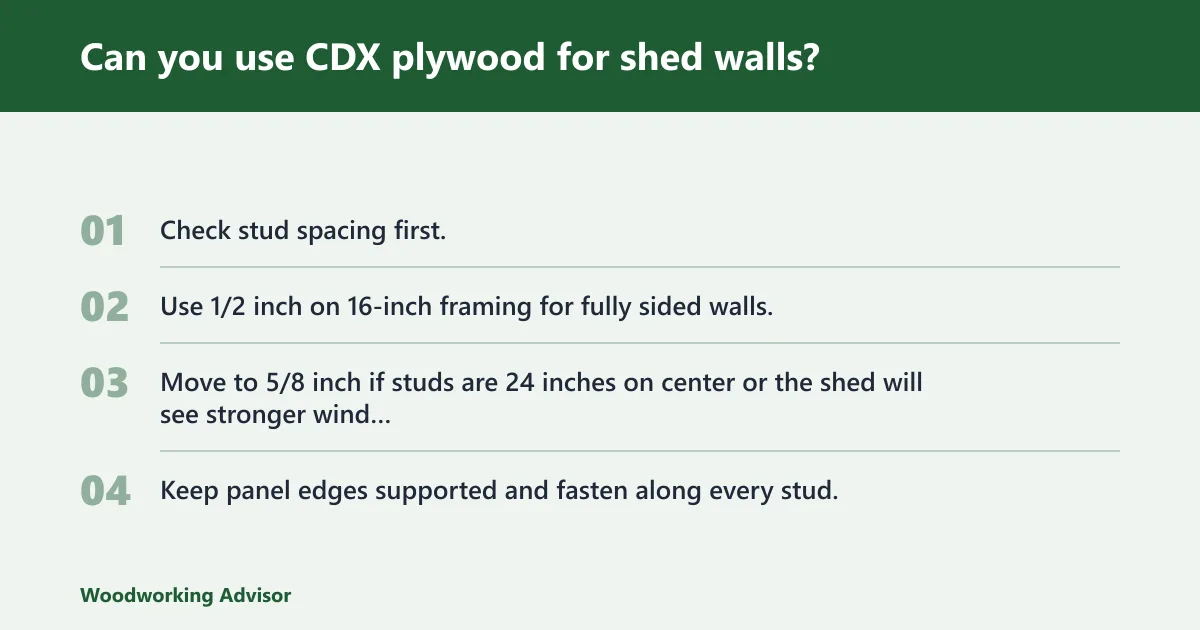
- Check stud spacing first.
- Use 1/2 inch on 16-inch framing for fully sided walls.
- Move to 5/8 inch if studs are 24 inches on center or the shed will see stronger wind exposure.
- Keep panel edges supported and fasten along every stud.
Is ACX worth paying for on a shed?
ACX is worth the extra cost when the wall may be left exposed temporarily or when you want a smoother paint-ready face. It has better face veneer quality than CDX, so it sands and paints more cleanly. It still needs wrap or siding for long-term weather protection, because the “X” refers to glue durability, not a finished exterior surface.
Paint-ready face quality
ACX gives you fewer voids and a cleaner face than CDX. That matters on visible shed walls, especially if the siding design leaves plywood in sight or if you plan to prime and paint the sheet itself. The better face also reduces the chance of blotchy paint absorption and patch visibility.
When ACX is a better fit than CDX
Choose ACX when the shed uses panel siding, when the wall will be seen for a while before cladding, or when the finish goal is painted plywood rather than hidden sheathing. It is also a better match for a tidy backyard shed where appearance matters nearly as much as cost.
A common first-timer mistake is buying CDX for a wall that will stay visible as a final surface. The panel may be serviceable, but the face defects often show through paint and caulk lines.
Where ACX still needs wrap and siding
ACX is not a substitute for a weather-resistive barrier or exterior cladding. House wrap blocks bulk water behind siding, and siding sheds direct rain before it reaches the panel face. Without that assembly, even better face veneer will age poorly in wet weather.
What thickness should shed wall plywood be?
For most shed walls, 1/2 inch is the normal choice on 16-inch studs, while 5/8 inch is better on 24-inch studs, taller walls, or wind-prone sites. Thickness affects stiffness, fastener holding, and resistance to panel flex. The right answer depends more on stud spacing and exposure than on brand or grade.
1/2 inch versus 5/8 inch
Use 1/2 inch when the wall is fully sheathed, wrapped, and sided over 16-inch framing. Move to 5/8 inch if the shed is tall, the walls are open to more wind, or the framing is on 24-inch centers. Thicker panel stock deflects less between studs and better resists drum-like movement in gusts.
Stud spacing and wall stiffness
With 24-inch spacing, the panel span is wider and the wall depends more on the sheathing for stiffness. That is why 5/8 inch often makes sense even on a modest shed. It is not about making the wall “stronger” in the abstract, it is about reducing flex between supports.
Wind load and panel span limits
Wind matters more on large, tall, or corner-exposed sheds. If the building sits in an open yard with little windbreak, a thicker panel can help keep the wall flatter before siding goes on. That also helps nails and screws stay tight over time.
How do OSB and pressure-treated plywood compare?
OSB is usually cheaper than plywood and works well when protected by house wrap and siding, but its edges swell more after wetting. Pressure-treated plywood resists moisture better in splash zones and at the base, yet it is not necessary for every wall. For most sheds, the right mix is standard exterior plywood above grade and pressure-treated material only where water sits or splashes.
OSB cost and edge swelling
OSB can be a smart buy on a fully sided shed in a dry location. It performs best when installed flat, wrapped promptly, and kept out of direct wetting. Its weak point is exposed edges, which can puff after repeated rain or contact with wet ground. That risk makes OSB less attractive for delayed siding or damp sites.
Pressure-treated plywood at the base and splash zone
Pressure-treated plywood is most useful where the wall is closest to grade, where lawn sprinklers hit, or where water splashes from roof runoff. It is not always needed for the full wall sheathing. In many sheds, a pressure-treated bottom plate and good clearance above soil do more practical work than paying for treated sheets across the whole wall.
When plywood is the better long-term buy
Plywood usually wins when the shed may stay exposed during construction, when paint quality matters, or when the site is damp enough that edge swelling would become a recurring repair. The extra sheet cost can be easier to justify if it avoids patching swollen corners, re-nailing loose edges, or replacing a failed lower course.
Decision table: choose plywood by exposure scenario
Match the sheet to the exposure, not the other way around. The main questions are how long the wall stays open, how much direct rain it sees, and whether siding or wrap will cover it soon. That is what drives the best value.
| Exposure scenario | Recommended sheet type | Thickness | Fastening notes | Main failure risk |
|---|---|---|---|---|
| Fully sided shed | CDX or exterior plywood | 1/2 inch on 16-inch studs; 5/8 inch on 24-inch studs | Use galvanized or coated nails or screws; match length to stud depth so you get solid embedment without punching through | Neglected wrap or siding gaps allow hidden moisture |
| Partially exposed shed | ACX or exterior plywood | 5/8 inch preferred if exposure lasts longer than a short build window | Fasten all panel edges tightly; seal cut edges before long exposure | Edge swelling and face checking |
| Temporary unfinished wall | Exterior plywood, ACX if appearance matters | 1/2 inch for short exposure; 5/8 inch if windy or open-framed | Use corrosion-resistant fasteners and cover with wrap as soon as possible | Weather exposure before siding goes on |
| Damp site | Exterior plywood with pressure-treated material at the base zone | 5/8 inch is safer for added stiffness | Keep the bottom edge above grade; use coated or galvanized fasteners | Splashback, capillary moisture, and base rot |
| Paint-grade finish | ACX or smooth exterior plywood | 1/2 inch to 5/8 inch based on framing | Prime all faces and edges, then paint; caulk joints as needed | Visible patching, paint failure, and moisture at cut edges |
How to choose

Start with exposure, then work down to grade and thickness. If the wall will be fully covered soon, CDX is usually enough. If the wall will be visible, wet for a while, or painted, move up to ACX or a smoother exterior plywood. If the shed sits in a damp yard or takes splashback, protect the base and treat the lower zone as the weak point.
Use these decision criteria
- How long will the wall stay exposed? Longer exposure pushes you toward ACX or exterior plywood.
- What siding is planned? Lap siding, T1-11, board-and-batten, and panel siding all change how much of the sheathing remains visible.
- What is the stud spacing? Choose 1/2 inch on 16-inch centers and lean to 5/8 inch on 24-inch centers or windy sites.
- Will you use house wrap? A weather-resistive barrier blocks bulk water, which lets you use lower-grade sheathing behind siding with more confidence.
- How wet is the site? Damp yards, shallow overhangs, and splash zones favor exterior plywood and better edge protection.
Installation details that matter
Use exterior-grade fasteners such as galvanized or coated nails or screws. Match fastener length to the stud depth so you get proper holding power without overdriving the panel. Seal cut edges where exposure is likely, and keep panel bottoms clear of soil and standing water.
For siding, the assembly matters as much as the sheet. Lap siding and board-and-batten usually depend on wrap and careful flashing. T1-11 and other panel siding expose more of the panel itself, which raises the value of a better face grade. Plywood choice should follow that assembly, not a default shopping list.
Frequently asked questions
What plywood is best for outdoor shed walls?
Exterior plywood is the best all-around choice for outdoor shed walls because it uses exterior glue and is made for weather exposure behind siding. For fully sided walls, CDX is usually enough. If the wall may stay visible or be painted, ACX or smoother exterior plywood is the better fit.
Can I use CDX plywood for a shed?
Yes. CDX plywood is common for shed wall sheathing, especially when you plan to install house wrap and siding soon after. It is a construction-grade sheet with exterior glue, so it handles limited exposure. It is less suitable for long-term uncovered use or high-visibility painted surfaces.
Is exterior plywood better than OSB for a shed?
Exterior plywood is usually better than OSB where the shed may see moisture, splashback, or delayed siding. OSB is cheaper and works well when protected by wrap and cladding, but its edges swell more after wetting. If the wall may stay exposed, plywood is the safer choice.
What thickness plywood should shed walls be?
For many sheds, 1/2-inch plywood works on 16-inch stud spacing. Use a thicker panel, often around 5/8 inch, on wider stud spacing, taller walls, or windier sites because it is generally stiffer across the span. Framing spacing and exposure matter more than the sheet price alone.
Do shed walls need pressure-treated plywood?
Usually no. Pressure-treated plywood is most useful at the base or in splash zones, not across every wall panel. For most sheds, a pressure-treated bottom plate, proper clearance above grade, and exterior plywood above that are enough. Use treated material where water contact is most likely.
Do shed walls need a weather barrier over plywood?
Yes, if you are adding siding. House wrap or another weather-resistive barrier helps protect the sheathing from bulk water and lets you use standard exterior plywood or CDX more confidently. Without it, the sheathing is more exposed to leaks at seams, fasteners, and siding joints.
Sponsored / affiliate links. As an Amazon Associate I earn from qualifying purchases. I may earn additional commission from eligible campaigns.