Best Glues for Loose Chair Spindles (2026): we compared
Use liquid hide glue for a snug, clean spindle joint, PVA wood glue for a tight modern joint, and two-part epoxy when the hole is worn or the spindle is broken; if the fit has more than a hairline gap, glue alone may not be enough. Ignore the failure mode and the spindle keeps loosening, the chair racks again, and the repair can fail under load. This guide shows how to diagnose the joint, choose the right adhesive, and rebuild it with the right fix.
This guide is part of our Wood glue essentials: types, uses, and cure times series.
Quick comparison
| Product | Badge | Best for | Price | ||
|---|---|---|---|---|---|
 |
Titebond II Premium Wood Glue 8 Oz. – Honey Cream, 5003Titebond | Our pick | 8-oz · Honey Cream · 5003 | $5.44
Price as of 26 Sep 2026
|
View |
 |
Gorilla Wood Glue, 8 ounce Bottle, (Pack of 7)GORILLA | Budget pick | 8-oz Bottle · 7-Pack | $33.85
Price as of 26 Sep 2026
|
View |
 |
Loctite Epoxy Instant Mix 5 Minute, 0.47 fl. oz. SyringeLoctite | Also great | 5-Minute Set · Double Syringe | $12.90
Price as of 26 Sep 2026
|
View |
 |
Titebond III Ultimate Wood Glue 4 Oz. – WoodworkingTitebond | Upgrade pick | 4-oz · Type I Waterproof | $4.98
Price as of 26 Sep 2026
|
View |
PVA wood glue is my first pick for a clean, tight wood-to-wood chair spindle joint. Epoxy takes over when the socket is worn, the hole is oversized, or the spindle has damage. Hide glue belongs in restoration work where later reversibility matters more than ease.
How we chose
I based this comparison on joint fit, cleanup difficulty, clamp demand, cure time, and whether the repair may need to come apart later. Chair spindles fail in different ways, so the adhesive has to match the failure, not the label.
Polyvinyl acetate adhesive is the family behind common PVA wood glues. Those products tend to behave similarly: relatively short-to-medium open time, a good wood-to-wood bond, and limited tolerance for dirt, oil, paint, or old glue. (en.wikipedia.org)
Clamp geometry matters too. A spindle joint can be hard to reach, and the clamp has to hold alignment without denting the chair frame. That changes the repair more than many buyers expect.
Titebond II Premium Wood Glue: best for tight chair spindle joints
This is for a snug, clean spindle joint where the tenon or dowel still fits the socket correctly. Based on the spec sheet and owner feedback, it suits everyday furniture repair when the surfaces are bare wood and the clamp can close the joint firmly.
It stands out for water resistance and easy cleanup while wet. That makes it practical for common chair work, especially when the repair needs straightforward handling and the joint is not damaged.
The drawback is fit sensitivity. Like most PVA wood glue, it is wrong for a dirty socket, a loose hole, or a cracked spindle. It needs close clamping and a clean bond line.
Gorilla Wood Glue: best for general wood-to-wood repairs
This suits a standard chair repair where the spindle still fits reasonably well and the goal is a strong wood-to-wood bond. Based on specs and reviews, the value here is quantity and easy bottle application rather than specialty gap-filling.
It works well when the joint is clean, dry, and well clamped. That makes it a practical shop bottle for many small fixes, not only one spindle.
The drawback is the same one that affects most PVA wood glues: it does not cure worn sockets or finish contamination. If the joint wobbles by hand, this is usually the wrong adhesive level.
Loctite Epoxy Instant Mix: best for stripped or oversized spindle sockets
This is for a loose, enlarged, or damaged socket where a normal wood glue joint has too much void to bridge. Based on the spec sheet, the self-mixing syringe is useful when the repair needs measured mixing and quick setup.
It stands out because epoxy is a true gap-filling adhesive. That matters when the spindle tenon or dowel no longer meets the mortise walls tightly, or when the chair has minor damage around the hole.
The drawback is working time and cleanup. Epoxy is less forgiving than PVA if the parts are not positioned correctly before it starts to set, and excess can be messy in a small spindle pocket.
Titebond III Ultimate Wood Glue: best for slower, more forgiving clamping
This is a good fit for a clean spindle repair when the clamp setup takes longer or the room is cool. Based on the product details, the longer open assembly time helps when a chair joint is awkward and alignment takes a minute.
It stands out for waterproof performance and more open time than many standard woodworking glues. That can help when a spindle has to be seated carefully across multiple connected parts.
The drawback is that it is still a PVA-style wood glue. It does not replace epoxy for a sloppy hole, and it does not fix a cracked spindle or a dirty, oily surface.
What is the best glue for reattaching loose chair spindles?
PVA wood glue is usually the first choice for a clean, tight wood-to-wood spindle joint. Use epoxy when the socket is loose, oversized, or damaged, and use hide glue when the repair is part of antique restoration. The right adhesive depends on fit, surface condition, and whether you may need to reverse the repair later.
Match glue to the failure, not the chair
The spindle tenon or dowel is often the real failure point. If it still fits snugly, PVA is usually enough. If the hole has worn oval, the joint has too much play, or the spindle is cracked, glue type matters less than rebuilding the part correctly.
Clean wood is the deciding factor
Old glue, dust, paint, and finish reduce bond strength. A loose spindle that is oily or coated is not a good PVA candidate until the joint is cleaned back to sound wood. That is where many quick fixes fail.
Can I use wood glue on a loose chair spindle?
Yes, if the fit is still tight enough for the spindle to seat without wobble and the surfaces are clean, dry, and bare wood. No, if the socket is worn, dirty, painted, or enlarged. Wood glue works best when the joint already does most of the holding.
How to tell before gluing
Dry-fit the spindle first. If it slips in with no resistance, rocks, or leaves a visible gap, PVA is not the right fix by itself. If the joint needs firm hand pressure and lines up without slop, wood glue can usually do the job.
Which one should you buy?
Buy for the failure you actually have. A snug modern joint points to PVA wood glue, a loose or stripped socket points to epoxy, and an antique chair that may need later reversal points to hide glue. If the spindle or socket is cracked, replacement often beats any adhesive.
| Condition | Adhesive choice | Prep | Clamp approach |
|---|---|---|---|
| Snug joint | PVA wood glue | Scrape old glue; dry fit first | Close clamping, padded jaws, keep alignment |
| Slightly loose joint | Epoxy if the gap is minor | Clean to bare wood; roughen lightly | Light pressure only; do not squeeze out all resin |
| Stripped socket | Epoxy or rebuild the hole | Remove debris; may need mechanical cleanup | Clamp just enough to hold position |
| Cracked spindle | Hide glue for restoration, epoxy for structural gap repair | Open crack, clean, dry thoroughly | Align carefully; clamp to close the crack |
| Finished or painted chair | Epoxy or hide glue only if prep is possible | Remove finish at the bond line | Use padding to avoid dents or finish damage |
| Antique restoration | Hide glue | Clean old glue; keep original parts if possible | Moderate clamp pressure, exact alignment |
When the spindle hole is badly enlarged, the repair has moved past adhesive choice. At that point a shim, new dowel, plug, or part replacement is safer than trying to flood the void with glue.
How do I clean old glue out of a loose spindle joint?
Scrape old glue out until you reach sound wood, then dry-fit the spindle again. Old adhesive blocks bond lines and keeps new glue from wetting the fibers. If the residue is hard, use careful mechanical cleaning; if finish or wax is present, clean that too before gluing.
Use a small, controlled cleanup sequence
- Remove the spindle if possible.
- Pick out loose chunks with a knife or small scraper.
- Sand lightly only if the socket is accessible.
- Wipe dust away and let the wood dry fully.
If the joint still feels slick, stop. That usually means finish, oil, or old adhesive remains, and the bond will be weak.
Do I need to remove the spindle before gluing it back in?
Usually yes, especially if the fit needs cleaning or the spindle must be aligned carefully before clamping. A dry test fit is mandatory whenever the joint is loose, the hole is worn, or the chair geometry makes access awkward. Gluing blind is how misalignment happens.
When removal is worth the effort
Remove the spindle if there is old glue, finish contamination, or any chance you will need epoxy or hide glue in the joint. If the spindle cannot be removed without breaking something else, the chair may need a different repair route.
Should I use PVA, polyurethane, or epoxy for chair spindle repair?
PVA is the default for a clean, tight spindle joint. Epoxy is better for loose, stripped, or damaged sockets. Polyurethane is rarely the first choice for this job because it can foam, is messier to control, and does not solve a bad fit any better than a proper gap-filling repair does.
Pick by fit and cleanup, not by hype
PVA cleans up with water and works best on snug wood-to-wood joints. Epoxy handles minor voids and damaged sockets. Polyurethane is not the standard answer for chair spindles, especially when the joint needs precise alignment and predictable cleanup.
How long should a chair spindle clamp before use?
Clamp long enough for the adhesive to reach handling strength, then leave the chair alone before full load. PVA usually needs a full overnight clamp for a safe furniture repair, while epoxy follows its own cure schedule. Do not trust squeeze-out as a cure signal.
Use the cure window as a safety step
Handling strength is not the same as full strength. A chair can seem fine after a short wait, then loosen again under racking forces if it is put back into service too soon. Leave the chair out of heavy use until the adhesive has fully cured.
Can I repair painted or finished chair spindles without stripping the whole chair?
Yes, if you can expose bare wood only at the bond line. You do not need to strip the entire chair, but the glue will not bond well to paint, varnish, or wax. Clean the contact area, remove finish only where the joint touches, and clamp carefully to avoid dents.
Local prep beats full stripping
For painted or finished chairs, a small, targeted cleanup is usually enough. Full refinishing is only needed when the finish reaches the actual glue surface and cannot be removed locally without damaging the repair area.
Common mistakes
Most spindle repairs fail for the same reasons: wrong adhesive, poor prep, or weak clamping. A chair joint repair has to resist racking forces, so a repair that looks neat can still fail if the fit is poor or the surfaces are contaminated.
- Using PVA on a sloppy hole: it will not bridge a real gap for long.
- Skipping the dry fit: the spindle may bind or sit crooked.
- Leaving old glue in place: the new bond sticks to residue instead of wood.
- Clamping without padding: chair rails and spindles dent easily.
- Overapplying glue: excess squeeze-out makes cleanup harder and can block full seating.
- Returning the chair to use too soon: cure time matters more than a surface-level dry feel.
If that didn’t work, try this next
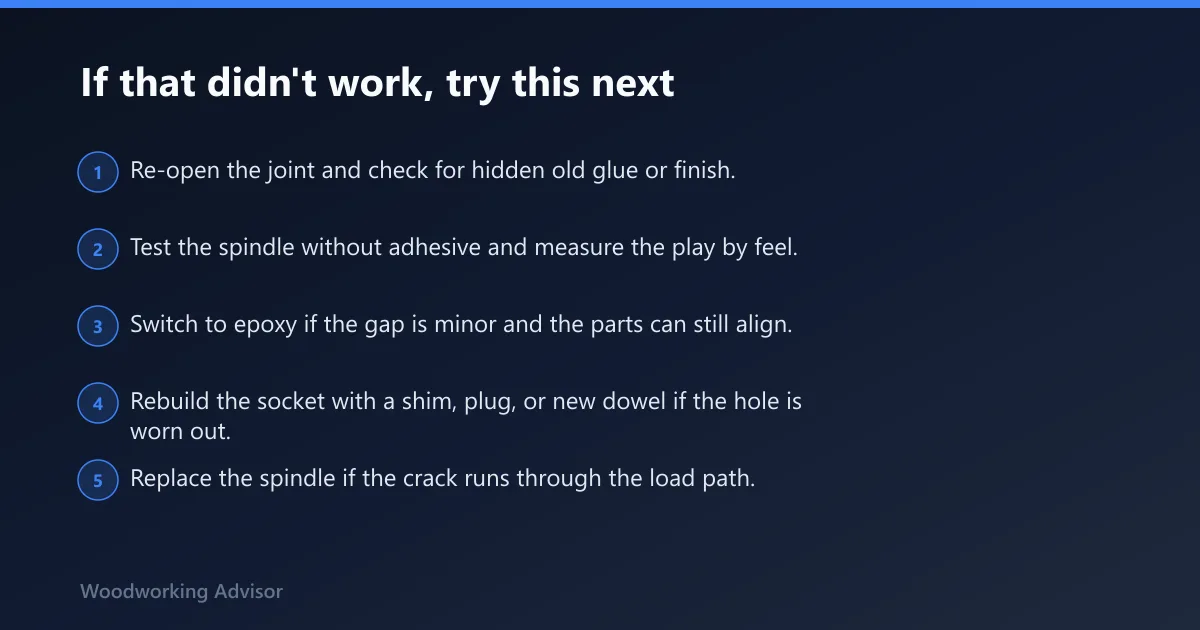
If the spindle still loosens after a clean PVA repair, the problem is usually fit, not glue. Move to epoxy for a minor gap, then to a rebuild if the socket is oversized or the spindle is cracked. Past that point, adhesive alone is the wrong fix.
- Re-open the joint and check for hidden old glue or finish.
- Test the spindle without adhesive and measure the play by feel.
- Switch to epoxy if the gap is minor and the parts can still align.
- Rebuild the socket with a shim, plug, or new dowel if the hole is worn out.
- Replace the spindle if the crack runs through the load path.
Prevention: Before reassembly, mark spindle orientation and clamp direction so the chair goes back together the same way every time. That keeps alignment predictable and reduces repeat loosening.
Sponsored / affiliate links. As an Amazon Associate I earn from qualifying purchases. I may earn additional commission from eligible campaigns.