Can You Paint Indoors in Winter?
Yes, you can paint indoors in winter if the room stays at the paint label’s minimum temperature, often 50–55°F for many interior latex/acrylic products, and holds there through drying and early cure. If the room falls below the label minimum, paint can dry slowly, stay tacky longer, and develop lap marks, poor leveling, or adhesion problems.
This guide is written for winter interior repainting where the room is small, occupied, or hard to ventilate. In practice, the most workable jobs are rooms that can hold about 60–68°F with relative humidity near 30–50%, such as a 10-by-12 bedroom at 62°F and 38% RH overnight, rather than a living room that drops from 68°F to the low 50s after bedtime.
When winter interior painting works
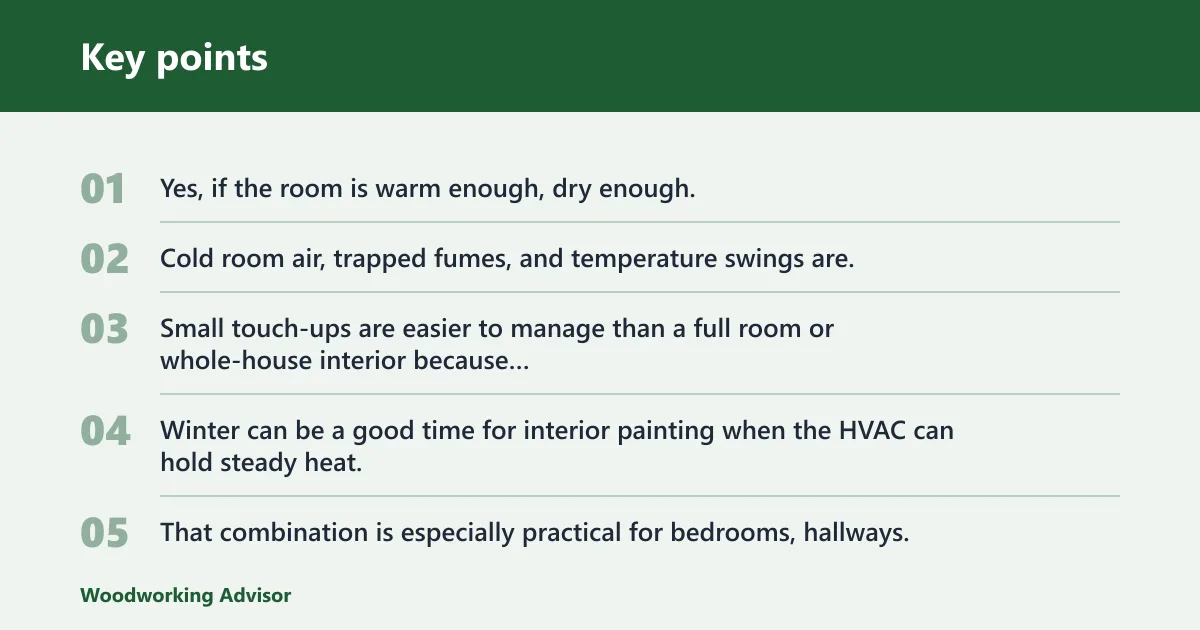


Yes, if the room is warm enough, dry enough, and ventilated without chilling the surfaces overnight. Winter itself is not the problem. Cold room air, trapped fumes, and temperature swings are. Small touch-ups are easier to manage than a full room or whole-house interior because less open paint is exposed at one time.
When winter is a good time to start
Winter can be a good time for interior painting when the HVAC can hold steady heat, the coating is low-VOC or zero-VOC, and you can move air without overcooling the room. That combination is especially practical for bedrooms, hallways, and bathrooms that need a quick turnaround.
A 10-by-12 bedroom is often a workable winter project if the room can stay near the label minimum all night, with a closed door and steady air movement. That is usually a better candidate than a large family room that warms up in the afternoon and loses several degrees before morning.
When to wait instead
Wait if the room cannot stay warm through the full drying period, if condensation appears on cold walls or trim, or if fumes cannot be managed safely. Oil-based paint is especially poor in a chilly, closed room because it dries slowly and can remain tacky for days when the temperature is low.
What room conditions are safe?
Safe winter painting depends on more than a warm afternoon. Most manufacturer labels for interior latex/acrylic coatings land around a 50°F minimum, while some products call for 60°F or higher. Humidity, airflow, and overnight stability matter just as much as the daytime reading.
Temperature targets that matter
For interior latex or acrylic paint, the label minimum is the go/no-go threshold. Many products specify about 50°F, while some premium or specialty coatings call for 60°F or more. If the room drops below that overnight, the film can level poorly, dry slowly, and stay soft longer.
Humidity limits and why they matter
Winter air is often dry, and that can help water leave latex paint more efficiently. Excess moisture does the opposite: it slows curing, extends odor, and can leave a dull or blotchy finish. Many paint manufacturers and pro guides advise keeping humidity below about 70%, but lower is usually better for winter interior work.
Humidity matters most in bathrooms, laundry rooms, basements, and tightly sealed bedrooms. Those rooms trap moisture from showers, drying clothes, and breathing, then add it back into the paint film. A room at 62°F and 55% RH may still be paintable, but it is less forgiving than the same room at 40% RH.
Why overnight stability matters more than a warm afternoon
A warm room for two hours is not enough if the thermostat drops hard overnight. Cold swings can create uneven drying, soft spots, and a longer tacky period on trim and walls. Keep the room stable during the first day and night, not just while you are applying the paint.
A common mistake is starting a late-afternoon coat in a room that feels comfortable at 68°F, then letting it fall to 54°F after bedtime. The wall may look dry the next morning, yet the coating can remain soft underneath and mark easily when touched or cleaned.
Winter paint readiness checklist
Use this checklist before you open a can. If one item misses the target, fix it first or wait. The safest answer is not about the calendar. It is about whether the room can hold manufacturer-approved conditions long enough for the coating to dry and begin curing evenly.
| Condition | Safe target | What to do if you miss it |
|---|---|---|
| Room temperature | Follow the paint label minimum; many interior latex/acrylic products specify 50°F or higher, while some require 60°F+ | Run heat early, close off unused rooms, and postpone painting if you cannot hold the range overnight |
| Relative humidity | Below 70%; lower is generally better for winter interior curing | Run a dehumidifier, reduce moisture sources, or wait for the room to dry out |
| Ventilation method | Fans moving air, with windows cracked slightly if conditions allow, and interior doors open for flow | Use mechanical air movement and door circulation if windows cannot stay open |
| Heater type | A space heater that warms the room without blasting wet paint | Reposition the heater, lower the output, or use central heat instead of direct heat |
| Coat thickness | Thin, even coats | Back-roll heavy spots, spread the coat thinner, and allow extra dry time |
| Overnight temperature stability | No drop below the paint’s minimum while drying and curing | Delay the job until the HVAC schedule or room isolation can hold steady heat |
| Go/no-go decision rule | Go only if the room can stay warm, dry enough, and ventilated for the full dry period | No-go if you need brief heat, cannot move fumes out, or expect a cold overnight swing |
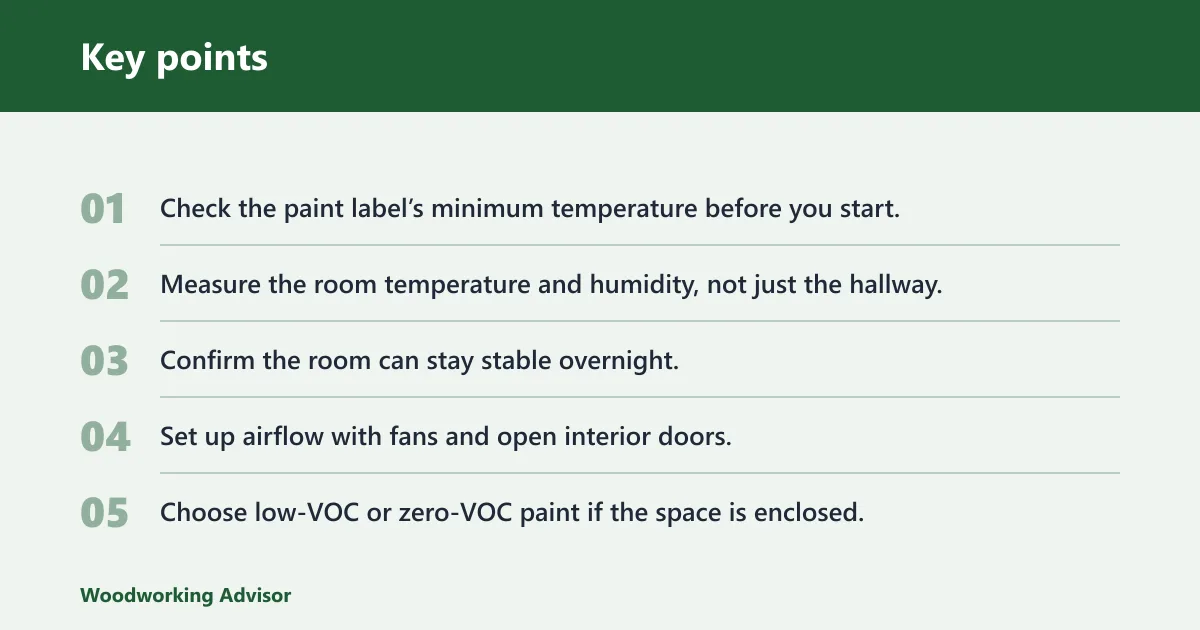
- Check the paint label’s minimum temperature before you start.
- Measure the room temperature and humidity, not just the hallway.
- Confirm the room can stay stable overnight.
- Set up airflow with fans and open interior doors.
- Choose low-VOC or zero-VOC paint if the space is enclosed.
- Paint in thin coats and plan for longer dry time.
Which paint works best indoors?
For winter interior work, interior latex or acrylic paint is usually the first choice because it dries faster than oil-based paint and is easier to manage in occupied rooms. Low-VOC or zero-VOC versions are the better fit when windows cannot stay open long. Oil-based paint can work in cold conditions, but it is slower and more pungent.
Interior latex/acrylic paint
Many paint manufacturer data sheets list interior acrylic latex at about 50°F and above, with some products requiring 60°F or more. That makes it practical for winter rooms if you can maintain the temperature and keep airflow moving. It also tends to have lower odor than stronger-solvent coatings, especially in low-VOC formulas.
Oil-based paint in cold rooms
Oil-based and alkyd coatings can have lower application-temperature limits on some labels, but that does not make them the best winter choice for a bedroom, hallway, or family room. Cold rooms slow their drying, and the odor is usually stronger and longer lasting than water-based alternatives.
Low-VOC paint for enclosed spaces
Low-VOC paint is the safer indoor option when the room is closed up for winter. It cuts fumes, which matters if children, pets, or sleeping spaces are nearby. If you cannot keep windows open for long, this choice matters more than squeezing extra drying speed from a harsher coating.
How do you ventilate a room in winter?
Ventilation is still necessary in winter, even if you cannot leave windows wide open. The goal is to move fumes out and fresh air through without stripping the room of heat. Fans, slightly open windows when weather allows, and open interior doors are the main tools.
Fans and interior doors
One helpful rule is to move air out of the room or toward a planned exit path, rather than blow dust across wet paint. Open interior doors help air travel through the house instead of pooling in one closed space. A box fan near a doorway is often more controllable than a ceiling fan alone.
When to crack windows slightly
If outdoor conditions allow, crack a window just enough to refresh the air without turning the room cold. That small opening can be paired with a fan and a warm room so the temperature stays in range. Wide-open windows are not required for every winter job, especially in a small room.
How to limit fumes without overcooling the room
Choose low-VOC paint, limit the number of open containers, and paint one room at a time. Close off the painted room from the rest of the house only if you can still move air through it. If you have to choose, steady temperature matters more than a bigger open window.
How should you heat and dry the space?
Use heat to hold the room in range, not to bake the paint. A space heater can help a cold room become paintable, but it should not blast directly on wet paint or sit close to the wall. Drying works best when warmth is even and air movement is controlled.
Safe space heater placement
Place the heater so it warms the room generally, not one patch of wall. Keep it clear of drapes, drop cloths, solvent cans, and dusty debris. Use it to maintain temperature before, during, and after painting, then let the room settle into a steady level instead of cycling sharply.
Why direct heat on wet paint is a bad idea
Direct heat can skin over the surface too fast while the coat underneath stays soft. That can lead to uneven drying, trapped odor, and a finish that marks easily. Strong hot air against one section can also create lap marks and visible edges where the paint dried at different speeds.
Using a dehumidifier to control indoor moisture
A dehumidifier is useful in closed winter spaces because it removes excess moisture that slows curing. That is especially helpful in basements, laundry rooms, and bathrooms where warm air alone does not solve the problem. Pairing dehumidification with steady heat gives latex paint a much better chance to set evenly.
Picture a small bathroom with the door shut, the shower recently used, and the mirror fogging up. Even if the room feels warm, the added moisture can keep paint tacky far longer than expected unless you reduce humidity first.
How long does winter paint take to dry?
Winter can lengthen both dry time and cure time, especially in cold rooms. Dry to the touch is not the same as fully cured. Manufacturer instructions and pro guidance commonly note that full cure can take weeks, so plan for longer protection against scuffs, tape, and cleaning than you would in warmer weather. See also paint curing in cold weather.
Dry to touch versus fully cured
A wall may feel dry within hours and still need days or weeks to harden fully. That gap matters when moving furniture back, hanging art, or closing doors against fresh trim. The colder the room, the longer that window can stretch.
Why thin coats help
Thin coats dry more evenly and reduce the chance of trapped solvent, soft spots, and visible roller lines. Heavy coats are more likely to stay gummy in winter. If coverage looks uneven after the first coat, a second thin coat usually beats one thick pass.
What to expect with cold rooms and slower cure times
Cold rooms slow both the visible dry stage and the internal cure stage. That means more patience between coats, more caution with airflow, and more care around heaters. A finish that looks acceptable at noon can still be vulnerable to damage the next morning if the room cools overnight.
Frequently asked questions
Can you paint indoors in winter?
Yes, you can paint indoors in winter if the room stays within the paint label’s minimum temperature, stays dry enough, and keeps moving air through the space. The main risks are cold overnight swings, trapped fumes, and coats that dry unevenly or stay tacky longer than expected.
What room temperature is safe for interior painting in winter?
A common safe range is 50°F to 85°F, and some products allow 50°F to 90°F. Many labels are more specific, so the paint can’s minimum temperature should control the decision. The best target is the one you can hold steadily through drying and early cure.
How do you ventilate while painting indoors in winter?
Use fans, keep interior doors open, and crack windows slightly if the weather allows. Low-VOC or zero-VOC paint is especially helpful when windows cannot stay open long. The goal is to move fumes out without cooling the room below the paint’s minimum temperature.
Does winter air help paint dry faster indoors?
Sometimes lower winter humidity helps, but cold room air can slow drying and curing. Dry air is helpful only when the room stays warm enough. If the temperature swings or drops overnight, the room can end up with slower curing, stronger odor, and a less even finish.
What kind of paint works best for indoor winter painting?
Interior latex or acrylic paint is usually the best winter choice because it dries faster than oil-based paint and is easier to manage indoors. Low-VOC or zero-VOC versions are better when the room is enclosed. Oil-based paint is slower and stronger smelling in cold rooms.
Should you paint indoors in the winter?
Paint indoors in winter when the room can hold steady heat, low enough humidity, and workable ventilation for the full dry period. Wait if you cannot prevent overnight cooling or manage fumes safely. Winter painting is a readiness question, not a calendar question.
Can you paint inside house in winter?
Yes, but treat each space separately. A small touch-up, a bathroom, and a whole-house interior are not the same job. The larger the project, the more you need stable temperature, controlled humidity, and a plan for airflow that does not overcool the house.
Can you paint interior walls in winter?
Yes, interior walls can be painted in winter if the room stays above the paint’s minimum temperature and the air does not stay damp. Use thin coats, keep air moving, and avoid direct heat on the wall. Stability overnight matters more than a warm afternoon.
Can you paint house interior in winter?
Yes, if the house can support the room-by-room conditions needed for paint to dry and cure well. Low-VOC paint, fans, a dehumidifier, and careful heater placement make winter work more practical. If the home cannot be ventilated without large heat loss, waiting is often the safer choice.
Sponsored / affiliate links. As an Amazon Associate I earn from qualifying purchases. I may earn additional commission from eligible campaigns.