Best Router Bit for Cutting MDF Cleanly (2026): we compared
Use a sharp solid-carbide spiral bit: downcut for a cleaner top edge, upcut for faster chip clearing, and compression for through-cuts that need both faces clean. The wrong geometry leaves fuzzy edges, burned cuts, swollen fibers, and tear-out that shows through paint. This guide matches bit type to MDF cut type, finish goal, and the failure mode to avoid for dados, templates, edge profiles, and cabinet parts.
Quick comparison
| Product | Badge | Best for | Price | ||
|---|---|---|---|---|---|
 |
EANOSIC Spiral Router Bits Up Down Compression Bit 1/2 inchEANOSIC | Our pick | 1/2 in shank · Solid carbide · 4 in length | $62.99
Price as of 11 Oct 2026
|
View |
 |
SpeTool 1/4 Inch Shank Downcut Spiral Router Bit 1/4 InchSpeTool | Budget pick | 1/4 in shank · Downcut · 1 in cutting length | $25.99
Price as of 11 Oct 2026
|
View |
 |
HILTEX 10101H Double-Flute Straight Cut Router Bit Set, 4Hiltex | Also great | 4-piece set · Straight cut · Dado grooving | $9.99
Price as of 11 Oct 2026
|
View |
 |
Amana Tool Bowl and Tray Plunge Router Bit, Carbide-Tipped,Amana Tool | Upgrade pick | Bowl and tray · 1/4 radius · 1-1/8 dia | $48.00
Price as of 11 Oct 2026
|
View |
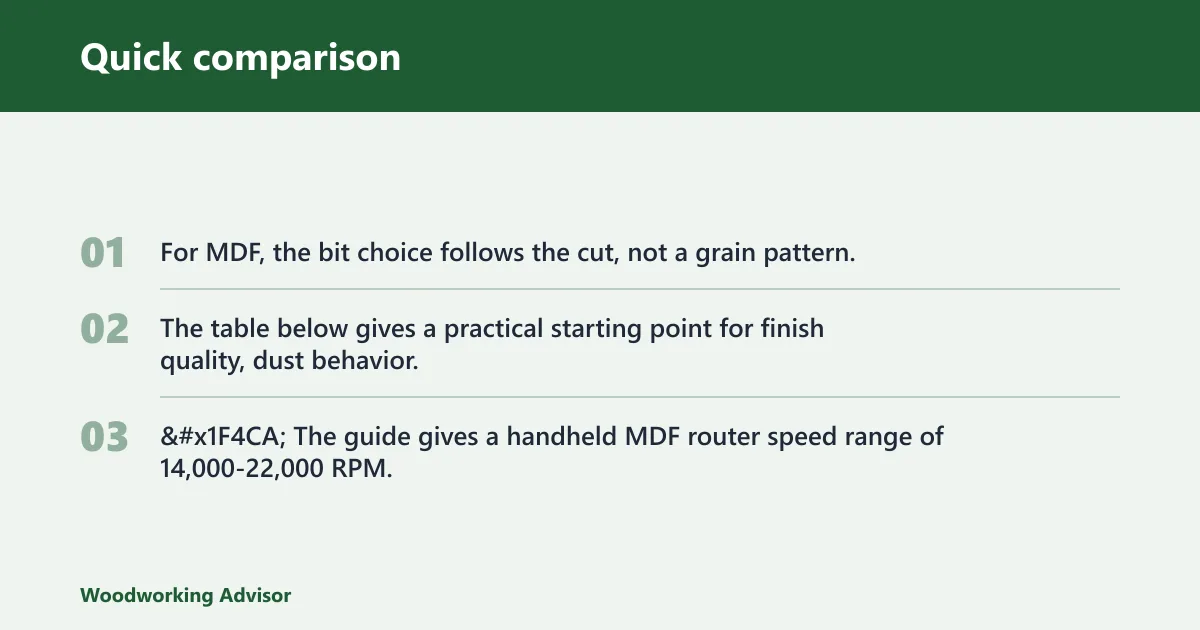
For MDF, the bit choice follows the cut, not a grain pattern, because MDF has no grain direction. The table below gives a practical starting point for finish quality, dust behavior, and the defect you are most likely to see if you pick the wrong geometry.
📊 The guide gives a handheld MDF router speed range of 14,000-22,000 RPM. Source: Can MDF Be Routed? Yes — Best Bits, RPM & Feed Rate Tips.
How we chose
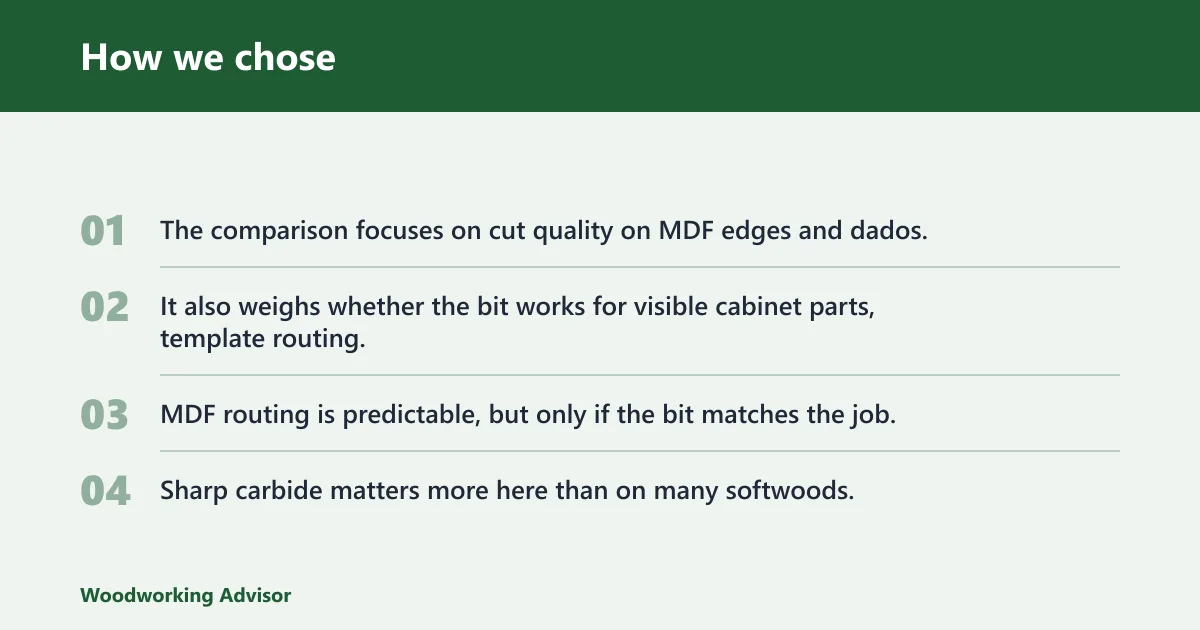
The comparison focuses on cut quality on MDF edges and dados, chip evacuation versus top-face finish, durability in abrasive resin-bonded fiberboard, and dust control with finishing follow-up. It also weighs whether the bit works for visible cabinet parts, template routing, flush trimming, and lower-visibility grooves.
MDF routing is predictable, but only if the bit matches the job. Sharp carbide matters more here than on many softwoods, because resin-bonded fiberboard wears cutting edges fast and shows defects clearly under paint.
| MDF routing task | Bit geometry | Finish quality | Dust behavior | Likely defect if misused |
|---|---|---|---|---|
| Visible edge profile on painted cabinet parts | Downcut spiral, solid carbide | High on the top face | Packs chips more than an upcut bit | Burning or poor chip clearance |
| Dados and channels in casework | Straight carbide bit | Moderate | Clears less efficiently than a spiral | Fuzzing at the walls and bottom |
| Flush trim on laminated MDF sheets | Downcut spiral or compression bit | High on the show face | Moderate to heavy chip loading | Top-face tearout or edge swelling |
| Template routing where underside finish matters more | Upcut spiral, solid carbide | High on the bottom face | Best chip evacuation | Lifting fibers on the top face |
| Roundovers, bowls, and tray recesses | Carbide-tipped profile bit | Good when feed and speed are balanced | Standard router dust, still fine and harmful | Burning on curves if feed is too slow |
Downcut spiral bit: best for visible edges
A downcut spiral is the first choice for exposed MDF edges, cabinet-door profiles, and template work where the top face must stay clean. It pushes chips downward, which helps reduce top-face tearout on MDF and gives a cleaner shoulder on profile cuts.
This geometry fits edge profiles, shallow rabbets, and many flush-trim jobs when the show face is on top. It is also a sensible pick for laminated MDF sheets, where a chipped veneer or paint-ready edge stands out fast.
The tradeoff is chip evacuation. Because the cutting action drives debris down, the bit can pack dust into the kerf, which raises burning risk if you creep through the cut or run the router too slowly.
Straight carbide bit: best for dados and channels
A straight carbide bit is the basic option for dados, channels, and other lower-visibility cuts in MDF. It is acceptable when the goal is accurate width more than a show-quality wall, but it is more prone to fuzzing than spiral geometry.
This makes it useful for cabinet carcases, shelf dados, and test joints where the groove will be hidden or primed later. A straight bit can also be easier to source in common sizes, which helps when you need a quick, simple setup.
The drawback is finish quality. Straight cutters clear chips less aggressively than spirals, so MDF walls can come out fuzzy, especially if the feed is hesitant or the cutter is already dull.
Upcut spiral bit: best for chip evacuation
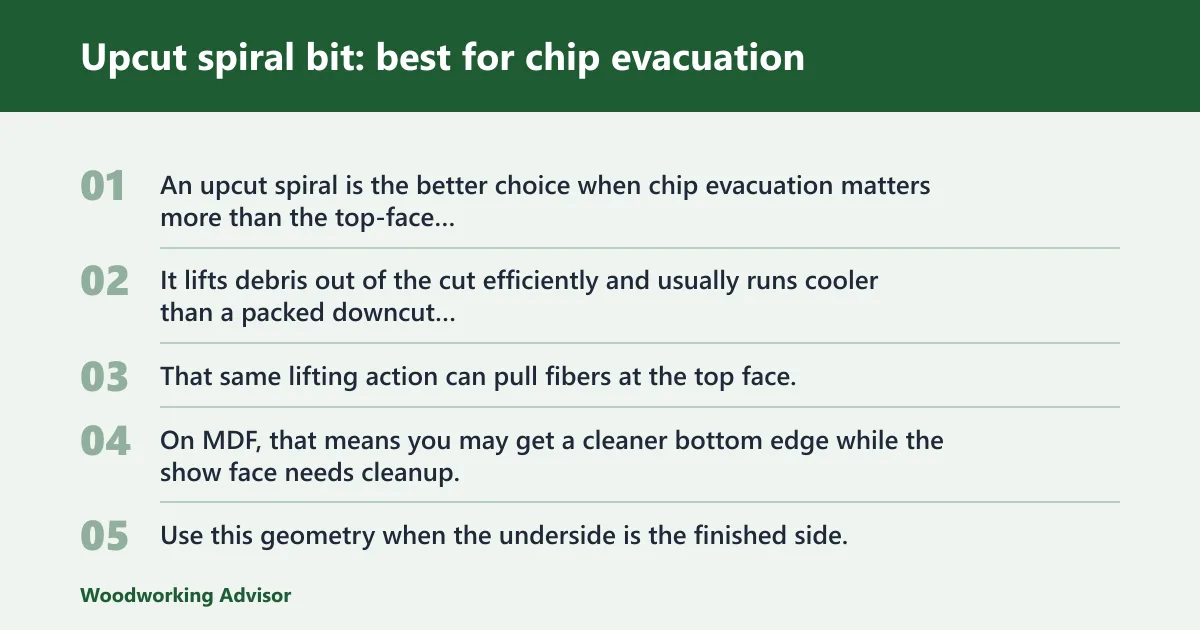
An upcut spiral is the better choice when chip evacuation matters more than the top-face finish, such as deep slots, template routing with a sacrificial backer, or underside-critical cuts. It lifts debris out of the cut efficiently and usually runs cooler than a packed downcut cut.
That same lifting action can pull fibers at the top face. On MDF, that means you may get a cleaner bottom edge while the show face needs cleanup, which is the opposite of what you want on painted cabinet doors or visible edge profiles.
Use this geometry when the underside is the finished side, or when the cut is deep enough that clogging would otherwise stall progress. The plain drawback is simple: it can leave a fuzzed top edge that needs sanding or sealing before paint.
Do you need carbide bits for MDF?
Yes. A sharp carbide bit is the baseline requirement for MDF routing, and plain high-speed-steel bits dull within a few feet in MDF. Because MDF is resin-bonded and abrasive, carbide holds edge retention far better and gives more predictable cut quality.
Carbide-tipped wood router bits make sense for many home shops because they come in practical sets with common profiles and sizes. Solid carbide is usually the better pick for spiral cutters and for frequent MDF work, while carbide-tipped sets are a cost-effective way to cover profiles, grooves, and edge work.
Wear shows up fast on MDF. The cut starts to look fuzzy instead of crisp, feed resistance rises, and the router may leave brown marks at the edges even when the speed has not changed.
How do you stop MDF edges from fuzzing?
Use a steady, moderate feed rate, choose the right spiral direction, and make a test cut before you commit to the full part. Fuzzing usually means the cut is too slow, the bit is dull, or the geometry is wrong for the face you want to keep clean.
Pass depth matters too. A shallower pass lowers strain on the cutter and helps keep the edge crisp, especially on visible cabinet parts and narrow profiles. If the router begins to sound loaded, you are probably cutting too slowly or trying to remove too much at once.
After routing, apply sanding sealer or primer to fuzzy edges before painting. MDF edges drink finish, and sealing locks down loose fibers so your topcoat does not raise them again.
Which one should you buy
If you are routing painted cabinet doors, visible edge profiles, or laminated MDF sheets, buy the downcut spiral first. It is the most direct answer for a clean top face, which is the surface that people notice.
If your work is mostly dados, channels, or hidden joinery, a straight carbide set is a practical value pick. The Hiltex set covers several groove widths, but you give up some finish quality compared with a spiral bit.
If your main problem is chip buildup in deeper cuts or underside finish, choose an upcut spiral. For bowl recesses and curved profiles, a carbide-tipped profile bit such as the Amana bowl-and-tray cutter is the better match, though it is not a general-purpose MDF bit.
For buyers who want one bit to cover the most visible MDF cuts, a solid-carbide downcut spiral is the safest starting point. For broader coverage, carbide-tipped sets are the budget-minded route, but they do not match the edge control of a dedicated spiral on show surfaces.
Can a router be used on MDF?
Yes, MDF routes cleanly with the right bit and a sensible setup. Because MDF has no grain direction, it cuts more predictably than solid wood, but it still needs a sharp carbide cutter, dust control, and a moderate feed rate to avoid burning or fuzzing.
Picture a 3/4-inch cabinet side with a shelf dado. A clean router cut is realistic if you keep the pass shallow, support the work, and use a bit chosen for the cut type instead of assuming any cutter will do the job.
How do I route MDF without chip-out?
Use a downcut spiral for the visible face, take light passes, and keep the router moving at a steady pace. Chip-out usually comes from the wrong cutter direction, a dull edge, or a pass that is too aggressive for the router’s power.
Suppose you are template-routing a 2-by-3-foot MDF panel for a cabinet side. Start with a test cut on offcut material, then watch the top edge closely; if you see ragged fibers, change direction, reduce depth of cut, or move to a downcut bit before finishing the part.
What RPM should I use when routing MDF?
A typical handheld MDF router speed range is 14,000-22,000 RPM, but the right setting depends on bit diameter, pass depth, and router power. Smaller bits generally tolerate higher speed, while larger bits need a more cautious setting to avoid overload and heat.
Too-slow speed can burn MDF because the cutter rubs instead of slices. Too-fast speed, especially with an aggressive feed or deep pass, can overload the cut and make tearout or chatter more likely. Use test cuts to find the setting that leaves a clean edge without scorching.
Do I need dust collection when routing MDF?
Yes. MDF produces very fine, resin-laden dust when routed, and that dust is a respiratory hazard. You should use dust collection at the router port or a shop vac setup, along with a proper dust mask or respirator.
Do not treat MDF dust like ordinary sawdust. It hangs in the air easily, settles everywhere, and is unpleasant to breathe during repeated passes. Good extraction also helps the bit clear chips, which can improve cut quality.
How do I seal routed MDF edges before painting?
Seal routed MDF edges with sanding sealer or primer before paint. This locks down fuzz, slows moisture uptake, and gives the topcoat a smoother base than bare fiberboard can provide.
Work the edge first, then inspect it under raking light. If the cut feels fuzzy, sand lightly, recoat, and let the sealer or primer dry fully before the finish coat. That sequence matters more than trying to bury a rough edge with paint alone.
How often should I replace a router bit used on MDF?
Replace or sharpen a MDF bit when the cut stops looking crisp, the router needs more push force, or burning starts to appear despite a reasonable feed and speed. MDF is abrasive enough that edge wear shows sooner than many woodworkers expect.
Solid-carbide and carbide-tipped bits last longer than high-speed steel, but no cutter stays sharp forever. If a bit begins to fuzz the edge instead of slicing it cleanly, do not keep forcing the job; that only creates more heat and more cleanup.
How to clean router bits
Clean router bits by removing packed resin and dust after use, especially from spiral flutes where MDF debris can lodge. A clean bit cuts cooler, clears better, and shows wear sooner when you inspect the edge.
A common first-timer mistake is leaving buildup on the cutter and assuming the edge is dull. If the bit looks dirty, clean it first, then check whether the cutting edge is actually damaged. A coated or carbide bit can still be in good shape even when it is dusty.
How we set the router up for MDF
- Choose the bit for the face that matters most.
- Set a moderate speed within the 14,000-22,000 RPM range for handheld work.
- Make a test cut on scrap MDF.
- Check for burning, fuzzing, or tearout.
- Adjust feed rate or pass depth before routing the final part.
Troubleshooting checklist for bad MDF cuts
- Burning: increase feed slightly, reduce RPM if the bit is oversized, and clean or replace the cutter.
- Fuzzing: switch to carbide, use a spiral cutter, or seal the edge before paint.
- Tearout: use a downcut bit on the show face and take shallower passes.
- Poor chip clearing: switch to an upcut spiral or shorten the pass depth.
- Rough hidden dados: a straight carbide bit may be fine, but only if the edge will not remain visible.
Frequently asked questions
What router bit cuts MDF cleanly?
A sharp solid-carbide spiral bit cuts MDF cleanly, with downcut spirals best for visible top edges and upcut spirals best when chip evacuation matters more. Straight carbide bits are acceptable for dados and hidden channels, but they usually leave more fuzz than a spiral geometry.
Should I use an upcut or downcut bit for MDF?
Use a downcut bit when the top face is the finish face, because it reduces top-face tearout on MDF. Use an upcut bit when you need better chip clearing or when the underside is the face that matters most. The wrong choice usually shows up as either fuzzing or packing.
Sponsored / affiliate links. As an Amazon Associate I earn from qualifying purchases. I may earn additional commission from eligible campaigns.