How Much Does an MDF Kitchen Cost vs Solid Wood?
For a full kitchen, MDF cabinets are often reported to cost about 10% to 30% less than solid wood, though the gap can shrink with painted doors, simple box construction, and standard sizes. If you miss where the money goes, you can pay for solid wood where it adds little, or buy MDF where moisture resistance matters. This guide breaks down material, door, and cabinet-box costs so you can see exactly where the price difference comes from.
| Decision factor | How Much Does an MDF Kitchen Cost | Solid Wood | Winner |
|---|---|---|---|
| Doors and drawer fronts | Paint-grade fronts: 10 doors × $75 = $750; 4 drawer fronts × $55 = $220 | Visible fronts in solid wood: 10 doors × $120 = $1,200; 4 drawer fronts × $95 = $380 | How Much Does an MDF Kitchen Cost |
| Cabinet boxes | 6 box units × $260 = $1,560 | 6 box units × $320 = $1,920 | How Much Does an MDF Kitchen Cost |
| Panels and exposed parts | 2 panels × $140 = $280 | 2 panels × $220 = $440 | How Much Does an MDF Kitchen Cost |
| Edge sealing | $240 | $120 | Solid Wood |
| Finish labor | Paint-grade finishing: $840 | Stain and clear-coat labor: $1,100 | How Much Does an MDF Kitchen Cost |
| Sample total | $3,890 | $5,160 | How Much Does an MDF Kitchen Cost |
Sample price delta: $5,160 – $3,890 = $1,270 less for the MDF-painted build, or about 25% below the solid-wood build in this sample.
Sample kitchen assumptions for the cost comparison
On the same cabinet layout, MDF usually wins on price because it uses a lower-cost fiberboard core than solid wood, and it is a common choice for kitchen cabinets. In a painted kitchen, the savings often come from the fronts, the panels, and the finish labor, while the boxes can be a separate line item that narrows or widens the gap.
What the sample kitchen includes
This comparison uses one simple layout assumption: 10 doors, 4 drawer fronts, 6 cabinet boxes, and 2 exposed panels. The MDF side assumes painted, paint-grade cabinetry; the solid-wood side assumes a stained or clear-finished build, which is where solid wood is often chosen.
What changes the cabinet quote most?
The biggest quote swings usually come from cabinet boxes, door and drawer-front material, and the finish system. A quote can look close at first glance, then change fast once you split painted fronts from stained fronts, count the exposed panels, and check whether the boxes are part of the same material package.
Cabinet boxes versus fronts
Cabinet boxes are a separate line item from doors and drawer fronts, and that matters. Many buyers focus on the visible face frame and front panels, but the box construction can add or subtract hundreds of dollars before finish work is priced.
Painted versus stained finish systems
Painted MDF usually fits paint-grade cabinetry better because the surface is smooth and even. Solid wood is often chosen for stained or natural finishes, where the grain is part of the look and the finishing process may take more labor.
Door style, panel count, and labor
Raised-panel doors, extra end panels, and decorative trim all increase labor and material cost. Flat, painted slab-style fronts keep the MDF price advantage intact more often than ornate profiles do.
Is MDF cheaper than solid wood for painted cabinets?
Yes, painted MDF is usually cheaper than solid wood for kitchen cabinets, and the sample here shows why: the biggest savings come from the doors, drawer fronts, and finish labor. The price gap can shrink if the quote uses simpler solid-wood parts or if the MDF build adds extra sealing and panel work.
Why MDF fits paint-grade cabinetry
MDF has a smooth surface, so it takes paint well and avoids the grain telegraphing you can see on some wood surfaces. It is also more uniform and less likely to crack than solid wood, which helps painted parts stay visually consistent.
Where solid wood still costs more
Solid wood costs more in the visible parts most homeowners notice first: doors, drawer fronts, and exposed panels. Those pieces often carry the largest material premium because they are the parts you see and touch every day.
When the savings can shrink
The gap gets smaller when the solid-wood quote uses a simple profile and the MDF quote adds extra edge sealing, moisture protection, or custom paint work. If both quotes use the same cabinet-box spec and the same finish quality, the difference may come down to the fronts more than the whole kitchen.
What parts of a cabinet are usually MDF versus solid wood?
Cabinet labels can hide mixed-material construction, so you need to compare parts separately. MDF commonly appears in paint-grade doors, drawer fronts, and panels, while solid wood is often used for visible parts, frames, or stain-grade pieces. The box, the front, and the finish can each use a different material.
Doors and drawer fronts
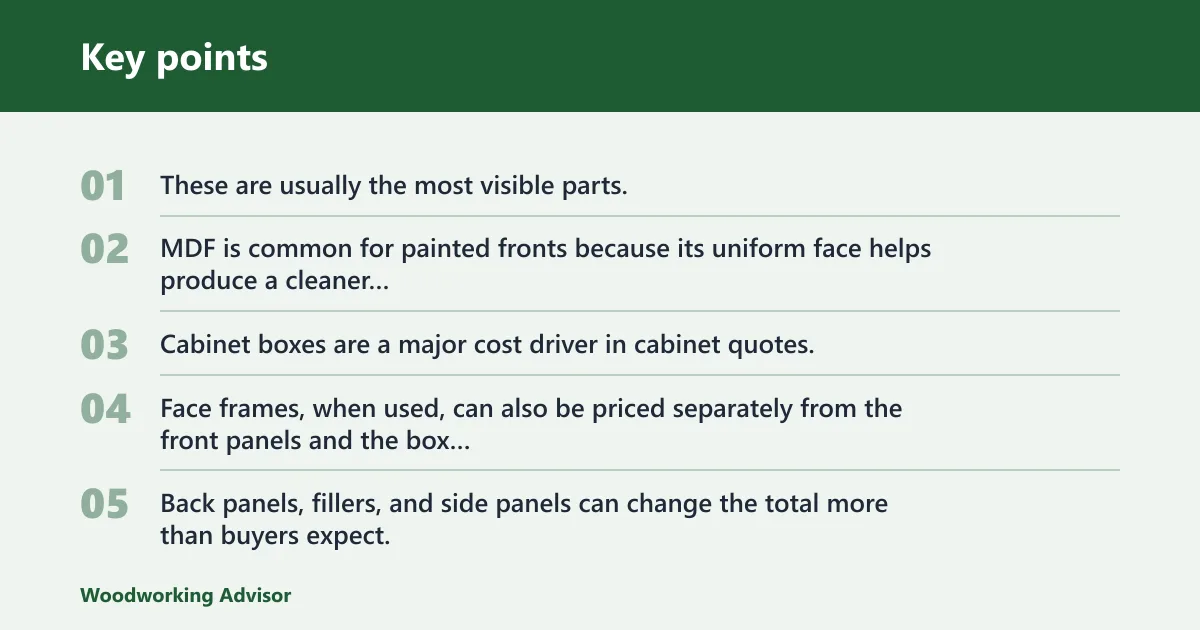
These are usually the most visible parts, so material choice shows up quickly in the price and the finish result. MDF is common for painted fronts because its uniform face helps produce a cleaner painted surface.
Cabinet boxes and face frames
Cabinet boxes are a major cost driver in cabinet quotes, and they may be built from a different material than the doors. Face frames, when used, can also be priced separately from the front panels and the box carcass.
Backs, fillers, and visible panels
Back panels, fillers, and side panels can change the total more than buyers expect, especially on an island or at a finished end. These pieces are often where solid wood adds cost without changing storage capacity.
Say your 12-inch sink base has a small plumbing leak that drips for a weekend. The cabinet material matters less than the response: dry it quickly, remove standing water, and inspect the edge sealing and toe-kick area before damage spreads into swollen edges or soft panel corners.
Moisture, sink bases, and edge sealing
Moisture exposure matters more than the label alone. MDF is sensitive to water, so sink-base cabinets and other wet zones need careful edge sealing, good finish coverage, and fast leak response. Solid wood can also move with humidity and seasonal change, so it is not a free pass around water risk.
Why leak exposure matters more than the label alone
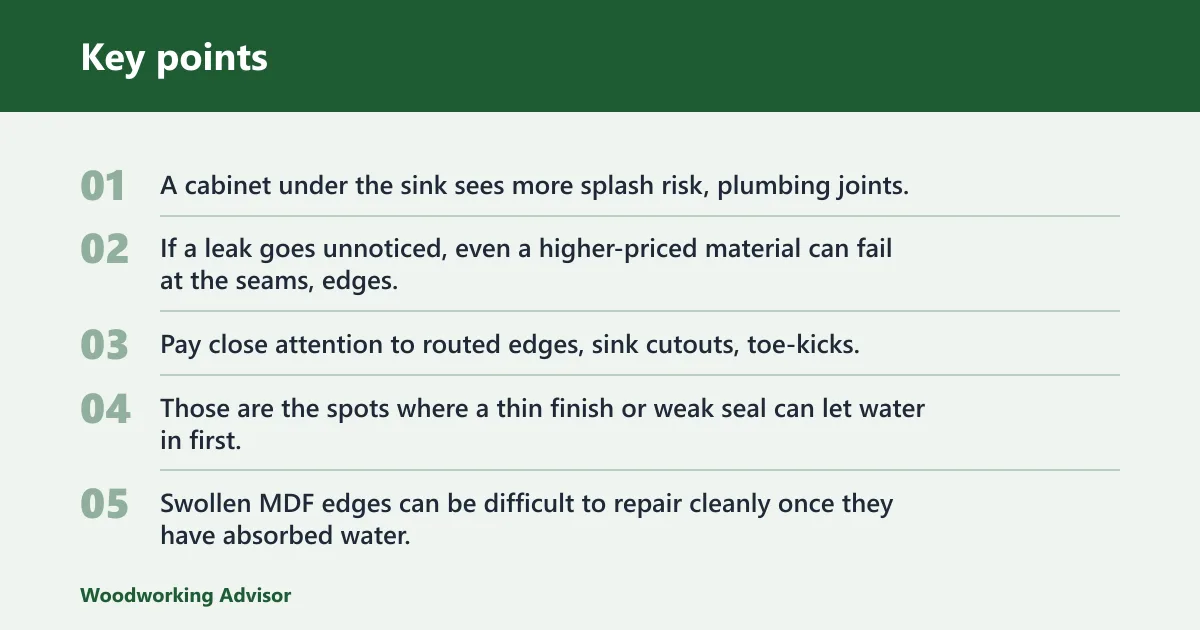
A cabinet under the sink sees more splash risk, plumbing joints, and cleanup water than other areas. If a leak goes unnoticed, even a higher-priced material can fail at the seams, edges, or finish cut lines.
Where sealing and finish quality matter most
Pay close attention to routed edges, sink cutouts, toe-kicks, and any exposed panel end grain or fiberboard edges. Those are the spots where a thin finish or weak seal can let water in first.
Repair and replacement risks in wet zones
Swollen MDF edges can be difficult to repair cleanly once they have absorbed water. Solid wood can also warp or move, but a cabinet quote should still spell out the edge treatment and the moisture protection used in the sink base.
A common first-timer mistake is assuming that all-painted cabinets are equally protected. A painted MDF door can look excellent, but if the quote leaves out edge sealing at the sink base, the low price can become a replacement bill later.
Choose How Much Does an MDF Kitchen Cost if… / Choose Solid Wood if…
Choose MDF if you want a painted kitchen, care most about the upfront quote, and are comparing standard doors, drawer fronts, and boxes on equal terms. Choose solid wood if the design depends on stained or natural finishes, if you want more visible wood character, or if the quote includes a wet-area specification you want to keep consistent across the whole kitchen.
Best-fit scenarios for MDF
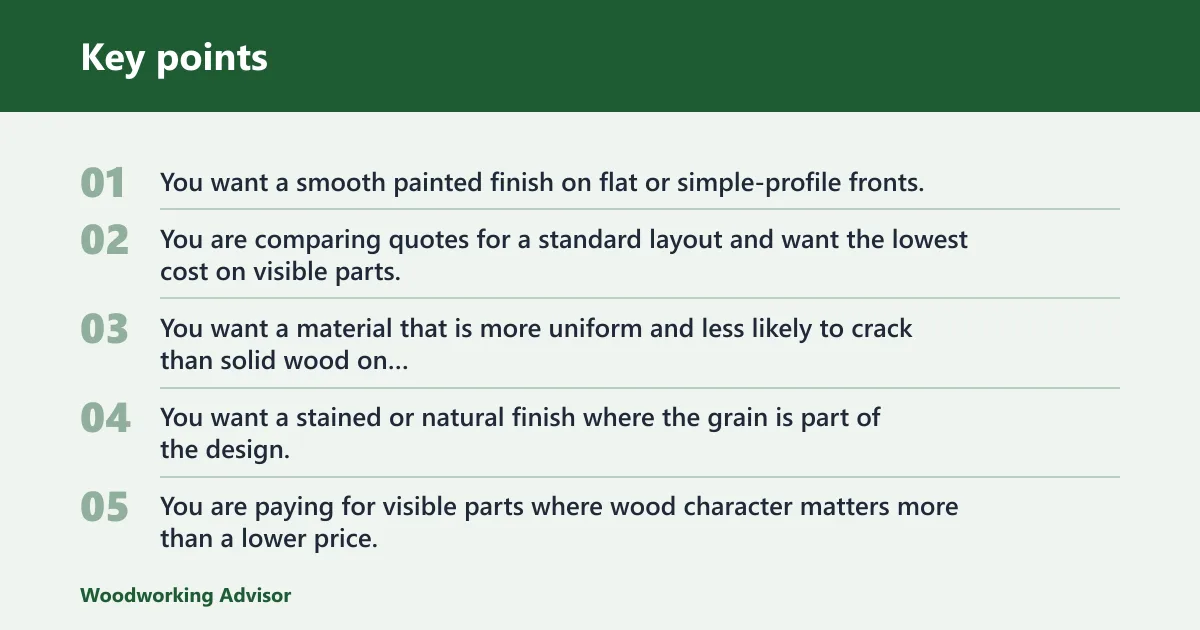
- You want a smooth painted finish on flat or simple-profile fronts.
- You are comparing quotes for a standard layout and want the lowest cost on visible parts.
- You want a material that is more uniform and less likely to crack than solid wood on painted components.
Best-fit scenarios for solid wood
- You want a stained or natural finish where the grain is part of the design.
- You are paying for visible parts where wood character matters more than a lower price.
- You want the quote to emphasize wood appearance on doors, frames, or exposed panels.
When to pay for the upgrade
Pay for solid wood when the visible surfaces are the design priority and the material change is obvious in the final look. Skip the upgrade when the quote adds a solid-wood premium to hidden or low-visibility parts that will not change the result you actually see.

What should I ask for in a cabinet quote to compare MDF and solid wood fairly?
Ask for a line-item quote that separates doors, drawer fronts, cabinet boxes, panels, edge sealing, and finish labor. Without those splits, you cannot tell whether the higher price comes from the material itself, the finish system, or a larger labor allowance on the same kitchen layout.
- Ask which parts are MDF and which are solid wood.
- Ask for the count and size of doors, drawer fronts, and panels.
- Ask whether the cabinet boxes are included in the front material price.
- Ask what edge sealing is included in wet areas and at exposed edges.
- Ask whether the finish system is paint, stain, laminate, or a mixed package.
- Ask for the labor difference if the same layout is priced in both materials.
Frequently asked questions
How much does an MDF kitchen cost compared with solid wood?
In a like-for-like cabinet quote, MDF usually costs about 10% to 30% less than solid wood. The exact gap depends on how many fronts, panels, and boxes are included, plus how much finish labor the quote assigns to paint versus stain or clear coat.
Is MDF cheaper than solid wood for painted kitchen cabinets?
Yes. Painted MDF is usually the lower-cost choice because it fits paint-grade cabinetry well and often needs less material spend on visible parts. The savings are strongest when the layout is simple and the quote keeps the box construction and finish system consistent across both options.
What parts of a kitchen cabinet are usually MDF versus solid wood?
Doors, drawer fronts, and exposed panels are the parts most often compared first, because they drive the look and a large share of the price. Cabinet boxes may be built from a different material entirely, so you should not assume the front material tells you the whole quote.
Does MDF hold up in a kitchen as well as solid wood?
MDF can hold up well in painted cabinet parts when the finish is sound and the edges are sealed, but it is sensitive to water. Solid wood also has movement concerns with humidity and seasonal change, so the better choice depends on the location, finish, and leak risk.
How much more does solid wood add to a cabinet quote?
In the sample comparison above, solid wood added $1,270 over the MDF-painted build. On real quotes, the premium changes with door count, panel count, finish labor, and how much of the cabinet package is actually visible wood rather than hidden structure.
Can MDF cabinets be painted for a high-end look?
Yes. MDF is a strong fit for paint-grade cabinetry because the surface is smooth and uniform, which helps the painted finish look even. The result still depends on surface prep, edge treatment, and the finish system, not on the material label alone.
Sponsored / affiliate links. As an Amazon Associate I earn from qualifying purchases. I may earn additional commission from eligible campaigns.