MDF Board Guide: Properties, Uses, Care, and Grades
For interior work, many makers choose standard MDF for dry painted parts, moisture-resistant MDF for kitchens or laundry areas, and roughly 1/2- to 3/4-inch sheets for common cabinets, shelves, trim, and wall panels. Pick the wrong grade or leave edges unsealed, and shelves sag, corners swell, fasteners loosen, and paint fails early. I have seen all four failures on jobs that looked fine on install day. This guide covers MDF properties, variant selection, thickness rules, cutting and fastening, finishing, moisture protection, and maintenance for long interior service.
What is MDF board made of?
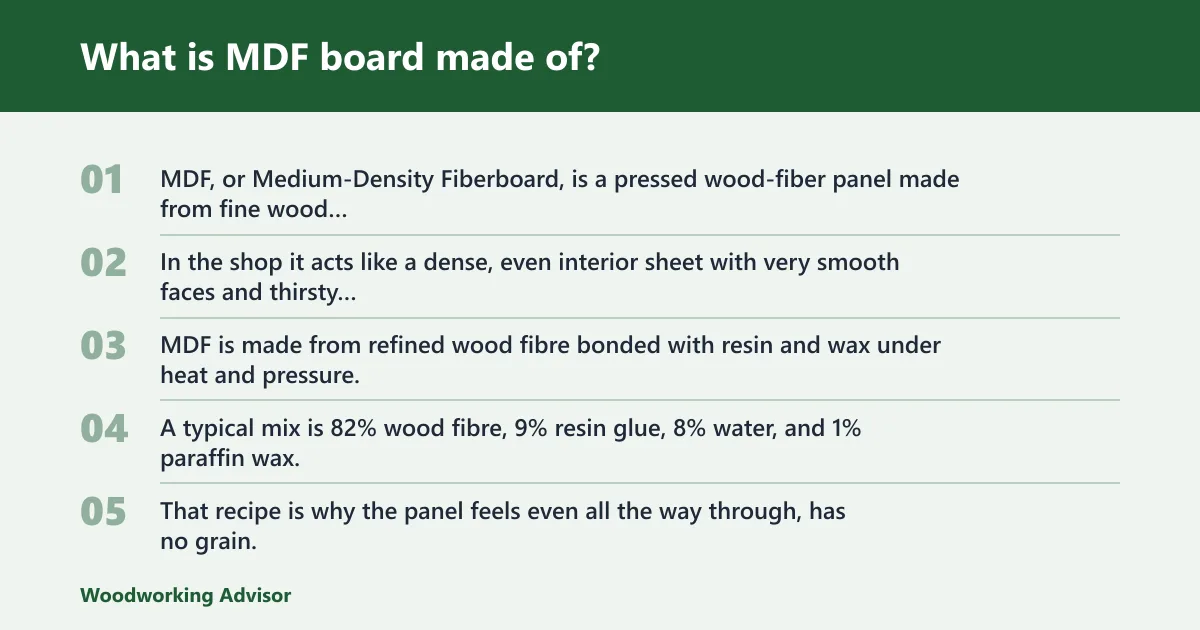
MDF, or Medium-Density Fiberboard, is a pressed wood-fiber panel made from fine wood fibres, resin, wax, heat, and pressure. In the shop it acts like a dense, even interior sheet with very smooth faces and thirsty edges, which is why it paints so well and also why it swells, bruises at edges, and strips screws if you get careless.
Core makeup and what it means in use
MDF is made from refined wood fibre bonded with resin and wax under heat and pressure. A typical mix is 82% wood fibre, 9% resin glue, 8% water, and 1% paraffin wax. That recipe is why the panel feels even all the way through, has no grain, and machines the same from one edge to the other.
The common binder is urea-formaldehyde resin. MDF contains about 9% urea-formaldehyde resin by weight, so emissions matter, especially for indoor furniture, children’s rooms, and tight houses. If indoor air is a concern, buy low-emission sheets and seal all faces and edges with primer and topcoat.
Density, weight, and why it feels different
MDF density is typically between 500 and 1,000 kg/m3. For shop decisions, many interior boards seem to fall in roughly the 600-800 kg/m³ range. MDF is generally denser than plywood, and it is stronger and denser than particle board. (en.wikipedia.org)
Weight changes everything. A 4×8 sheet at 1/2 inch weighs about 75-85 pounds, and a standard 3/4-inch 4×8 MDF sheet weighs roughly 97 pounds. That makes full sheets awkward on a table saw, rough on cabinet installs, and hard on weak wall anchors.
Smooth faces, porous edges, no grain direction
The faces are flat and knot-free, with no grain direction to fight during routing or painting. That is why MDF works well for painted doors, trim backers, speaker boxes, wall panels, and machined profiles.
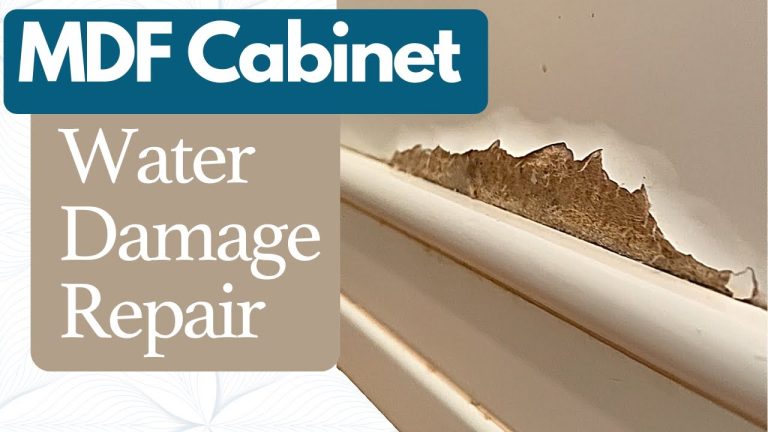
The edge is another story. Raw MDF edges drink finish and raise fuzz, and they need two or three coats of shellac-based primer before topcoating. Skip that step and the edges swell from humidity, print through the paint, and chip more easily in use.
Emissions, finish choice, and room fit
Finish work does more than make MDF look good. Primer and paint slow moisture pickup and help trap residual emissions. In bedrooms, nurseries, and built-ins with low air movement, low-emission MDF with a full film finish makes more sense than raw or lightly sealed board.
EN 622-5 classifies MDF for dry conditions, humid conditions, and load-bearing uses. For a homeowner, the practical takeaway is simple: match the board class to the room, then seal every exposed edge before installation.
📊 MDF costs about 40-50% less than plywood in the cited guide. Source: What Is MDF? Properties, Uses, and When to Choose It.
Which type of MDF should you choose?
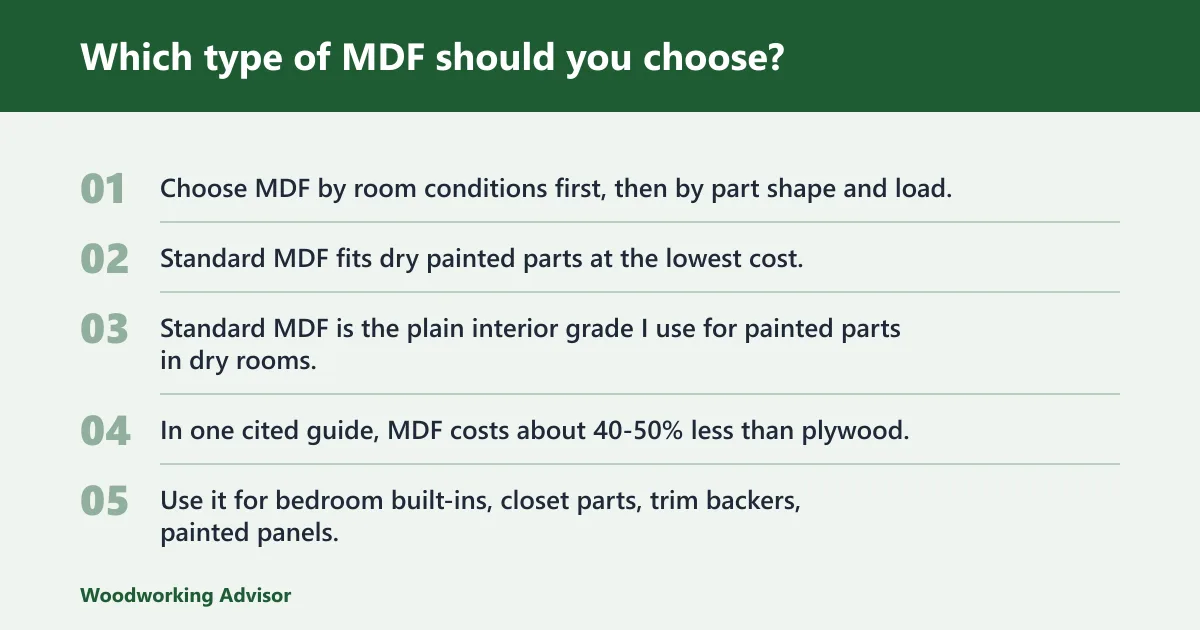
Choose MDF by room conditions first, then by part shape and load. Standard MDF fits dry painted parts at the lowest cost, moisture-resistant MDF suits humid interiors, fire-retardant MDF belongs in code-sensitive work, ultralight helps with handling, and bendy MDF is for curves rather than straight, load-bearing panels.
Standard MDF for dry interior work
Standard MDF is the plain interior grade I use for painted parts in dry rooms, and it is the lowest-cost common variant. In one cited guide, MDF costs about 40-50% less than plywood. Use it for bedroom built-ins, closet parts, trim backers, painted panels, and furniture in rooms that stay dry year-round.
A practical rule helps here. Standard MDF is acceptable when the part will stay indoors, off the floor, away from plumbing risk, and protected by primer and paint on all sides. If the room has regular humidity spikes, upgrade.
Moisture-resistant MDF for kitchens, baths, and laundry areas
Moisture-resistant MDF is formulated for humid interior spaces where steam, damp air, and the occasional splash are part of normal use. In some markets it is green, though color varies by maker. It handles ambient moisture better than standard MDF, but it is still not waterproof and should never sit in standing water.
Use it for painted cabinet doors, vanity side panels away from splash zones, laundry-room shelving, and window seats in damp rooms. Do not use it for sink bottoms that may leak for hours, bathroom floors, or any exterior exposure.
Fire-retardant MDF for code-sensitive spaces
Fire-retardant MDF includes fire-resistant additives and is intended for interiors where building requirements call for it. In some markets it is red or blue. That color coding helps in the shop, but labels matter more than color because formulations differ.
This board is more common in commercial fit-outs, corridor paneling, and public interiors than in routine DIY furniture. It still needs the same edge sealing and careful handling as other MDF types.
Ultralight and bendy MDF for special cases
Ultralight MDF is easier to carry, lift, and install overhead. The tradeoff is lower strength and lower screw-holding ability than standard MDF. It fits ceiling panels, decorative facings, and large painted parts with good support behind them.
Bendy MDF is made for curved work. It is useful for rounded cabinet ends, arches, and formed wall details. Bend radius depends on thickness and on whether the sheet is made to bend lengthwise or crosswise, so the sheet orientation matters as much as its thickness.
What are the main properties of MDF board?
The properties that matter most in real projects are paint-ready faces, predictable machining, heavy weight, weak edges, and only fair fastener holding. MDF cuts cleanly and glues well, but it chips at corners, sags on long spans, and loses strength fast when moisture gets past the finish.
Machining and paint-grade performance
MDF machines evenly because there is no grain direction, void, or knot to hit. It routes clean profiles, takes templates well, and leaves a smooth face for painted work. That makes it a strong fit for shaker doors, interior trim details, and flat panel parts.
It also damps vibration well. MDF is acoustically well damped, making it useful for speaker enclosures.
Fasteners, glue, and edge weakness
Glue bonds are usually more reliable than screws in MDF. Screws driven into edges can split or mushroom the material, and repeated removal makes the hole weaker each time. Pilot holes help. Confirmat screws or suitable coarse-thread screws improve results, especially in thicker stock.
For cabinet boxes and shelves, glue blocks, dados, and mechanical support cut stress on fasteners. Relying on a few screws near a raw MDF edge is a common failure path, and I have repaired plenty of those.
Weight, stiffness, and sag risk
MDF is heavy, but weight does not equal stiffness. A shelf can feel solid in hand and still sag when loaded across a long unsupported span. Thicker board helps, but support layout matters more than many buyers expect.
For shelving, use thicker stock, keep spans modest, and add a solid front lipping or intermediate support where loads are real. Books, dishes, and small appliances expose weak shelf planning very quickly.
Impact resistance at corners and edges
MDF dents and chips at corners more easily than many people expect. The face can look fine at purchase while the corner is already crushed from one fork-lift bump or one hard drop on the garage floor.
That damage matters because broken corners drink moisture and print through paint. Protect corners during transport, keep sheets supported, and trim away battered edges before using a full sheet for visible parts.
What is MDF board used for?
MDF is used for interior furniture, cabinets, joinery, wall panels, trim backers, shelving, speaker boxes, and shaped painted parts. It works best where a flat, stable, paint-grade surface matters more than water resistance, screw holding in edges, or low weight during handling and installation.
Where MDF works well
Good uses include painted cabinet doors, side panels in dry rooms, media units, closet systems, radiator covers, wall panel systems, interior moulded details, and furniture parts with routed edges. Thin sheets also work for templates, skins, and back panels.
For shaped parts, MDF is often easier to machine than plywood because there are no face veneers to tear. For flat painted panels, it usually takes less prep on the face than lower-grade plywood.
Is MDF board good for cabinets and furniture?
MDF is good for some cabinet and furniture parts when the room stays dry, the finish fully seals the board, and loads are reasonable. It performs best on painted doors, end panels, and built-ins with support. It is a poor choice for hard-use wet zones, long unsupported shelves, and pieces moved often.
Cabinet doors and drawer fronts are often a strong fit because MDF stays flat and machines clean profiles. Cabinet sides can also work indoors, especially in bedrooms and living spaces. Sink cabinets, toe-kicks on wet floors, and garage storage near damp concrete are riskier choices.
Where another panel is the better call
Plywood is the safer pick when lower weight, better fastener holding, or occasional moisture exposure matters. Solid wood also makes more sense for parts likely to be knocked, refinished, or re-fastened several times over the life of the piece.
MDF should be avoided for sustained moisture exposure because it swells and loses structural integrity. Once swollen, it rarely returns to a crisp, reliable edge.
Can MDF be used outdoors?
No. MDF should stay out of outdoor work and out of wet-exposure jobs. Moisture-resistant MDF tolerates humid indoor air better than standard MDF, but it is still an interior panel and should not be used for exterior trim, shed shelving, porch ceilings, or any part exposed to rain or persistent dampness.
How do sheet size and thickness affect project results?
Sheet size and thickness change stiffness, weight, screw-holding depth, profile depth, and ease of handling. Most buyers focus on price first, but thickness often decides whether a shelf stays flat, a door feels solid, or a routed edge looks sharp rather than thin and fragile.
Common sizes and what they mean in a home shop
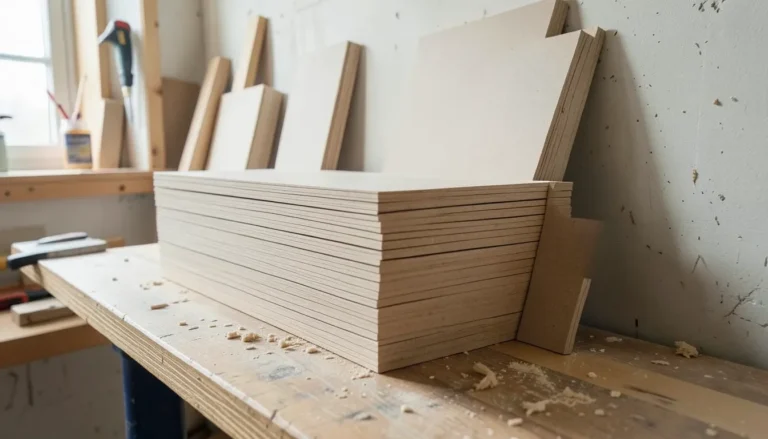
Standard consumer MDF sheets are often 4 feet wide and 8 feet long. In many regions, metric panels are also common. Full sheets are efficient for large cabinet runs and wall panels, but they are heavy enough that cutting them down before final sizing is usually the safer move.
MDF is also sold from about 1/8 inch to 1 inch, with common thicknesses like 1/2 inch, 5/8 inch, 3/4 inch, and 1 inch.
Thin, mid-thickness, and thick MDF by use case
Thin MDF around 1/8 inch to 1/4 inch fits skins, templates, door-panel inserts, cabinet backs in low-stress use, and curved laminations over forms. It is easy to shape but offers little screw-holding depth.
Mid-thickness MDF around 1/2 inch to 3/4 inch handles most cabinet sides, painted doors, drawer parts for light duty, wall panels, and trim backers. This is the working range for many interior projects.
Thicker MDF around 3/4 inch to 1 inch makes sense for heavier routed profiles, speaker enclosures, deep edge shaping, and shelves with careful support. Thickness helps, but do not expect a thick shelf to ignore span and load.
What is the difference between standard MDF and moisture-resistant MDF?
Standard MDF is the lower-cost board for dry indoor work, while moisture-resistant MDF is formulated for humid interiors such as kitchens, baths, and laundry rooms. The upgrade buys more humidity tolerance, not outdoor durability, and it pays off when edges, sink areas, or seasonal moisture swings raise swelling risk.
Simple decision rule for choosing between them
Use standard MDF when the room is dry, the part is painted on all sides, and there is little chance of splash, condensation, or floor moisture. Upgrade to moisture-resistant MDF when the room gets regular steam, humidity spikes, damp mopping nearby, or plumbing-related risk.
That rule matters more than generic claims. A bedroom wardrobe does not need moisture-resistant board. A laundry-room wall cabinet usually does.
Cost, performance, and failure risk
Moisture-resistant MDF usually costs more, but the extra cost is small compared with repainting a swollen vanity side or replacing a shelf with puffed edges. It still needs edge sealing, intact paint film, and careful location choice.
If water sits on either product long enough, both can fail. Moisture-resistant MDF simply gives a wider margin in humid interior service.
What are the main properties that matter in real projects?
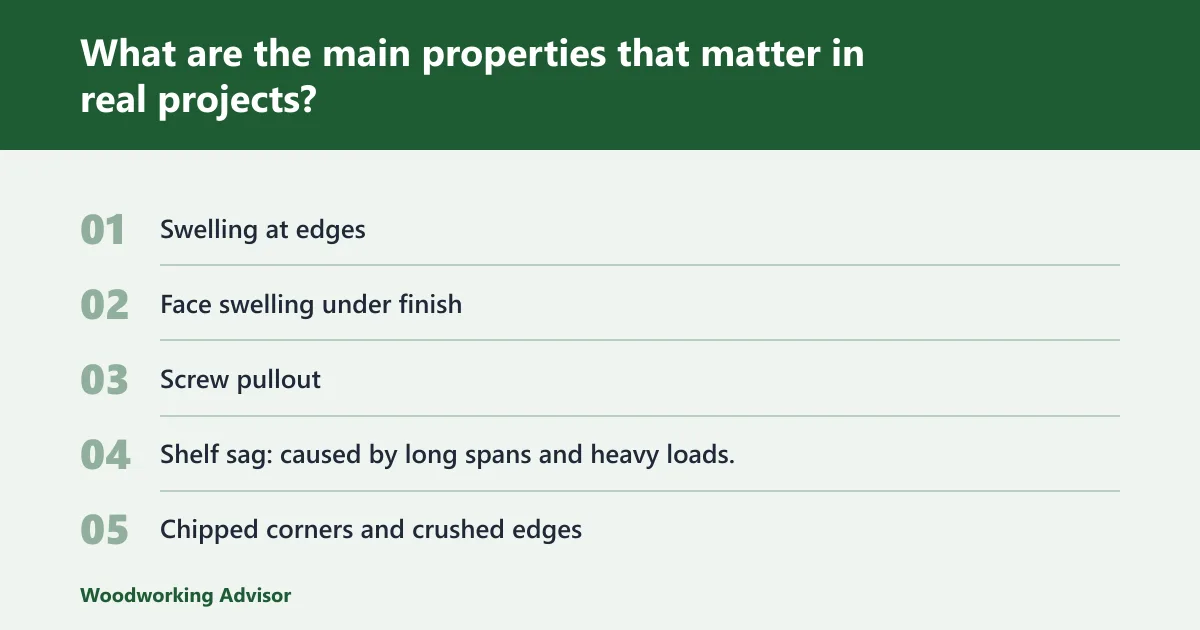
In real projects, the big issues are edge sealing, fastener strategy, shelf support, and handling damage before the piece is even built. Smooth faces are easy. Long-term success usually comes down to preventing moisture entry, avoiding stripped screw holes, and keeping corners intact from delivery through installation.
Shop-floor MDF decision chart
| Project type | Best MDF variant | Thickness range | Protection steps |
|---|---|---|---|
| Painted interior trim backers and wall panels | Standard MDF | 1/4 inch to 1/2 inch | Prime both faces, seal all cut edges, keep off damp floors during install |
| Bedroom or living-room built-ins | Standard MDF | 1/2 inch to 3/4 inch | Use dados or glue blocks, pilot holes for screws, paint every face and edge |
| Kitchen cabinet doors and painted end panels | Moisture-resistant MDF | 5/8 inch to 3/4 inch | Shellac-prime edges, use durable topcoat, keep sink splash areas protected |
| Laundry-room shelving and cabinets | Moisture-resistant MDF | 3/4 inch | Limit shelf spans, seal hidden edges, avoid contact with wet floors |
| Curved reception-style panels or rounded furniture parts | Bendy MDF | Roughly thin-sheet range | Support over a stable frame, skin with finish layer, seal all exposed edges |
| Decorative ceiling panels or large lightweight facings | Ultralight MDF | 1/4 inch to 1/2 inch | Use full backing support, avoid edge-loaded screws, finish both sides |
| Code-sensitive commercial-style paneling | Fire-retardant MDF | 1/2 inch to 3/4 inch | Verify labeling, follow finish schedule, seal edges like standard MDF |
Failure-mode checklist
- Swelling at edges: caused by unsealed edges, wet mopping nearby, sink splash, or storage on damp concrete. Prevent it with shellac-based primer on edges, full paint coverage, and dry storage.
- Face swelling under finish: starts where paint is scratched through or where water sits. Prevent it by repairing finish breaks early and keeping standing water off the piece.
- Screw pullout: common in edges, thin stock, and over-tightened holes. Prevent it with pilot holes, confirmat or suitable coarse-thread screws, glue blocks, and joinery that does not rely on screws alone.
- Shelf sag: caused by long spans and heavy loads. Prevent it with thicker stock, shorter spans, front edging, center support, or a different panel choice.
- Chipped corners and crushed edges: often happen before assembly. Prevent them with flat support during transport, careful lifting, and cutting away damaged margins.
- Machining blowout and fuzz: caused by dull tools or aggressive passes. Prevent it with sharp blades and bits, scoring cuts when needed, and light cleanup sanding before primer.
In-store inspection checklist before buying a sheet
- Check flatness across the full sheet, not just the top panel in the stack.
- Inspect edges for swelling, softness, or rough crushed spots.
- Look for corner damage and face scratches that will print through paint.
- Compare thickness consistency on exposed edges in the stack.
- Read labeling for board type, emission class, and intended condition class.
- Avoid sheets stored where they show water marks, dirt tide lines, or damp smell.
How should MDF edges be sealed before painting?
MDF edges should be sanded smooth, cleaned of dust, filled where fuzzy or pitted, then primed with two or three coats of shellac-based primer before topcoating. Edges need more build than faces because they are far more porous and will otherwise swell, fuzz, and print through paint.
Primer and sealer choices
Shellac-based primer is commonly recommended because it dries fast, builds quickly on thirsty edges, and sands to a hard surface. It is my default for painted furniture, cabinets, and trim work.
Other sealers can work, but the key is film build and edge coverage. Thin first coats that soak in and disappear do little by themselves.
Step-by-step edge sealing
- Lightly sand the cut edge to remove saw fuzz without rounding it over too much.
- Fill torn or pitted areas if needed, then sand flush.
- Apply the first coat of shellac-based primer to the edge only and let it dry fully.
- Sand lightly to knock down raised fibers.
- Apply a second coat. If the edge still looks dull or patchy, apply a third.
- Prime the face and back, then inspect under raking light before topcoat.
- Topcoat with a durable paint film, especially in kitchens and baths.
How do you protect MDF from moisture?
Protect MDF from moisture by choosing the right grade, sealing every face and edge, keeping the paint film intact, and avoiding locations where water can sit or wick into the board. Moisture-resistant MDF gives extra margin in humid rooms, but no MDF grade should be treated as waterproof.
Protection starts before cutting. Store sheets flat, dry, and off concrete. Prime hidden faces on cabinet parts when possible. Keep sink bases, dishwasher end panels, and floor-near trim out of the splash zone or use another panel.
How do you store, handle, clean, and maintain MDF?
Store MDF flat, dry, and fully supported, handle it without dragging edges, and clean finished surfaces with a lightly damp cloth rather than soaking cleaners. Most long-term failures start before installation through damp storage, corner crush, or finish damage that later lets moisture into the board.
Storage, acclimation, and handling
Keep sheets flat on level support. Standing a full sheet on edge for long periods can bow it, and resting it on a few narrow points can bruise edges. Keep it off concrete with spacers or a pallet.
Let the material acclimate indoors before cutting and finishing if it came from a cold truck or damp warehouse. Even interior-grade sheet goods behave better when temperature and humidity stabilize before layout and paint.
Cleaning and routine care
Clean painted MDF furniture and built-ins with a soft cloth that is only lightly damp. Avoid flooding joints, soaking shelf edges, or using aggressive abrasives that cut through the finish film.
Check sink-area panels, laundry cabinets, and shelf front edges once in a while. Small chips or finish breaks are easier to repair before they turn into swollen edges.
Touch-up and repair
Minor dents and chips can be filled, sanded, spot-primed, and repainted. Soft swollen fibers should be cut back to sound material before repair. If a panel has swelled through its full thickness or screw holes have turned to powder, replacement is usually the cleaner fix.
What safety steps matter when cutting and machining MDF?
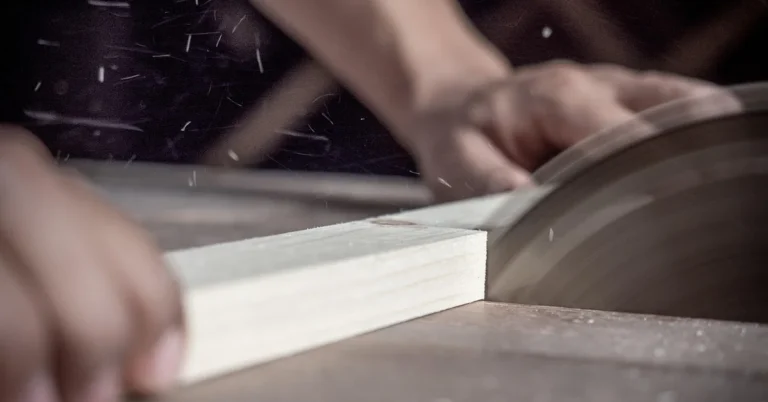
Fine MDF dust needs respiratory and eye protection plus dust collection at the tool. Cutting and routing release a very fine powder that hangs in the air, irritates eyes and skin, and spreads through the shop unless extraction, cleanup, and sensible tool choices are part of the process.
Dust protection and collection
Use respiratory protection rated for fine dust, along with eye protection. A dust mask alone is a weak answer for heavy cutting sessions. Capture dust at the saw, router, and sander whenever possible.
Because MDF dust is so fine, cleanup matters after the cut too. Vacuum the machine, bench, and surrounding area rather than sweeping clouds back into the air.
Blade and bit choices
Sharp blades and bits leave cleaner cuts and less fuzzy edge damage. Dull tooling overheats the panel, tears fibers, and creates more cleanup before primer. For visible edges, a fresh carbide blade or bit is worth it.
Support the sheet fully during cutting. Heavy panels shift if unsupported, and that movement causes chipped corners and rough exits long before finishing begins.
Selecting the right blade for clean MDF cuts
Choosing the correct saw blade prevents chipping and reduces waste when cutting MDF. For straight cuts, use a carbide blade with 60 to 80 teeth; an alternate-top-bevel grind works well for circular saws, while table saws benefit from higher tooth counts or fine finish grinds. If cutting laminate-faced MDF, a triple-chip grind or high-tooth-count blade protects the surface. Curves require fine-tooth jigsaw blades or narrow-kerf options to maintain edge integrity. This guide breaks down specific blade recommendations for different saw types and cut styles. MDF cutting blade guide
Frequently asked questions
What are the main properties of MDF board?
MDF has smooth faces, a uniform interior, no grain direction, and porous edges. It machines cleanly and paints well, but it is heavy, weaker at corners than many expect, and vulnerable to swelling if moisture gets through the finish. Screw holding is fair on faces and weaker in edges.
What is MDF board used for?
MDF is used for indoor cabinets, furniture parts, wall panels, trim backers, shelving, speaker boxes, and curved or routed painted components. It suits paint-grade work where a flat, knot-free surface matters. It is a weaker choice where low weight, outdoor exposure, or repeated fastener removal is expected.
Is MDF board good for cabinets and furniture?
MDF is good for many painted cabinet and furniture parts if the room stays dry, the edges are sealed, and loads are sensible. It does well on doors, end panels, and built-ins. It does less well on sink bases, long unsupported shelves, and pieces that get dragged or moved often.
How do you protect MDF from moisture?
Use the right grade for the room, keep the board off wet floors, seal every edge and face, and maintain the paint film so water cannot reach raw fibers. Moisture-resistant MDF helps in humid interiors, but no MDF should be left with standing water or used outdoors.
Can MDF be used outdoors?
No. MDF is an interior panel, including moisture-resistant grades. Outdoor humidity, rain, dew, and repeated wet-dry cycles cause swelling and loss of strength. If a project may see exterior conditions or regular wetting, choose a panel made for exterior service instead of trying to protect MDF afterward.
How should MDF edges be sealed before painting?
Sand the edge smooth, fill torn spots if needed, then apply two or three coats of shellac-based primer, sanding lightly between coats. Edges need more primer than faces because they are much more porous. After the edge builds and looks even, topcoat it with the same paint system used on the faces.
Sponsored / affiliate links. As an Amazon Associate I earn from qualifying purchases. I may earn additional commission from eligible campaigns.