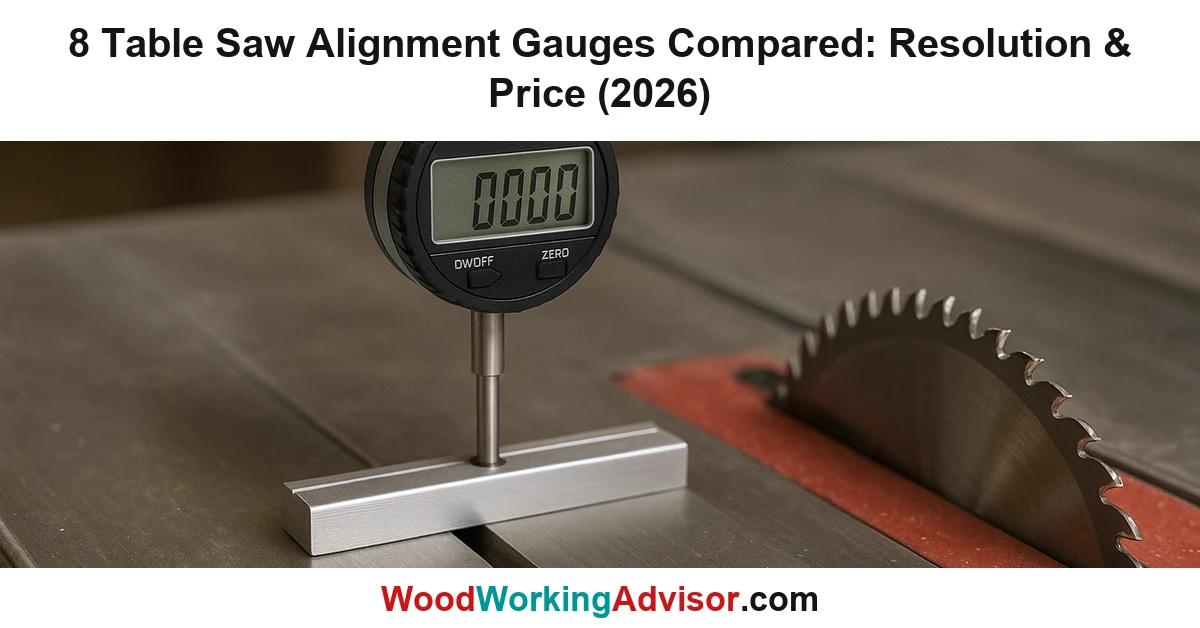
8 Table Saw Alignment Gauges Compared: Resolution & Price (2026)
The Rockler Table Saw Alignment Gauge ($71.99) is the best all-around pick for checking blade-to-fence parallelism, but the real finding in this comparison is sharper than any single pick: three digital gauges costing $35–$40 measure to 0.0005" resolution — twice as fine as the $72–$125 dial gauges compared here. In table saw alignment gauges, precision doesn’t scale with price. (See our full table saw coverage for setup, fence and blade guides beyond just alignment gauges.)
8 Table Saw Alignment Gauges Compared
Every gauge below was checked live via the Amazon Creators API on August 2, 2026, and cross-referenced against manufacturer specs where the listing itself didn’t settle a dial-vs-digital or resolution question. Prices and buy-box availability move on Amazon — treat the numbers below as a snapshot from that date, not a permanent price.
| Pick & Product | Price | Readout Type | Resolution | Base / Mount | Verdict |
|---|---|---|---|---|---|
| #1 Best Overall Rockler Table Saw Alignment Gauge | $71.99 | Dial | 0.001" | Miter bar (non-magnetic) | Best all-around kit |
| Best for Auto-Adjust to Any Miter Slot Woodpeckers SG-WP Saw Gauge and Alignment Tool | $124.99 | Dial | 0.001" | Auto-adjust pin + miter bar (non-magnetic) | Best for multi-saw shops |
| Best Dial Indicator for Decimal + Fraction Readout iGaging EZ-Align 34-0928 Table Saw Gauge | $54.99 | Dial | 0.001" | Miter bar, magnet-assisted seating (non-magnetic) | Best fraction readout |
| Best Digital Gauge for Fine-Tuning Neoteck 0-1" Digital Dial Indicator Table Saw Gauge | $39.99 | Digital | 0.0005" | Miter bar (non-magnetic) | Best digital fine-tuning |
| Best for Large & Cabinet Table Saws BOBOVAV Table Saw Alignment Gauge (18cm Rod) | $34.99 | Digital | 0.0005" | Miter bar, 18cm rod (non-magnetic) | Best for large/cabinet saws |
| Best Budget Digital Gauge HDLNKAK Table Saw Digital Dial Indicator Gauge | $35.99 | Digital | 0.0005" | Miter bar (non-magnetic) | Best budget digital |
| Best for Blade & Bit Height Setup (No Batteries) FivePears 15-Pc Gauge Setup Block Set | $35.99 | None (fixed blocks) | N/A — fixed blocks | N/A | Best for height/depth setup |
| Best for Blade Tilt & Bevel Angle (Magnetic Base) Wixey Digital Angle Gauge | $31.99 | Digital | 0.1° (angular) | Magnetic base | Best for bevel/tilt angle |
The pattern that jumps out: the three analog dial gauges (Rockler, Woodpeckers, iGaging) all top out at 0.001" resolution and range from $54.99 to $124.99. The three digital gauges (Neoteck, BOBOVAV, HDLNKAK) all measure to 0.0005" — twice as fine — and cost $34.99 to $39.99. Resolution and price move in opposite directions in this category, which is the opposite of what most buyers assume walking in.
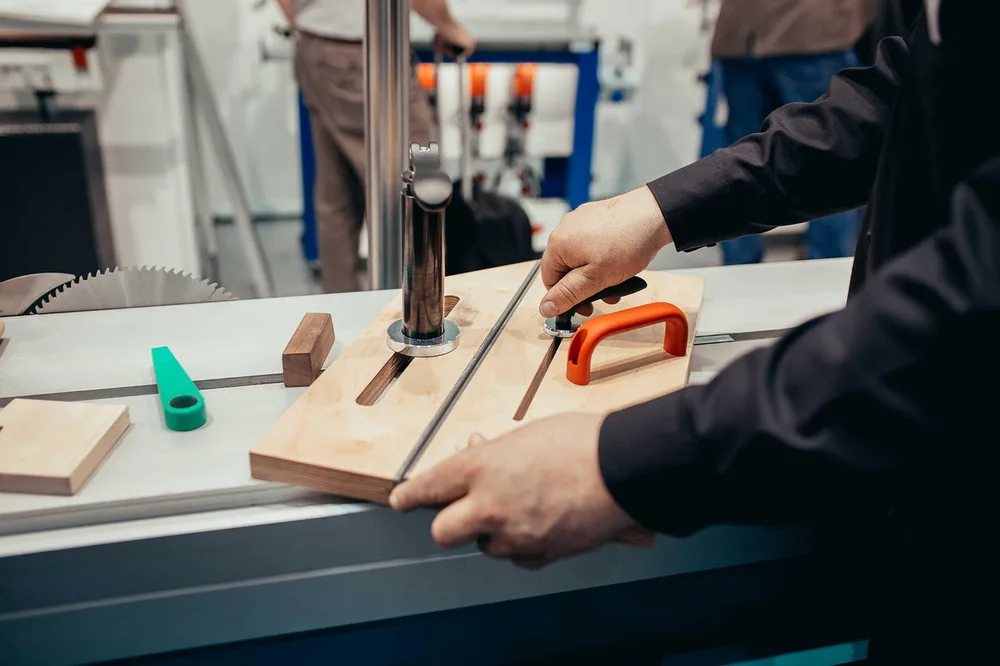
Best Table Saw Alignment Gauges
Each pick below covers a distinct real-world need — not a generic ranking. Specs are pulled from the live Amazon listing and, for the two picks where the listing alone didn’t settle a dial-vs-digital question, cross-checked against the manufacturer’s own product page.
1. Rockler Table Saw Alignment Gauge — #1 Best Overall
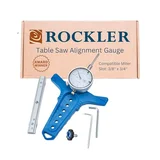
Price: $71.99 · Check price on Amazon →
- Readout: analog dial indicator, 0.001" accuracy, 1" plunger travel
- Mount: 6" aluminum miter bar with expandable glide blocks (non-magnetic)
- Fits standard 3/8" x 3/4" miter slots, 3-3/4" to 7-3/4" from blade
- Kit includes: gauge body, miter bar with knob, hex key, tension screwdriver
- Weight: 1.15 lbs
Who it’s for: Woodworkers who want a known brand, a complete kit out of the box, and don’t mind reading an analog dial face.
Rockler’s own product page (item #66646) confirms the 0.001" accuracy and 1" plunger travel independently of the Amazon listing, and lists the miter bar length at 6" with a working range of 3-3/4" to 7-3/4" from the blade — enough for the vast majority of contractor and hybrid saws, though cabinet saws with a wider table may push past that range. The expandable glide blocks are the detail that separates this from cheaper miter-bar gauges: they take up slop in a miter slot that’s been widened slightly by years of use, which a rigid bar can’t do.
Pros
- Complete kit — miter bar, knob, hex key and tension screwdriver all included
- Rockler brand backing and easy warranty support if the dial sticks
- Expandable glide blocks give a snug but smooth-sliding fit in the slot
- Prevents blade binding, which cuts down on burning and scoring once tuned
Cons
- Analog dial only — no digital display, so you’re counting needle revolutions past 0.025"
- 0.001" resolution is exactly twice as coarse as the $35-40 digital picks below
- Priced above three digital competitors that measure finer for less money
Main drawback: At $71.99 for 0.001" resolution, it’s out-measured by gauges costing half as much — you’re paying for the Rockler name and the bundled kit, not for finer precision.
2. Woodpeckers SG-WP Saw Gauge and Alignment Tool — Best for Auto-Adjust to Any Miter Slot
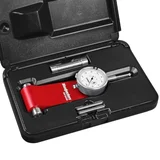
Price: $124.99 · Check price on Amazon →
- Readout: analog dial indicator, 1" travel, 0.001" graduations, rotation counter
- Mount: auto-adjusting pin system fits any miter slot width (non-magnetic)
- Fitted hard storage case included
- Body made in USA (dial indicator itself is imported)
Who it’s for: Shops running multiple table saws with different miter slot widths who want zero fitting hassle switching between them.
The pin-based auto-adjust is the genuine differentiator here: instead of turning a knob to snug up glide blocks, you set the cradle pin onto two small pins pressed into the slot and the gauge centers itself. That matters more in a shared shop or a shop running several different saw brands than it does for a single-saw hobbyist, which is exactly why this is priced and positioned as the professional option rather than the default recommendation.
Pros
- Pin-based cradle auto-adjusts to slot width — no glide-block fiddling on odd-size slots
- Dial has a full rotation counter, useful for tracking multiple full turns of deviation
- Rugged fitted case for shop storage and transport
- USA-made gauge body with a reputation for tight machining tolerances
Cons
- The most expensive pick here by a wide margin — nearly 4x the cheapest digital option
- Still capped at 0.001" resolution despite the premium price
- Overkill for a woodworker who owns one saw with a standard slot
Main drawback: The extra money buys auto-adjust convenience across saws, not finer measurement — a $40 digital gauge still out-resolves it on any single saw.
3. iGaging EZ-Align 34-0928 Table Saw Gauge — Best Dial Indicator for Decimal + Fraction Readout
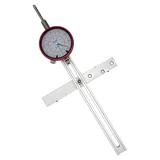
Price: $54.99 · Check price on Amazon →
- Readout: analog dial, dual scale — decimals to 0.001" and fractions to 1/64"
- Accuracy: ±0.001" per inch, repeatability 0.001"
- Mount: 9" x 3/4" slider bar with rare-earth magnets that help seat it in the miter slot (not a magnetic base for external mounting)
- Measuring range: 3-1/2" to 11" from the miter slot
- Hardened, anodized aluminum construction
Who it’s for: Woodworkers who think in fractions rather than decimals and want both scales available without doing mental math.
This is a different SKU from the older "iGaging 35-0928" listing that some retailers still reference — that’s a separate, newer digital product from the same brand. The 34-0928 EZ-Align tested here via its manufacturer spec sheet is the analog dial version, and its extended 3-1/2" to 11" measuring range from the miter slot is genuinely the longest reach of any pick in this comparison, useful on saws where the blade sits unusually far from the slot.
Pros
- Only dial pick here with both decimal and fraction scales on the same face
- Longest reach from the miter slot (up to 11") of any pick in this lineup
- Anodized aluminum resists rust and shop grime
- Embedded rare-earth magnets help the bar seat and stay put in the slot
Cons
- Still an analog dial — no digital version at this SKU
- The internal seating magnets are easy to confuse with a true magnetic base; this tool still requires the miter slot to mount
- Same 0.001" resolution ceiling as Rockler and Woodpeckers, at a mid-tier price
Main drawback: It reads in fractions, which is genuinely useful, but that convenience doesn’t change the fact that it’s half the resolution of the digital picks below for a similar price.
4. Neoteck 0-1" Digital Dial Indicator Table Saw Gauge — Best Digital Gauge for Fine-Tuning
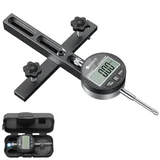
Price: $39.99 · Check price on Amazon →
- Readout: digital LCD, 0-1" (0-25.4mm) range
- Resolution: 0.0005" / 0.01mm, switchable inch/mm, zero-set function
- Mount: 2x 3/4" CNC-anodized aluminum bars, self-adjusting spring-plunger "Smart Bar" (non-magnetic)
- 6-hole rod for repositioning the indicator
- Includes hard storage case
Who it’s for: Anyone chasing the tightest achievable blade-to-miter-slot parallelism on a standard-size saw without paying premium-dial prices.
The listing’s description of the "Smart Bar" self-adjusting spring plungers is worth taking at face value here: a miter slot that’s been widened unevenly by years of sled and jig use is a real, common problem, and a bar that only needs its spring plungers set once (rather than re-snugged every use) genuinely saves setup time over a plain rigid bar like the Rockler’s. At $39.99, it undercuts every dial gauge in this comparison while beating all three on resolution.
Pros
- Twice the resolution of every dial pick above (0.0005" vs 0.001") for roughly half the price of the Rockler
- Self-adjusting spring plungers keep the bar snug even in miter slots that vary slightly along their length
- Digital zero-set and inch/mm switching removes reading-error guesswork
- Storage case included
Cons
- Battery-powered LCD — a dead coin cell mid-project is a real (if minor) risk a mechanical dial never has
- No magnetic base
- Shorter bar reach than the BOBOVAV pick below
Main drawback: It’s an electronic instrument, so battery life and LCD reliability are the trade-off for the finer resolution — keep a spare coin cell in the drawer.
5. BOBOVAV Table Saw Alignment Gauge (18cm Rod) — Best for Large & Cabinet Table Saws
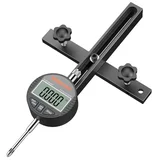
Price: $34.99 · Check price on Amazon →
- Readout: digital LCD, resolution 0.0005" / 0.01mm, inch/mm switch, zero-set
- Mount: CNC-machined anodized aluminum bars (0.02mm processing accuracy), non-magnetic
- Rod length: 18cm, versus the ~13cm rod standard on most competitors
- Fits standard 3/4" slots plus wider non-standard slots via plunger-screw adjustment
Who it’s for: Owners of cabinet saws or wide-table hybrids where a standard 13cm rod doesn’t comfortably reach across the table.
The 18cm rod versus the ~13cm rod on most competitors sounds like a minor spec until you’re actually trying to reach a blade set well inboard on a cabinet saw’s wider table — a short rod simply can’t bridge that distance, forcing awkward indicator placement that reduces reading accuracy regardless of the gauge’s rated resolution. This is the pick to reach for specifically because of that extra reach, not despite its newer-brand status.
Pros
- Longest rod of any pick here — real reach advantage on cabinet saws and wide hybrid tables
- Matches the Neoteck’s 0.0005" resolution at a slightly lower price
- Wide slot compatibility beyond the standard 3/4" size
- Cheapest way into the finer 0.0005" resolution tier in this comparison
Cons
- Newer, less-established brand than Neoteck or iGaging
- No magnetic base, same battery dependency as every other digital pick here
- Thinner track record than the more recognized brands in this list
Main drawback: The spec sheet matches or beats pricier rivals, but BOBOVAV has less of a track record on this site’s radar than Neoteck or iGaging.
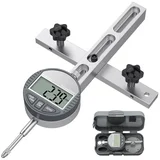
6. HDLNKAK Table Saw Digital Dial Indicator Gauge — Best Budget Digital Gauge
Price: $35.99 · Check price on Amazon →
- Readout: digital LCD, 0-25.4mm (0-1") range
- Resolution: 0.01mm / 0.0005", switchable mm/inch, zero-set function
- Mount: 2x 3.2" adjustable anodized aluminum rods, 3 chute partitions (non-magnetic)
- Marketed for table saws, band saws and drill presses
Who it’s for: Budget-conscious buyers who still want real digital precision instead of settling for a $70-125 dial gauge.
At $35.99, this is within a dollar of the FivePears block set and Wixey angle gauge — the cheapest tier in this entire comparison — while still delivering the same 0.0005" resolution as the pricier Neoteck and BOBOVAV picks. The trade-off is real: shorter 3.2" bars and a less recognizable brand name than Neoteck, but the core measurement spec doesn’t suffer for it.
Pros
- Cheapest route to 0.0005" digital resolution in this entire lineup
- Same core resolution spec as pricier digital rivals
- Works across multiple shop machines, not just table saws
Cons
- Shortest bars of the three digital picks (3.2" vs Neoteck/BOBOVAV’s longer rods)
- Generic-brand support with no dedicated customer service reputation
- No magnetic base
Main drawback: The shorter rod length means less reach on wider saws than the BOBOVAV pick — fine for a standard contractor saw, tighter on a large cabinet saw.
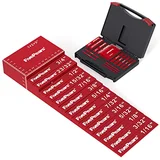
7. FivePears 15-Pc Gauge Setup Block Set — Best for Blade & Bit Height Setup (No Batteries)
Price: $35.99 · Check price on Amazon →
- 15 aluminum setup blocks, sizes 1/16" through 1x2x3", combinable for up to 100 measurements
- No dial or digital readout — fixed reference blocks only
- Laser-engraved size markings that won’t fade
- Red anodized aluminum construction
Who it’s for: Someone who already owns a real parallelism gauge (a pick above) and wants a companion tool for blade and bit height setup.
This one is included deliberately, not as filler: it shows up in Amazon’s own search results alongside genuine alignment gauges, and a buyer scanning listings by title alone could easily assume it does the same job as picks #1–6. It doesn’t — the 15 blocks (1/16" through 1x2x3", combinable for up to 100 measurement values) are for setting a fixed height or depth against a reference, not for reading continuous parallelism deviation. It’s genuinely useful for router bit height and dado depth, which is a real and common shop task, just not this one.
Pros
- Nothing to calibrate, drop out of calibration, or run out of battery
- Useful well beyond table saws — router bit height, dado depth, bandsaw fence setup
- Laser-engraved markings stay legible for years
- One set covers most shop height-setting tasks without buying separate gauges
Cons
- This does NOT measure blade-to-miter-slot parallelism — the actual alignment job most people searching this term want
- No continuous or variable readout, only fixed increments
- A genuinely different tool from the other seven picks in this comparison
Main drawback: It doesn’t do the core parallelism-alignment job the other seven picks do — buy this in addition to, not instead of, a dial or digital gauge.
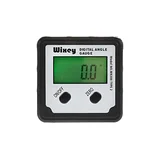
8. Wixey Digital Angle Gauge — Best for Blade Tilt & Bevel Angle (Magnetic Base)
Price: $31.99 · Check price on Amazon →
- Readout: digital LCD, 0.1° resolution, ±0.2° accuracy
- Mount: strong built-in magnetic base — no miter-slot bar required
- Backlit display, auto shut-off, zero-calibration function
- Measures angle in degrees, not linear inch/mm parallelism
Who it’s for: Anyone whose table saw’s bevel/tilt stops have drifted and needs to re-zero 90° and 45°, separate from blade-to-fence parallelism.
It’s included here because several of the competing roundups researched for this comparison bundle angle gauges and parallelism gauges together under the same "alignment gauge" search intent, and a buyer searching that term genuinely might need either one. The magnetic base is the real differentiator: it’s the only tool in this lineup that doesn’t need a miter slot at all, which makes it just as useful on a miter saw as a table saw.
Pros
- Only true magnetic-base tool in this comparison — sticks directly to blade, fence or table
- Solves a different but related problem: re-zeroing the 90°/45° bevel stops
- Cheapest pick in the entire lineup
- Backlit LCD reads clearly in a dim shop
Cons
- Measures angle in degrees, not linear parallelism — it cannot replace picks #1-6 for blade-to-fence alignment
- Battery-powered like the other digital picks
- 0.1° resolution, not a precision linear measurement
Main drawback: It solves the tilt-angle problem, not the parallelism problem — most buyers need this alongside, not instead of, a dial or digital parallelism gauge.
How We Picked These
No product on this page was physically obtained or hands-on tested for this update — this is a spec-and-price comparison, not a testing lab report, and we’re stating that plainly rather than implying otherwise.
- Live pricing and availability for all 8 picks pulled from the Amazon Creators API on August 2, 2026 — every price shown is a real buy-box price from that date, not a remembered or estimated one.
- Resolution and readout type (dial vs. digital, 0.001" vs. 0.0005") taken from the manufacturer listing’s own feature bullets, and independently cross-checked against Rockler’s own product page and iGaging’s spec sheet via a specialist retailer (taytools.com) for the two picks where the Amazon listing’s wording was ambiguous.
- No star ratings or review counts are shown for any pick. Amazon’s API returned no customer-review data for these ASINs at the time of research, and rather than copy a number from a competitor page or invent one, we’re leaving that field blank.
- Three ASINs previously featured on this page (a CDIYTOOL fence jig, a DFM Tool Works height gauge, and an XDOVET dial indicator) returned no live buy-box price during this update and were dropped in favor of eight alternatives that all verified live.
If you’ve used any of these gauges in your own shop and your experience contradicts something above, the comment section is the right place — this page gets rechecked on a refresh cycle, not left static. Prices in particular move: Amazon buy-box prices on tools like these can shift 10–20% within a few weeks of a bulk refresh, so treat the August 2, 2026 snapshot above as directionally accurate rather than locked in, and check the live price link before ordering.
What to Consider When Buying a Table Saw Alignment Gauge
Resolution: Dial vs. Digital
The single biggest number on this page is resolution, not price. A 0.001" dial gauge and a 0.0005" digital gauge aren’t cosmetically different — the digital reading is genuinely twice as fine. For most hobby shops, 0.001" is plenty accurate to eliminate burning and kickback. Furniture makers and anyone chasing glue-line rip cuts will notice the difference a 0.0005" digital gauge makes. It’s worth being specific about what "resolution" means here: it’s the smallest increment the indicator can display, not a guarantee that your saw itself holds that tolerance once you start cutting. A gauge that reads to 0.0005" will show you exactly how far off you are; getting the saw to actually hold that setting under vibration and repeated use is a separate mechanical question the gauge can’t answer for you.
Miter Slot Compatibility and Bar Length
Six of the eight gauges here mount via a bar that rides in your saw’s miter slot, and all six are built for the standard 3/8" x 3/4" slot. If your saw (or a European-style saw with a T-slot) uses a nonstandard slot, check the adjustment range before buying — the BOBOVAV and Neoteck both note adjustability beyond the standard width via their plunger screws.
Magnetic Base vs. Miter-Bar Mount
Only the Wixey digital angle gauge in this comparison has a true magnetic base, and it measures bevel angle, not parallelism. Every parallelism gauge here mounts via the miter slot instead, which is the more precise method for that specific measurement — a magnetic base on a flat cast-iron table can shift slightly under hand pressure in a way a slot-mounted bar can’t.
Parallelism Gauges vs. Blade-Tilt (Bevel) Gauges
These are two different tools solving two different problems. A parallelism gauge (picks #1–6) confirms your blade is parallel to the miter slot and fence. A digital angle gauge (pick #8) confirms your blade’s 90° and 45° bevel stops are accurate. A saw that cuts clean rips can still have a sloppy bevel stop, and vice versa — most shops eventually own both. Neither of these is the same tool as a miter gauge, which controls crosscut angle at the blade rather than measuring anything — it’s easy to conflate the three in a search results page.
Battery Life and Digital Reliability
Every digital gauge in this lineup runs on a coin-cell battery. That’s a real trade-off for the finer resolution: a dial gauge never goes dead mid-project. If you keep a spare CR2032 in the shop, this is a non-issue; if you don’t, factor it in.
Storage Case and Portability
Woodpeckers and Neoteck both ship in a fitted case, which matters more than it sounds like — a bare dial indicator left loose in a drawer is exactly the kind of precision tool that gets knocked out of calibration by other tools bouncing against it. If you’re building out a full alignment kit, it’s worth storing it alongside your other table saw jigs rather than a general tool drawer.
What’s Included in the Kit
Check whether the miter bar, hex key and any mounting hardware ship with the gauge or need to be sourced separately. All eight picks here include everything needed to mount and use the gauge out of the box, but that’s not universal in this category — some competing listings sell the indicator alone.
Price vs. Precision
The dataset above makes this concrete: the three priciest picks here ($54.99–$124.99) are all analog dial gauges reading to 0.001". The three cheapest full parallelism gauges ($34.99–$39.99) are all digital and read to 0.0005". If resolution is your priority, the budget picks are objectively the better spec — the extra money in the dial gauges buys brand reputation, kit completeness, or slot auto-adjust, not finer measurement. That’s a genuinely counterintuitive result for a tool category, where the instinct is usually to assume the $125 option outperforms the $35 one on the one number that actually matters. In this specific category, it doesn’t — and that’s worth knowing before you spend the extra $90 assuming it buys you tighter tolerances.
Multi-Tool Compatibility
Several listings (Neoteck, HDLNKAK) explicitly note their bar fits standard miter slots shared by band saws, router tables and drill presses, which stretches the value of a single gauge across more than one machine in a home shop.
How to Use a Table Saw Alignment Gauge
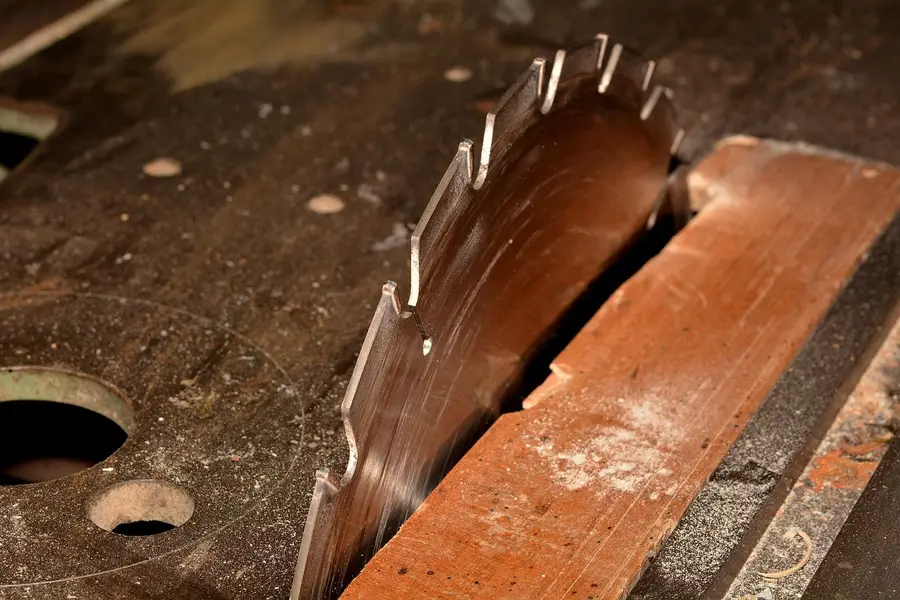
- Unplug the saw and raise the blade to its full height.
- Fit the gauge’s bar into the miter slot (or, for a magnetic angle gauge like the Wixey, set the base on the blade).
- Position the indicator tip against a single tooth near the front of the blade and zero the dial or digital display.
- Rotate the blade by hand until that same tooth is at the back of the table, keeping the indicator tip against it.
- Read the deviation shown — this is how far out of parallel the blade is to the miter slot.
- Loosen the trunnion bolts (the bolts that hold the motor/arbor assembly under the table) and adjust by roughly half the deviation shown.
- Re-zero and repeat the front-to-back check until the reading is at or near 0.
- Repeat the same front-to-back check against the rip fence to confirm the fence is equally parallel to the blade.
If the fence step above is unfamiliar, our dedicated walkthrough on how to square a table saw fence to the blade covers that adjustment in more detail. And if you’re getting a deviation reading that seems too large to be a simple trunnion adjustment, check whether the real cause is a dull or warped blade before you start loosening bolts.
Frequently Asked Questions
What is a table saw alignment gauge used for?
A table saw alignment gauge measures how parallel your blade is to the miter slot and rip fence. You mount the gauge’s bar in the miter slot, zero the dial or digital indicator against a tooth, then rotate the blade to read the same tooth at the front and back of the table. Any difference between the two readings is your parallelism error, which you correct by adjusting the trunnion bolts or fence.
Dial or digital: which is more accurate for table saw alignment?
Neither type is inherently more accurate at the mechanism level, but the resolution differs directly. The three dial gauges in this comparison (Rockler, Woodpeckers, iGaging) read to 0.001", while the three digital gauges (Neoteck, BOBOVAV, HDLNKAK) read to 0.0005" — twice as fine — for less than half the price of the priciest dial option. A digital gauge also removes the need to count needle revolutions, a common source of dial-reading mistakes.
How often should I check my table saw’s alignment?
Check alignment after any fence, trunnion or blade change, after moving the saw, or if you notice burning, binding or kickback on cuts that used to come out clean. Many woodworkers also do a quick check every few months of regular use, since vibration alone can walk trunnion bolts loose over time. Pairing a regular alignment check with the rest of your table saw safety routine is a reasonable habit to build.
Can I use a table saw alignment gauge on other tools like a band saw or drill press?
Most of the gauges in this comparison mount on a standard 3/8" x 3/4" miter-slot bar, which fits many band saws, router tables and drill press tables that share the same slot size — the Neoteck and HDLNKAK listings both mention this directly. The Wixey digital angle gauge, since it’s magnetic rather than slot-mounted, works on any ferrous metal surface, including a miter saw.
What’s the difference between an alignment gauge and a digital angle gauge?
A parallelism alignment gauge (picks #1–6 here) measures whether the blade is parallel to the miter slot and fence, in thousandths of an inch. A digital angle gauge like the Wixey measures the blade’s tilt angle in degrees, confirming your 90° and 45° bevel stops are accurate. They check two different things, and most shops eventually want both.
Do I need a magnetic base on a table saw alignment gauge?
No — in fact, only one of the eight gauges compared here (the Wixey) has a true magnetic base, and it’s an angle gauge, not a parallelism gauge. The other seven mount via a bar that rides in the miter slot, which is the standard, more precise method for checking blade-to-slot parallelism.
How much blade-to-fence deviation is actually dangerous?
Most saw manufacturers and woodworking references treat roughly 0.005" of deviation over the length of the blade as enough to cause burning, and a fence angled toward the blade (rather than away from it) raises real kickback risk before that. Given the 0.001"–0.0005" resolution of the gauges compared here, all eight can detect deviation well below that danger threshold — the differences between them are about convenience and reach, not whether they can catch a genuine problem.
Is a $35 digital gauge really as good as a $125 dial gauge?
For the specific job of measuring blade-to-slot parallelism, the digital gauges in this comparison (Neoteck, BOBOVAV, HDLNKAK) read to a finer resolution than the pricier dial gauges (Rockler, Woodpeckers, iGaging) — that part is a direct spec comparison, not an opinion. What the extra money in the dial gauges buys instead is brand support, a bundled storage case, or (for the Woodpeckers) auto-adjust across different miter slot widths. Whether that’s worth $80–$90 more depends on whether you value those extras, not on which one measures more accurately.
Final Thoughts
For most shops, the Rockler Table Saw Alignment Gauge ($71.99) remains the safest all-around buy — a complete kit from a brand with real customer support behind it. But the number worth remembering from this comparison isn’t a product name, it’s a spec: three digital gauges here measure to 0.0005", twice the resolution of the analog dial gauges costing up to $125. If precision per dollar is what you’re optimizing for, the $35–$40 digital picks are the better spec on paper, full stop. An alignment gauge is one piece of a larger job — see our full table saw setup checklist if you’re tuning the whole machine rather than just checking parallelism, and consider a fence upgrade like a Biesemeyer-style fence if your gauge keeps finding the same fence drifting back out of true.
Sponsored / affiliate links. As an Amazon Associate I earn from qualifying purchases. I may earn additional commission from eligible campaigns.