Best Woodworking Project Books for Kids: we compared
Woodworking project books for kids often line up with age and tool skill: younger kids may need pre-cut, hand-tool projects; kids around 8–10 may be ready for simple measuring and drilling with close supervision; older kids may be able to follow fuller plans. Poor matches waste money and raise safety risks. This guide compares kid-friendly books by age fit, tool complexity, safety guidance, and homeschool usefulness.
Quick comparison
| Product | Badge | Best for | Price | ||
|---|---|---|---|---|---|
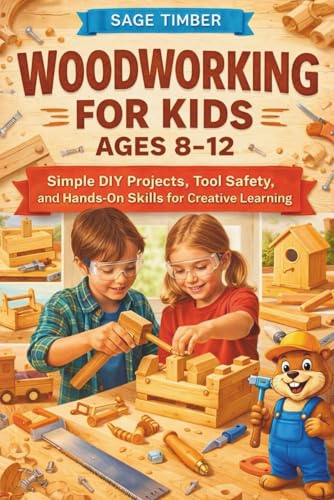 |
WOODWORKING FOR KIDS AGES 8–12: Simple DIY Projects, Tool | Our pick | 8–12 years, DIY projects, tool safety | $16.99
Price as of 13 Oct 2026
|
View |
 |
Woodworking for Kids: The Ultimate Guide to Introduce KidsIndependently Published | Budget pick | 80+ projects, step-by-step images, child-friendly | $15.95
Price as of 13 Oct 2026
|
View |
 |
The Complete Woodworking Book for Kids: Turn Screen-Free | Upgrade pick | Screen-free time, parent-child bonding, illustrated projects | $24.97
Price as of 13 Oct 2026
|
View |
 |
Awesome Engineering Activities for Kids: 50+ Exciting STEAMCallisto Kids | Also great | 50+ STEAM projects, engineering-focused, diverse activities | $6.97
Price as of 13 Oct 2026
|
View |
Use the table in this section to sort true beginner books from books that quietly assume a fuller tool setup. The best fit depends on age, supervision, and whether your home is set up for hand tools only or for light drilling and layout work.
📊 One highlighted book is designed for kids ages 4-12. Source: Woodworking Projects for Kids.
How we chose
This roundup favors books that make age fit easy to judge, spell out safety guidance, and keep the tool list realistic for families. It also separates curriculum-style books from loose project collections, because homeschoolers need order and repeatable lessons while other buyers may want a few simple builds.
We looked for project counts, step-by-step sequencing, and whether the book asks parents to gather only a few basics or a longer list of tools. A good kids woodworking book should state the level of adult help required.
Age band and supervision level
Young children should start with close supervision and simple hand tools. That usually means pre-cut pieces, clear measuring help, and adult control of saws, drills, and fastening steps.
Tool demands and safety guidance
The best books name the tools you need and explain safe use in plain terms. Hammers, saws, drills, measuring tools, nails, and screws should be tied to the project, not listed as if every family already owns them.
Project count and lesson clarity
Books with step-by-step instructions are easier to follow than loose idea collections. A large project count helps only if the instructions stay age-appropriate and the builds remain realistic for the child.
Parent prep and homeschool usefulness
Homeschool families often need a curriculum feel: order, repeatable lessons, and skill progression. Other families may only need a short project book that uses one tool set and can be opened on a weekend.
WOODWORKING FOR KIDS AGES 8–12: best for safety-minded beginners
This is the best overall pick for most families with kids who are ready for real but controlled woodworking. It is aimed at ages 8–12, includes safety guidance, and keeps the focus on hands-on skill building instead of tool-heavy complexity.
Its strongest point is fit: the age band is clear, the learning curve is manageable, and the content is built for independent learning with adult oversight. The drawback is that it sits above the simplest hand-only projects, so families with very young children may still need something lighter.
Woodworking for Kids: best for project variety
This book is a strong choice when you want a large stack of step-by-step builds and visual instructions. The 80+ project count makes it useful for a child who wants repeated practice, and the image-led format helps explain each stage.
The drawback is that a big project list can hide differences in difficulty. Parents still need to check whether a given project asks for more setup, more cutting, or more tool handling than their child can manage safely.
This is the best fit for parent-child woodworking sessions that should feel structured and screen-free. The illustrated, step-by-step format is a plus for younger learners who need visual prompts and a slower pace.
The main drawback is that the title leans toward shared activity more than independent child use. Families looking for a pure self-led project book may find it a little more guided than they need.
Awesome Engineering Activities for Kids: best for STEAM-minded households
This is the right pick when you want building, problem-solving, and design thinking to sit beside woodworking. It is broader than a kids woodworking book, so it works best for families who want variety and are comfortable mixing wood tasks with other STEAM activities.
The drawback is focus. Because it is not a woodworking-only title, families searching for a strict project sequence with saw-and-hammer guidance may want a more dedicated woodworking book first.
What are the best woodworking project books for kids?
The best woodworking project books for kids match the child’s age, the adult supervision available, and the tool setup you already have. For younger children, the best books keep to simple hand tools and short builds. For older children, the best books add measuring, drilling, and clearer project sequencing.
For most families, the best overall choice is WOODWORKING FOR KIDS AGES 8–12 because it fits a defined age band, includes safety guidance, and stays centered on hands-on learning. Families that want many options may prefer the 80+ project title, while homeschoolers often need the more structured feel of the illustrated shared-lesson book.
What age is appropriate for kids to start woodworking?
Many children can start woodworking in early elementary years if the project is simple and supervision is close. Younger children should begin with hand tools, pre-cut material, and adults handling the risky cutting or drilling steps. Age matters less than attention span, hand control, and the adult’s ability to supervise.
A useful rule is to match the job to the child’s stage: small layout tasks and assembly for younger kids, simple measuring and light drilling for middle elementary ages, and fuller plan reading for older children. Start with short sessions and easy wins.
Best for ages 4 to 6
For ages 4 to 6, choose books that stay with pre-cut parts, sanding, fastening, and very basic layout. A birdhouse is a good first project because it is familiar, easy to explain, and simple to finish without a long tool list.
Best for ages 7 to 9
For ages 7 to 9, look for books that add measuring, simple drilling under close supervision, and step-by-step builds with clear pictures. Bookends and simple dispensers often fit this band well because they teach layout and assembly without demanding advanced cutting.
Best for ages 10 to 12
For ages 10 to 12, a child can usually handle more sequence, more layout, and tighter instruction if the book explains each step clearly. The age-specific 8–12 title is a strong match here, especially for families that want structured learning with safety guidance.
Which woodworking books for kids use only simple hand tools?
The books that rely on simple hand tools are usually the safest start for younger children and tool-light homes. Look for hammers, hand saws used with adult control, measuring tools, nails, screws, and basic assembly steps. If a title expects a drill press, power saws, or repeated machine setup, it is no longer a simple hand-tool book.
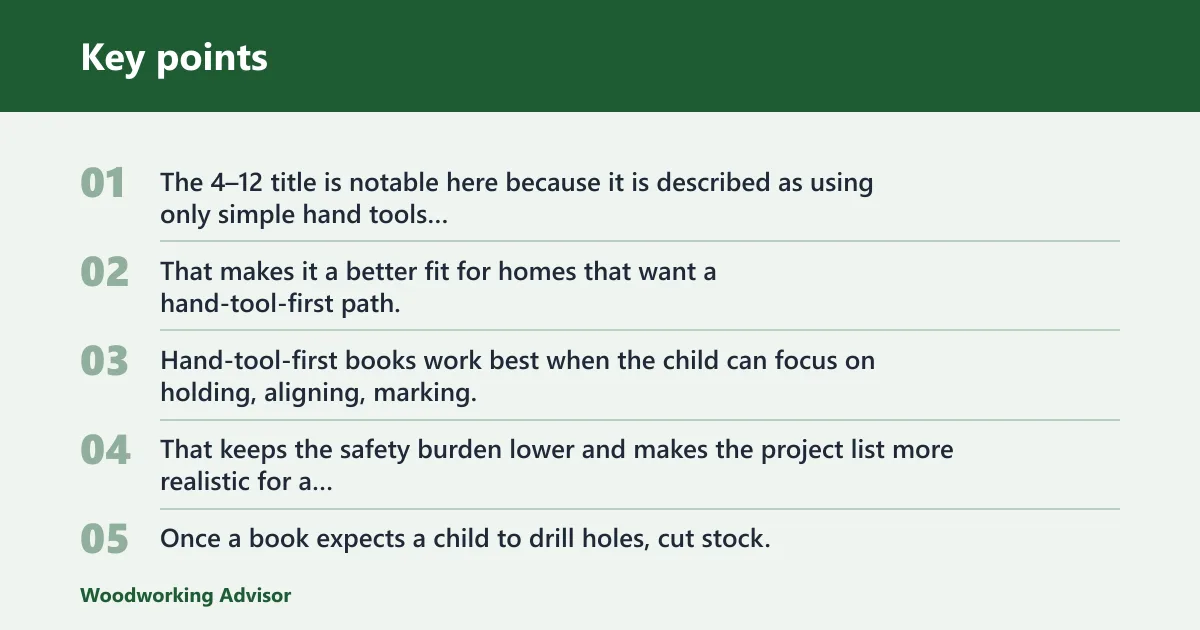
The 4–12 title is notable here because it is described as using only simple hand tools to build every project, and its projects avoid power tools for younger kids. That makes it a better fit for homes that want a hand-tool-first path.
Books that stay with hand tools and measuring basics
Hand-tool-first books work best when the child can focus on holding, aligning, marking, and fastening rather than machine operation. That keeps the safety burden lower and makes the project list more realistic for a kitchen-table or garage-workbench setup.
Books that need saws, drills, or more setup
Once a book expects a child to drill holes, cut stock, or do repeated measurement and layout, adult help becomes part of the project, not an optional extra. That is fine for older children, but it is a poor match for a family that wants nearly all work to stay hand-driven.
Books with beginner projects like birdhouses, bookends, and dispensers
Beginner-friendly project lists often include birdhouses, bookends, baskets, robots, and simple dispensers. Birdhouses and bookends are usually the easiest starting points because they teach measurement and assembly without a complicated shape. Baskets and robots can be fun, but check the fastening and cutting steps first.
Are there woodworking books for beginners that include safety lessons?
Yes. The stronger beginner books build safety into the lesson instead of adding it as a short note at the front. That matters because a child who is learning to hold a saw, use a hammer, or line up screws needs repeated reminders about hand position, clamp use, and adult supervision.
The best beginner titles explain what the child can do alone and what must stay with the adult. That clarity is more useful than a long list of projects with no warning about tool handling or cut prevention.
How many projects do kids woodworking books usually include?
Project counts vary a lot. Some books are short and curated, while others pack in dozens of ideas. The better question is whether the count matches the instruction quality and the child’s age. A large project count is useful only if the projects stay simple enough to finish.
One highlighted book includes construction details for 52 projects, while another offers over 80 easy step-by-step projects. That spread shows why parents should compare project count with tool demand and lesson clarity instead of buying on quantity alone.
What tools do I need for kids woodworking projects?
Start with only the tools the chosen book actually needs. For many beginner projects, that means a hammer, a child-safe or closely supervised saw, a drill for older kids, a tape measure or ruler, a square or straightedge, nails, screws, and sandpaper. Buying everything up front is usually unnecessary.
The safer approach is to build a tools list from the projects you will actually do. That keeps costs down and avoids collecting gear for builds you may never attempt.
- Pick one project.
- Read the tool list twice.
- Separate adult-only tools from child-handled tools.
- Buy or borrow only what the project needs.
- Start with scrap wood before cutting better stock.
Are there woodworking project books with step-by-step lessons?
Yes, and those are usually easier for kids and parents to follow. Step-by-step sequencing reduces confusion, shows the order of cuts and fasteners, and makes it easier to spot where a child will need direct help. That is especially useful for homeschoolers who want repeatable lessons.
The two books with the strongest step-by-step signals here are the 80+ project title and the illustrated shared-adventure book. Both are better for families who want clearer follow-through than for readers who only want a few loose project ideas.
Are printable PDF woodworking project plans available for kids?
Yes, printable or PDF books can be a smart choice when you want offline use and easy re-reading at the workbench. A PDF format is especially useful if the child works from a printed copy while the adult keeps a master version clean and intact.
The post specifically recommends I Can Do That in PDF format. Printable plans help when you want a project to stay open on the bench, but they still need the same age match, safety review, and tool check as any paper book.
Which one should you buy?
Choose by child age, attention span, and how much adult help you want to give. For most families with a child in the 8–12 range, the age-specific safety-minded book is the best starting point. For children who want many projects, the 80+ project title gives more variety. For homeschool use, the illustrated shared-activity title is stronger on lesson feel.
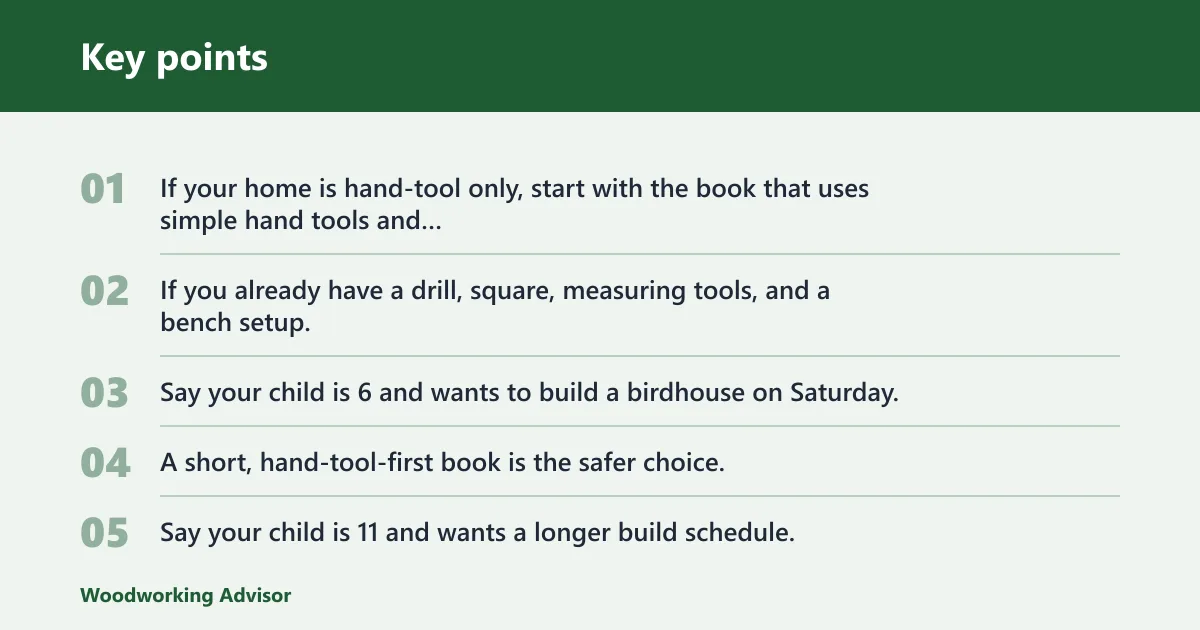
Choose by the tools you already own, too. If your home is hand-tool only, start with the book that uses simple hand tools and avoids power tools for younger kids. If you already have a drill, square, measuring tools, and a bench setup, the broader project books become more practical.
Say your child is 6 and wants to build a birdhouse on Saturday. A short, hand-tool-first book is the safer choice, because the project can stay simple and the adult can control the cut and fastening steps. Say your child is 11 and wants a longer build schedule. A structured book with more steps and visual guidance usually fits better.
Quick comparison by age, tools, and safety
| Book | Age fit | Tool complexity | Safety guidance | Project count | Lesson structure | Parent prep required | Best for |
|---|---|---|---|---|---|---|---|
| WOODWORKING FOR KIDS AGES 8–12 | 8–12 | Low to moderate; simple hand tools | Clear safety guidance for young woodworkers | 52 projects | Skill-building focus with age-specific flow | Low to moderate | Absolute beginners; tool-light households |
| Woodworking for Kids | Broad child range | Low to moderate; step-by-step project builds | Implicit child-friendly pacing, but still check each project | 80+ projects | Strong visual sequence | Moderate | Homeschoolers; families wanting variety |
| The Complete Woodworking Book for Kids | Middle childhood and up | Low to moderate | Shared-activity framing supports adult oversight | Not stated in the listing | Illustrated, step-by-step, lesson-like | Moderate | Homeschoolers; parent-child sessions |
| Awesome Engineering Activities for Kids | Mixed STEAM ages | Varies by activity | General project safety, not woodworking-only | 50+ activities | Broader engineering structure | Moderate | Homeschoolers; mixed craft-and-build homes |
For homeschoolers, the best fit is usually the book with the clearest lesson flow, not the biggest project count. For absolute beginners, start with the age-specific title that uses simple hand tools. For tool-light homes, avoid books that quietly assume drills, saws, and a full bench setup.
Sponsored / affiliate links. As an Amazon Associate I earn from qualifying purchases. I may earn additional commission from eligible campaigns.