Bruce Hardwood Floor Cleaner Review: Is It Worth It?
Bruce Hardwood Floor Cleaner suits sealed, finished floors that need routine care. It is not for waxed, oil-soap, or unfinished wood. Its value is controlled light cleaning: pick up dry soil first, then use a light spray-and-wipe pass for maintenance without flooding the floor.
Verdict on Bruce floor cleaner
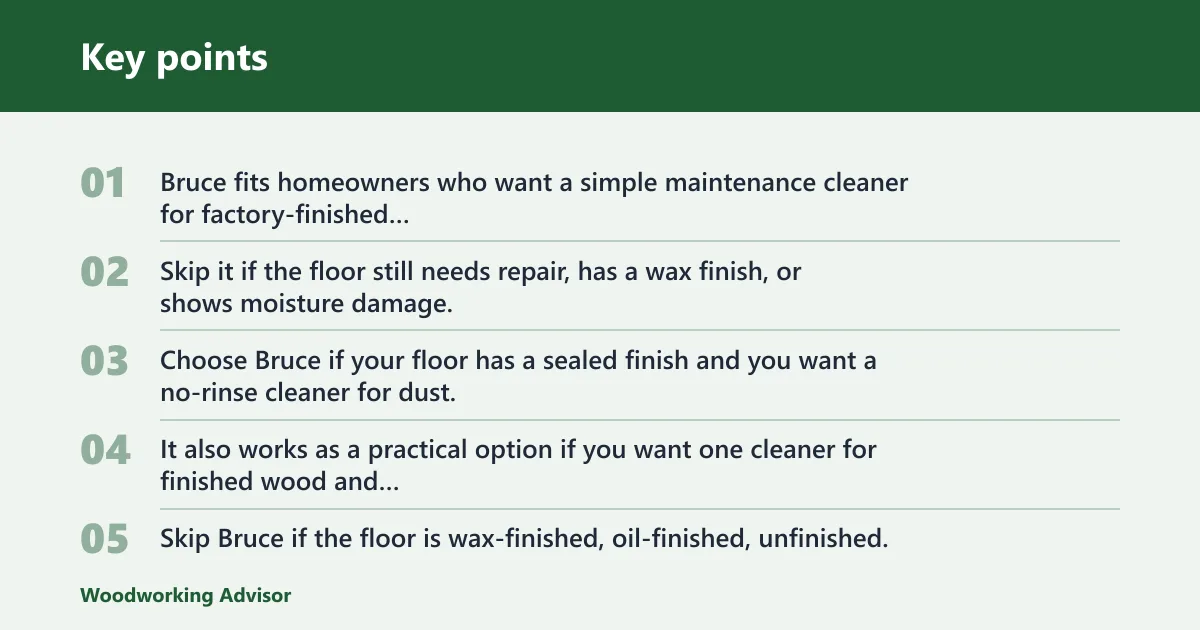


Bruce fits homeowners who want a simple maintenance cleaner for factory-finished hardwood and many laminate floors. Skip it if the floor still needs repair, has a wax finish, or shows moisture damage, because the cleaner is made for sealed surfaces and routine grime, not finish restoration.
Who should buy it?
Choose Bruce if your floor has a sealed finish and you want a no-rinse cleaner for dust, soil, and light everyday buildup. It also works as a practical option if you want one cleaner for finished wood and laminate, as long as you check the floor maker’s care directions first.
Who should skip it?
Skip Bruce if the floor is wax-finished, oil-finished, unfinished, or already damaged in ways that may trap moisture or cleaner residue. Those surfaces need a different care plan, and Bruce’s own guidance warns against water-heavy methods on hardwood.
What this review covers
This review focuses on fit, finish matching, and use cases. It separates safe surfaces from mismatches, compares ready-to-use and concentrate formats, and explains when Bruce is a cleaner and when you need a repair product instead.
Should you use Bruce cleaner?
Use Bruce when the floor is sealed, the surface is stable, and the goal is routine cleanup. Do not use it as a catch-all for every wood floor. Bruce says it is recommended for everyday hardwood cleaning, but that does not make it safe for every finish or damage type.
Polyurethane-finished hardwood
Polyurethane-finished hardwood is the clearest fit. Bruce cleaner is intended for finished wood floors, and DG Floors says it works on solid hardwood floors with a sealed finish. That makes it a sensible maintenance cleaner for polyurethane, as long as you avoid excess liquid.
Laminate and engineered wood
Laminate is a compatible surface, and Bruce Hardwood & Laminate Floor Cleaner is commonly grouped with engineered wood in product discussions. Still, confirm the manufacturer’s care guidance before using any cleaner on engineered flooring, because surface construction and wear layers vary by product line.
Waxed, oiled, and unfinished floors
Do not use Bruce on wax-finished floors, oil-finished floors, or unfinished wood. Bruce warns against wax-based cleaners on hardwood floors and also says not to mop hardwood floors with water. Those warnings point to a finish-sensitive cleaner, not a treatment for porous or waxed surfaces.
Spot cleaning, weekly mopping, and residue problems
Bruce works best for spot cleaning and weekly maintenance, not for sticky buildup or a finish mismatch. If residue appears, the usual causes are too much product, too much moisture, or a floor that was never suited to a spray cleaner in the first place.
Bruce cleaner decision table
| Finish type and safety | Floor condition and use case | Safe or unsafe | Why | Exact application method |
|---|---|---|---|---|
| Polyurethane-finished hardwood | Weekly maintenance on a sealed floor | Safe | Bruce is recommended for everyday hardwood cleaning and is meant for finished wood floors. | Dry pick up first, spray lightly, then wipe with a damp microfiber mop or cloth. |
| Laminate flooring | Light soil after routine traffic | Safe | Bruce Hardwood & Laminate Floor Cleaner is made for laminate as well as finished wood. | Use a light spray and a barely damp microfiber mop; do not saturate seams. |
| Wax-finished hardwood | Any cleaning task | Unsafe | Bruce warns against wax-based cleaners on hardwood floors, and waxed floors need a different care method. | Do not use Bruce; follow the floor maker’s wax-care directions instead. |
| Oiled floors | Routine cleaning | Unsafe | Oil-finished surfaces can react poorly to general spray cleaners unless the manufacturer says otherwise. | Check the flooring label or manual before using any cleaner. |
| Unfinished wood | Dust or grime removal | Unsafe | Bruce is for finished, sealed surfaces, not raw wood that can absorb moisture. | Do not apply Bruce; use the finish or sealant maker’s instructions. |
| Spot cleaning | Small spill or fingerprint area | Safe | Bruce recommends spraying product and wiping with a damp cloth or terrycloth swivel-head mop for spills or spots. | Spray the spot lightly, wipe immediately, and dry the area if needed. |
| Weekly mopping | Whole-room maintenance | Safe | Bruce is designed for maintenance, but excess water can damage hardwood floors. | Use a dust mop or vacuum first, then a lightly damp microfiber mop with minimal spray. |
| Residue troubleshooting | Floor feels tacky or streaked after cleaning | Condition-dependent | Residue often points to overuse, too much water, or the wrong finish match. | Stop wet cleaning, dry-buff with microfiber, and reassess the floor finish before the next application. |
How do you use Bruce correctly?
The correct method is simple: remove dry soil first, apply a light spray, and wipe with a damp microfiber mop or cloth. Bruce says to avoid excess water, not to mop hardwood floors with water, and not to use steam on hardwood floors.
Pre-clean with a dust mop or vacuum
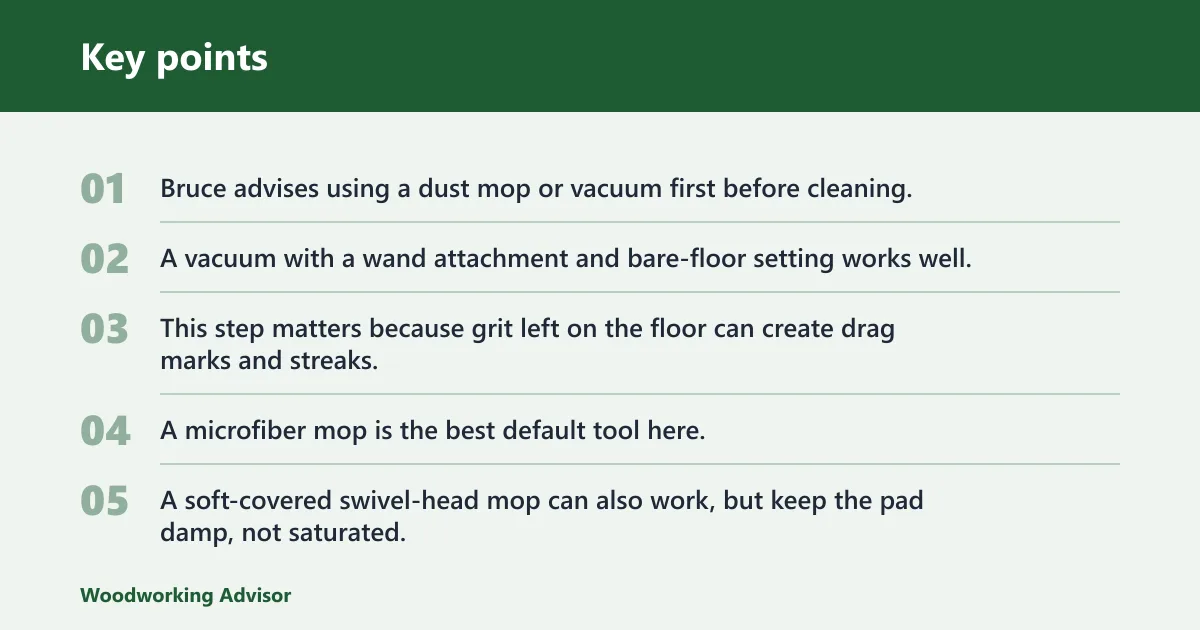
Bruce advises using a dust mop or vacuum first before cleaning. A vacuum with a wand attachment and bare-floor setting works well, and the beater bar should be off. This step matters because grit left on the floor can create drag marks and streaks.
Use a microfiber mop lightly damp
A microfiber mop is the best default tool here. A soft-covered swivel-head mop can also work, but keep the pad damp, not saturated. The goal is controlled contact, not a wet pass that leaves the floor glossy for the wrong reasons.
Spray-and-wipe technique
For spots or spills, Bruce recommends spraying product and wiping with a damp cloth or terrycloth swivel-head mop. For a larger area, work in sections, spray lightly, and wipe right away. Do not flood the boards; Bruce says excess water can damage hardwood floors.
How to avoid streaks and excess residue
Streaks usually come from overspray, dirty mop pads, or cleaning over dust instead of removing it first. If the floor looks hazy, switch to a cleaner pad, reduce the amount sprayed, and use shorter passes. Say your dining room has a 12-foot traffic lane and the floor looks cloudy after a quick wipe; that usually points to too much product, not a bad cleaner.
Suppose a kitchen entry has one sticky spot from a spilled drink. Clean that spot first rather than rewetting the entire room. Bruce is made for that kind of targeted cleanup, and the smaller the wet area, the lower the risk of streaks.
What Bruce cleaner is and formats
Bruce Hardwood & Laminate Floor Cleaner comes in a ready-to-use spray and a concentrate. Both are aimed at finished floor maintenance, but they serve different cleaning habits. If you want simple spot treatment, the spray is easier. If you clean large areas often, the concentrate may fit better.
Ready-to-use spray format
The ready-to-use spray is a 32 oz bottle. It fits quick maintenance, minor spills, and small rooms where convenience matters more than refill economics. You spray and wipe, with no mixing step.
Concentrate format
The concentrate is a 64 oz bottle. DG Floors says it makes approximately 20 gallons of cleaning solution, which can matter for frequent whole-floor cleaning. Bruce does not need a separate rinse step, but you still need to avoid over-wetting the floor.
No-rinse cleaning claims
It is sold as a no-rinse cleaner, which can make it convenient for sealed floors that only need light soil removal. That claim does not override finish rules. No-rinse is useful only when the floor surface is compatible and the product is used sparingly.
Bruce vs. Bona
Bruce and Bona both sit in the finished-floor maintenance category, so the better pick depends on the floor and the cleaning goal. Bruce has a practical edge when you want a cleaner tied to finished hardwood and laminate guidance, while Bona is often the safer comparison point when you want to check broader floor-care recommendations before choosing.
Where Bruce fits better
Bruce fits best if you want a cleaner backed by floor-care instructions that call for a light spray-and-wipe approach on sealed hardwood. It also fits readers who prefer a separate touch-up path, since Bruce Fresh Finish and the Bruce Touch-Up Kit exist for worn areas and minor scratches.
Where Bona may be the safer pick
Bona may be the safer pick if your flooring maker already lists Bona in its care directions or if you want to follow a product recommendation already printed by the floor manufacturer. That is less about performance claims and more about matching the cleaner to the floor warranty language.
What to check before buying
Check the flooring type, finish type, and care sheet before choosing either product. If the floor is sealed hardwood or laminate, Bruce is a reasonable candidate. If the floor is waxed, oiled, unfinished, or damaged, neither brand should be your first move.
Who is Bruce cleaner for?
Bruce is for homeowners with finished wood floors who want a maintenance cleaner, not a repair system. It also suits laminate owners who want a wood-floor cleaner and are willing to follow the floor maker’s directions. It is not the right pick for floors that need refinishing, waxing, or moisture-heavy cleaning.
Finished wood floor owners
If your hardwood has a sealed finish, Bruce is a practical everyday cleaner. It is especially useful when the floor only has dust, foot traffic, or light grime. For larger worn areas, Bruce Fresh Finish is the separate touch-up product, and the Bruce Touch-Up Kit handles minor scratches and abrasions.
Laminate owners who want a wood-floor cleaner
Laminate owners often want one cleaner that also works on finished wood, and Bruce fits that narrow need. The key is to use the light spray-and-wipe method and avoid soaking seams. If the laminate maker forbids liquid cleaners, follow that instruction instead.
Readers who need touch-up or repair products instead of daily cleaner
Choose a repair product if the issue is not dirt. Bruce Fresh Finish is for larger worn-out areas, while the Bruce Touch-Up Kit is for small scratches and marks. A cleaner will not repair worn finish, and it should not be treated like one.
Pros and cons
- Pros: Good match for sealed hardwood and many laminate floors.
- Pros: Simple spray-and-wipe routine with no rinse step.
- Pros: Available in ready-to-use and concentrate formats.
- Pros: Separate Bruce Fresh Finish and Touch-Up Kit options exist for wear and scratches.
- Cons: Not suitable for waxed, oiled, or unfinished wood.
- Cons: Easy to misuse if you over-spray or leave too much moisture.
- Cons: Does not solve finish damage or deep wear.
Frequently asked questions
Is Bruce hardwood floor cleaner safe for all hardwood floors?
No. Bruce is best for sealed, finished hardwood, and Bruce says excess water can damage hardwood floors. It is not the right cleaner for wax-finished, oil-finished, or unfinished wood. If the floor finish is unclear, check the manufacturer’s care instructions before using any cleaner.
How do you clean Bruce hardwood floors without streaks?
Start with dry pickup using a dust mop or vacuum, then spray lightly and wipe with a damp microfiber mop. Keep the pad clean and avoid flooding the boards. Streaks usually come from too much cleaner, too much water, or soil left on the floor before mopping.
Can I use Bruce hardwood floor cleaner on laminate?
Yes, Bruce Hardwood & Laminate Floor Cleaner is made for laminate as well as finished wood. Use it sparingly and keep moisture low, especially near seams or edges. If the laminate maker has a stricter cleaning rule, follow the floor maker’s instructions first.
Does Bruce hardwood floor cleaner leave a residue?
It should not leave a residue when used correctly, but residue complaints usually trace back to over-application or a finish mismatch. If the floor feels tacky, reduce the spray amount, switch to a clean microfiber pad, and verify that the surface is actually sealed and suitable for the product.
How often should I use Bruce hardwood floor cleaner?
Use it as needed for everyday maintenance, not as a heavy-duty wash cycle. For many homes, that means spot cleaning during the week and a light whole-floor pass when visible soil starts to build up. The right frequency depends on traffic, pets, and the finish condition.
What is the difference between Bruce concentrate and ready-to-use cleaner?
The ready-to-use spray is a 32 oz bottle meant for direct application. The concentrate is a 64 oz bottle, and DG Floors says it makes approximately 20 gallons of cleaning solution. The spray is simpler for small jobs; the concentrate is often better for frequent larger-area cleaning.
Sponsored / affiliate links. As an Amazon Associate I earn from qualifying purchases. I may earn additional commission from eligible campaigns.