Can Latex Paint Be Thinned With Water Local Pro Ratios
Many people wonder, Can Latex Paint Be Thinned With Water? Local Pro Ratios, when they start a painting project. It might seem confusing at first, especially if you’re new to painting.
You want your paint to be just right, not too thick and not too runny. We’ll make it super simple to figure out. We’ll walk you through how to get your paint perfect every time.
Get ready to learn the easy way to thin latex paint and achieve professional-looking results without any hassle.
How To Thin Latex Paint With Water
Learning how to thin latex paint with water is a key skill for any DIY painter or even a seasoned professional. When paint is too thick, it doesn’t flow well from your brush or roller. This can lead to brush marks, uneven coverage, and a generally messy finish.
Thinning the paint correctly ensures a smooth, consistent application. It helps the paint spread evenly and adhere properly to surfaces, making your painting job look much more polished. Understanding the right ratio is important to avoid making the paint too thin, which can cause it to drip or not cover well.
Why Thin Latex Paint
Thinning latex paint isn’t just about making it easier to use. It actually serves several practical purposes that can significantly improve your painting project. When paint is too thick, it can clog sprayers and make it hard to get a smooth finish with brushes and rollers.
Thinning it out can help it flow more freely, reducing the risk of drips and runs. This is especially important when painting detailed trim or using a sprayer. Properly thinned paint can also adhere better to surfaces, leading to a more durable and professional-looking finish.
Improved Flow and Application
When latex paint is too thick, it can feel sticky and drag on your brush or roller. This makes it hard to spread the paint evenly across the surface. Thinning it with a small amount of water makes the paint smoother and more fluid.
It allows the paint to glide effortlessly, creating a consistent coat without the struggle. This means fewer passes with your brush or roller, saving you time and effort.
Better for Spraying
Using a paint sprayer can be a fantastic way to get a very smooth finish quickly. However, paint sprayers require paint to be a specific consistency to work correctly. If the paint is too thick, it can clog the sprayer’s nozzle, leading to uneven spraying and frustration.
Thinning the paint to the manufacturer’s recommended viscosity for spraying ensures it passes through the sprayer smoothly, resulting in a fine, even mist of paint on your walls or surfaces.
Enhanced Coverage
While it might seem counterintuitive, thinning latex paint can sometimes improve its coverage. When paint is too thick, you often need to apply more pressure to spread it. This can lead to you using more paint than necessary and still not getting a complete coat.
Thinning the paint slightly allows it to spread thinner, but over a larger area. This means you can achieve full coverage with fewer coats, saving both paint and time.
The Role of Water in Latex Paint
Latex paint, also known as water-based paint, is formulated with a base of acrylic or vinyl polymers suspended in water. Water acts as the solvent, meaning it dissolves and disperses the other components of the paint, like pigments and binders. When you apply latex paint, the water evaporates.
As it evaporates, the polymer particles come closer together, coalesce, and form a solid, continuous film that adheres to the surface. Adding more water simply increases the solvent content temporarily.
The binders in latex paint are crucial. They are the glue that holds the pigment particles together and attaches them to the surface. The pigments provide the color, and the additives help with things like drying time and mildew resistance.
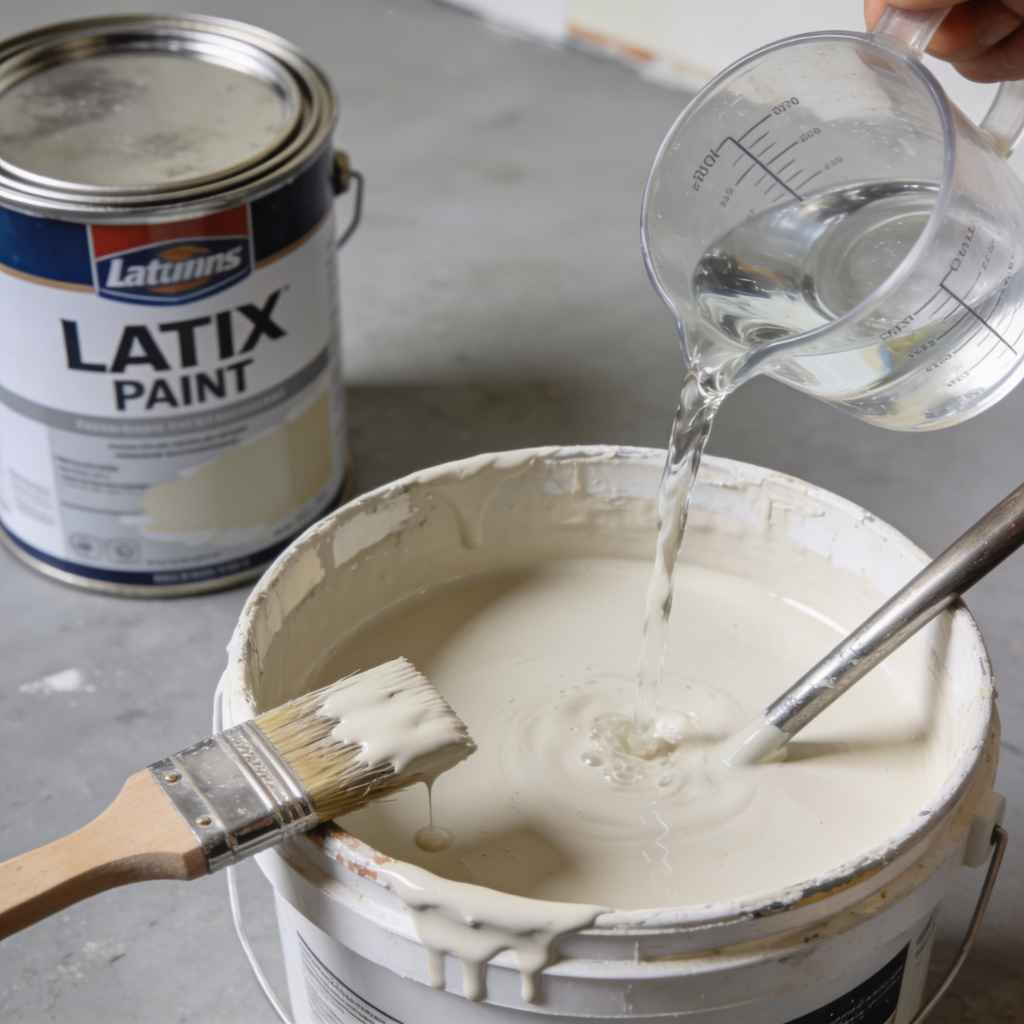
Water is the carrier that allows all these ingredients to be mixed and applied smoothly. When you add water, you are essentially making the paint more liquid by increasing the amount of carrier. This is why it’s important to add water cautiously; too much can dilute the binders, affecting the paint’s ability to stick and form a durable film.
Understanding Paint Viscosity
Viscosity is a measure of a fluid’s resistance to flow. Think of honey versus water; honey has high viscosity because it flows slowly, while water has low viscosity and flows very quickly. In painting, viscosity is super important because it affects how easily the paint spreads and how smooth the finish will be.
If paint is too thick (high viscosity), it will be hard to apply, leave brush marks, and won’t level out nicely. If it’s too thin (low viscosity), it will drip everywhere and might not cover the surface well.
Paint manufacturers specify the ideal viscosity for their products, often suggesting ranges for different application methods like brushing, rolling, or spraying. For many latex paints, the natural viscosity is designed for brush or roller application straight out of the can. However, for specific tools like airless sprayers or HVLP (High Volume Low Pressure) sprayers, the paint often needs to be thinned to achieve the manufacturer’s recommended lower viscosity.
This ensures the paint atomizes properly and creates a consistent spray pattern.
What Happens When You Add Water
Adding water to latex paint decreases its viscosity. This means the paint becomes more fluid and easier to spread. The water acts as a diluent, separating the binder particles and pigments.
This allows them to flow more freely. As the water evaporates, the binder particles will re-form the paint film. However, if you add too much water, the binder particles can become too far apart.
This can weaken the paint film. A weakened film may not adhere as well to the surface. It can also be less durable and more prone to chipping or peeling over time.
The key is to add only enough water to achieve the desired consistency without compromising the paint’s integrity. For most interior latex paints, adding up to 10% water by volume is generally considered safe. For example, if you have a gallon of paint (which is 128 ounces), 10% would be about 12.8 ounces of water.
It’s always best to start with a very small amount and add more gradually until you reach the right flow. This approach helps maintain the paint’s performance while making it easier to work with.
Can Latex Paint Be Thinned With Water? Local Pro Ratios
The short answer is yes, latex paint can definitely be thinned with water. This is a common practice among painters to achieve the perfect consistency for different jobs. The question is not if you can, but how much and when.
Professional painters often use specific ratios, or “pro ratios,” to ensure they are not over-thinning. These ratios are typically based on the type of paint and the application method. Understanding these local pro ratios helps avoid common mistakes that can ruin a paint job.
For instance, when spraying, painters might thin the paint more than they would for brushing. The exact percentage can vary by brand and product line. Many professionals start with a 5% to 10% dilution.
However, some specialty coatings or specific spray applications might call for up to 15% or even 20% water. It’s crucial to check the paint can’s label for any specific thinning instructions. When in doubt, always err on the side of adding less water first and testing the consistency.
General Thinning Guidelines
For most latex paints used for brushing or rolling, adding a small amount of water is perfectly fine. A good starting point is to add about 1/2 cup of water for every gallon of paint. This is roughly a 4% dilution.
This small amount usually doesn’t affect the paint’s durability or adhesion. It just makes it a bit easier to spread. If you are using a higher quality paint, it often has better binders, meaning it can tolerate a little more thinning without issues.
If you plan to spray the paint, you will likely need to thin it more. For spray applications, a common guideline is to add 1 to 2 cups of water per gallon of paint. This is around 8% to 16% dilution.
Again, always refer to the paint manufacturer’s recommendations for spraying. They often provide specific instructions for thinning their products for spray application. Testing the paint consistency on a scrap piece of cardboard before you start painting your project is always a good idea.
Factors Influencing the Ratio
Several factors determine the right amount of water to add. The type of latex paint is a big one. Higher quality paints, often called “premium” or “100% acrylic,” have better binders and can typically withstand more thinning than lower-quality paints.
The temperature and humidity of the room where you are painting also play a role. On a hot, dry day, paint will dry faster and might seem thicker. Adding a little water can help it flow better in these conditions.
Conversely, on a cool, damp day, paint will dry slower and might already have a good consistency.
The surface you are painting on matters too. A very porous surface, like unprimed drywall or wood, will absorb the water from the paint more quickly. This can make the paint seem thicker as you apply it.
In such cases, a slight thinning might be beneficial. However, for non-porous surfaces like metal or previously painted glossy surfaces, over-thinning can lead to poor adhesion. So, always consider the substrate.
The tool you use for application is also a major factor, as we’ll discuss next.
Application Methods and Thinning Needs
The way you apply paint significantly impacts how much you might need to thin it. Different application tools require different paint consistencies to work optimally. What works for a brush won’t necessarily work for a sprayer.
Understanding these differences helps you choose the right amount of water to add, ensuring a smooth and professional finish for your specific project.
Brushing and Rolling
When using brushes or rollers, the paint typically needs to be thicker than for spraying. The bristles of a brush and the nap of a roller grab the paint and transfer it to the surface. If the paint is too thin, it can drip off the brush or roller before it even reaches the wall.
Most latex paints are formulated to have the right viscosity for brushing and rolling straight out of the can. If you find it a bit too thick, adding just a small amount of water, perhaps 1/4 to 1/2 cup per gallon, is usually sufficient.
The goal is to achieve a consistency that allows the paint to flow smoothly from the brush or roller without being stringy or globby. You want it to spread easily and level out nicely on the surface. If you notice drag marks or uneven application with a brush, it might indicate the paint is a bit too thick.
A roller might leave lap marks if the paint isn’t flowing well. Always test your thinned paint on a small area or a piece of scrap material before committing to the whole project.
Spraying Latex Paint
Paint spraying is where thinning latex paint becomes almost essential. Sprayers, especially airless sprayers, atomize the paint into a fine mist. For this to happen effectively, the paint needs to be much thinner than what’s ideal for brushing or rolling.
Manufacturers of sprayers provide specific viscosity recommendations, often measured in Krebs units or by visual inspection. If the paint is too thick, it won’t spray evenly. It can cause sputtering, uneven fan patterns, and even clog the nozzle of the sprayer, leading to a poor finish and potential damage to the equipment.
A common recommendation for thinning latex paint for spraying is between 5% and 20% water, depending on the sprayer type and the paint itself. High-quality paints often contain more solids and can tolerate higher thinning ratios without losing their integrity. Always consult the paint manufacturer’s technical data sheet or the paint can label for specific thinning instructions related to spraying. For an exact ratio breakdown by sprayer type — HVLP, airless, and compressed air — see our guide on whether you need to thin water-based paint for spraying.
Some paints are not recommended for spraying unless significantly thinned, while others are formulated for easier spraying right out of the can.
Testing the Consistency
Before you begin painting, it’s crucial to test the consistency of your thinned paint. This simple step can save you a lot of trouble and ensure you achieve the desired results. You don’t need fancy equipment; a basic test is usually enough.
This helps you verify that you’ve added the right amount of water and that the paint will perform as expected on your project.
The Stir Stick Test
One of the easiest ways to check paint consistency is the “stir stick test.” After adding water and stirring the paint thoroughly, dip a clean stir stick into the paint. Lift the stick out and observe how the paint drips off. If the paint comes off in thick, gloppy streams, it’s still too thick.
If it runs off like water, it’s too thin. You are looking for a consistency where the paint flows off the stick in a smooth, steady stream, perhaps with some slight “stringing” but without forming large clumps.
For spraying, you might want the paint to flow a bit more freely than for brushing. The ideal result is a steady, even flow that coats the stick well but then releases cleanly. If you are using a paint sprayer, the manufacturer often provides a viscosity cup.
You fill the cup with paint and time how long it takes for the paint to drain through a small hole in the bottom. This gives a more precise measurement of viscosity.
Spray Tip and Fan Pattern
If you are using a paint sprayer, the best test is to actually spray a small section. Use the appropriate spray tip for the paint you are using. Aim at a piece of scrap cardboard or an inconspicuous area.
Observe the fan pattern and how the paint lays down. A properly thinned paint will create a uniform, oval-shaped fan pattern with even coverage. If the pattern is uneven, has hard edges, or the paint splatters, it’s likely too thick.
If the paint runs immediately or doesn’t cover well, it might be too thin.
Pay attention to the edges of the spray fan. They should be soft and blend into the main spray. Hard edges can indicate the paint is too thick for the sprayer’s pressure or tip size.
Also, check for “tailing,” where the spray is thicker on one side than the other. This can also be a sign of incorrect thinning or pressure settings. Adjust your thinning and sprayer settings based on these observations until you achieve a consistent, even spray.
When Not to Thin Latex Paint
While thinning latex paint with water is often beneficial, there are times when it’s best to avoid it. Adding too much water can compromise the paint’s performance, and for certain applications or paint types, thinning isn’t necessary or even recommended. Knowing when to skip thinning is just as important as knowing how to do it.
High-Quality Paints and Their Properties
Premium or 100% acrylic latex paints are formulated with high-quality binders and pigments. These paints are designed to offer excellent coverage, durability, and adhesion right out of the can. They often have a superior viscosity that allows for smooth application with brushes and rollers without thinning.
In fact, thinning these paints too much can actually dilute the binders, reducing their performance. For these paints, it’s usually best to use them as they are unless you have a specific reason or are using a sprayer.
The superior binder content in these paints means they form a strong, flexible film when dry. This film resists cracking, peeling, and fading better than lower-quality paints. When you thin them, you reduce the concentration of these powerful binders.
While a little thinning might be okay for spraying, it’s wise to stick to the manufacturer’s instructions very closely. For brushing and rolling, you will likely find they perform perfectly without any added water, providing a professional finish with ease.
Specific Paint Types and Finishes
Some specialized latex paints have unique formulations that are not meant to be thinned. For example, high-gloss or semi-gloss paints often contain more resins to achieve their sheen. Thinning these can affect the final sheen, making it duller.
Some specialty paints, like elastomeric coatings used for waterproofing or textured paints, also have specific properties that can be altered by adding water. Always check the product label for any warnings against thinning or specific instructions.
Similarly, primers are often formulated for optimal adhesion and sealing properties. While some latex primers can be thinned slightly, others are best applied at their original consistency. If a paint’s primary purpose is extreme durability, stain blocking, or a very specific finish, thinning might interfere with that.
For example, some intumescent paints, designed to expand and protect surfaces from fire, have very precise formulations that thinning could disrupt.
When Coverage or Durability is Paramount
If your project requires maximum coverage in the fewest coats or the highest possible durability, it’s often best to avoid thinning. The binders in latex paint are what give it its strength and ability to adhere to surfaces. When you add water, you are essentially increasing the distance between these binder particles.
This can weaken the paint film, making it less resistant to wear and tear. For high-traffic areas, or surfaces that will experience a lot of abrasion, using the paint as-is will provide the most robust finish.
If the paint seems too thick for application, consider if a different application tool might be more suitable. For instance, if brushing is difficult, a wider brush or a roller with a longer nap might help. If spraying is the goal, and the paint is too thick, investigate if a different spray tip or a lower pressure setting might help before resorting to thinning beyond the recommended amount.
Prioritizing the paint’s inherent protective qualities ensures your painted surfaces will last longer and withstand the elements or daily use.
Common Mistakes When Thinning Latex Paint
Thinning latex paint can be a helpful technique, but it’s easy to make mistakes that can negatively impact your project. Understanding these common pitfalls can help you avoid them and ensure a successful painting outcome. These errors often relate to adding too much water, not stirring properly, or using the wrong type of water.
Adding Too Much Water
This is probably the most frequent mistake. It’s tempting to add more water if the paint still feels a bit thick, but over-thinning can be detrimental. When you add too much water, you dilute the binders that hold the paint together and help it adhere to the surface.
This can lead to poor adhesion, meaning the paint might peel or chip later on. It can also result in a less durable finish that is more prone to scuffing or damage.
Another consequence of over-thinning is reduced hiding power. The pigments that give the paint its color and opacity can become too spread out. This means you might need more coats to achieve full coverage.
The paint might also become more transparent, allowing the underlying color to show through. If you’re aiming for a specific color, this can be a frustrating problem. It’s always better to add water gradually and test frequently than to add a lot at once.
Inadequate Stirring
Latex paint contains pigments and binders that can settle over time. When you add water, you need to stir the paint thoroughly to ensure the water is fully incorporated into the entire can. If you don’t stir enough, you’ll end up with areas of thick paint and areas of very thin, watery paint.
This will lead to an inconsistent application. Some parts of your surface will be covered with paint that is too thick, while others might have paint that is too thin and won’t cover well.
Proper stirring involves using a stir stick to scrape the bottom and sides of the can. You want to ensure all the settled solids are lifted and mixed into the liquid. Stirring for at least a couple of minutes usually does the trick.
For larger quantities or if the paint has been sitting for a long time, consider using a paint mixer attachment for a drill. This provides more vigorous and consistent mixing, ensuring the water and paint are completely blended.
Using Tap Water Instead of Distilled Water
While tap water can be used in a pinch, it’s not always the best choice. Tap water contains minerals and impurities that can sometimes affect the paint’s performance. These minerals can react with the paint components, potentially altering its color, sheen, or drying properties.
For critical projects or when using high-quality paints, using distilled water is recommended. Distilled water is pure and free from these impurities, ensuring a more predictable and consistent result.
The minerals in tap water, such as calcium and magnesium, can sometimes cause streaks or affect how the paint levels out. While the effect might be subtle, it can be noticeable on large surfaces or when aiming for a perfectly smooth finish. Distilled water provides a neutral carrier that won’t interfere with the paint’s chemical makeup.
It’s a small step that can make a big difference in the final appearance and quality of your paint job.
Local Pro Ratios for Different Paints
Professional painters often have a feel for how much to thin different types of paint based on their experience. While exact ratios can vary, there are general guidelines that professionals follow to achieve optimal results for various latex paint formulations and application methods.
Standard Interior Latex Paints
For standard interior latex paints, which are typically acrylic or vinyl-acrylic blends, professionals usually aim for a slight thinning for easier application. For brushing and rolling, they might add around 1/2 cup of water per gallon, which is about 4% water. This helps improve flow and reduce drag without significantly compromising the paint’s film integrity.
When spraying these paints, the ratio increases. A common starting point is 1 to 1.5 cups of water per gallon, equating to approximately 8% to 12% thinning. This helps ensure the paint atomizes properly through the sprayer nozzle, creating a smooth, even coat.
They always test the spray pattern to confirm the right consistency before proceeding with the entire project.
Premium 100% Acrylic Paints
High-quality 100% acrylic paints are known for their superior binders and durability. Professionals often find these paints can be used as-is for brushing and rolling, as they have excellent flow properties. If thinning is required for spraying, they are more cautious.
They might start with a lower percentage, perhaps 5% to 10% water (about 0.5 to 1 cup per gallon), and adjust as needed based on the sprayer and tip size.
The robust nature of these paints means they can withstand a bit more thinning than standard latex paints while still maintaining their film strength and adhesion. However, over-thinning can still be an issue, so meticulous testing is key. The goal is to achieve optimal sprayability without sacrificing the long-term performance of the premium paint.
Exterior Latex Paints
Exterior latex paints are formulated to withstand harsh weather conditions, UV exposure, and temperature fluctuations. They often have a different binder system than interior paints, designed for maximum adhesion and flexibility. For brushing and rolling, they are generally used as-is.
Their viscosity is optimized for outdoor application.
If thinning is necessary for spraying exterior paints, especially for large areas or specific applications, professionals typically stick to the lower end of the thinning scale, often around 5% to 8% water. The focus is on maintaining the paint’s protective qualities. Adding too much water could compromise its ability to repel moisture or withstand environmental stresses.
Always check the manufacturer’s guidelines for exterior paint thinning, as some may specifically advise against it.
Specialty Coatings (e.g., High Gloss, Textured)
Specialty coatings require careful consideration. High-gloss paints achieve their sheen from a high concentration of resins. Thinning them can reduce the gloss level.
Professionals usually avoid thinning high-gloss finishes unless absolutely necessary for spraying, and even then, they use minimal amounts of water. For textured paints, thinning can alter the texture itself. If a textured paint needs thinning for spraying, it’s often done with very specific thinning agents or in very small quantities, as recommended by the manufacturer.
For these types of paints, the emphasis is on preserving the unique properties of the coating. The desired finish or texture is paramount, and thinning can easily disrupt it. If you’re unsure, it’s always best to consult the paint manufacturer’s technical data sheet or contact their support line.
They can provide the most accurate advice for their specific products.
Frequently Asked Questions
Question: How much water can I add to a gallon of latex paint?
Answer: For most standard interior latex paints, you can safely add up to 10% water by volume, which is about 12.8 ounces per gallon. For brushing or rolling, starting with 1/2 cup (4 ounces) per gallon is usually enough. For spraying, you might need more, up to 1 to 1.5 cups (8 to 12 ounces) per gallon, but always test first.
Question: Will thinning latex paint make it less durable?
Answer: If you add too much water, yes, it can make the paint less durable. This is because it dilutes the binders that form the paint film. Adding small amounts, especially for easier application, generally doesn’t harm durability.
Always follow recommended ratios and test the paint.
Question: Can I use a thinning additive instead of water?
Answer: Yes, specialized paint additives can be used to thin paint. These are often called “extenders” or “flow improvers.” They can sometimes offer better results than water, as they are designed not to compromise the paint’s binders as much. However, water is the most common and cost-effective thinning agent for latex paints.
Question: How do I know if my latex paint is too thick for spraying?
Answer: If the paint splatters, creates an uneven spray pattern, or clogs the spray gun, it’s likely too thick. You can also use a viscosity cup to measure. The paint should flow smoothly through the tip without excessive stringing or slow drainage.
Question: Should I thin primer the same way as paint?
Answer: It depends on the primer. Some latex primers can be thinned similarly to paint, especially for spraying. However, always check the primer’s product label or technical data sheet.
Some primers are designed for specific adhesion properties that thinning might affect.
Summary
Yes, you can thin latex paint with water for better application. Professionals use specific ratios, often starting around 5-10% water for spraying and less for brushing. Always test consistency and avoid over-thinning to maintain durability.
Using distilled water and stirring well are key. Not all paints should be thinned, so check labels for specific instructions.
Sponsored / affiliate links. As an Amazon Associate I earn from qualifying purchases. I may earn additional commission from eligible campaigns.