Deck Railing Wobbling: Common Causes and Fixes
A wobbling deck railing usually means a failed post connection, loose framing, or undersized hardware; fix the structural cause, not the visible screws. Left alone, the movement can grow fast and let the guardrail fail under load. This guide helps you pinpoint the failure point and choose the right repair.
What you’ll need

- Work gloves, eye protection, and a flashlight
- Socket wrench or ratchet set
- Drill/driver with bits sized for existing hardware
- Wood awl or screwdriver for probing soft wood
- Carpenter’s square and tape measure
- Replacement galvanized or stainless hardware
- Through-bolts, washers, and nuts sized to the connection
- Pressure-treated 2×4 or 2×6 stock for solid blocking
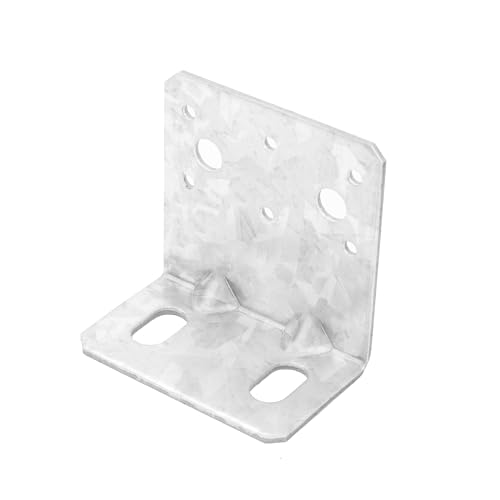
- Metal brackets or tension ties rated for structural use
- Exterior wood filler only for minor cosmetic holes, not structural repair
Deck railing diagnosis matrix
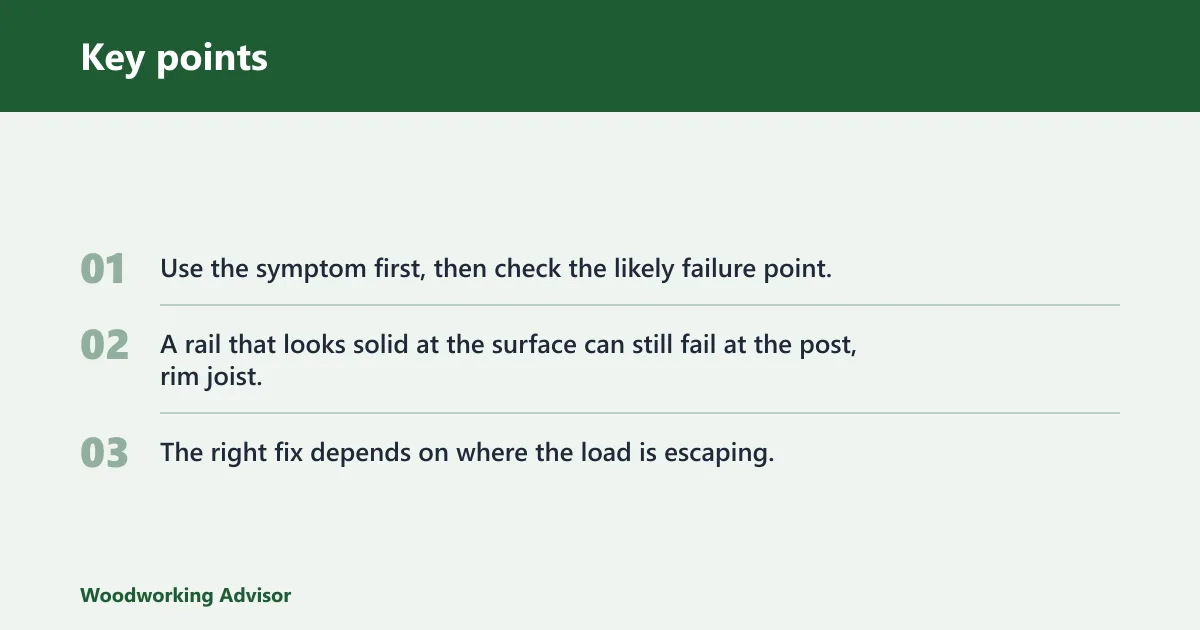
Use the symptom first, then check the likely failure point. A rail that looks solid at the surface can still fail at the post, rim joist, or connection hardware. The right fix depends on where the load is escaping.
| Symptom | Likely failure point | Test method | Repair type | Likely materials | When to replace |
|---|---|---|---|---|---|
| Moves only when pushed sideways | Post-to-frame connection | Push near the post base while watching the bracket or bolts | Through-bolt and block the connection | Pressure-treated blocking, galvanized carriage bolts, washers, nuts | Post is cracked, split, or loose at the base |
| Hardware tight but post still flexes | Rim joist or under-supported framing | Check for rim joist rotation or missing blocking under the post | Add solid blocking or tension ties | Pressure-treated 2×4 or 2×6, metal brackets | Framing is split or badly crushed |
| Soft wood at fastener holes | Crushed fibers or rot | Probe holes with an awl; look for crumbly wood | Replace damaged wood and reset the connection | New post stock, galvanized or stainless fasteners | Structural rot extends into the post or frame |
| Wobble worsens after rain or thaw | Seasonal movement plus loosening hardware | Compare movement in wet and dry weather | Refasten with corrosion-resistant hardware | Through-bolts, structural screws, washers | Fasteners have elongated holes or damaged wood fibers |
| Railing shifts at the top rail, not the post | Rail-to-post joint | Hold the post while moving the top rail independently | Replace rail connectors or brackets | Metal brackets, structural screws | Connectors are bent, cracked, or corroded |
| Rust stains around bolts | Corroded hardware | Inspect bolt heads, nuts, and washers for rust or pitting | Replace with galvanized or stainless hardware | Galvanized carriage bolts, stainless bolts, washers, nuts | Corrosion has reduced fastener strength |
| Post twists at the base | Rim joist can rotate or split | Check whether the rim joist moves with the post | Through-bolt and add blocking | Blocking, washers, nuts, structural screws | Rim joist is cracked through or badly split |
| Composite post cap feels firm but base moves | Hidden substructure failure | Remove trim or access cover to inspect the base connection | Rebuild the base connection, not the cap | Manufacturer-approved connectors, stainless hardware | Internal reinforcement is damaged or missing |
Why is my deck railing wobbling when I lean on it?
A railing usually wobbles because the load is moving through a weak joint, not because the top rail alone is loose. The usual failure points are the post-to-frame connection, the rim joist, or damaged fasteners. If the post flexes, the repair must stiffen the structure that holds the post.
Guardrail top rails must hold at least 200 pounds of pressure in any outward or downward direction, and decks higher than 30 inches off the ground must have railings at least 36 inches tall. Local code may vary, but a wobble means the connection should be checked before use.
How do you find the failure point?
Start at the rail-to-post joint, then check the post base, then inspect the framing. A rail that shifts at the top needs different hardware than a post that rocks at the deck edge. A hidden rot pocket can leave the surface looking fine and still let the joint fail under load.
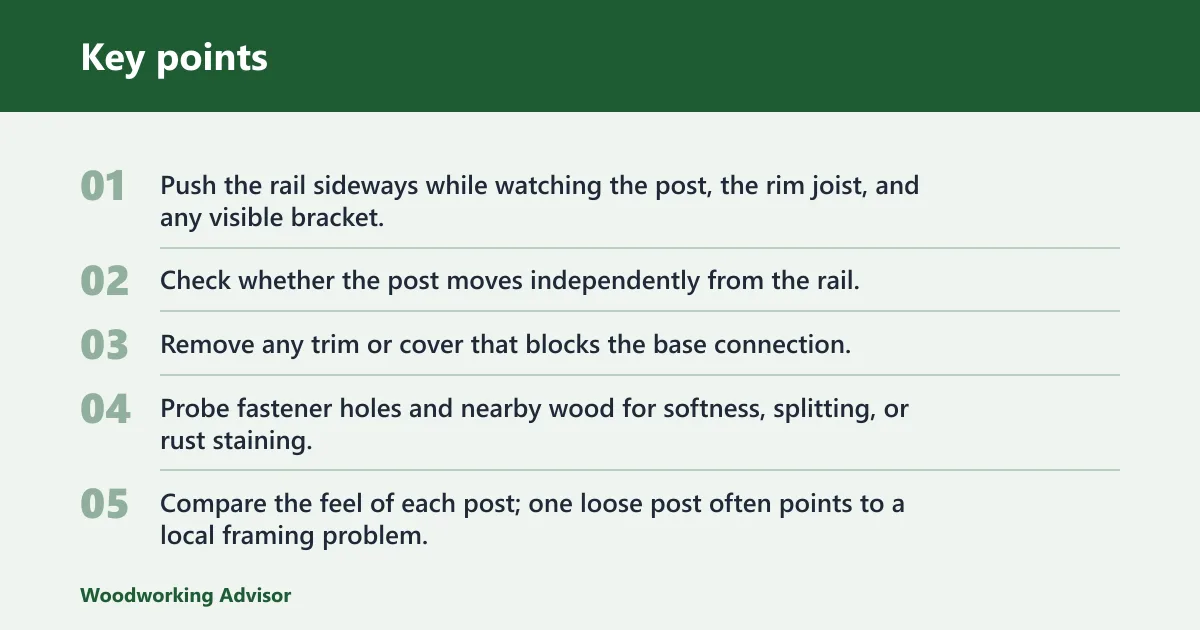
- Push the rail sideways while watching the post, the rim joist, and any visible bracket.
- Check whether the post moves independently from the rail.
- Remove any trim or cover that blocks the base connection.
- Probe fastener holes and nearby wood for softness, splitting, or rust staining.
- Compare the feel of each post; one loose post often points to a local framing problem.
How do I fix a loose deck railing without rebuilding the whole deck?
Most repairs start with replacing weak hardware, then stiffening the framing where the post attaches. Tightening visible screws alone can be temporary if the wood fibers are crushed or the rim joist is under-supported. Solid blocking between joists is often the single most effective fix when the structure is still sound.
How do you fix it in the least invasive way?
- Remove loose or rusted fasteners and inspect the hole size.
- Install pressure-treated blocking between joists where the post lands.
- Use through-bolts with washers and nuts instead of relying on screws or nails.
- Add a structural bracket or tension tie if the connection still shifts.
- Recheck the post after each step and stop if the wood keeps crushing.
Say your wood railing wobbles only at one corner post after a winter thaw. If the bolts are tight but the post still shifts, the likely problem is hidden movement at the framing, not the rail face. Blocking and through-bolting usually address that better than more surface screws.
A common first-timer mistake is adding longer screws into the same soft holes. If the fibers are crushed, the new screws may bite for a week and then loosen again. In that case, remove the failed fasteners, rebuild the connection, and use washers to spread the load.
What hardware should be used to secure deck railing posts?
Posts should be connected to the deck framing with approved lag screws or bolts at a minimum, but screws or nails are not generally acceptable for post connections. For many repairs, through-bolts are often preferred because they clamp the joint with washers and nuts and may resist pullout better than screws alone.
Deck repair articles commonly recommend galvanized carriage bolts, lag screws, and structural screws. Use galvanized or stainless hardware where moisture or salt exposure is a concern, because coastal exposure can make metal rust faster. Replace rusted or damaged fasteners rather than reusing them.
Do loose railing posts need blocking behind the rim joist?
Often, yes. If the post attaches near the rim joist and that area flexes, rotates, or lacks support, solid blocking can keep the connection from twisting. Blocking is typically cut from pressure-treated lumber and installed between joists to stiffen the post attachment point.
If the rim joist is split or badly crushed, blocking alone will not solve the problem. In that case, the repair may need through-bolting, a metal bracket, or replacement of the damaged framing member.
When should I replace instead of repair?
Replace the post or framing when the damage is structural. Wood rot, cracked posts, or crushed fibers at the connection point usually mean tightening will not restore capacity. A rail that cannot meet the load requirement after repair, or that keeps moving after hardware is replaced, should move toward rebuild.
When should you replace rotted railing posts instead of tightening hardware?
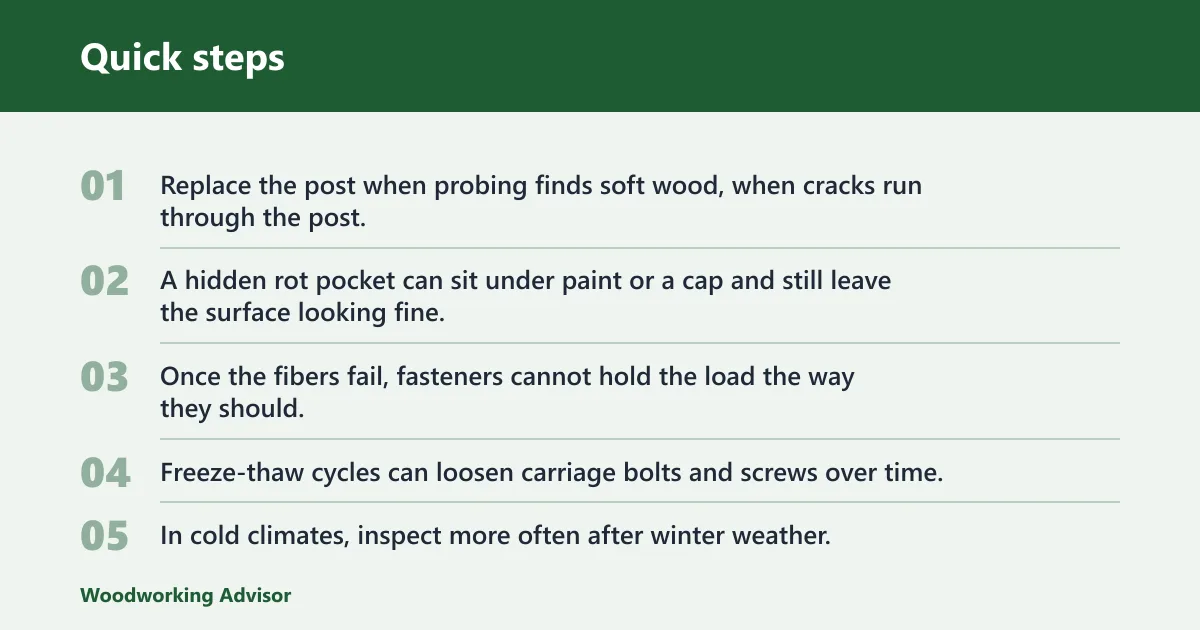
Replace the post when probing finds soft wood, when cracks run through the post, or when rot reaches the base connection. A hidden rot pocket can sit under paint or a cap and still leave the surface looking fine. Once the fibers fail, fasteners cannot hold the load the way they should.
Wood movement matters too. Freeze-thaw cycles can loosen carriage bolts and screws over time, and seasonal expansion may make an already weak post connection slip faster. In cold climates, inspect more often after winter weather.
Wood railings can often be repaired with new posts, blocking, and bolts. Composite systems usually depend on manufacturer-approved connectors and internal framing details, so do not substitute random brackets. Metal railings more often fail at welds, brackets, or base plates; if those parts are bent or cracked, replacement is usually the safer path.
Should I use metal brackets or blocking to stiffen a wobbly railing?
Use both when the connection needs it. Blocking adds solid bearing behind the post, while metal brackets or tension ties help transfer lateral load into the framing. Brackets are reinforcement, not a fix for rotten wood or split framing.
Common mistakes
- Relying on screws alone in a high-load post connection.
- Tightening bolts without checking for crushed wood or hidden rot.
- Ignoring a rim joist that rotates or splits under the post.
- Mixing rusted hardware with new fasteners in damp locations.
- Using cosmetic trim to hide a structural problem.
- Assuming a composite cap means the internal post is sound.
If a 6-foot section of rail feels firm at the top but the base post rocks when you lean on it, the connection may be loose below. That points away from the balusters and toward the post-to-frame connection. Refastening the top rail would miss the real failure point.
Loose fasteners usually leave a connection that can be tightened, at least for a while. Hidden rot or crushed fibers feels different: the hardware tightens, but the wood still gives way or the hole enlarges. Probe the wood, check for discoloration, and inspect the underside of the post and rim joist.
If the wood is soft, flaky, or split around the bolt path, treat it as structural damage. A sound-looking surface can hide failure beneath paint, stain, or trim.
What building code strength does a deck railing need to meet?
Guardrail code requirements vary by local code, but the practical check is simple: the railing must be tall enough and strong enough for the load it is meant to carry. Common references include IRC-style standards, with the 36-inch height and 200-pound load figures often used as the baseline for many decks.
Also check spindle spacing. Gaps must be smaller than 4 inches so a 4-inch ball cannot pass through. If a railing is loose and also out of dimension, repair may need more than hardware replacement.
How do I keep a repaired railing from loosening again?
Inspect fasteners and joints every spring and after the first hard freeze in cold climates. On older decks, also check again after heavy rain, thaw, or a season of strong wind. Moisture, seasonal movement, and corrosion are the usual reasons a repair loosens again.
For damp or coastal sites, use galvanized or stainless hardware from the start. If the deck is older or the rail already moved once, recheck bolt tension after the wood dries and then again after the next wet season.
Frequently asked questions
Is a wobbly deck railing dangerous?
Yes. A railing that moves under hand pressure may not hold the 200-pound load reference expected of modern guardrails. Treat it as a structural issue, not a cosmetic one, and stop using that section until the post connection and framing are inspected.
Sponsored / affiliate links. As an Amazon Associate I earn from qualifying purchases. I may earn additional commission from eligible campaigns.