DIY Bird House Plans
For beginner DIY bird house plans, choose the bird first, then size the box to its cavity needs: bluebirds generally use a 1 1/2-inch entrance, wrens about 1 1/8 inches, and chickadees about 1 1/8 inches. Wrong dimensions or poor placement can invite predators, exclude the target species, or leave the box unused. This guide gives you a species fit chart, the key measurements, and placement rules that help the house get occupied.
Sizing and placement by target species


Species fit comes before the cut list. A box that looks fine on a fence can still fail if the hole is too wide, the floor is too small, or the site is wrong for the bird you want.
Why species fit matters before you cut wood
Cavity nesters do not all want the same box. Bluebirds want open grass or field edges. Chickadees want wooded habitat. Wrens often use tighter boxes closer to shrubs or yard edges. Tree swallows want open space near water or mowed ground.
If you build one generic box and place it anywhere, you are guessing twice: once on size and once on location. That is where many first attempts fail before nesting starts.
One measured starter plan for a simple box
This starter plan follows a common small-box pattern and uses the key dimensions: a 5 1/2 inch by 5 1/2 inch floor, about 3/4 inch untreated stock, at least four drainage holes, and two 5/8-inch vent holes near the top of each side wall. Keep the roof overhang at 2 to 4 inches.
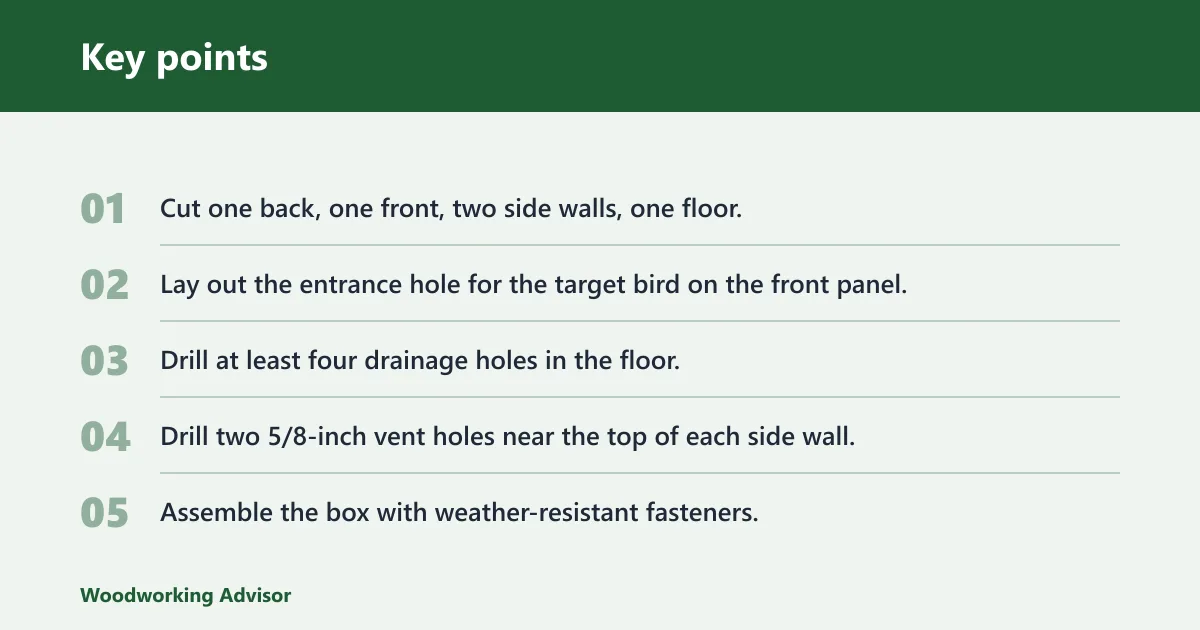
- Cut one back, one front, two side walls, one floor, and one roof from 3/4 inch untreated pine, cedar, or fir.
- Lay out the entrance hole for the target bird on the front panel.
- Drill at least four drainage holes in the floor.
- Drill two 5/8-inch vent holes near the top of each side wall.
- Assemble the box with weather-resistant fasteners.
- Leave one side or the roof easy to open for cleaning.
- Mount the house on a free-standing metal pole or PVC pipe, not a tree or fence post.
A simple birdhouse can be made from a single board in about one hour. Keep the design plain so each piece supports the cavity, the entrance, and the cleaning access.
What to change for bluebirds, wrens, chickadees, and swallows
Bluebirds need a larger box opening than wrens or chickadees. Tree swallows use a 1 3/8-inch entrance. Black-capped chickadees use 1 1/8 inches. Mountain bluebirds need a slightly larger 1 9/16-inch opening than eastern bluebirds.
Round openings are the usual starting point. Oval openings can work too, but shape matters less than the final clear opening for many species. If you change shape, keep the entrance within the species range and do not make it wider just for convenience.
Bird house spec sheet
Use this selector before you cut wood. It narrows the plan by bird, hole size, floor size, height, habitat, and the most common mistake that causes failure.
| Target bird | Hole diameter | Inside floor size | Mounting height | Best habitat | Perch | Cleaning access | Common mistake to avoid |
|---|---|---|---|---|---|---|---|
| Eastern bluebird | 1 1/2 inch round | 5 1/2 inch by 5 1/2 inch | About 5 to 6 feet | Open lawn, pasture, field edge | No | Hinged side or roof | Mounting in dense woods |
| Western bluebird | 1 1/2 inch round | 5 1/2 inch by 5 1/2 inch | About 5 to 6 feet | Open, lightly treed habitat | No | Hinged side or roof | Using a tiny entrance that blocks the bird |
| Mountain bluebird | 1 9/16 inch round | 5 1/2 inch by 5 1/2 inch | About 5 to 6 feet | Open country, grassland edge | No | Hinged side or roof | Choosing a site with no open approach |
| Tree swallow | 1 3/8 inch round | 5 1/2 inch by 5 1/2 inch | 5 to 6 feet | Open ground near water or fields | No | Hinged side or roof | Mounting too high for the usual range |
| Black-capped chickadee | 1 1/8 inch round | About 4 inch by 4 inch to 5 inch by 5 inch, depending on plan | 5 to 15 feet | Wooded yard or forest edge | No | Hinged side or roof | Putting it in an open field |
| Wren | About 1 1/8 inch to 1 1/4 inch, depending on the exact species | About 4 inch by 4 inch to 5 inch by 5 inch | About 5 to 10 feet | Shrubby yard edge or garden border | No | Hinged side or roof | Using a box that is too open and exposed |
| Common backyard finches | Often not suited to enclosed birdhouses | Varies by species | Varies by species | Varies by species | No | Depends on the species | Assuming every finch uses a standard box |
This table matters because the wrong species choice is a design error, not just a siting error. Many common backyard finches do not use enclosed birdhouses at all, so a standard box can sit empty even if the build is solid.
What size hole should a DIY bird house have?
The entrance hole should match the species, not the builder’s taste. For bluebirds, common sizes are 1 1/2 inches for eastern bluebirds, 1 1/2 inches for western bluebirds, and 1 9/16 inches for mountain bluebirds. Tree swallows use 1 3/8 inches, and black-capped chickadees use 1 1/8 inches.
Round versus oval openings
Round openings are simpler to drill and easier to standardize. Oval openings can suit some birds, but they need careful sizing because the narrow and wide measurements both matter. If you use an oval, keep the species clearance intact and avoid widening it for easier entry.
Common hole sizes by species
Use 1 1/8 inches for black-capped chickadees. Use 1 3/8 inches for tree swallows. Use 1 1/2 inches for eastern bluebirds and western bluebirds. Use 1 9/16 inches for mountain bluebirds. Those numbers are close enough to matter; a slight change can alter which bird can enter.
Picture a box with a hole that is too wide for the target bird. A larger bird or a predator may enter, and the intended species may avoid the box because the opening no longer feels safe. The box can then sit unused through the season.
What happens when the opening is too large
A hole that is too large reduces species control. It can invite competitors, raise the chance of predation, and make the box less attractive to the bird you want. If the opening is too small, the bird simply cannot enter, which wastes the build even if the rest of the plan is correct.
How big should the floor be?
The most common starter floor size is 5 1/2 inches by 5 1/2 inches. That footprint works well for several bluebird plans and gives a simple square base that is easy to cut and assemble.
The 5 1/2 inch by 5 1/2 inch baseline
Use this size as the starting point for bluebird boxes and other small cavity nesters with similar needs. It keeps the interior manageable without making the house cramped or overbuilt. Western bluebird boxes use the same 5 1/2 inch by 5 1/2 inch floor as eastern bluebirds.
Species-specific floor changes
Smaller birds such as chickadees and some wrens often use smaller interior floors. Exact dimensions vary by species and plan, so the floor should match the bird’s cavity preference rather than the builder’s scrap pile. A box that is too large can feel exposed inside and may be less attractive.
A common first-timer mistake is building a deep box with a large floor because it seems safer. For many small birds, that adds unnecessary volume and can make the nest cavity less suitable. Too shallow is also a problem because eggs and nest material can be exposed to wind and predators.
When a box gets too deep or too shallow
Depth should support the nesting cavity without creating a trap-like interior. If the box is too deep, young birds may have more difficulty reaching the entrance. If it is too shallow, the nest can be overly exposed and may dry out too quickly in hot weather.
Where should you mount it?
Mount the box to match the species and the site, not just the nearest post. Bluebirds and swallows prefer open ground. Chickadees prefer wooded or forest-edge habitat. Wrens do better near brush, shrubs, or yard edges.
Pole mounting versus tree mounting
Use a free-standing metal pole or PVC pipe rather than a tree or fence post. Pole mounting makes it easier to add predator control and keeps the house away from climbing routes. Trees and fence posts give squirrels and other climbers a direct path.
Height ranges for bluebirds, chickadees, and wrens
Tree swallow houses are typically mounted 5 to 6 feet high. Black-capped chickadee houses are recommended at 5 to 15 feet high. Bluebird boxes are commonly placed around 5 to 6 feet high as well. Keep the placement within the range that suits the target species.
Suppose you mount a chickadee box in open lawn at 5 feet. The height is acceptable, but the habitat is wrong, so the box may stay empty. If you move the same box to a wooded edge at the same height, the placement suddenly matches the bird’s habits much better.
Best habitat for each species
Bluebirds want open views and short grass where they can find insects. Tree swallows also prefer open areas. Chickadees want cover nearby. Wrens often choose edges, shrubs, or yards with dense plant structure close by. Habitat fit is as important as the hole size.
How do you keep predators out?
Keep the design plain and hard to climb. Skip the perch. Mount on a free-standing pole or PVC pipe. Use a baffle if needed. Most predator problems begin with a box that gives birds and intruders easy access to the entrance.
Why birdhouses should skip perches
Perches are unnecessary for cavity nesters and can help predators or competitors reach the opening. The bird does not need a perch to enter. Removing it makes the front cleaner and reduces one more foothold for unwanted visitors.
Baffles and other barrier details
A baffle is most useful when it blocks climbing from below or above on a pole-mounted house. Keep the barrier practical and sized for the support system you use. The point is to stop access, not to build a giant feature that dominates the yard.
Placement mistakes that invite squirrels and raccoons
Mounting on a tree gives squirrels a direct route. Mounting on a fence post gives climbing mammals a stable path. Placing the box near overhanging limbs also helps predators reach it. Set the box where the pole stands clear and the route up is difficult.
Build the box with the right materials
Use untreated, unpainted pine, cedar, or fir with walls at least 3/4 inch thick. Those woods are practical for a simple box and avoid chemical treatment inside a nesting cavity. Painted interiors and treated lumber are poor choices for a birdhouse that should stay natural and dry.
Untreated pine, cedar, or fir
Pine is easy to cut. Cedar resists weather well. Fir is also a workable choice. The main requirement is that the wood stays untreated and thick enough to insulate the cavity without adding unnecessary weight.
3/4 inch stock and a simple cut list
Use 3/4 inch stock for the walls, front, back, sides, floor, and roof. A plain box can be cut from one board if the layout is planned well. That is the fastest route for a beginner who wants a clean, species-appropriate house.
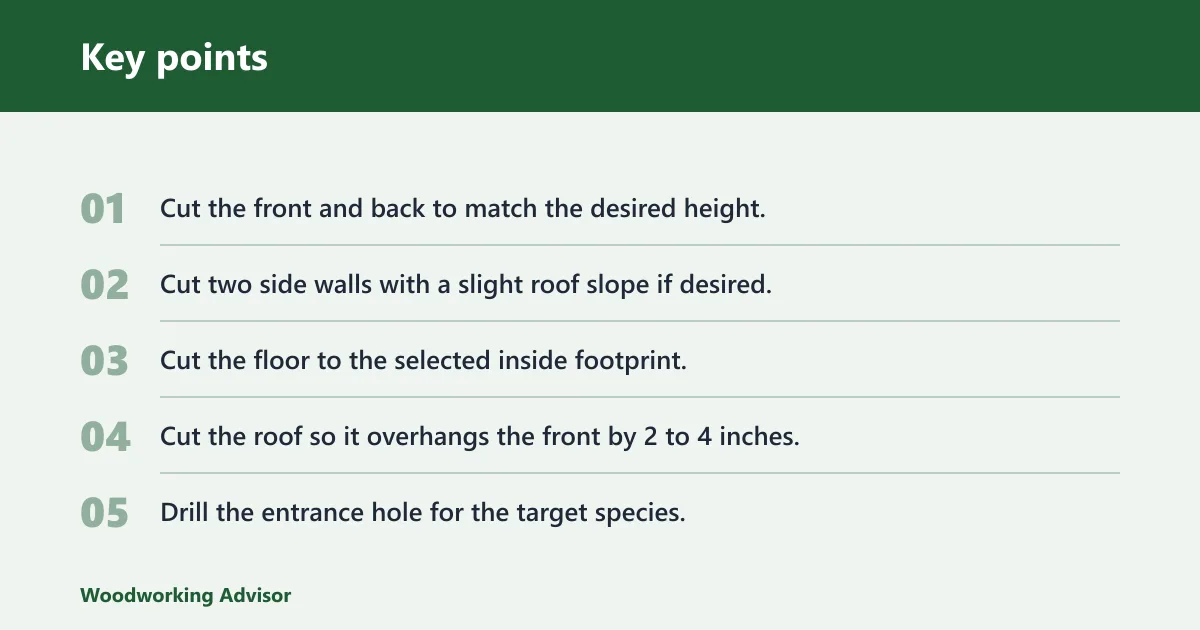
- Cut the front and back to match the desired height.
- Cut two side walls with a slight roof slope if desired.
- Cut the floor to the selected inside footprint.
- Cut the roof so it overhangs the front by 2 to 4 inches.
- Drill the entrance hole for the target species.
- Drill at least four drainage holes in the floor.
- Drill two 5/8-inch vent holes near the top of each side wall.
- Assemble with screws or nails that hold outdoors.
Vent holes, drainage holes, and roof overhang
Ventilation helps keep the box from overheating. The guide recommends two 5/8-inch vent holes near the top of each side wall. Drainage matters too. The guide recommends at least four drainage holes in the floor so water does not collect after rain.
The roof should overhang the front by 2 to 4 inches. That helps shed rain away from the entrance and keeps the opening drier. Weather protection does not need decoration. It needs enough cover to keep the cavity usable.
How do you clean it after nesting season?
Choose an easy-open design before the box goes up. A hinged side or hinged roof lets you clean out old nesting material after the season. That helps reduce parasites and prepares the house for the next breeding cycle.
Hinged side or roof access
The access panel should open without damaging the box. A simple hinge or removable side panel is easier to service than a fully fixed box. Make sure the closing edge is snug so the house still stays weather-resistant.
Seasonal cleaning steps
Wait until nesting is finished and the house is no longer in use. Open the access panel. Remove old nest material. Clear debris from the floor and check the entrance for damage. Then close the panel securely before the next season starts.
Repairs to check before next spring
Look for loose fasteners, cracked wood, clogged drainage holes, and warped roof sections. Check that the entrance size is still correct and that the mounting hardware remains stable. Small repairs now prevent a failed setup later.
Frequently asked questions
What wood should I use for a bird house?
Use untreated, unpainted pine, cedar, or fir with walls at least 3/4 inch thick. Those woods are practical for a beginner box and avoid chemical treatment inside the cavity. Avoid treated lumber and painted interiors because the nesting space should stay plain and safe.
Should a bird house have a perch?
No. A perch is not needed for cavity nesters and can give predators or larger birds a foothold at the entrance. A clean front with no perch is the better choice for bluebirds, swallows, chickadees, and most wrens that use enclosed boxes.
How do I keep squirrels and predators out of a bird house?
Mount the box on a free-standing metal pole or PVC pipe, not a tree or fence post. Skip the perch. Add a practical baffle if needed. Also keep the house in the right habitat, because a poorly placed box is easier for predators to reach.
Where should I mount a bird house for bluebirds or chickadees?
Bluebirds and tree swallows do best in open habitat such as fields, lawns, or open edges. Chickadees prefer wooded or forest-edge settings and can be mounted at 5 to 15 feet high. For both, a free-standing pole is better than a tree because it reduces climbing access.
Can I build a bird house from one board or scrap wood?
Yes, if the board is untreated and thick enough. A simple birdhouse can be made from a single board in about one hour. Scrap wood works only if it is sound, untreated, and large enough to cut the required walls, floor, and roof without forcing the dimensions.
Sponsored / affiliate links. As an Amazon Associate I earn from qualifying purchases. I may earn additional commission from eligible campaigns.