Elmer’s Wood Glue Review for Furniture Projects: Worth It?
Elmer’s Carpenter’s Wood Glue is a solid yes for tight, indoor furniture joints with good clamping, and a no for wet locations, badly fitted joints, or anything that needs extra water resistance. I use it on clean long-grain joints for basic furniture work, and I skip it the moment moisture or sloppy fit enters the picture.
This guide is part of our Wood glue essentials: types, uses, and cure times series.
Verdict


Use the wrong glue and a chair rail, tabletop seam, or veneer patch can creep, open, or fail after a season of use. I judge Elmer’s by joint type, moisture exposure, and clamp strategy, so you can choose it with confidence or pick a stronger alternative.
Pros and cons
- Pros: Good fit for indoor furniture repairs and builds; cleans up with water while wet; sands and paints after cure; usually easier to handle than thicker, water-resistant alternatives.
- Cons: Interior-focused; not the right pick for exposed outdoor furniture; weaker choice for end grain, loose joints, and mixed-material repairs; the tan or clear look can still telegraph through thin finishes if squeeze-out is missed.
According to Elmer’s Glue vs Wood Glue: Which Actually Holds Stronger? — Gorilla Wood Glue lists shear strength at 3,900 to 4,000 psi. (source)
Specs at a glance
| Item | Elmer’s Carpenter’s Wood Glue | Why it matters on furniture |
|---|---|---|
| Product type | PVA wood glue | Best suited to wood-to-wood joints, especially tight long-grain joints |
| Use case | Interior furniture and home repairs | Not intended as a wet-service adhesive |
| Claimed strength | Around 3,500-3,600 PSI | Useful as a reference, but ASTM D905-style numbers do not predict every chair or tabletop joint |
| Drying color | Brown or clear depending on variant | Matters on light finishes and open pores |
| Cleanup | Water while wet | Makes squeeze-out removal simple before cure |
| Surface behavior | Sandable and paintable | Helpful on paint-grade casework and repaired trim |
| Standard context | ASTM D905 is the common shear test reference for wood glue | Good for comparing lab numbers, not a substitute for real joint design |
Glue-All versus Carpenter’s Wood Glue
Elmer’s Glue-All and Elmer’s Wood Glue are separate product lines. That matters because Glue-All is a regular white PVA made for craft and paper work, not a structural furniture adhesive, and it is not water-resistant. Carpenter’s Wood Glue is the one to use on wood joints.
That split is easy to miss on a shelf. For a chair rail, apron, or cabinet frame, the wrong bottle can mean a bond that never belonged there.
Who it is for
Elmer’s Carpenter’s Wood Glue fits DIY woodworkers doing indoor repairs, face-frame cabinet work, small tables, and other furniture with tight joinery.It is not the right bottle for exposed exterior furniture or any joint that will live wet.
Best fit by reader type
- Good for: indoor chair repairs, casework, aprons, tabletops, and veneer work with clean contact surfaces.
- Good for: paint-grade furniture where cleanup, sanding, and color match matter more than maximum weather resistance.
- Not for: deck furniture, garden benches left in the weather, or loose joints that need gap filling instead of proper repair.
What works on furniture?
Its strongest use is on long-grain and edge-glue joints, where PVA wood glue normally performs best. On furniture parts that fit well, the glue line is thin, the clamping is straightforward, and the joint can fail in the wood before it lets go at the bond line. That is the result I want.
Where it tends to behave well
- Chair rails and aprons with clean shoulders and mating faces.
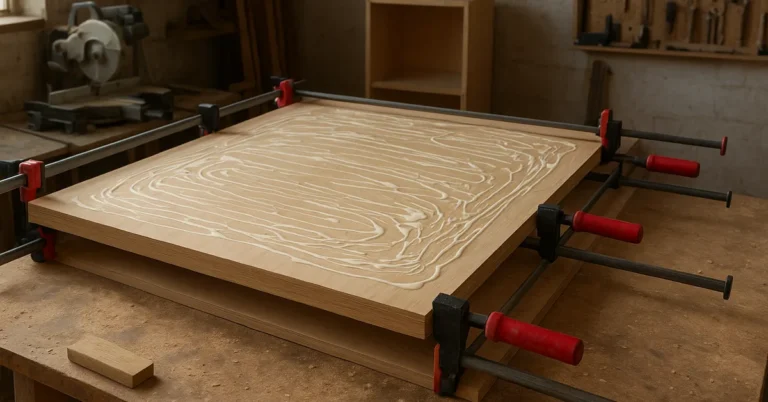
- Tabletop seams made from dry stock and well-prepared edges.
- Cabinet frames, face frames, and casework joinery.
- Loose internal joints that are cleaned, reglued, and clamped correctly.
- Veneered parts when the substrate is sound and flat.
Why it is appealing in the shop
Sandability and paintability matter more than many product pages admit. If a bead squeezes out on a cabinet rail or a small repair, water cleanup before cure keeps the line cleaner and cuts down on later scraping.
That said, clean squeeze-out is not proof of a strong joint. It only means the mess was managed well.
What does not?
It is weak where furniture glue failures usually begin: end grain, poor fit, and moisture exposure. End grain drinks adhesive and leaves little effective bond area, so a loose or sloppy joint will still be a weak joint after clamping. Big parts with lots of setup time also punish any glue with a short working window.
Common failure modes to avoid
- End grain: not the place to expect strong structural performance without proper joint design.
- Loose joinery: glue does not fix bad fit; it only locks in a bad fit.
- Moisture exposure: interior PVA is not a wet-service answer.
- Large glue-ups: if assembly drags on too long, open time becomes a real limit.
Moisture content matters
Dry stock matters, especially on larger glue-ups. Around 12% moisture is the practical upper edge people watch for furniture work, and wetter material can move after assembly, open seams, or telegraph stress into the glue line. That is one reason a tabletop or wide panel needs more discipline than a quick chair repair.
Clamp time is not cure time. A joint may be safe to move after clamping, yet still need a full day before it is loaded, scraped hard, or put into service.
Open time, clamp time, and cure time
- Open time: the working window before the glue starts to lose its grip and the assembly gets slippery or starved.
- Clamp time: the period under pressure before the part can usually be handled or unclamped.
- Cure time: the longer period before the bond reaches its real working strength.
Furniture-project decision table: where Elmer’s passes and fails
This table treats Elmer’s the way furniture failures happen in real life: by joint type, moisture exposure, and whether the part needs long-term reliability or only a short-term repair. Indoor use is the safe lane. Covered outdoor use is conditional. Exposed outdoor use is a fail.
| Project / exposure | Joint prep | Clamp time before moving | Indoor | Covered outdoor | Exposed outdoor | Verdict |
|---|---|---|---|---|---|---|
| Chair rails and rungs | Clean old glue, dry fit, tight mortise-and-tenon or dowel surfaces | Allow a full clamp cycle before handling; full cure before load | Pass | Conditional fail | Fail | Good indoors if the fit is tight; not the first choice where moisture or racking loads are high |
| Tabletops and panels | Flat, dry edge prep; even pressure across the full width | Keep clamped through initial set; avoid moving the panel early | Pass | Conditional fail | Fail | Fine for interior tops; for patio tabletops, move to a water-resistant glue |
| Cabinets and casework | Square parts, tight corners, correct cauls if needed | Clamp until the frame can be safely handled | Pass | Conditional pass | Fail | One of its better uses if the cabinet stays indoors |
| Loose joints | Scrape old residue, restore fit, avoid gluing over dust | Clamp until squeeze-out stabilizes | Pass | Conditional fail | Fail | Works when the joint is still mechanically sound; poor fit lowers the odds fast |
| Veneered parts | Flat substrate, even spread, light pressure, no trapped voids | Clamp gently but firmly; do not shift the sheet | Pass | Conditional fail | Fail | Useful for repairs, but moisture and movement are the enemy |
How does Elmer’s compare with Gorilla and Titebond III?
Gorilla Wood Glue lists a shear strength of 3,900 to 4,000 psi, uses ASTM D905-style testing language in the category, and This Old House lists a 20 to 30 minute drying time. Titebond III is the waterproof benchmark many woodworkers use for outdoor builds, and Repairman Knows calls it the best overall wood glue. Elmer’s sits below those two when moisture or working time matter most.
Shear strength and test standards
Claimed strength around 3,500-3,600 PSI puts Elmer’s in the normal furniture-glue conversation, but the number should be read through ASTM D905-style testing, not as a promise that every joint will fail in the wood first. A well-fit long-grain joint can beat a higher-numbered glue in a bad joint.
Open time and clamp time
Gorilla Wood Glue is attractive when faster clamp release matters, and Titebond III is the one many buyers reach for when the glue-up takes longer or the project is larger. Elmer’s is fine when the assembly is simple and the parts go together quickly, but it is less forgiving on wide tabletops or chair assemblies with several moving parts. (thisoldhouse.com)
Water resistance and outdoor use
ANSI/HPVA Type I is generally treated as the waterproof standard, while Type II is commonly used where some water resistance is needed, such as kitchens, bathrooms, and covered outdoor exposure. Elmer’s Carpenter’s Wood Glue is not the bottle to trust for exposed outdoor furniture; it is an interior glue first, and This Old House lists it as waterproof in a product roundup context, which conflicts with how it is typically positioned for interior furniture use. For outdoor builds, Type II or Type I glue is the safer lane.
Which bottle wins for furniture repairs
For indoor repairs, Elmer’s can be the value play. For faster clamp release and stronger moisture tolerance, Gorilla Wood Glue is usually the better fit. For outdoor or wet-service furniture, Titebond III is the safer choice and the baseline many woodworkers use when failure would be expensive.
Should you buy it?
Buy Elmer’s Carpenter’s Wood Glue when the work is indoor furniture, the joints fit well, and the price matters more than maximum water resistance. Skip it when the project lives outdoors, sees repeated dampness, or needs a longer open time for a complex assembly. For those jobs, a Type II or Type I PVA is money better spent.
Cost check
This Old House says most wood glues cost between $10 and $20, and it lists Elmer’s Carpenter’s Wood Glue as a 16-ounce bottle. The product data here prices an 8-ounce Elmer’s bottle at $8.77, which is about $1.10 per ounce. That is not the cheapest lane, but it is still reasonable for a small repair bottle.
Compared with Titebond II at $5.44 for 8 ounces, Elmer’s is the pricier bottle in this set on a per-ounce basis. Gorilla and Titebond III usually earn their keep when the project needs more moisture resistance, not when the repair is a small indoor chair rail.
Best-value situations
- Small indoor chair repairs where a little bottle is easier to handle than a full-size jug.
- Cabinet and casework repairs where cleanup and finish behavior matter.
- Projects that do not justify paying extra for exterior performance.
When to spend more
- Covered patio furniture with regular damp exposure.
- Any exposed outdoor table, bench, or chair.
- Large glue-ups where a longer working window helps alignment.
Alternatives


Titebond II Premium is the smarter buy when the joint may see moisture, especially on covered outdoor furniture, kitchens, bathrooms, or any interior build where water resistance matters more than saving a few cents. Its lower price in the product data also makes it a strong value pick for many furniture jobs, though it is still not the full waterproof answer.
Elmer’s Carpenter’s Wood Glue is still the easiest choice for straightforward indoor furniture work when the fit is good and the assembly is short. Its drawback is simple: once the project moves into wetter service or sloppier joinery, the glue choice stops being the weak link and the joint design becomes the problem.
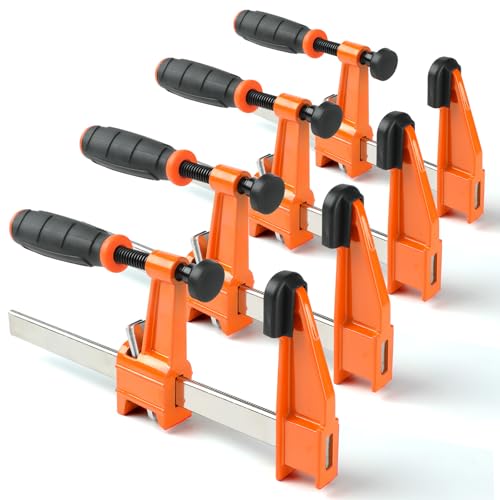
These quick-release bar clamps are not glue, but they matter because clamp strategy changes the result as much as the adhesive. A set like this helps with tabletop seams and cabinet frames, though the 6-inch format is limiting on larger panels and wide chair assemblies. For long glue-ups, clamp reach still has to match the work.
Frequently asked questions
Is Elmer’s wood glue strong enough for furniture projects?
Yes, for tight indoor furniture joints it is strong enough in normal use. The key is fit. On long-grain joints, clean surfaces, and proper clamping, it can do the job well. On loose, end-grain, or moisture-prone joints, strength numbers matter less than the joint design and the service environment.
Is Elmer’s wood glue waterproof or just water-resistant?
For furniture buyers, it should be treated as an interior glue, not a wet-service adhesive. ANSI/HPVA Type I is the waterproof class and Type II is the water-resistant class used for harder environments. Elmer’s Carpenter’s Wood Glue belongs in the indoor category unless the packaging clearly says otherwise for a specific variant.
How long does Elmer’s wood glue need to clamp before moving the piece?
Clamp time is not full cure time, so the part should stay in pressure long enough to hold alignment before handling. For furniture work, the practical rule is to wait until the joint can be moved without shifting, then give it a full cure period before hard use or machining.
Does Elmer’s wood glue work on hardwoods and softwoods?
Yes, it can work on both hardwoods and softwoods when the joint is tight and the surfaces are clean. Hardwood and softwood do not change the rules much; fit, moisture content, and clamp pressure matter more. It is less forgiving on porous end grain and poorly prepared repairs.
How does Elmer’s wood glue compare with Titebond or Gorilla Wood Glue?
Gorilla Wood Glue lists 3,900 to 4,000 psi shear strength and is favored for faster clamp release, while Titebond III is the better outdoor baseline and a stronger pick for wet exposure. Elmer’s is fine for indoor furniture, but it is the least compelling choice when water resistance or longer working time matter.
Can Elmer’s wood glue be used for outdoor furniture?
Not for exposed outdoor furniture. That is the wrong service condition for an interior PVA. For covered patio pieces, a Type II or Type I glue is safer. If the chair, bench, or table will face rain, sun, and seasonal movement, choose a glue made for that duty.
What is the drying color of Elmer’s wood glue?
Elmer’s Carpenter’s Wood Glue can dry brown or clear depending on the variant. That matters on open-grain woods and paint-grade work, where glue line visibility can show through. Color is still secondary to fit, though. A neat-looking glue line is not the same thing as a durable bond.
How much does Elmer’s wood glue cost compared with other brands?
The product data here lists an 8-ounce Elmer’s bottle at $8.77, which is about $1.10 per ounce. Titebond II is listed at $5.44 for 8 ounces, which is cheaper on a simple ounce basis. For a small indoor repair, Elmer’s can still be worth it; for larger glue-ups, cost per ounce starts to matter more.
Sponsored / affiliate links. As an Amazon Associate I earn from qualifying purchases. I may earn additional commission from eligible campaigns.