How Much Does Hard Maple Lumber Cost Per Board Foot?
Hard maple lumber is often reported at about $5 to $12 per board foot for FAS/Select stock, with common shop-grade and rough-sawn material sometimes closer to about $4 to $9, depending on thickness and supplier. Miss the grade or surfacing details, and your “cheap” quote can jump fast at checkout. This opening covers the price band, then shows how thickness, grade, surfacing, and waste change the total you actually pay.
Typical cost range
For a practical buying range, hard maple often lands near the middle of the hardwood market: one guide lists it at $8–$12 per board foot, while another calculator places it at $5–$10 per board foot. Treat those numbers as price bands from past yard quotes, not guarantees. Region, grade, thickness, and surfacing can move the quote in either direction.
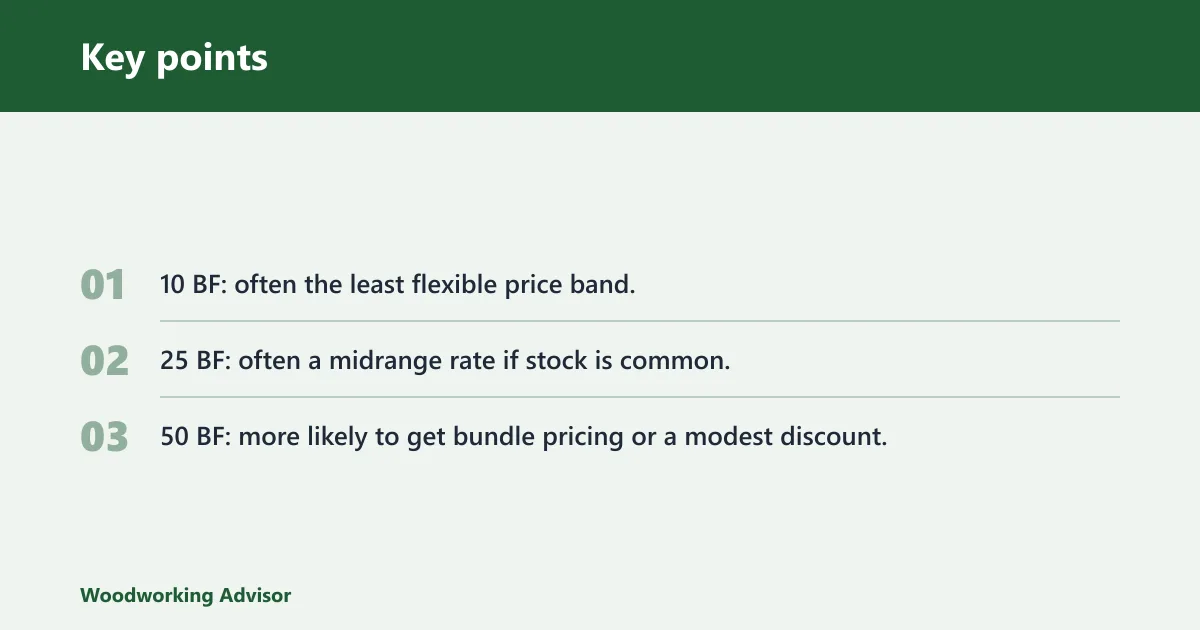
For small purchases, expect the per-BF rate to sit toward the top of the band. At 10 BF, the sawyer or retail yard is less likely to discount than it is at 50 BF. At 25 BF, many yards price closer to the middle, especially if you accept mixed widths or rough stock with a little more selection work.
When a quote looks low, check three things first: whether it is rough or surfaced, what grade it is, and whether the yard is quoting mixed widths. A board that is wide, defect-free, and already surfaced can cost more than a rough board of the same species name. That is normal.
How quantity changes the rate
Buying more usually lowers the rate a bit, but not always by much. The same hard maple board can be priced one way at a yard’s retail rack and another way in a bundle or mill-run order. Compare board-foot price first, not the sticker total, so you can see whether the larger order truly saves money.
- 10 BF: often the least flexible price band.
- 25 BF: often a midrange rate if stock is common.
- 50 BF: more likely to get bundle pricing or a modest discount.
When a yard quote is low or high
A quote is usually low when the boards are narrow, mixed in appearance, and sold rough. A quote is usually high when the stock is FAS, wide, thick, or already surfaced on both sides. If the yard also charges for milling, the checkout total can move well above the posted lumber rate.
What is a board foot?
A board foot is 144 cubic inches, and hardwood is commonly sold by that unit. For rough lumber, the standard formula is thickness × width × length ÷ 12 when length is in feet. That makes it easy to compare boards of different sizes on the same pricing basis.
The board foot formula
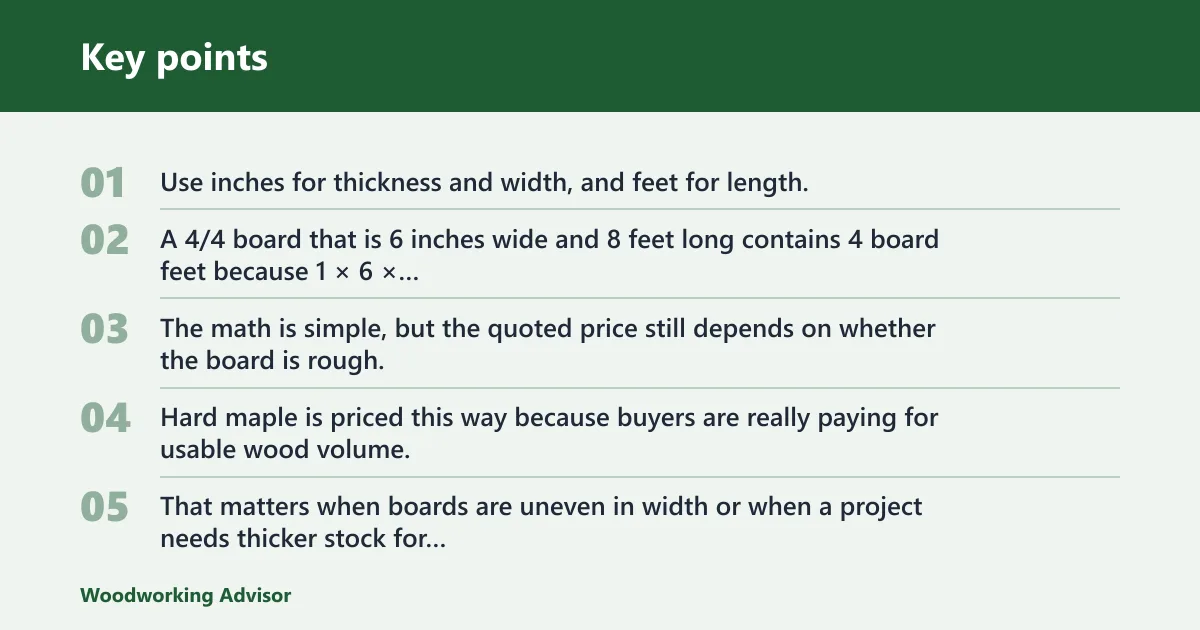
Use inches for thickness and width, and feet for length. A 4/4 board that is 6 inches wide and 8 feet long contains 4 board feet because 1 × 6 × 8 ÷ 12 = 4. The math is simple, but the quoted price still depends on whether the board is rough, surfaced, graded, or selected for wide width.
Hard maple is priced this way because buyers are really paying for usable wood volume, not just the board count. That matters when boards are uneven in width or when a project needs thicker stock for joinery, turning, or later surfacing.
Rough thickness notation
Rough hardwood thickness is quoted in quarters of an inch. A 4/4 board is 1 inch rough thickness, 5/4 is 1.25 inches, and 8/4 is 2 inches. After surfacing, the usable thickness is lower: a 4/4 board surfaces to about 13/16 inch or 3/4 inch, a 5/4 board surfaces to about 1 1/16 inch, and an 8/4 board surfaces to about 1 3/4 inch.
That reduction matters. If you need a finished 1-inch part, 4/4 stock may not leave enough margin after flattening and jointing. In that case, 5/4 is often the safer purchase.
Hard maple worksheet
This worksheet gives a simple hard-maple buying matrix for common rough stock. It is meant for budgeting, not for a live quote. Use it to compare thickness bands and to see how a lower per-BF price can still produce a larger checkout total once waste and surfacing are added.
| Stock | 10 BF | 25 BF | 50 BF |
|---|---|---|---|
| 4/4 | $50–$120 | $125–$300 | $250–$600 |
| 5/4 | $55–$130 | $138–$325 | $275–$650 |
| 8/4 | $65–$150 | $163–$375 | $325–$750 |
These bands assume a rough-hardwood buying context and reflect the common reality that thicker stock costs more per board foot. The numbers widen because board width, grade, and region can move the quote. A yard that leans toward cabinet-grade stock may sit toward the top end, while a mixed-rack supplier may sit lower.
Checkout formula with waste and surfacing
Use this formula to budget the final bill:
Total cost = [(project BF × waste factor) + extra BF for defects] × board-foot price + surfacing charges
Plan on 15–20% extra for waste and defects. For straight cuts and simple parts, 10–15% may be enough. If the layout includes angles, short parts, or boards with knots and checks, use the higher end or more.
- Calculate your project board feet.
- Add waste at 10–20%, depending on cut layout.
- Multiply by the price per board foot.
- Add surfacing or milling fees separately.
- Check whether the board thickness still fits the finished part.
If a project needs about 20 BF of finished parts and you allow about 20% waste, a common rule of thumb is to budget for 24 BF before milling charges. If the yard charges extra for S2S work, that fee is added after the lumber subtotal, not hidden inside the species price.
Why does hard maple cost more in thicker stock?
Thicker hard maple usually costs more per board foot because it takes longer to dry, requires larger logs, and gives the mill less flexibility in how it can be sawn. An 8/4 board is also more likely to carry a premium because many buyers need it for table legs, thick edges, or parts that must stay stable after surfacing.
4/4 versus 8/4 pricing
4/4 is the common baseline. 8/4 often carries a higher board-foot price because fewer logs can yield it cleanly, and the board must stay sound through more drying time and more movement control. Even when the sticker price per BF looks close, the thicker board can cost more overall once waste and surfacing are included.
A common first-timer mistake is buying 4/4 for a part that needs a finished 7/8 inch thickness after jointing. After flattening, the board may come up short. The safer move is to buy 5/4 or 8/4 when the finished dimension leaves little room for cleanup.
Drying and yield effects
Thicker stock loses more time in the kiln or air-drying stack, and that affects yard pricing. It also removes more usable volume when a board must be trimmed for defects, cup, or end checking. The seller is pricing the risk of lower yield, not just the raw volume of wood.
How do grade and width change the price?
Grade and width both matter a lot in hard maple pricing. FAS is the highest hardwood grade and usually costs more because it contains fewer defects and yields more clear cutting stock. #1 Common is a cabinet-grade option that may price lower, but the buyer gives up some clear area and may need more boards to finish the job.
Grade: FAS and #1 Common
FAS is typically the higher-priced choice for wide, clear panels and visible work. #1 Common often makes sense for cabinet parts, face frames, and smaller components where short clear sections are enough. Lower grades bring more knots, color variation, or defect repair work, and that lower yield is why the price drops.
Hard maple is grouped with cabinets, floors, and butcher block uses, and that demand pulls pricing upward when clear stock is scarce. It is often described as a “Very Hard” species, which also helps explain why buyers pay attention to grade before they price the rest of the build.
Wide boards often cost more per board foot, especially above about 11 inches. Larger logs are harder to source, and wider clear cuts are rarer. A 12-inch board with good grain and low defect content may be priced above a narrow board even when both are the same thickness and length.
Picture a shelving project that calls for 10-inch-wide boards. If the yard only has 6-inch stock in the grade you want, you may need to glue up narrower pieces or buy a higher grade than planned. That can raise both waste and cost.
What extra costs change the final total?
Surfacing and milling can change the checkout total as much as the lumber price itself. S2S work reduces rough thickness and adds labor cost, but it gives you a flatter, more usable board. The tradeoff matters most when the project needs a specific finished thickness or when the boards must be ready for glue-up.
Surfacing and milling charges
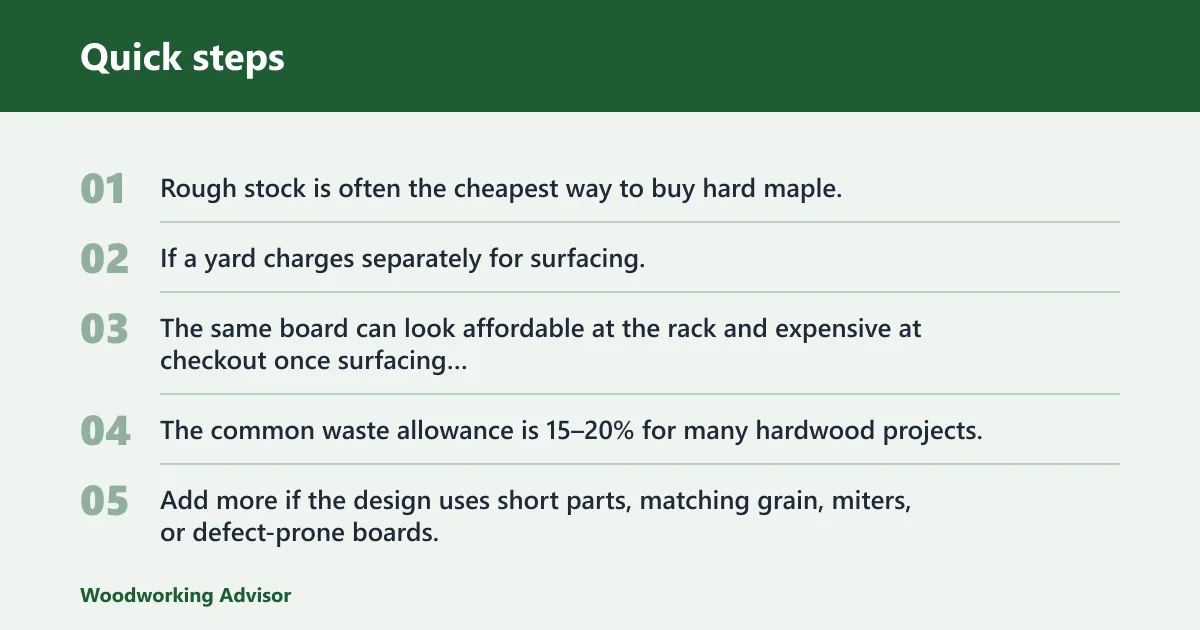
Rough stock is often the cheapest way to buy hard maple, but surfaced lumber is easier to use. If a yard charges separately for surfacing, that fee should be treated like a shop service, not ignored in the lumber budget. The same board can look affordable at the rack and expensive at checkout once surfacing is added.
Waste allowance and layout losses
The common waste allowance is 15–20% for many hardwood projects, and 10–15% is a fair minimum for straightforward layouts. Add more if the design uses short parts, matching grain, miters, or defect-prone boards. Hard maple is hard enough to machine cleanly, but it still loses yield when the cut plan is tight.
Suppose a cabinet side needs a 7-inch-wide, 24-inch-long blank from a 4/4 board. If the only board available is 6 1/2 inches wide after trimming, it will not work without a glue-up or a wider board. That is a width problem, not a species problem, and it changes the real cost immediately.
Failure cases to price before you buy
If the board is too narrow, you may need to glue up two boards, which increases labor and can force a higher grade purchase. If it is too short, you lose yield to trimming and may need another board for the missing length. If the part needs thicker quarter stock than the plan allows, 4/4 will not be enough after surfacing.
Frequently asked questions
How much is hard maple per board foot right now?
A practical current buying band is about $5 to $12 per board foot, with some guides placing hard maple at $8 to $12 and others at $5 to $10. The exact number depends on grade, thickness, width, surfacing, and local supply. Small purchases usually sit toward the higher end.
What is a fair price for hard maple lumber?
A fair price is one that matches the form you are buying. Rough 4/4 stock should not be priced like FAS, wide, surfaced boards. If a quote sits around the middle of the published hard-maple band and the grade is clear, it is usually reasonable for retail buying.
How do I calculate board feet for hard maple boards?
Use thickness × width × length ÷ 12 when length is in feet. The result is the board-foot volume of rough hardwood. For example, a 1-inch-thick, 6-inch-wide, 8-foot board equals 4 board feet. The formula works the same for hard maple as for other rough hardwoods.
Is hard maple priced by board foot or linear foot?
Hard maple is normally priced by the board foot, not the linear foot. Linear-foot pricing can hide width and thickness differences, which makes it hard to compare boards fairly. Board-foot pricing is better for rough hardwood because it reflects the actual volume you are buying.
How much extra hard maple should I buy for waste?
Plan on 15–20% extra for many hardwood projects. For simple straight cuts, 10–15% may be enough. If the layout has angles, short parts, or boards with defects, add more. That cushion helps cover offcuts, trim loss, and boards that do not meet the cut list.
Is hard maple more expensive than walnut per board foot?
Not always. Hard maple can be below walnut in some markets, and it can move above walnut in others when wide, thick, or high-grade maple is scarce. Regional supply and the form you buy matter more than a fixed species ranking. Compare the actual yard quote, not the species name alone.
Sponsored / affiliate links. As an Amazon Associate I earn from qualifying purchases. I may earn additional commission from eligible campaigns.