Hard Maple vs Soft Maple for Furniture: Uses Compared
For furniture, hard maple is better for tops, chairs, and wear points; soft maple is usually the smarter buy for painted pieces, cabinet parts, and most casework because it machines similarly, weighs less, and costs less. I have seen people choose by the word “hard” alone, then pay extra for added weight, blotchy stain, or dinged-up edges in spots that never needed the harder stock. This guide sorts the choice by part, finish plan, dent risk, weight, and budget, then gives picks for tables, chairs, cabinets, drawer fronts, and painted work.
This guide is part of our Maple Species Hardness Chart: Janka Rating Compared series.
| Factor | Hard Maple | Soft Maple: Which Is Better For Furniture | Winner |
|---|---|---|---|
| Cost | Usually costs more, especially when the project does not need extra dent resistance. | Usually less expensive because the trade name covers several species and supply is broader. | Soft Maple: Which Is Better For Furniture |
| Lifespan in wear-prone furniture parts | Best when abuse resistance matters; on tops, edges, chair parts, and other impact-prone components, dents and visible damage show up more slowly. | Holds up well in many furniture parts, but on busy horizontal surfaces and corners that catch blows, it usually shows more visible damage than hard maple. | Hard Maple |
| Maintenance / finish prep | Strong under clear finish, but stain can turn uneven without careful prep; many builders find it can fight stain. | Often a simpler pick for stain and paint, with fewer blotch headaches and more predictable color in furniture work. | Soft Maple: Which Is Better For Furniture |
| Performance: dent resistance | Typically Acer saccharum and measures 1,450 lbf on the Janka scale. | A broad grouping that commonly ranges from 700 to 950 lbf on the Janka scale. | Hard Maple |
| Performance: weight and handling | About 44 lb per cubic foot dried to 12% moisture content; denser and heavier, which can make handling, shipping, and moving harder. | Often lighter; examples include red maple at 38 lb/ft3, bigleaf maple at 34 lb/ft3, and silver maple at 33 lb/ft3, making finished pieces easier to move and own. | Soft Maple: Which Is Better For Furniture |
| Best-fit use | Better for tops, chairs, exposed edges, desk fronts, chair stretchers, front legs, and other wear points. | Usually the smarter buy for painted pieces, cabinet parts, most casework, doors, drawer fronts, broad painted panels, and lower-wear parts. | Hard Maple |
| Finish path for stain and paint | Can look excellent under clear finish, but darker color introduces uneven absorption as a real variable. | Often the easier route for stained Shaker cabinets, painted chests, or toned finishes where predictable color matters more than maximum hardness. | Soft Maple: Which Is Better For Furniture |
| Overall furniture value | Best when abuse resistance matters. | Best when finish strategy, lower weight, and budget matter more than maximum hardness. | Tie |
Dent resistance
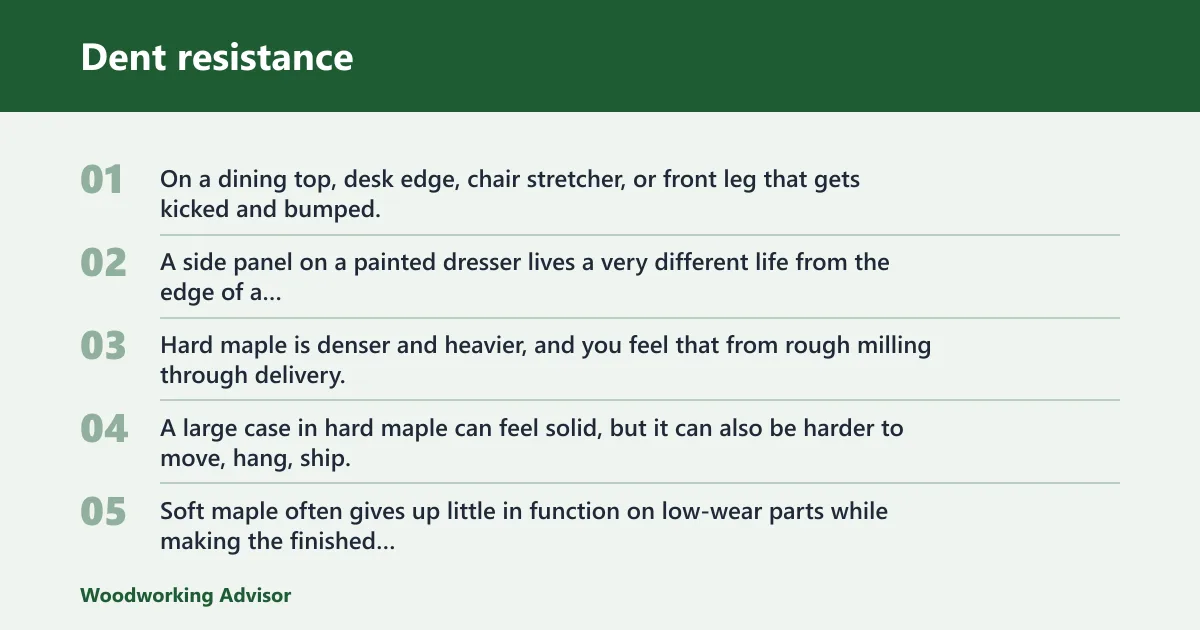


This is the clearest win for hard maple. On a dining top, desk edge, chair stretcher, or front leg that gets kicked and bumped, the extra hardness pays back fast in ordinary use.
It does not matter equally everywhere. A side panel on a painted dresser lives a very different life from the edge of a breakfast table.
Weight and density
Hard maple is denser and heavier, and you feel that from rough milling through delivery. A large case in hard maple can feel solid, but it can also be harder to move, hang, ship, and wrestle up stairs.
Soft maple often gives up little in function on low-wear parts while making the finished piece easier to own and easier to move.
Finish path for stain and paint
Many builders find that hard maple can fight stain. It can look excellent under clear finish, but once darker color enters the plan, uneven absorption becomes a real variable.
Soft maple is often the easier route for a stained Shaker cabinet, a painted chest, or a toned finish where predictable color matters more than top-end hardness.
Best fit for high-wear furniture parts
Hard maple pays for itself on dining tops, desk fronts, chair stretchers, and exposed edges that hands, plates, shoes, and belt buckles hit over and over. Soft maple holds up well in many furniture parts, but on busy horizontal surfaces and corners that catch blows, hard maple usually keeps the visible damage down.
Cost sensitivity
Paying more makes sense when the extra hardness will actually stop dents on a top, chair leg, stretcher, or front edge that people see every day. Paying more for hidden rails, broad painted panels, or a low-abuse bookcase side usually buys little except heavier boards and a higher lumber bill.
📊 Hard maple averages about 44 lb per cubic foot dried to 12% moisture content. Source: Wood-database.
What do hard maple and soft maple actually mean?
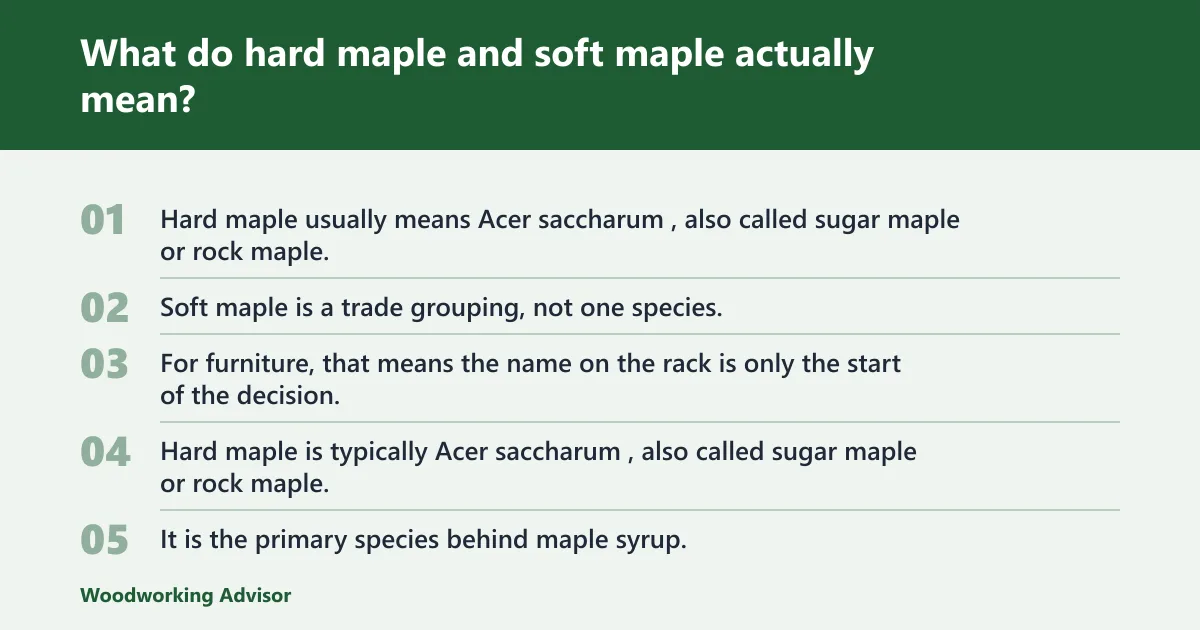
Hard maple usually means Acer saccharum, also called sugar maple or rock maple. Soft maple is a trade grouping, not one species, and can include several maples with different hardness and weight. For furniture, that means the name on the rack is only the start of the decision.
Hard maple usually means Acer saccharum
Hard maple is typically Acer saccharum, also called sugar maple or rock maple. It is the primary species behind maple syrup, but for furniture builders the useful points are simpler: it is the denser, heavier maple and the one usually picked for high-wear parts.
On the Janka scale, hard maple measures 1,450 lbf. That puts it in the range where dents, edge bruising, and abrasion show up more slowly.
Soft maple is a trade grouping, not one species
Soft maple is a broad label, not a single species. Common soft maple species include bigleaf maple, box elder, red maple, silver maple, and striped maple.
At the furniture level, that matters because one “soft maple” board may act much closer to hard maple than another. Acer rubrum is a common soft maple species and is often around 950 lbf. Acer saccharinum is another common soft maple species and is often closer to 700 lbf. On the West Coast, Acer macrophyllum often shows up in the soft maple grouping.
Why the names mislead furniture buyers
Maple in both groups comes from broadleaf trees, so both are botanically hardwoods. In the shop, “soft” does not mean weak, and “hard” does not mean it wins every job.
The real mistake is turning a category name into a blanket verdict. Furniture parts do different jobs. Tops need dent resistance. Doors need stability and lower weight. Painted casework needs clean machining and an easy finish path more than it needs maximum Janka numbers.
How much harder is hard maple than soft maple?
Hard maple is meaningfully harder in real furniture use. Hard maple measures 1,450 lbf on the Janka scale, while soft maple commonly falls between 700 and 950 lbf. In practice, hard maple is often noticeably harder than many soft maples, which tends to show up most on tops, edges, and chair parts.
What the Janka test actually measures
The Janka test measures force to embed a 0.444-inch steel ball halfway into wood. It is a dent-resistance test, not a full summary of strength, stiffness, or joinery behavior. (wood-database.com)
That makes it useful for furniture. If a child drops a metal cup on a dining table or shoes catch a stretcher, Janka is part of the story.
Where the extra hardness matters
It matters most on horizontal surfaces and exposed corners. Dining tops, desk tops, chair seats, front legs, stretchers, and drawer fronts all get touched, hit, or rubbed in ways that leave marks.
Hard maple is usually the better call when the damage will be easy to see and annoying to live with. A breakfast nook table is a good example. So is a chair rung that gets shoe contact every day.
Where it does not matter much
It matters far less on side panels, web frames, interior rails, cabinet doors that are handled gently, and paint-grade casework. In those places, soft maple can perform without issue while keeping the project lighter and cheaper.
That is the point many broad comparisons miss. A whole piece is not one part.
How do weight and density change the build?
Weight changes more than carrying effort. Hard maple averages about 44 lb per cubic foot dried to 12% moisture content, while common soft maple species are often lighter, such as red maple at 38 lb/ft3, bigleaf maple at 34 lb/ft3, and silver maple at 33 lb/ft3. That affects handling, shipping, assembly, and how heavy the furniture feels in use.
Handling and milling
Heavier stock is harder to move through a small shop and harder to wrestle onto machines. On a narrow chair leg blank, that difference is minor. On a wide case side or thick tabletop panel, it becomes obvious.
Soft maple often feels friendlier during milling and dry assembly because the parts are less tiring to lift and rotate.
Shipping, delivery, and installation
Large dressers, media cabinets, and wardrobes can become awkward very fast in hard maple. If the project has to go upstairs, hang on a wall, or ship any distance, lower density can be a real design advantage.
There is also a day-to-day use factor. A dining chair that is too heavy gets dragged. A movable side table that weighs less gets used more easily.
Perceived quality versus practical weight
Some buyers equate weight with quality, and there is some truth in that feeling. A hard maple table can feel substantial in a good way.
But there is a limit. Extra mass on a coffee table top is different from extra mass in cabinet doors or a chest that needs to be moved for cleaning. Good furniture balances feel with function.
Which maple finishes better for furniture?
Soft maple is often easier when stain or paint is part of the plan, while hard maple can also look best under a clear finish. Neither species gets a free pass on prep. The better finisher depends on the finish path: clear, stained, or painted.
Clear finish on hard maple and soft maple
Under a clear finish, both can look clean and bright. Hard maple is a common choice when the goal is a pale, crisp surface with strong wear resistance.
Soft maple can also look excellent clear, especially when the project does not need the densest stock available. The practical difference under clear finish is often less about color and more about whether the part needs hard maple’s added surface toughness.
Staining behavior and blotch risk
Hard maple can stain unevenly. It can go patchy or muddy if the prep schedule and coloring method do not match the board.
Soft maple often stains more predictably, though it is still a wood that benefits from sample boards, sharp sanding discipline, and a tested sequence. This is where projects go bad. If a project must hit a medium or dark stain target and the visible parts are broad, soft maple may be the smarter furniture wood even when it is less hard.
Painted furniture
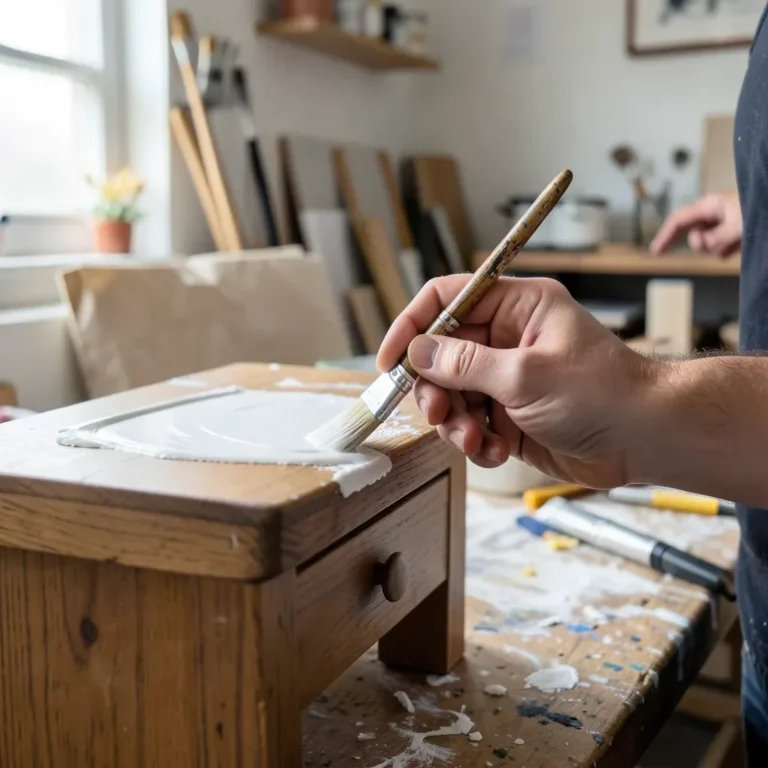
For painted furniture, soft maple is often the easy winner. It machines cleanly, keeps weight down, and does not ask the buyer to pay for dent resistance that primer and paint do not reveal.
That is especially true for case sides, face frames, doors, and drawer fronts on built-ins, wardrobes, and dressers where paint is the plan from the start.
Which maple is better for tabletops and chair parts?
Hard maple is usually better for tabletops and chair parts because these parts take repeated impact, abrasion, and edge wear. Soft maple can still work on lighter-duty tables or occasional chairs, but hard maple proves its value fastest on surfaces and structures that get touched and bumped every day.
Tabletops and desks
For dining tables, kitchen tables, homework desks, and work-from-home desktops, hard maple is usually the safer pick. The top is where dents collect and where every scratch catches light.
Soft maple is reasonable for an occasional table, a low-use side table, or a painted top where future dents are less visible and easier to accept.
Legs, rails, and chair parts
Chair parts are high-risk parts. Front legs get kicked. Stretchers get shoe wear. Chair backs and rails see racking loads during use and movement.
Hard maple usually makes more sense here, especially on slender members and exposed corners. For cabinet rails and face frames in lower-abuse furniture, soft maple is often fully adequate.
Doors, drawer fronts, and case goods
This is where soft maple starts to look strong. Cabinet doors and drawer fronts need to hold up, but they often benefit more from lower weight and a friendlier finish path than from top-end hardness.
For full casework, soft maple is often the more sensible species unless the piece has a heavy-use top integrated into it.
Best furniture uses by part type
Where hard maple earns its extra cost
- Dining and desk tops
- Chair legs, stretchers, and other high-contact chair parts
- Exposed edges likely to take knocks
- Drawer fronts on heavily used family furniture where edge wear will show
Where soft maple is often the smarter furniture wood
- Painted case goods
- Cabinet frames and many rails
- Doors and panels where lower weight helps
- Drawer fronts and face frames when stain or paint predictability matters more than maximum dent resistance
- Large cabinets, wardrobes, and built-ins where moving and installing weight matters
Movement and humid-room design
Wide tops, doors, and side panels need sound design whichever maple is chosen. Seasonal movement still matters. Floating panels, sensible grain orientation, and room for expansion matter more than whether the board says hard or soft on the rack.
In humid rooms, lower weight can also be useful on doors because heavy doors stress hinges and invite sag over time if the build is marginal.
Furniture-part decision table and pass/fail checklist
Decision table by furniture component
| Furniture component | Finish type | Dent risk | Weight concern | Cost sensitivity | Better pick | Why |
|---|---|---|---|---|---|---|
| Dining tabletop | Clear or light clear | High | Low to medium | Medium | Hard maple | High-wear horizontal surface where 1,450 lbf hardness pays off. |
| Desk top | Clear or toned clear | High | Medium | Medium | Hard maple | Better resistance to keyboard, tool, and edge dents. |
| Coffee table top | Paint or stain | Medium | Medium | High | Soft maple | Often enough durability with lower cost and an easier finish path. |
| Chair legs and stretchers | Clear or stain | High | Low | Low to medium | Hard maple | Impact-prone parts where visible bruising matters. |
| Table aprons and rails | Any | Low to medium | Low | High | Soft maple | Usually hidden from direct abuse, so extra hardness buys little. |
| Drawer fronts | Paint or stain | Medium | Low | Medium | Soft maple | Good value unless the piece will take frequent knocks. |
| Cabinet doors | Paint, stain, or clear | Low to medium | High | High | Soft maple | Lower weight helps hinges and handling. |
| Face frames | Paint or stain | Medium | Low | High | Soft maple | Machines similarly and usually gives better value. |
| Case sides and panels | Paint or stain | Low | High | High | Soft maple | Weight and cost matter more than top-end dent resistance. |
| Painted dresser or cabinet | Paint | Low to medium | High | High | Soft maple | Lower weight, lower cost, and no need to pay for hidden hardness. |
Pass/fail checklist
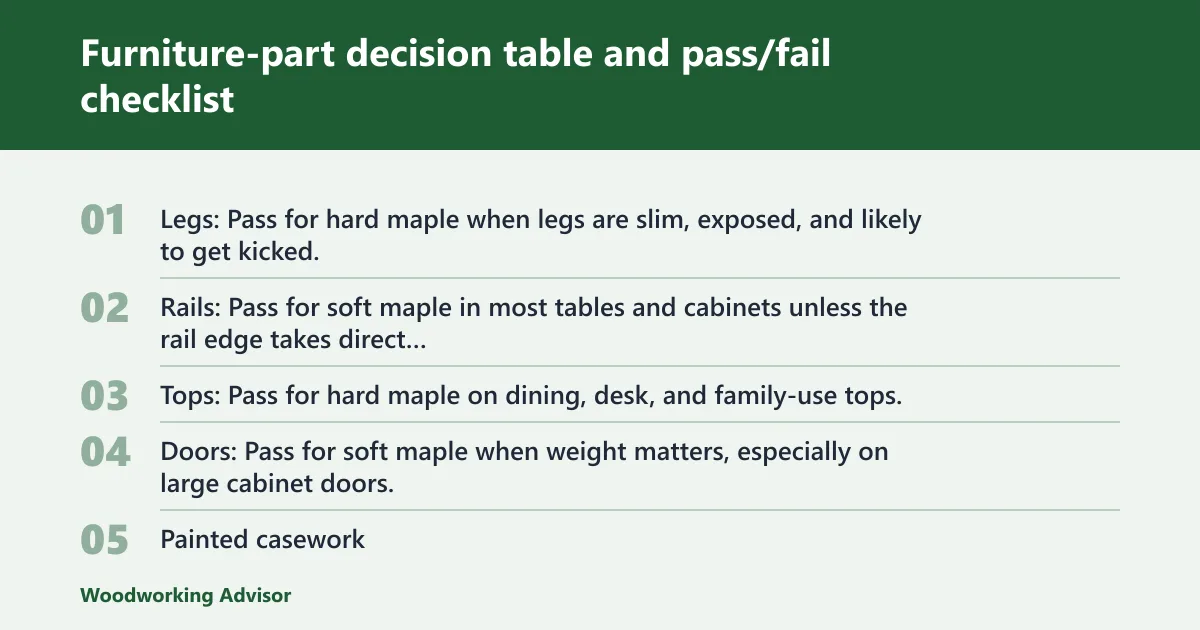
- Legs: Pass for hard maple when legs are slim, exposed, and likely to get kicked. Pass for soft maple when legs are chunky, low-wear, or painted.
- Rails: Pass for soft maple in most tables and cabinets unless the rail edge takes direct abuse or the part is unusually thin.
- Tops: Pass for hard maple on dining, desk, and family-use tops. Pass for soft maple on occasional tables or painted tops where moderate denting is acceptable.
- Doors: Pass for soft maple when weight matters, especially on large cabinet doors. Fail hard maple if the only benefit is bragging rights.
- Painted casework: Pass for soft maple almost every time. Fail hard maple when the project is broad, heavy, and fully painted.
Why does soft maple cost less than hard maple?
Soft maple usually costs less because it covers a wider mix of species, is often lighter and lower in demand for heavy-wear applications, and can be easier to source regionally. The lower price is not a warning sign by itself. Often it simply means the wood is a better match for more ordinary furniture parts.
Species mix and demand
Hard maple has a strong reputation in wear-heavy uses, so demand stays high where dent resistance matters. Soft maple covers a broader pool of boards and species, which often widens supply.
That trade-name grouping helps keep price lower, though the exact gap varies by market and grade.
Regional availability changes the label
What a yard sells as soft maple changes by region. East Coast supply often means red maple or silver maple. West Coast yards may carry bigleaf maple under the same soft maple umbrella.
That affects weight, appearance, and hardness, so the best move is to ask what species are in the stack instead of buying the label blindly.
When paying extra buys little
Paying up for hard maple makes weak economic sense on painted cabinets, broad side panels, low-wear doors, and hidden structural parts. Those are the places where soft maple often returns more practical value per board.
How can you tell hard maple from soft maple in the lumber yard?
Reliable identification starts with paperwork and questions, not color. Ask the yard for the species name, check the invoice, compare board weight in similar sizes, and use endgrain only as a secondary cue. Color alone is too inconsistent to trust.
What to ask for
Ask whether the stock is Acer saccharum or a soft maple species grouping. If the yard cannot say, ask what name will appear on the invoice or tally sheet.
That answer is worth more than guessing from face grain.
Weight and labeling clues
If two boards are similar in size and moisture content, the heavier one is often hard maple. That is not a lab test, but it is a useful shop-floor clue.
Invoices and bin tags are better clues still. Species labels beat visual guesswork every time.
Why color and figure can mislead
Color alone is unreliable. Soft maple can look pale. Hard maple can vary. Figure and surface tone shift with growth, drying, and light exposure.
Endgrain can help a trained eye, but in a yard setting it should stay a secondary confirmation, not the main basis for buying.
Choose hard maple if… / Choose soft maple if…
Choose hard maple if…
- The part is a tabletop, desktop, chair part, or another high-wear component.
- Exposed edges will take abuse and dents will be obvious.
- A clear finish is planned and a little extra weight is acceptable.
- The project needs the best dent resistance maple commonly offers in furniture work.
Choose soft maple if…
- The piece is painted, stained darker, or needs a more forgiving finish path.
- The build is large casework, cabinet work, doors, or other lower-wear furniture parts.
- Weight matters for transport, installation, hinges, or daily handling.
- Budget matters and the project will not use hard maple’s extra hardness in any visible way.
Frequently asked questions
Is hard maple better than soft maple for furniture?
Hard maple is better for furniture parts that take wear, such as tabletops, chair parts, and exposed edges. Soft maple is often the better furniture buy for painted work, doors, drawer fronts, and broad casework because it is lighter, usually less expensive, and often easier to finish predictably.
Can soft maple be used for furniture without issue?
Yes. Soft maple can be used for furniture without issue when the parts are not high-impact wear points. It works very well for cabinet frames, doors, case sides, drawer fronts, and painted furniture. Problems usually come from choosing it for tops or edges that take repeated dents.
Does soft maple stain better than hard maple?
Often, yes. Soft maple frequently gives a more predictable stain result, while hard maple can go uneven if the coloring schedule is not tuned to the wood. Neither species should be stained without sample boards, but soft maple is often the easier path when stain color is a firm project requirement.
Which maple species are included in soft maple?
Soft maple is a broad trade grouping rather than one species. Common examples include red maple, silver maple, bigleaf maple, box elder, and striped maple. That mix changes by region, which is why two yards can both sell “soft maple” that differs in weight, hardness, and appearance.
Is hard maple worth the extra cost for furniture?
Hard maple is worth the extra cost when the furniture part will show dents quickly or take daily abuse, especially on tops and chair parts. It is usually not worth paying extra for painted casework, low-wear doors, hidden rails, or large cabinets where weight and finish ease matter more.
What is the best use for hard maple versus soft maple?
The best use for hard maple is high-wear furniture parts: dining tops, desktops, chair legs, stretchers, and exposed edges. The best use for soft maple is most cabinet and casework parts, especially painted pieces, doors, panels, drawer fronts, and projects where lower weight and lower cost make more sense.
Sponsored / affiliate links. As an Amazon Associate I earn from qualifying purchases. I may earn additional commission from eligible campaigns.