Best Router Bits for Maple (2026): Based on Specs and Reviews
For maple, choose carbide bits with the right geometry for the cut: downcut or compression for clean edges, straight or spiral for mortises, and 1/2-inch shanks for larger cutters to cut chatter and burning. The wrong bit can leave torn grain, dark burn marks, and wandering cuts that waste expensive stock. This guide compares the best router-bit geometries for maple by task, plus shank size, feed rate, and setup choices that cut cleaner.
Matching cutter type and spiral direction to your maple work
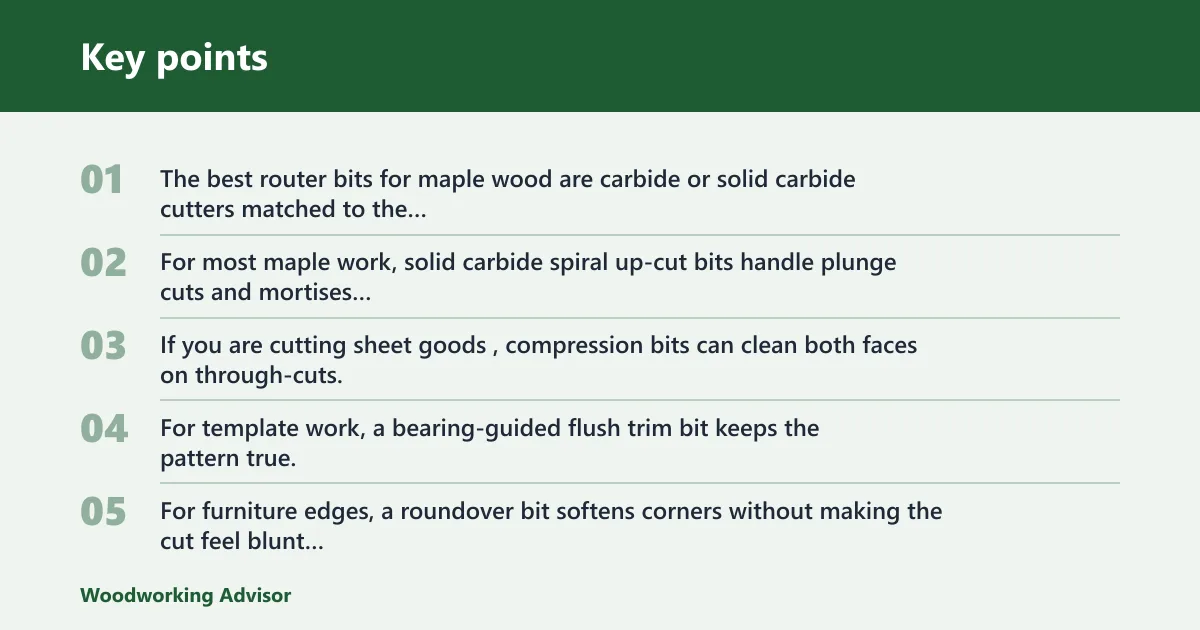

The best router bits for maple wood are carbide or solid carbide cutters matched to the cut you need, not a generic set. For most maple work, solid carbide spiral up-cut bits handle plunge cuts and mortises well because they pull chips out of the cut, while downcut spirals work better when the top edge matters most.
If you are cutting sheet goods, compression bits can clean both faces on through-cuts, but they are usually unnecessary in solid maple. For template work, a bearing-guided flush trim bit keeps the pattern true. For furniture edges, a roundover bit softens corners without making the cut feel blunt or uncontrolled.
Woodhaven sells spiral up-cut bits in 1/4 inch, 5/16 inch, 3/8 inch, and 1/2 inch diameters. It also offers up-cut bits in standard and extended lengths for deep mortises and through-cuts. That matters in maple because heat builds quickly when chips stay in the kerf.
Top pick: solid carbide spiral up-cut bits

Solid carbide spiral up-cut router bits are the most useful all-around choice for maple when you need clean plunge cuts, deep mortises, or fast chip clearing. Their chip ejection direction pulls debris up and out of the cut, which helps prevent recutting and heat buildup in hard maple.
Use them for mortising, slotting, and most plunge work in hardwood. The tradeoff is the top edge can show minor fuzzing or tear-out on exit faces, especially in hard maple or end grain, so they are not the best final-pass bit when the visible edge is the priority.
Runner-up: downcut spirals for cleaner top edges
Downcut spiral router bits are the better choice when the top surface needs the cleanest possible edge. They press fibers down as they cut, which helps reduce splintering on maple cabinet parts, veneered panels, and final finish passes. CMT markets downcut spiral router bits for clean shearing and efficient chip ejection.
The limitation is chip clearing. Because the cut tends to trap waste below the bit, you need a slower feed and shallower passes than with upcut bits. In thick maple, that makes downcuts a finish tool, not the first choice for deep mortises or long plunge cuts.
Best specialty pick: compression bits for through-cuts in sheet goods
Compression router bits are best when both faces matter, especially in plywood and composites where a clean top and bottom edge are both visible. They are designed to combine top and bottom edge cleanup in through-cuts, which is why cabinet shops often reach for them on sheet goods.
In solid maple, that advantage is narrower. A compression bit can help on through-cuts or thick parts with visible faces on both sides, but it is usually more tool than you need for ordinary edge profiling, mortising, or template routing in solid stock.
Quick comparison
| Product | Badge | Best for | Price | ||
|---|---|---|---|---|---|
|
EANOSIC Upcut Spiral Router Bits 1/4 inch ShankEANOSIC | Our pick | 1/4" shank · 1/4" cutting dia. · upcut spiral | $19.99
Price as of 4 Nov 2026
|
View |
 |
Freud 50-098: 5/16" (Dia.) Top Bearing Flush Trim BitFreud | Also great | 5/16" dia. · 1/4" shank · top bearing | $24.71
Price as of 4 Nov 2026
|
View |
|
Whiteside RD5200T Spiral Downcut Three Flute Router Bit: 1/2Whiteside Router Bits | Also great | 1/2" cutting dia. · 3 flute · downcut spiral | $99.71
Price as of 4 Nov 2026
|
View |
 |
Amana Tool 46022 CNC Compression Spiral for MortisingAmana Tool | Pair with it | 1/2" shank · 3-flute · compression spiral | $150.19
Price as of 4 Nov 2026
|
View |
This table is the fastest way to rule out the wrong geometry for maple. Match the task first, then match shank size and pass depth to cut tear-out, chatter, and burning.
For maple, the cleanest choice often depends on the face you care about most. A visible top edge favors a downcut; a deep mortise favors an upcut; a through-cut in sheet goods favors compression.
How we chose
The comparison below centers on maple-specific failure modes: tear-out, burn marks, fuzzy end grain, and chatter. It also separates hard maple from soft maple, because the same bit can behave differently as density rises.
Three setup factors matter here. First, chip clearing. Second, rigidity from shank size. Third, whether the cut is a final pass or a roughing pass. Those factors matter more than a long generic list of profiles.
Woodhaven’s up-cut design language, CMT’s downcut and mortising bit descriptions, and the published product details for the listed bits inform the geometry calls here. The goal is simple: pick the bit shape that solves the maple problem in front of you.
Maple routing decision table
| Task | Bit geometry | Shank size | Pass depth | Risk level | Best choice | Avoid | Why |
|---|---|---|---|---|---|---|---|
| Hard maple edge profiling | Downcut spiral or roundover | 1/2 inch | Shallow, final pass only | High | Downcut spiral | Aggressive upcut in one pass | Hard maple tears at the top edge; downcutting supports fibers better on the visible face. |
| Soft maple template routing | Top-bearing flush trim | 1/4 inch or 1/2 inch | Light passes | Medium | Flush trim bit | Overfeeding a dull straight bit | Template work needs bearing control more than aggressive chip removal. |
| Mortising | Solid carbide spiral up-cut or straight plunge | 1/2 inch preferred | Multiple shallow passes | High | Upcut spiral | Short, thin 1/4 inch bit for deep mortises | Upcut bits clear chips; deeper mortises in maple generate heat fast. |
| Flush trimming | Top-bearing flush trim | 1/4 inch | Light passes, keep bearing riding smoothly | Medium | Flush trim bit | Forcing the cut against grain | Bearing-guided trimming keeps the edge true and reduces wander on hardwood. |
| Through-cuts | Compression spiral | 1/2 inch | Step down gradually | Medium | Compression bit | Upcut on visible faces when both sides matter | Compression geometry helps keep both faces cleaner through the full thickness. |
What router bits work best in maple?
For maple, solid carbide spiral up-cut bits work best for plunge cuts and mortises, downcut spirals work best for clean top edges, and flush trim or roundover bits work best for template work and edge profiling. Straight plunge bits still make sense for grooves and joinery when you need a simple, rigid cutter.
Solid carbide spiral up-cut bits
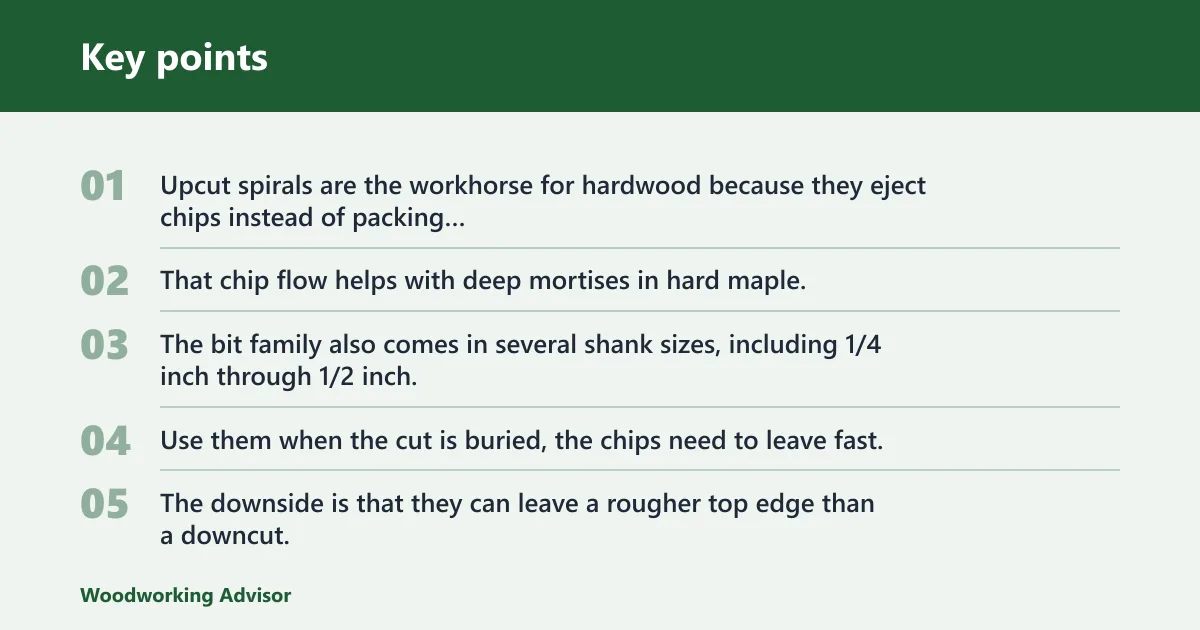
Upcut spirals are the workhorse for hardwood because they eject chips instead of packing them into the kerf. That chip flow helps with deep mortises in hard maple, where heat and recutting can quickly degrade cut quality. The bit family also comes in several shank sizes, including 1/4 inch through 1/2 inch.
Use them when the cut is buried, the chips need to leave fast, or you need a clean plunge into maple. The downside is that they can leave a rougher top edge than a downcut, so they are often followed by a lighter finish pass if the face will remain visible.
Straight plunge bits
Straight plunge router bits still make sense in hardwood like maple for mortising and groove cutting, especially when you want a simple, predictable cutter path. CMT’s mortising bits use a negative shear angle design, and CMT says those mortising bits produce no splintered edges or rough bottoms.
Long-bit options are useful when depth matters, but length reduces rigidity. That is where shank size becomes important. A longer straight bit in a small shank can flex more easily, which increases chatter and makes clean walls harder to hold in hard maple.
Flush trim and roundover bits
Flush trim router bits are the right tool for template routing and bearing-guided trimming. A top-bearing design follows the pattern while cleaning up hardwood edges, which makes it useful for cabinet parts and shaped components in maple. Roundover bits then finish the edge by softening sharp corners for furniture or casework.
These are the bits to choose when the geometry of the edge matters more than chip evacuation. They are also where feed control matters: too slow, and the cut burns; too fast, and the bearing can chatter or the bit can leave a stepped edge.
Should I use upcut, downcut, or compression bits in maple?
Use upcut bits for deep mortises and plunge cuts, downcut bits for the cleanest top edge, and compression bits mainly for through-cuts in plywood or veneered sheet goods. In solid maple, compression is usually a special-case tool rather than the default choice.
Upcut spirals for deep cuts and chip clearing
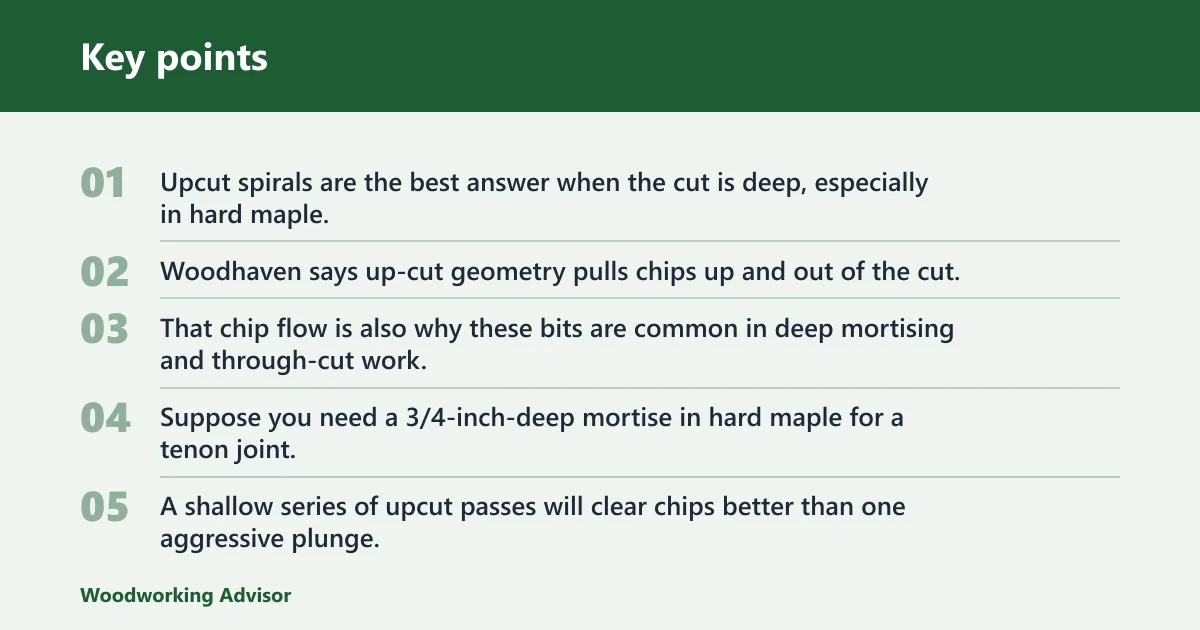
Upcut spirals are the best answer when the cut is deep, especially in hard maple. Woodhaven says up-cut geometry pulls chips up and out of the cut, which helps reduce recutting and makes plunge routing cleaner. That chip flow is also why these bits are common in deep mortising and through-cut work.
Suppose you need a 3/4-inch-deep mortise in hard maple for a tenon joint. A shallow series of upcut passes will clear chips better than one aggressive plunge, and the cleaner evacuation lowers the chance of darkened walls.
Downcut spirals for cleaner top edges
Downcut spirals are the better pick when the visible top face matters more than the bottom of the cut. They are often the right finish-pass tool for cabinet parts, veneer-faced panels, or any maple edge that will stay exposed. CMT markets downcut spiral router bits for clean shearing, which is the behavior you want at the surface.
The tradeoff is slower feed and more attention to chip clearing. If you hold the bit in one place too long, heat builds fast in maple. Keep the pass light and use the bit where its top-edge advantage matters most.
Compression bits for through-cuts
Compression bits are valuable when you need both the top and bottom edges to come out clean, especially in plywood and composites. In solid maple, they are most useful on through-cuts where both faces remain visible or where the cut passes through a veneered panel backed by maple parts.
A common first-timer mistake is buying a compression bit for every maple project. That usually adds cost without adding value on solid stock. For ordinary edge profiles, mortises, and grooves, an upcut, downcut, flush trim, or roundover bit is usually the better fit.
What shank size and feed rate should you choose?
For maple, 1/2-inch shanks are usually the better choice for larger cutters because they are stiffer and resist chatter better than 1/4-inch shanks. Use 1/4-inch shanks where the cutter is small and the cut is light, but check router collet fit before you mount anything.
1/4 inch versus 1/2 inch shanks
Router shank size affects rigidity as much as compatibility. A 1/4-inch shank fits many trim routers and light-duty setups, but it flexes more easily in hard maple. A 1/2-inch shank is generally the better choice for larger diameters, deeper cuts, and longer cutters because it helps control chatter and burning.
The basic rule is simple: match the shank to the cutter load and your router collet. Do not force a mismatch. Use the size your collet accepts, and favor the stiffer option when the bit diameter or cutting length grows.
Pass depth and feed rate in maple
Keep pass depth shallow enough that the router can move chips without scrubbing the cut. In maple, a shallow pass gives the bit time to clear waste and reduces heat, which protects edge quality. That is especially important with downcut or compression geometries that do not evacuate chips as freely.
Feed rate should stay brisk enough to avoid burning but controlled enough to prevent tear-out. If the cut sounds labored or the chips turn to dust, the feed is too slow, the pass is too deep, or the bit is dull. Any of those can darken maple quickly.
Heat control, chip evacuation, and burn mark prevention
Heat control in maple starts with chip evacuation. Upcut spirals help here, which is why they are so useful for deep mortises and plunge cuts. Downcuts need more care, and compression bits need enough feed to keep the cutter from polishing the walls instead of cutting them.
Use multiple passes on thick stock, keep the router moving, and stop if the bit begins to burnish the surface. A fresh, sharp bit cuts cooler. A dull edge rubs, and rubbing is what leaves burn marks in maple.
Which one should you buy?
If you need one bit first, buy a solid carbide spiral up-cut bit with a 1/2-inch shank for mortising and plunge work. If your main job is visible edges, buy a downcut spiral. If you cut veneered sheet goods or plywood, buy a compression bit. If you template-rout or flush-trim, buy a top-bearing flush trim bit.
Best choice by budget
If you want the most versatility for the least money, start with a good upcut spiral. EANOSIC’s 1/4-inch shank upcut spiral is the lowest-cost option in the group, and it suits lighter router setups, but its smaller shank makes it less stable for heavy maple work. For larger jobs, a 1/2-inch shank bit is the safer long-term choice.
Best choice by task
For mortises in hard maple, choose an upcut spiral or a straight plunge bit with enough rigidity. For clean cabinet edges, choose a downcut spiral on the final pass. For template routing, choose the Freud top-bearing flush trim bit. For through-cuts in sheet goods, choose the Amana compression spiral.
When to skip a specialty bit
Skip compression if you are working solid maple and only one face is visible. Skip downcut if you are clearing a deep mortise. Skip a thin-shank bit if chatter or burning would ruin a visible edge. There is no need to buy a generic router-bit set when one geometry solves the actual problem.
Freud’s 50-098 top-bearing flush trim bit is a strong fit for template routing and edge cleanup, but its 1/4-inch shank means it is better for light to moderate trimming than for aggressive hardwood removal. Whiteside’s RD5200T downcut spiral is a better fit when the top face must stay clean, but its price and slower cutting behavior make it a specialized tool rather than a first purchase. Amana’s compression spiral is the cleanest answer for through-cuts in sheet goods, though it is overkill for plain solid-maple edge work. EANOSIC’s upcut spiral is the budget-friendly way to start, provided the lighter shank and shorter cutter length match the job.
Care, maintenance, and storage
Sharpness matters in maple more than in softer woods because dull edges create heat fast. Clean resin and pitch from the flutes after use. Store bits in sleeves, racks, or separated compartments so cutting edges do not strike each other. A nicked carbide edge will burn maple long before it looks obviously dull.
- Inspect the cutting edge before each job.
- Clean resin buildup with an appropriate bit cleaner.
- Check that the shank is fully seated in the collet.
- Use shallow passes on hard maple.
- Finish with the bit geometry that matches the visible face.
Frequently asked questions
What router bits are best for maple wood?
For maple wood, solid carbide spiral up-cut bits are best for plunging and mortising, downcut spirals are best for cleaner visible edges, and flush trim bits are best for template work. Roundover bits are useful for furniture edges. The right geometry matters more than buying a broad set.
What shank size is better for routing maple, 1/4 inch or 1/2 inch?
For maple, 1/2-inch shanks are usually better for larger cutters and deeper cuts because they are stiffer and resist chatter. A 1/4-inch shank can work for lighter-duty routing and trim routers, but always match the bit shank to the router collet and the cut depth.
How do I reduce tear-out when routing maple?
Use a sharp bit, make shallow passes, and choose a bit geometry that supports the fibers on the visible face. Downcut spirals help on final passes, while upcut spirals help with chip evacuation in deeper work. Slow feed can burn maple, so keep the router moving.
What router bit works best for mortises in hard maple?
A solid carbide spiral up-cut bit is the best general choice for mortises in hard maple because it clears chips efficiently and handles plunge cuts well. Straight plunge bits also work, especially for groove-like mortises, but they need enough rigidity and a careful pass schedule.
Can I use straight router bits in hardwood like maple?
Yes. Straight router bits still work in hardwood like maple for mortising and groove cutting, especially when you want simple geometry and predictable walls. The main limits are chip clearing and heat, so use shallow passes and avoid forcing a long straight bit through dense stock too fast.
Which router bits give the cleanest edge on maple cabinets?
Downcut spirals usually give the cleanest top edge on maple cabinet parts, especially on final passes. For patterned edges, a top-bearing flush trim bit is useful, and roundover bits clean up exposed corners. If both faces are visible in a through-cut, a compression bit can be the better choice.
Are spiral router bits better than straight bits for maple?
Spiral bits are often better for maple because they clear chips more effectively and reduce recutting in deep cuts. Straight bits still have a place for mortises and grooves, especially when you want a simple cutter path. The better choice depends on whether chip clearing or edge finish matters most.
Sponsored / affiliate links. As an Amazon Associate I earn from qualifying purchases. I may earn additional commission from eligible campaigns.