Heat Lamp for a Workshop
A heat lamp is a practical workshop heater only for close-range spot warming at a bench, and only if the lamp matches the fixture rating and stays well away from dust, solvents, and wood scraps. Misuse can char materials, crack bulbs, or start a fire fast. This guide explains safe placement, wattage and fixture checks, and when a space heater or infrared panel is the better choice.
What a workshop heat lamp does
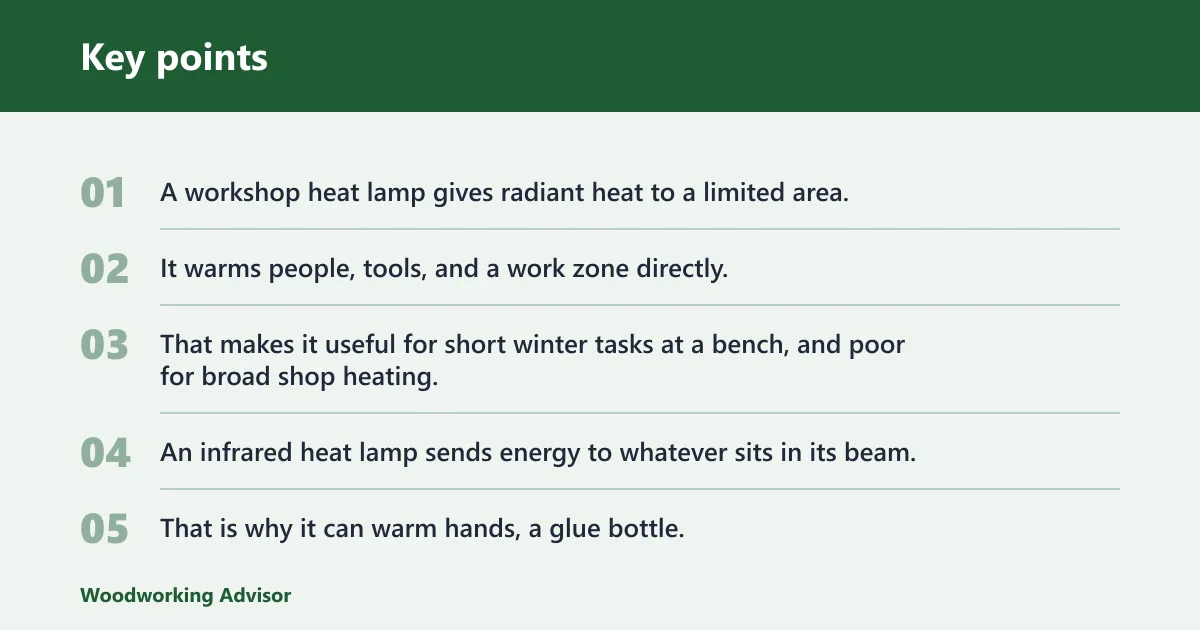


A workshop heat lamp gives radiant heat to a limited area. It warms people, tools, and a work zone directly, instead of raising the temperature of the whole room. That makes it useful for short winter tasks at a bench, and poor for broad shop heating.
Radiant heat versus room heat
An infrared heat lamp sends energy to whatever sits in its beam. That is why it can warm hands, a glue bottle, or a bench surface faster than the surrounding air. It does little for a large, leaky, or uninsulated workshop.
That difference matters. If you want the room itself to feel warmer, a ceiling-mounted radiant quartz heater or a properly sized garage heater is the better path. A heat lamp is for a local heat zone, not for replacing a full-room heater.
Common confusion with LED shop lights
An LED shop light gives illumination, not heat. It can look similar in a garage ceiling listing, which leads to bad search results and bad purchases. If the goal is warmth, the fixture must be described as a heat lamp, infrared lamp, radiant heater, or similar heating product.
Picture a bench under an LED strip: the surface gets brighter, but your cold hands stay cold. Swap that for a true heat lamp aimed at the work zone, and the warmth is concentrated where you need it. The function is different from the first switch flip.
Workshop heat decision table
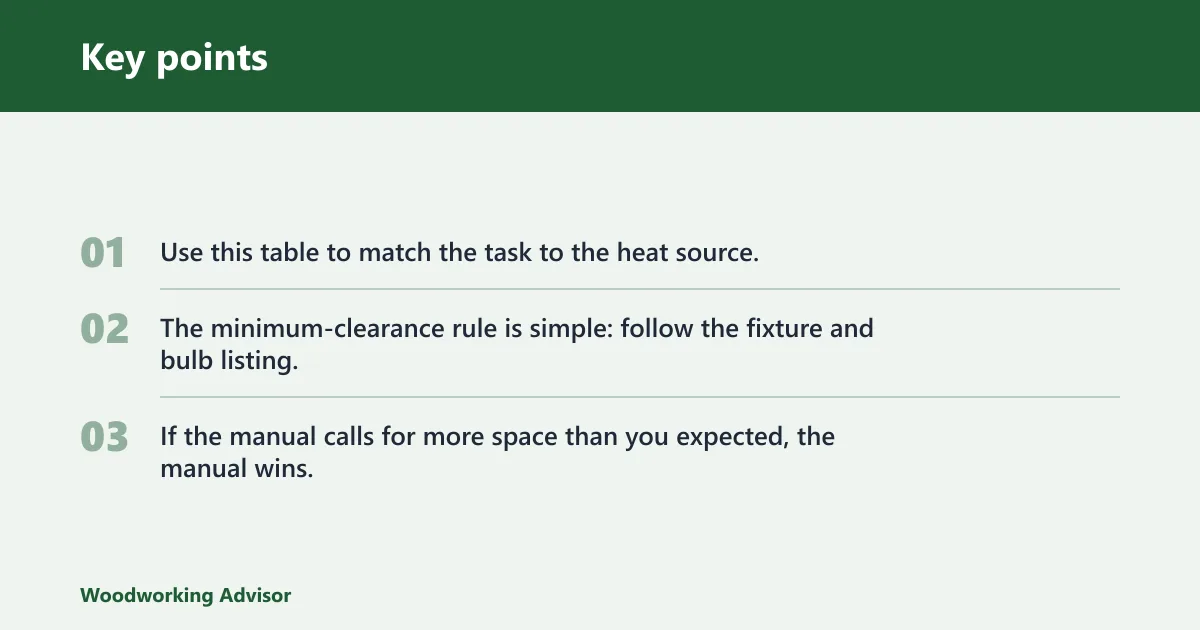
Use this table to match the task to the heat source. The minimum-clearance rule is simple: follow the fixture and bulb listing, then keep all combustibles outside that heat zone. If the manual calls for more space than you expected, the manual wins.
| Workshop task | Recommended device | Minimum clearance mindset | Likely limitation | Safer alternative when the lamp is a poor fit |
|---|---|---|---|---|
| Bench warming | Infrared heat lamp aimed at the workbench heat zone | Keep sawdust, paper, and scraps outside the lamp’s listed heat zone | Heats only the lit spot, not the room | Ceiling-mounted radiant quartz heater |
| Glue curing | Heat lamp only if the glue maker allows gentle external warmth and the area is clear of combustibles | Follow the glue label and the lamp manual; keep the bottle, rags, and waste away from the bulb | Too much heat can skin over glue or dry the surface unevenly | Room heater that warms the whole space more evenly |
| Finish drying | None near the finish area | Keep the lamp away from solvents, finish rags, and wet coatings | Fire risk and uneven drying | Ventilation and a heater placed outside the finishing zone |
| Hand comfort | Heat lamp for a seated bench zone | Keep skin out of direct contact with the fixture or guard | Glare and hot spots if the beam is too concentrated | Radiant heater or enclosed space heater sized for the shop |
| Dust-heavy cutting | None during active cutting | Keep the lamp out of the dust stream and away from airborne debris | Sawdust can collect on hot parts | Heat the shop before work, then shut the heat source off during cutting |
| Full-room heating | None | A heat lamp is not a room heater | Poor coverage and high exposure risk | Ceiling-mounted radiant quartz heater or a garage heater made for the room size |
Can you use a heat lamp in a workshop?
Yes, but only as a localized work-zone heater. A heat lamp can help at a bench, near a vise, or beside a seated task where your hands and tools need direct warmth. It is the wrong choice for open-shop heating, finishing areas, or any space packed with combustible debris.
Good fit for a localized work zone
The best use case is a workbench heat zone separated from combustibles. That means a lamp aimed at the user or the task, with sawdust, paper, cardboard, solvents, and finish rags kept out of the beam and away from the fixture body. The lamp should not share space with clutter.
A common first-timer mistake is placing the lamp where it seems convenient, then leaving a pile of offcuts, a rag can, or a glue bottle underneath it. That setup turns a comfort tool into a hazard. The lamp should serve the task, not the storage pile.
Poor fit near finishing materials
Do not treat a heat lamp as a finishing aid around solvents or fresh finish materials. Heat can increase vapor release, dry surfaces unevenly, or move a flammable item too close to a hot bulb. That is a poor trade for a little extra warmth.
When a radiant heater is the better choice
If the goal is broader comfort in a winter shop, a ceiling-mounted radiant quartz heater is a better match. It uses radiant heat too, but it is aimed at garage and shop installation, and some models include a work light. For larger spaces, a 7,500W electric garage heater on 240 volts is a more substantial room-heating option than a lamp.
How far should it be from combustibles?
There is no universal distance number that fits every lamp, bulb, and fixture. Follow the manufacturer’s listing and manual first. Then keep sawdust, paper, solvents, finish rags, and wood scraps outside the lamp’s specified heat zone, because exposed bulbs can ignite nearby combustibles fast.
Follow the fixture and bulb manual first
Clearance depends on the exact lamp, the socket, the guard, and the mounting method. A heat lamp with a rated fixture can still be unsafe if it is placed too close to loose debris or mounted in the wrong enclosure. Use the listing for the fixture you actually bought.
Keep workshop combustibles out of the heat zone
Sawdust is not the only issue. Paper, solvent containers, finish rags, cardboard, and plastic packaging all belong outside the lamp zone. If the bench collects dust quickly, a heat lamp should not sit there during cutting or cleanup.
Use a guard when the lamp is exposed
A heat lamp guard helps reduce contact burns and accidental impact. It does not make a bad installation safe, but it can help if someone brushes past the fixture or a board bumps the lamp. Use the guard only with a compatible setup.
Which bulb and socket fit the job?
A 250-watt heat lamp bulb is a common incandescent option, and it must go into a compatible heat-rated fixture and socket. The bulb alone is not enough. The holder, wiring, mounting, and surrounding materials all need to be intended for heat.
250-watt heat lamp bulb basics
For workshop spot heating, a 250-watt incandescent heat lamp bulb is often used as a replacement bulb format. It is meant for targeted warmth, not broad coverage. If you see a PAR or R40 style bulb, confirm the fixture style, beam spread, and socket compatibility in the manufacturer’s listing before buying.
Farmlighting lists a Philips infrared heat lamp at 175 watts, which shows how lamp wattage can vary by product line. The right choice depends on the fixture, the work zone, and the heat output the manufacturer specifies.
E27 porcelain or ceramic holder
An E27 porcelain or ceramic lamp holder is a heat-rated socket type used with heat lamps in some markets. It needs heat-rated materials, not a cheap plastic socket. Fixture listings vary by market, so check the exact base type and heat rating before ordering parts.
For a heat lamp setup, the socket and the bulb must match. Farmlighting also lists a porcelain or ceramic E27 holder priced separately at €2.80, while the Philips infrared lamp is priced at €11.50. Those listings are useful for compatibility checks, not as proof of safe installation.
Why heat-rated materials matter
Heat lamps run hot enough to punish weak parts. Plastic housings, underspecified cords, and unlisted sockets can soften or fail. Choose fixtures and holders meant for heat, and confirm that the mounting surface can tolerate the fixture’s operating temperature.
When a heat lamp is the wrong choice
A heat lamp is the wrong choice when the task needs room-level warmth, when dust is heavy, or when the area contains solvents and finish rags. It is also a poor choice if the lamp would have to sit close to moving stock, sanding debris, or cluttered shelving. In those cases, choose a heater designed for the room.
Dust-heavy cutting and open-shop airflow
During cutting, routing, or sanding, a lamp can collect dust on the guard and around the bulb area. That adds heat-related risk without giving much benefit. If the shop is busy with airborne dust, heat the space before the work begins or use another heater outside the cutting zone.
Whole-room winter heating
A heat lamp does not heat a whole workshop evenly. It warms whatever sits in its beam and leaves the rest of the room cold. If you need broad comfort for long sessions, look at a ceiling-mounted radiant quartz heater or a garage heater sized for the room.
Areas with solvents or finishing rags
Do not place a heat lamp near finishing materials. Solvents, wet finish, and oily rags belong far from exposed bulbs. The lamp can dry one area while creating a hazard in another, which is exactly the wrong tradeoff in a woodshop.
Installation and buying checks
Before buying, decide whether you need a bench heater or a room heater. If the answer is bench warmth, choose a heat-rated lamp, a compatible socket, and a guard. If the answer is full-room comfort, the safer path is usually an enclosed heater made for garage or shop use.
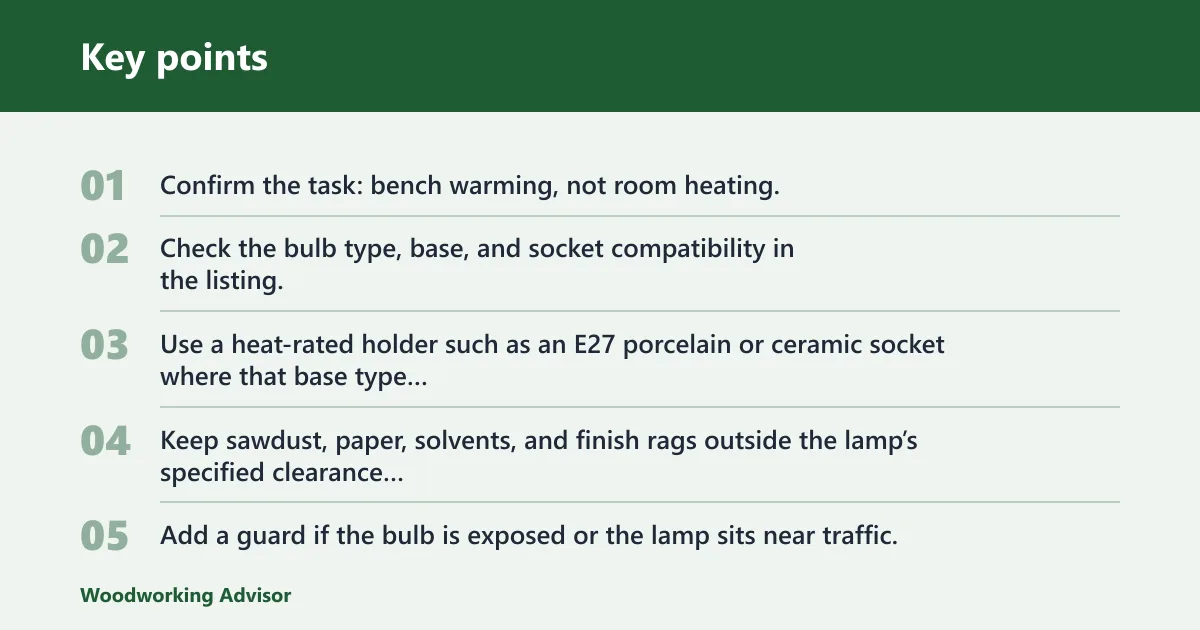
- Confirm the task: bench warming, not room heating.
- Check the bulb type, base, and socket compatibility in the listing.
- Use a heat-rated holder such as an E27 porcelain or ceramic socket where that base type is specified.
- Keep sawdust, paper, solvents, and finish rags outside the lamp’s specified clearance zone.
- Add a guard if the bulb is exposed or the lamp sits near traffic.
- For larger spaces, compare the lamp with a ceiling-mounted radiant quartz heater or a garage heater made for workshop use.
- Check the certification marks and follow the manual before powering anything on.
Walmart lists a ceiling-mounted radiant quartz heater for garages and shops, and that type is also sold with a work light. Walmart also lists a 7,500W electric garage heater for workshop use at 240 volts. Those examples point to the right category for larger spaces: enclosed, purpose-built heaters, not an exposed bulb over a bench.
Guard, mount, and cord checks
Inspect the guard, mounting hardware, and cord path before use. The lamp should not hang where it can be struck by lumber, clamps, or a rolling cart. If the cord or fixture is questionable, do not improvise a fix. Replace it with a listed component made for the load and temperature.
Suppose your bench sits in a cold corner and your hands get stiff after ten minutes. A heat lamp aimed at the work zone can make that one task more comfortable. Suppose the same corner also holds open solvent cans and sanding dust. Then the lamp is the wrong tool, and a different heater belongs elsewhere in the shop.
Frequently asked questions
What are heat lamps used for?
Heat lamps are used for targeted radiant warmth. In a workshop, that means warming hands, a tool, or a bench area at close range. They are not room heaters, and they are generally a poor fit for dusty, cluttered, or finishing-heavy spaces where exposed bulbs could sit too close to combustibles.
How far should a heat lamp be from sawdust and wood?
There is no single safe distance that applies to every model. Follow the lamp and fixture manual first, then keep sawdust and wood scraps outside that specified clearance. If your bench accumulates dust quickly, a heat lamp is usually the wrong tool for that location.
Are heat lamps safer than a space heater in a garage?
Not by default. A heat lamp has an exposed hot bulb and a narrow heat pattern, while a space heater or garage heater may be enclosed and designed for broader area heating. Safety depends on the intended use, enclosure, clearances, dust exposure, and the manufacturer’s instructions.
Do heat lamps heat a whole workshop or just a spot?
Just a spot. That is their strength and their limit. An infrared heat lamp warms the object or person in front of it rather than the full room. For a whole workshop, you need a heater designed for room-level coverage, such as a ceiling-mounted radiant quartz heater or similar garage heater.
Can a heat lamp help prevent tools from rusting?
It can help only in a narrow sense by warming a small area and reducing surface chill, which may limit condensation on nearby metal. It does not stop rust on its own. Clean, dry storage and humidity control do much more than a lamp aimed at one bench zone.
What is the difference between a heat lamp and an infrared heater?
A heat lamp is a bulb-based radiant source used for close-range warmth. An infrared heater is a broader heating appliance that also transfers energy by infrared radiation, often in a more enclosed or room-focused format. In a workshop, the heater is usually the better choice when you need wider coverage.
Sponsored / affiliate links. As an Amazon Associate I earn from qualifying purchases. I may earn additional commission from eligible campaigns.