Hickory vs Oak Hardwood Flooring Durability Compared
Hickory is the better pick for dent resistance: Janka hardness is about 1,820 versus red oak at about 1,290 and white oak at about 1,360, but oak usually wins for stability and easier refinishing. Pick the wrong species, and you can end up with dents, seasonal movement, or higher upkeep. This guide compares hickory vs oak for foot traffic, pets, climate, refinishing, and long-term cost.
| Factor | Hickory | Oak Hardwood Flooring | Winner |
|---|---|---|---|
| Dent resistance | 1,820 Janka; very hard and highly resistant to denting in busy rooms | White oak at 1,360 Janka; red oak at 1,290 Janka | Hickory |
| Dimensional stability | Good in the right build, but movement can be more noticeable in changing humidity | White oak is the steadier choice; engineered oak improves performance in variable climates | Oak Hardwood Flooring |
| Refinishing ease | Harder to sand and can take more effort to refinish cleanly | Sands more cleanly and is easier to refinish | Oak Hardwood Flooring |
| Stain predictability | High color variation can make matching more difficult | More uniform color; oak takes stain more predictably | Oak Hardwood Flooring |
| Cost and install practicality | Material often costs more and the hardness can add labor effort | Usually lower material cost and easier handling | Oak Hardwood Flooring |
| Best overall fit | Heavy wear, pets, and rooms where dents matter most | Projects that value stability, refinishing, and stain control | Tie |
Hickory vs oak: the durability trade-off
Hickory wins on dent resistance, but that is only one part of durability. In a real home, the better floor is the one that handles wear, humidity, refinishing, and cost without creating new problems. Oak often pulls ahead here, especially white oak.
The Janka hardness scale measures resistance to dents and wear. Hickory scores 1,820, which is above both white oak at 1,360 and red oak at 1,290. That means hickory is the tougher surface when a chair leg, boot heel, or dropped pan hits the floor.
Hardness is not the whole story
Hardness helps with dent resistance, but it does not tell you everything about everyday performance. Grain structure, moisture movement, sanding behavior, and finish choice all affect how long the floor looks good. Oak is more uniform in appearance and easier to keep consistent through install and refinish work.
Which floor resists dents better?
Hickory resists dents better than oak. Its Janka rating is 1,820, and it is commonly recommended for high-traffic areas because it stands up well to concentrated impact from shoes, toys, and furniture legs. Oak still holds up well, but it gives up some dent resistance to hickory.
White oak and red oak compared
White oak at 1,360 is harder than red oak at 1,290, so white oak is the stronger of the two oak choices for dent resistance. Red oak remains a practical residential species, but if dent resistance is the main goal, white oak closes some of the gap without going as far as hickory.
What hardness does and does not predict
Hardness predicts how well a board resists small impacts, but it does not guarantee better long-term appearance. A harder floor can still show scratches in a soft finish, and a slightly softer floor can look better for longer if the surface finish and stain match the room well. That is why the finish matters as much as the species.
In a hallway that runs from a mudroom into a kitchen, hickory is the safer bet if your main concern is dents from grit, boots, and dropped items. If that space also needs easier future sanding and a more even color match, white oak may be the more practical floor.
Does hickory scratch less than oak?
Not always. Hickory can resist dents better than oak, but scratches depend on the finish, debris on the floor, and the type of contact. Pet claws, chair feet, and grit under shoes can mark either species if the topcoat is weak or worn down.
Pet claws and chair legs
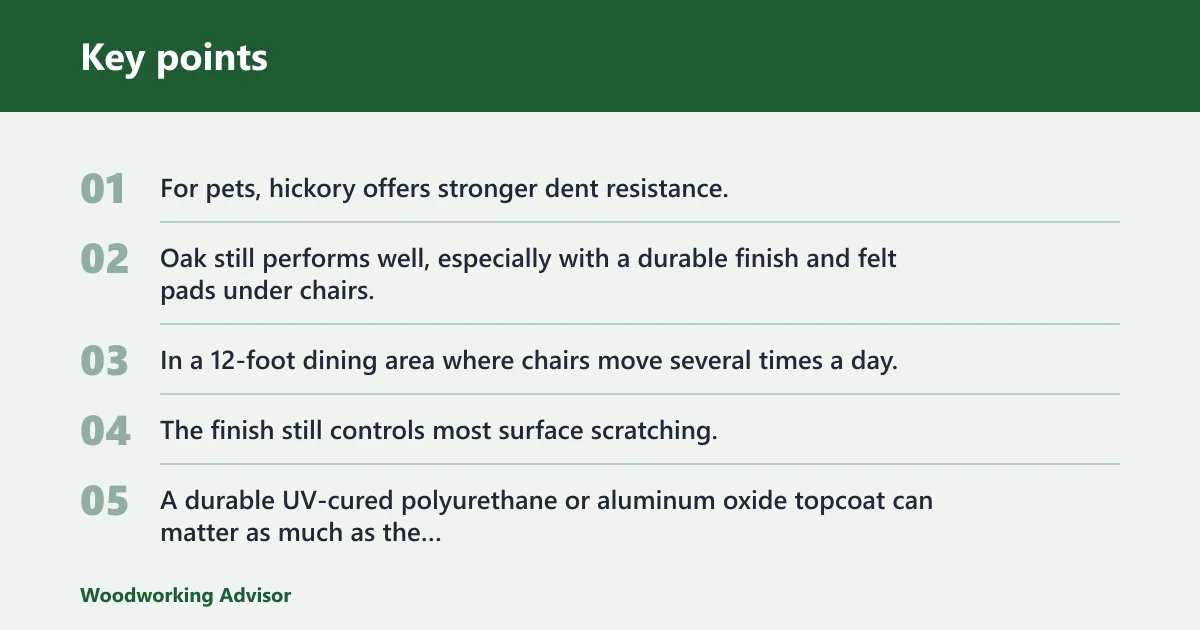
For pets, hickory offers stronger dent resistance, which helps when nails or sudden stops concentrate force in one spot. Oak still performs well, especially with a durable finish and felt pads under chairs, but it is usually the better choice when you want easier repair and a more even appearance after wear.
In a 12-foot dining area where chairs move several times a day, a harder species helps with dents. The finish still controls most surface scratching. A durable UV-cured polyurethane or aluminum oxide topcoat can matter as much as the species under it.
Dropped objects and hallway traffic
Dropped cookware is more likely to leave a dent on oak than on hickory. In high-traffic hallways, hickory also does well because its dense surface tolerates repeated impact. Still, hallway wear is not only about hardness; it also depends on how well the floor is finished and maintained.
Why finish matters as much as species
Finish quality affects durability and maintenance. Durable UV-cured polyurethane and aluminum oxide finishes generally improve wear resistance, while water-based sealants can make a floor easier to live with when low odor or lighter color tone matters more. A weak finish can make a hard floor feel less durable than a softer one with a better topcoat.
Which is more stable in real homes?
Oak, especially white oak, is usually the safer choice when stability matters more than maximum dent resistance. That does not mean hickory is a bad floor; it means hickory can be less forgiving when humidity swings are larger or when the subfloor and installation details are not ideal. Engineered construction narrows that gap.
White oak, red oak, and movement context
White oak is generally the steadier of the two oak species, and both oak types are ring-porous, open-grained woods. The common belief that white oak is closed-pore is wrong. Its grain structure and moisture behavior make it a better fit when stain control and stable movement matter.
Humid climates and seasonal change
In humid climates, any solid hardwood can move with the seasons. That is where oak often has the edge in day-to-day practicality, especially white oak. Hickory can still work well, but the install needs to account for acclimation, subfloor condition, and a room that sees wider moisture changes.
When engineered construction makes more sense
Engineered hardwood construction improves dimensional stability and is often the smarter call over concrete or radiant heat. Typical engineered wear layers range from 2–6 mm, and thicker wear layers of 3–6 mm can allow multiple refinishes. That gives you more room to balance stability with long-term service life.
Refinishing and stain matching
Oak is easier to refinish and easier to match. Hickory can be refinished when it is solid hardwood, but its density makes sanding slower and less forgiving. If you want a floor that can be tuned to a specific stain color later, oak is usually the simpler path.
Sanding behavior for hickory and oak
Oak sands more cleanly, which matters when you are removing old finish, flattening wear, or fixing a patch. Hickory is harder to sand, so the work can take longer and demand more care to avoid uneven sanding marks. That extra effort is one reason oak often wins on total project practicality.
Solid versus engineered wear layers
Solid wood gives you the most room for future sanding. Engineered flooring can also be refinished, but only if the veneer is thick enough, and the 2–6 mm wear-layer range sets the limit. If future refinishing is a priority, check the manufacturer’s listing for the exact wear layer before you buy.
Picture a living room with a warm walnut stain planned for a later date. Oak is usually easier to color-match because its grain and base color are more uniform. Hickory’s bold grain and high color variation can be beautiful, but that same variation can make stain matching more demanding.
Cost, value, and installation factors
Oak is usually cheaper or more widely available than hickory. Hickory material commonly falls between $4 and $9 per square foot, while oak material commonly falls between $3 and $8 per square foot. Installed cost depends on more than species, though, because labor, underlayment, and subfloor prep often add $2 to $5 per square foot.
Material price versus installed cost
Species price is only part of the bill. A harder floor can take more labor to cut, nail, and sand, and that can affect the total even if the material difference looks small. If the subfloor needs flattening or moisture work, that can outweigh the species price difference quickly.
Hickory is worth paying for when dent resistance is the main goal and the room will see hard use. Think kids, pets, busy hallways, or a household that wants a tougher look with bold grain. If those needs are secondary, oak usually offers a better balance of cost and practicality.
Choose Hickory if… / Choose Oak Hardwood Flooring if…
Choose Hickory if you want the harder surface, expect heavy foot traffic, or need better resistance to dents from pets, toys, and dropped objects. Choose Oak Hardwood Flooring if you want easier refinishing, more predictable stain results, and a floor that is usually simpler to install and keep consistent over time.
- Choose Hickory if the room sees frequent impact from shoes, bags, or pet claws.
- Choose Hickory if bold grain and higher color variation fit the design plan.
- Choose Oak Hardwood Flooring if you care more about stability, stain matching, and refinishing.
- Choose Oak Hardwood Flooring if the project involves radiant heat, concrete, or a humidity-prone space and you want engineered construction.


Hardwood flooring decision matrix
This matrix is an editorial decision aid, not a laboratory ranking. Scores typically run from 1 to 5, with 5 indicating the best result for that factor in the stated scenario. The goal is to translate species traits into the kind of decision homeowners actually make.
| Scenario | Hickory score | Oak Hardwood Flooring score | Best fit | Recommendation |
|---|---|---|---|---|
| Pets | 5 | 4 | Hickory | Choose hickory when claw traffic and dropped bowls are the main concern. |
| Kids | 5 | 4 | Hickory | Choose hickory for play areas that need the toughest dent resistance. |
| High-traffic hallways | 5 | 4 | Hickory | Choose hickory if hallway wear and impact are the top durability concerns. |
| Humid climates | 3 | 5 | Oak Hardwood Flooring | Choose oak, especially white oak, when seasonal movement and moisture control matter most. |
| Future refinishing | 3 | 5 | Oak Hardwood Flooring | Choose oak if you want easier sanding and a cleaner path to future refinishing. |
| Custom stain matching | 2 | 5 | Oak Hardwood Flooring | Choose oak when you need predictable stain behavior and a more uniform base color. |
Frequently asked questions
Is hickory harder than oak flooring?
Yes. Hickory is harder than both white oak and red oak on the Janka scale, with a rating of 1,820. White oak is about 1,360, and red oak is about 1,290. That hardness difference is why hickory is often chosen for dent resistance in busy rooms.
Which hardwood flooring is more durable, hickory or oak?
It depends on what you mean by durable. Hickory is more durable against dents and impact. Oak is often more durable in the broader project sense because it is easier to sand, easier to stain-match, and often simpler to keep looking consistent over time.
Does hickory flooring scratch less than oak?
Not automatically. Hickory resists dents very well, but scratch resistance also depends on the finish and the grit that gets tracked across the floor. A strong finish can make oak perform better than a poorly finished hickory floor.
Is white oak or hickory better for high-traffic floors?
For pure dent resistance, hickory is better. For a high-traffic floor where stability, stain control, and refinishing all matter, white oak is often the better overall choice. It gives up some hardness, but it usually gives back easier long-term maintenance.
Which floor is easier to refinish, hickory or oak?
Oak is easier to refinish. It sands more cleanly, which helps when you are removing finish or correcting wear. Hickory is harder to sand, so refinishing can take more effort and more care to keep the surface even.
Does hickory flooring cost more than oak?
Usually yes. Hickory material commonly falls between $4 and $9 per square foot, while oak commonly falls between $3 and $8 per square foot. Installed cost can shift further once labor, subfloor prep, and underlayment are added.
Can hickory and oak both be used as engineered flooring?
Yes. Both species are available as solid or engineered flooring. Engineered construction is often the better choice over concrete or radiant heat because it improves dimensional stability, and thicker wear layers can preserve some future refinishing potential.
Sponsored / affiliate links. As an Amazon Associate I earn from qualifying purchases. I may earn additional commission from eligible campaigns.