Best Wood Glue for Furniture Repair (2026): Research Shows
For most furniture repairs, choose PVA wood glue for tight, clampable joints; use epoxy for gaps, missing wood, or cracked parts; use liquid hide glue when reversibility matters; use waterproof glue only for exterior exposure. The wrong adhesive can leave a joint weak, brittle, misaligned, or hard to repair later. This guide matches glue type to joint condition, load, gap size, moisture exposure, and the need to undo the repair.
Quick comparison
| Product | Badge | Best for | Price | ||
|---|---|---|---|---|---|
 |
Titebond III Ultimate Wood Glue, 16-Ounces #1414 |Titebond | Our pick | 16 oz · Natural · Waterproof | $7.95
Price as of 20 Oct 2026
|
View |
 |
Gorilla Ultimate Waterproof Wood Glue, Natural Color, 8 ozGORILLA | Also great | 8 oz · Tan · Waterproof | $5.97
Price as of 20 Oct 2026
|
View |
 |
Titebond Original Wood Glue 5064, Industry Standard forTitebond | Budget pick | 16 oz · Clear · Standard | $5.49
Price as of 20 Oct 2026
|
View |
 |
Elmer’s E7010 Carpenter’s Wood Glue, Interior, 8 Ounces ,Elmer’s | Also great | 8 oz · Tan · Interior | $8.60
Price as of 20 Oct 2026
|
View |
This quick comparison is about repair fit, not brand loyalty. The right glue depends on joint condition, movement, and whether you need future disassembly.
How we chose
The picks below focus on four practical filters: how tight the joint is, how much gap the glue must fill, whether the piece sees humidity or outdoor exposure, and whether you need the repair to be reversible later.
That matters because furniture failures are not all the same. A loose chair rung, a veneer edge lift, and a broken corner each need a different chemistry.
Titebond III Ultimate Wood Glue: best for outdoor furniture
Choose this when the repair needs a waterproof PVA and the joint still fits well. Based on the manufacturer’s specs and published product details, it suits exterior furniture, kitchen items, and indoor pieces that may see humidity. It also gives you water cleanup before cure and good sandability.
Its Type I waterproof rating matters more than a generic “water-resistant” label. Titebond III Ultimate also gets an open time around 10-15 minutes in published guidance, which helps when you need a little extra alignment time on chair assemblies or table parts.
The drawback is that it is still a PVA, so it is not the right answer for wide gaps, crushed fibers, or missing wood. Use it for good-fitting joints, not for repairs that need real void filling.
Titebond Original Wood Glue: best for tight chair joints
This is the straightforward choice for tight wood-to-wood joints where water resistance is not the main issue. It fits the common chair rung, table apron, and cabinet joint category, and it is a practical all-purpose PVA for indoor furniture repair.
For tight joints, PVA wood glue is often the best answer because it bonds well, cleans up with water before cure, and sands cleanly after it sets. That makes it especially useful when the parts already meet well and the clamp can hold them in alignment.
The drawback is simple: it is not a gap filler. If the mortise is wallowed out, the crack is open, or fibers are missing, move to epoxy or add reinforcement instead of piling on more PVA.
Gorilla Ultimate Waterproof Wood Glue: best for longer working time
Pick this when you want waterproof PVA performance with a little more open time than a fast-setting interior glue. It bonds hardwoods and softwoods, and its published working time gives you more room for alignment on longer assemblies or awkward clamp setups.
It is useful for indoor or outdoor repairs where the joint still fits, but the assembly is fussy enough to need extra minutes. That makes it a reasonable choice for furniture parts that must be clamped carefully before the glue starts to grab.
The drawback is that waterproof PVA still does not solve large gaps or damaged wood fibers. If the break has missing material, the chemistry is wrong for the problem.
Elmer’s Carpenter’s Wood Glue: best for simple indoor repairs
This is a basic interior PVA for straightforward furniture repairs where cleanup matters and the joint is well matched. It suits home repairs, trim, and light-duty joinery when you want a familiar, water-cleanup glue for indoor use only.
For many small furniture fixes, that is enough. Tight joints, modest clamp pressure, and a clean fit are what make PVA work, not a fancy label.
The drawback is that it is interior-focused, so it is not the right pick for exterior furniture or damp environments. It also does little for gaps, splintered breaks, or missing wood.
Furniture repair glue selector
| Failure type | Gap size | Joint movement | Indoor/outdoor exposure | Reversibility needed | Recommended glue chemistry | Clamp time range | Avoid-this warning |
|---|---|---|---|---|---|---|---|
| Chair rung loose in mortise | Tight to hairline | High racking force | Indoor | Usually no | PVA wood glue | Follow label; clamp until set | Avoid epoxy unless the mortise is worn or crushed |
| Table leg joint with slight wear | Small | Moderate | Indoor or humid room | Usually no | Type I or Type II PVA; waterproof PVA for humid areas | Follow label; keep pressure even | Avoid overfilling the joint with glue alone |
| Veneer edge lifting | Hairline | Low | Indoor | Sometimes | CA glue for tiny lifts; hide glue if reversibility matters | Seconds to minutes, depending on product | Avoid polyurethane foam squeeze-out near finished surfaces |
| Split panel with clean crack | Tight crack | Low to moderate | Indoor | Sometimes | PVA for tight splits; epoxy if fibers are crushed or missing | Follow label; hold alignment carefully | Avoid relying on CA for long structural cracks |
| Antique joint needing future disassembly | Tight to small | Moderate | Indoor | Yes | Hide glue | Follow label; allow full cure | Avoid permanent epoxy unless the repair cannot be reversed |
| Broken corner or missing wood | Large void | Moderate | Indoor or outdoor, depending on finish | Usually no | Two-part epoxy | About 24 hours for full cure in some products | Avoid liquid PVA; it will not rebuild missing structure |
What is the strongest glue for wood repair?
The strongest glue for wood repair is the one that matches the joint, not the one with the boldest label. For tight wood-to-wood joints, PVA can bond very strongly. For gaps, missing wood, or crushed fibers, two-part epoxy is usually the stronger choice because it can rebuild material instead of just bonding surfaces.
Strength also depends on fit and load. A well-clamped chair rung with PVA can outperform a badly fit joint filled with “strong” glue, because the joint shape and contact area matter as much as the adhesive chemistry.
Strongest for tight joints
For a snug mortise-and-tenon or a close-fitting apron joint, PVA wood glue is usually the practical strength winner. It spreads well, cleans up with water before cure, and sands cleanly, which matters when the joint surfaces already meet properly.
Strongest for gap filling
For a loose, wallowed, or broken joint, epoxy is stronger in practice because it fills voids and bonds to damaged fibers. Polyurethane can help in uneven repairs, but epoxy is the more reliable choice when the missing material is the real problem.
Where strength depends on the joint, not the bottle
A chair under racking force fails differently from a veneer edge or a split panel. A tight joint can be made strong with PVA, but a damaged one often needs epoxy, wood hardener, or mechanical reinforcement such as dowels, splines, or screws.
PVA wood glue: best for tight-fitting furniture joints
PVA wood glue is the best fit for tight wood-to-wood repairs that need good bond strength, simple cleanup, and clean sanding. It is the common choice for chair rungs, table aprons, and cabinet joints when the parts already fit well and the clamp can hold them square.
That includes Type I and Type II variants. Type I gives greater water resistance, while Type II is a common step up from standard interior glue for moderate moisture exposure. The key point is that PVA works best when the joint is already close-fitting.
Type I versus Type II
Type I PVA is the better call for outdoor furniture, kitchen pieces, and humid rooms. Type II is useful when you want more water resistance than standard interior glue but do not need full exterior performance. Both still depend on a tight fit.
Cleanup, sanding, and clamp time
PVA cleanup is simple before cure: water removes squeeze-out while it is still wet. After cure, it sands well, which helps on visible furniture parts. Clamp time and full cure time vary by product, so keep the joint aligned until the label says it can be released.
Where PVA fits common furniture repairs
Use it for chair rungs, table aprons, cabinet frames, and edge-glued breaks where the wood surfaces meet cleanly. It is not the right choice for stripped screw holes, broken corners, or rotten sections, because those problems need structure, not just adhesive.
Which one should you buy for outdoor or humid furniture?
For outdoor furniture or humid rooms, choose a glue with ANSI/HPVA Type I water resistance when the joint still fits well. That rating matters more than a vague “waterproof” claim because it points to better performance in kitchens, bathrooms, patios, and other moisture-prone spaces.
If the repair is exterior but not badly damaged, a waterproof PVA is usually the cleanest option. If the wood is missing, split badly, or softened by rot, waterproof glue alone is not enough.
Why Type I water resistance matters
Type I water resistance is commonly treated as a benchmark to look for when furniture will see repeated moisture exposure. It is especially useful for outdoor furniture, kitchen items, and bathroom vanities where humidity and cleanup water are part of normal use.
Titebond III ultimate Wood Glue use cases
Titebond III Ultimate Wood Glue is a good example of a waterproof PVA. Published product details describe it as Type I waterproof, with open time around 10-15 minutes, and available in liquid and gel versions. It is also described as food safe once cured, which matters for some kitchen items.
When waterproof does and does not matter
Waterproof matters for exterior furniture, sink-side cabinetry, and pieces that may be washed or wiped frequently. It does not excuse poor joint fit. A waterproof glue cannot rescue a loose, crushed, or split joint by itself.
Epoxy and polyurethane: best for gaps and damage
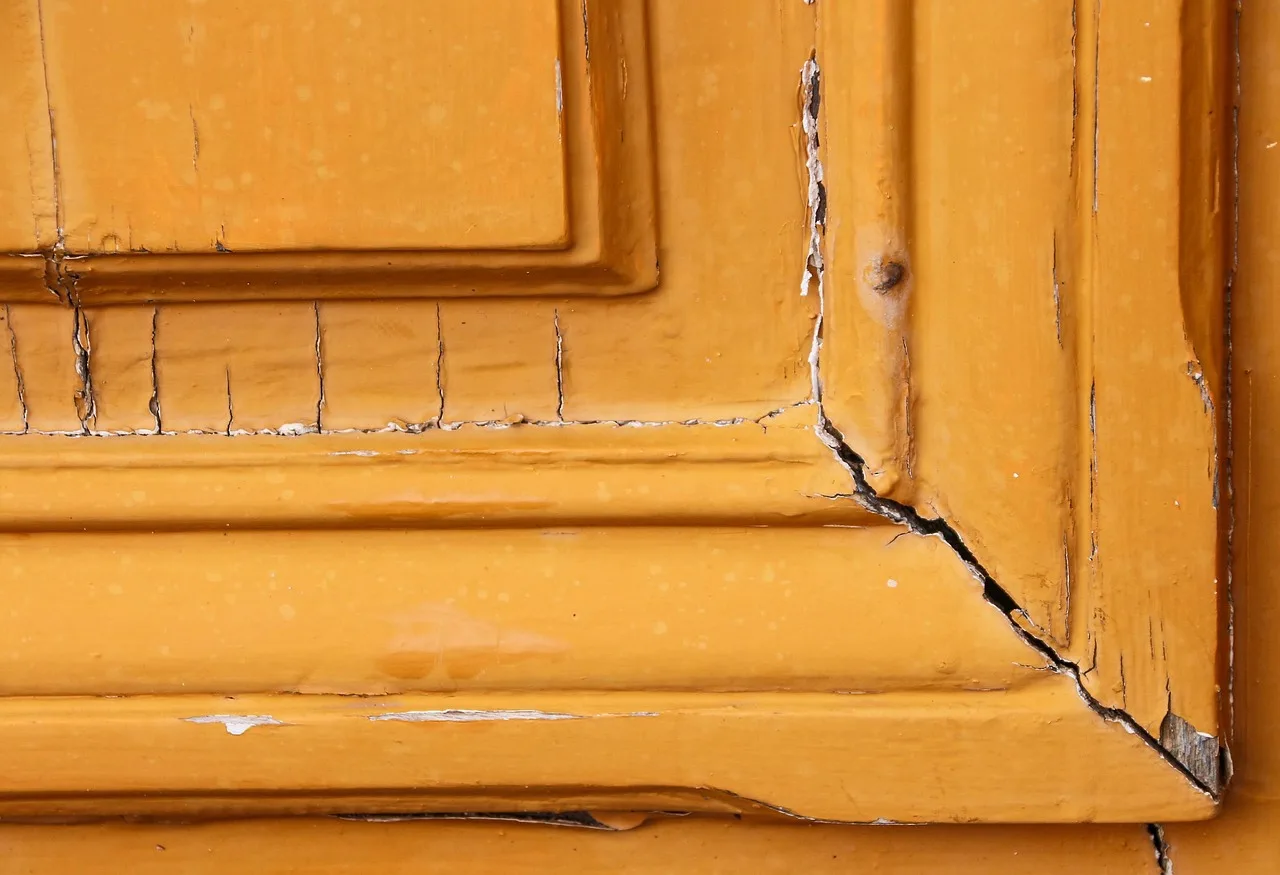
When the wood is missing, crushed, or badly worn, epoxy is usually the best repair chemistry. Polyurethane also has a role, especially on uneven or mixed-material repairs, but it is not a substitute for a true gap-filling rebuild when the joint has lost structure.
Use this section as the line between “glue it” and “rebuild it.” If the break has voids, the repair needs a material that can occupy space as well as bond surfaces.
Two-part epoxy for missing wood and crushed fibers
Two-part epoxy is the better choice for loose joints, broken corners, rotted sections, and missing fibers. It is sold in clear or paste formulations, and some products cure fully in about 24 hours. It works where liquid glue would simply run away or fail to support the void.
This is where products such as PC Products PC-Woody fit the job. They are aimed at rotted or missing wood, which is a different repair from simple joinery.
Polyurethane for uneven or mixed-material repairs
Polyurethane glue is useful when the surfaces are uneven or when wood meets metal, ceramic, or another material. It needs moisture to activate and expands as it cures, so firm clamping is important. That expansion helps in some gaps, but it can also create cleanup problems if you use too much.
Use it when the fit is imperfect and you need a glue that tolerates some irregularity. Do not rely on it as a cure-all for badly damaged furniture joints.
When to stop and add reinforcement
If a chair leg is wallowed out or a rail has repeated failure, glue alone may not be enough. Add dowels, screws, splines, or a new wood insert when the original fibers can no longer hold the load. Glue bonds the repair; reinforcement gives it shape and strength.
Should you use CA or hide glue?
Use CA glue for tiny repairs such as hairline cracks, trim touch-ups, and quick edge fixes. Use hide glue for antique furniture when reversibility matters, especially if you may need future disassembly. They solve different problems, and neither is a substitute for epoxy on real voids.
CA glue for hairline cracks and small trim repairs
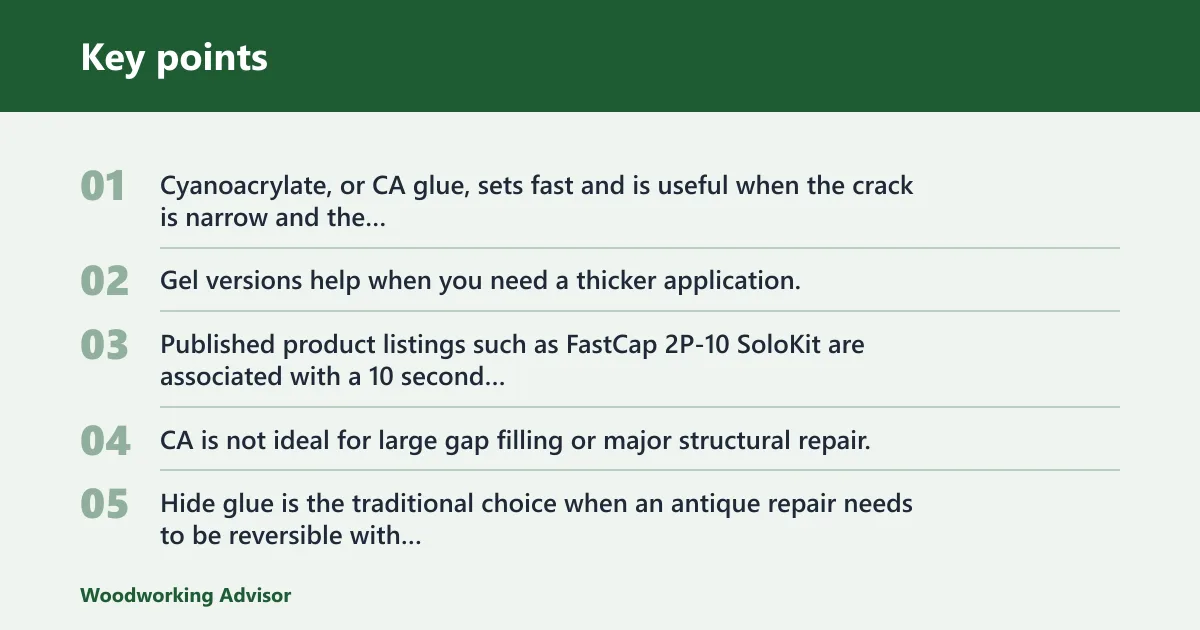
Cyanoacrylate, or CA glue, sets fast and is useful when the crack is narrow and the repair is small. Gel versions help when you need a thicker application. Published product listings such as FastCap 2P-10 SoloKit are associated with a 10 second bond, which shows how fast CA can work on small repairs.
The drawback is size. CA is not ideal for large gap filling or major structural repair, because the bond line is too thin for that kind of damage.
Hide glue for antique furniture and reversibility
Hide glue is the traditional choice when an antique repair needs to be reversible with heat and moisture. That reversibility matters when the piece may need to come apart again for future conservation or repair work.
It is the safer choice for many antiques because it keeps future disassembly possible. That matters more than raw convenience when preservation is the goal.
When fast set is helpful and when it is not
Fast set is useful for tiny trim, hairline checks, and nonstructural fixes where alignment is simple. It is not useful for parts that need more working time, careful clamping, or meaningful gap filling. On those jobs, epoxy or PVA is the better fit.
How to choose
Start with the failure mode. Tight joints point to PVA, damaged gaps point to epoxy, mixed-material or uneven repairs may suit polyurethane, and antiques with future service in mind point to hide glue. The size of the gap matters more than the marketing on the bottle.
Then match the glue to the movement. Chair joints under racking force need a stronger, well-clamped bond than a trim crack or veneer edge. If the part moves, the glue must hold under that movement or the repair will fail again.
- Measure the gap by eye and by fit. Hairline and tight joints can take PVA or CA; wider voids need epoxy.
- Check the load. Chair joints and table legs need stronger structural repair than decorative trim.
- Check moisture exposure. Use Type I waterproof PVA for outdoor furniture or humid rooms.
- Decide whether future disassembly matters. Choose hide glue for antiques when reversibility matters.
- Decide whether glue is enough. Add wood hardener, epoxy filler, or reinforcement when fibers are crushed or missing.
Say your chair rung is loose but the mortise still looks square. PVA is the right repair because the problem is fit, not missing wood. Suppose the same chair leg has a wallowed hole and crushed fibers. That call moves to epoxy plus reinforcement, not more clamp pressure.
Frequently asked questions
What kind of glue is best for wood?
The best glue for wood is the one that matches the repair. Tight interior joints usually call for PVA wood glue. Gaps and broken corners need epoxy. Hairline cracks may suit CA. Antique furniture often benefits from hide glue when reversibility matters more than permanent permanence.
What is the best wood glue for furniture repair?
For most furniture repair, the best wood glue is PVA when the joint fits well. It is strong, easy to clean up with water before cure, and sands well. If the joint is loose, broken, or missing wood, epoxy is the better choice because the problem is no longer a simple glue-up.
What is the strongest wood glue for furniture repair?
The strongest wood glue for furniture repair is the one that matches the load and the gap. Waterproof PVA is strong on tight joints, especially on chair parts and table assemblies. Epoxy is stronger where the joint has damage, voids, or missing fibers and needs rebuilding, not just bonding.
Is wood glue strong enough for furniture?
Yes, wood glue is strong enough for many furniture repairs when the joint fits properly and is clamped well. It is not enough when the joint is loose, the wood is crushed, or the break has missing material. In those cases, use epoxy or add mechanical reinforcement.
What glue is best for repairing chairs?
For chair repairs, PVA wood glue is usually the best choice for tight rungs, rails, and aprons because chairs see racking force but often have close-fitting joints. If the joint is worn or wallowed out, switch to epoxy and consider reinforcement, because the failure is structural rather than cosmetic.
What glue should I use for antique furniture repair?
Use hide glue for antique furniture repair when future disassembly matters. It is reversible with heat and moisture, which helps preserve the piece for later work. If the antique has missing wood or broken corners, epoxy may still be needed on the damaged area, but only where reversibility is less important.
What glue works best for gaps in broken wood joints?
Two-part epoxy works best for gaps in broken wood joints. It can fill missing material, support crushed fibers, and rebuild corners or loose areas where liquid glue would not stay in place. Polyurethane can handle some uneven repairs, but epoxy is the more dependable choice for voids.
Should I use PVA, epoxy, or CA glue for furniture repair?
Use PVA for tight, clampable joints. Use epoxy for gaps, missing wood, and broken corners. Use CA for hairline cracks and very small trim repairs. If the repair needs future disassembly, hide glue may be better than all three. The joint condition should decide the chemistry.
Sponsored / affiliate links. As an Amazon Associate I earn from qualifying purchases. I may earn additional commission from eligible campaigns.