How Much Does a Cedar Deck Cost?
A cedar deck typically costs about $45 to $80 per square foot installed, so a 200-square-foot deck often lands near $9,000 to $16,000, with stairs, railings, and site work pushing it higher. Miss the pricing breakdown, and you can overpay for labor, underbuy materials, or accept a quote that leaves out code-required parts. This article shows where cedar deck cost comes from and gives you a line-item framework to check any contractor estimate.
How much does a cedar deck cost?
A cedar deck usually sits in the mid to upper range of wood deck pricing because the boards cost more than pressure-treated pine and because railings, stairs, and framing are often priced separately. For most projects, installed cost is driven more by deck height and access than by board color or grain.
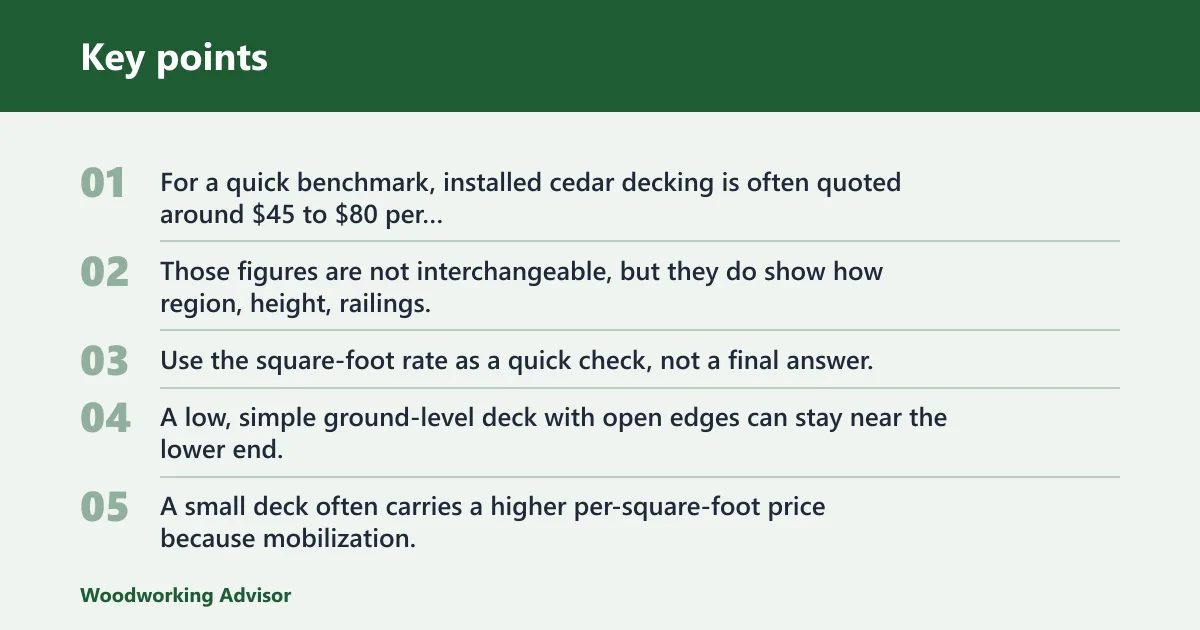
For a quick benchmark, installed cedar decking is often quoted around $45 to $80 per square foot, while Toronto cedar deck pricing has been listed at $70 to $115 per square foot installed. Those figures are not interchangeable, but they do show how region, height, railings, and municipal requirements can move the final number a lot.
Installed cost per square foot
Use the square-foot rate as a quick check, not a final answer. A low, simple ground-level deck with open edges can stay near the lower end, while an attached or elevated deck with railings, stairs, deeper footings, and permit drawings can land much higher.
Deck size also changes the math. A small deck often carries a higher per-square-foot price because mobilization, minimum labor charges, and short-run overhead are spread across fewer square feet.
Material-only versus installed pricing
Material-only pricing tells you what the wood costs. Installed pricing tells you what the finished deck costs after framing, fasteners, labor, footings, railings, stairs, and permit-related work are added. Those are not the same number, and mixing them is the easiest way to misread a quote.
Western red cedar deck boards can cost $4 to $9 per linear foot. That is only one part of the bill. It does not include joists, beams, posts, hardware, railings, stairs, or site work.
What changes the total fastest
Deck height changes the total fastest. Ground-level decks often need less railing and simpler access. Walkout decks usually need more structure and some railing. Second-story decks almost always raise the cost because they need deeper footings, more safety railing, and more labor time.
Railings can make up about 25-40% of total deck cost, especially if aluminum, cable, or glass railing is chosen instead of plain wood. Stairs are another fast cost driver because they add labor, stringers, treads, railings, and code checks.
Cedar deck quote calculator
Use this table to test a contractor estimate against a transparent line-item model. The totals below are installed-cost ranges, not material-only numbers, and they assume a typical cedar deck with standard framing, common railing needs, and one basic stair run where required.
| Deck size | Decking boards | Framing | Railings | Stairs | Total installed | Red-flag variance note |
|---|---|---|---|---|---|---|
| 8×8 | $700 to $1,200 Typical: $950 |
$900 to $1,600 Typical: $1,200 |
$0 to $1,800 Typical: $900 |
$0 to $1,200 Typical: $600 |
$2,600 to $5,800 Typical: $3,650 |
If the quote is far above $5,800 for a simple low deck, ask what railing, footing, or access item is driving it. |
| 12×12 | $1,400 to $2,400 Typical: $1,900 |
$1,800 to $3,400 Typical: $2,500 |
$1,200 to $4,000 Typical: $2,400 |
$600 to $2,000 Typical: $1,100 |
$5,000 to $11,800 Typical: $7,900 |
A quote above $11,800 may be justified by height, cable or glass railing, or deep-footing work. Without those, it is worth a second look. |
| 20×20 | $3,900 to $6,800 Typical: $5,200 |
$4,500 to $8,200 Typical: $6,200 |
$2,500 to $9,500 Typical: $5,700 |
$1,000 to $3,800 Typical: $2,200 |
$11,900 to $28,300 Typical: $19,300 |
If railings are a small share of the quote on an elevated deck, check whether they were omitted or priced as a separate change order. |
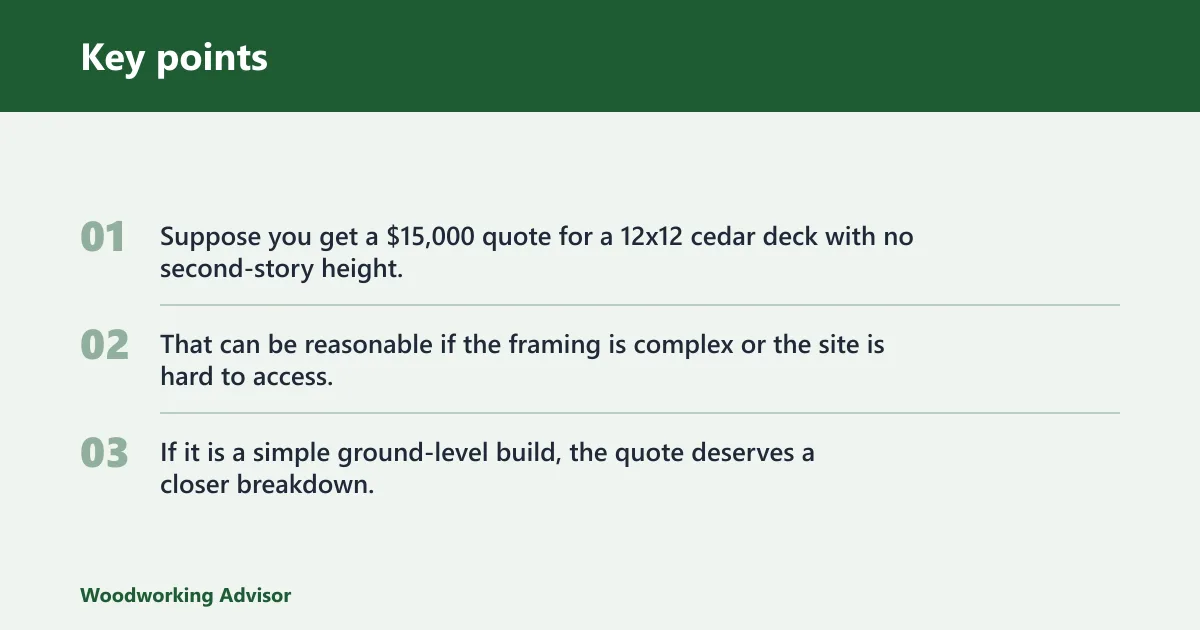
Suppose you get a $15,000 quote for a 12×12 cedar deck with no second-story height, standard wood railing, and one short stair run. That can be reasonable if the framing is complex or the site is hard to access. If it is a simple ground-level build, the quote deserves a closer breakdown.
How much do cedar deck boards cost?
Cedar deck boards are usually priced per linear foot in supplier quotes, and that price is only the board material. Western red cedar deck boards can cost $4 to $9 per linear foot, while Eastern Red Cedar sits near Western red cedar in pricing. Northern White Cedar is the cheapest cedar decking option, but it is less durable than red cedar and is better suited to projects where lower upfront cost matters most.
The board grade changes the bill. Clearer, straighter, and more uniform boards cost more than boards with knots and color variation. Wider boards, longer lengths, and higher trim grades also raise waste and material cost.
Linear-foot pricing versus full-board totals
Linear-foot pricing is useful because it lets you compare cedar to other species quickly. But linear-foot pricing does not include hidden material waste, fasteners, joist tape, or extra boards needed for cuts around stairs and picture framing. That is why a deck board quote can look modest while the installed deck quote climbs fast.
For cedar board shopping, ask whether the quote assumes standard 1×6 or 5/4 decking, what board length mix is included, and whether the estimate allows for waste on corners and stair cuts. Those details often explain why two cedar quotes differ.
What adds to a cedar deck cost
Cedar decking is only the surface. The structure underneath, plus safety and code items, can add thousands. The most common add-ons are framing, fasteners, railings, stairs, footings, and permit or engineering fees.
Framing and fasteners
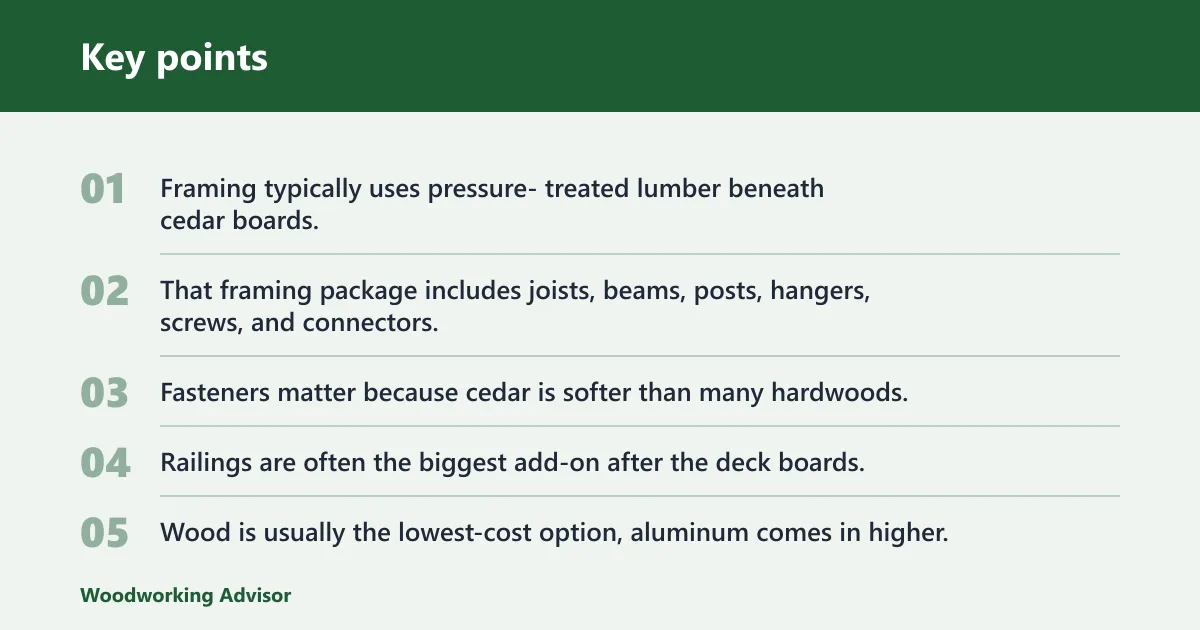
Framing typically uses pressure-treated lumber beneath cedar boards, even on a cedar deck. That framing package includes joists, beams, posts, hangers, screws, and connectors. Fasteners matter because cedar is softer than many hardwoods, and the surface can show damage if the wrong screws or spacing are used.
Railings
Railings are often the biggest add-on after the deck boards. Wood is usually the lowest-cost option, aluminum comes in higher, cable systems add more labor and hardware, and glass is usually the priciest option. The more visible and code-heavy the railing, the more it tends to move the quote.
Stairs
Stairs add both labor and inspection risk. A simple three-step stair set is very different from a long stair run with landings, handrails, and code-compliant spacing. Most contractors price stairs as a separate line item because the geometry and finish work are not the same as the deck floor.
Footings and frost depth
Footings depend on frost depth and footing type. Raised or attached decks usually need footings below local frost depth, and that can mean deeper excavation, more concrete, or an alternate support system. Sonotube footings are common, while helical screw piles can be faster in some soils but may cost more up front.
Picture a walkout cedar deck on a sloped lot. The deck surface itself may look modest, but the support work below it can drive the total because the posts are taller, the footings are deeper, and the railing requirement starts sooner.
Permit and engineering fees
Permit and engineering costs are separate line items for some deck heights and attachments. Municipalities may require drawings, footing details, or structural review, especially when the deck attaches to the house or rises above a threshold that triggers guardrail and inspection rules. These fees are easy to miss in a rough quote.
Cedar vs pressure-treated pine
Pressure-treated pine deck pricing is usually the lower-cost baseline. Cedar decking can cost at least twice as much as pressure-treated wood, so cedar is not the cheapest way to build a deck. The tradeoff is appearance, natural rot resistance, and a different maintenance profile.
Pressure-treated pine typically has the lowest installed cost tier in common deck guides, but it usually needs more visible maintenance over time. Cedar can last more than 40 years with sealing and regular maintenance, but that lifespan assumes ongoing upkeep. If upkeep will be skipped, cedar’s value drops quickly.
When cedar makes sense
Cedar tends to make sense when you want a natural wood look, better resistance than basic pine, and a deck that will be maintained on schedule. It is often a better choice when the deck is moderate in size and the owner is comfortable paying more up front for a warmer appearance.
When cedar stops making sense
If the deck is very large, very high, or heavily railed, cedar can stop making sense because the premium adds up fast. At that point, labor, railings, and footings may dominate the budget, and the owner may not get enough value from cedar’s higher material cost to justify it.
How does deck height change price?
Deck height changes price by changing structure, safety, and permit needs. Ground-level decks are usually the simplest. Walkout decks need more structure and often more railing. Second-story decks push cost higher because access is harder, footings are more demanding, and code requirements are stricter.
Ground-level decks
Ground-level cedar decks can be the most affordable to build because they often need less railing and less complex support. They can still need permits, but the structural and code burden is usually lighter than on an elevated deck.
Walkout decks
Walkout decks often sit above grade enough to need guardrails and more substantial footings. They are a common point where a cedar deck quote starts to climb because the structure underneath is no longer simple.
Second-story decks
Second-story decks are the costliest tier for cedar because height affects everything. You may need deeper footings, more posts, taller railings, stair access, and more engineering review. Labor also rises because crews spend more time working safely at height.
Access matters more than many homeowners expect. Tight side yards, steep grades, long material carries, and limited equipment access can all raise labor time. A quote that looks high may be carrying a real access premium, but that premium should be named clearly in the estimate.
A common first-timer mistake is comparing only the deck surface area. A 20×20 cedar deck with cable railing and deeper footings is not in the same pricing class as an 8×8 ground-level platform, even though both are wood decks.
Frequently asked questions
How much does a cedar deck cost per square foot?
A cedar deck typically costs about $45 to $80 per square foot installed, with higher numbers for elevated decks, premium railings, and harder sites. In some markets, cedar pricing can run higher, and Toronto pricing has been listed at $70 to $115 per square foot installed.
How much does a 20×20 cedar deck cost?
A 20×20 cedar deck has 400 square feet, so a practical installed range is often about $11,900 to $28,300, with a typical midpoint near $19,300 in the calculator above. Railings, stairs, and footing depth are the biggest reasons the final price moves.
How much does a 12×12 cedar deck cost?
A 12×12 cedar deck has 144 square feet, and a common installed range is about $5,000 to $11,800, with a typical midpoint near $7,900. A simple low deck can stay near the low end, while cable railing or extra footing work pushes the quote higher.
How much would an 8×8 cedar deck cost?
An 8×8 cedar deck has 64 square feet, and a typical installed range is about $2,600 to $5,800. Small decks can still feel expensive per square foot because labor minimums, railing requirements, and footing setup do not shrink as much as the deck surface does.
What is the cost of a cedar deck vs pressure treated?
Cedar decking can cost at least twice as much as pressure-treated wood. Pressure-treated pine is usually the lower-cost baseline, but cedar offers a more refined look and better natural resistance. The right choice depends on budget, maintenance plans, and how long the deck is expected to stay in service.
Sponsored / affiliate links. As an Amazon Associate I earn from qualifying purchases. I may earn additional commission from eligible campaigns.