How Much Cedar to Repel Moths? Exact Amounts by Closet Size
About 1-2 cedar blocks per square foot of closet — or one ball per drawer — is the practical amount, though cedar repels egg-laying moths rather than killing established larvae or adults. Using too little cedar, or letting it go more than 3-6 months without re-sanding, is why closets “protected” with cedar still get moth damage. This guide covers exact quantities by space size, what cedar actually kills versus just repels, and how to keep the scent active.
Quick Answer
Use roughly 1-2 solid cedar blocks (or about 1 ounce of chips) per square foot of closet space, or one cedar ball per drawer. Cedar’s oils repel egg-laying moths and kill only the smallest larvae — it does not kill eggs, pupae, or adult moths, and the scent fades within months, so re-sand the surface every 3-6 months to keep it working.
Natural Repellent Qualities of Cedar
Best Cedar Moth-Protection Kit
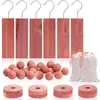
Homode Cedar Variety Pack (40 Pieces) – $17.99
Includes hang-ups for closet rods, balls for drawers, sachets for shelves, and sandpaper to re-sand the surface — matches the mixed-format placement this guide recommends for closets and drawers together.
- Best for: covering a full closet plus several drawers in one purchase
- Why we picked it: one pack supplies every format this guide covers (hangers, balls, sachets) instead of buying three separate products
- Main drawback: individual pieces are smaller than dedicated closet planks, so large closets may need a second pack
Compare more cedar moth-protection options
 Option 1 Cedar Space Chip Planks (16-Pack) – $12.59
|
 Option 2 Woodever 56-Piece Set with Hooks – $17.99
|
 Option 3 Dr. Killigan’s Cedarwood Planks (10-Pack) – $24.97
|
As an Amazon Associate we earn from qualifying purchases.
Cedarwood’s scent comes from aromatic compounds concentrated in the reddish heartwood — primarily cedrol and thujopsene, sesquiterpene alcohols that moths find repellent — the same aromatic oils behind what cedar wood smells like. These compounds are what earned cedarwood oil its EPA pesticide registration for clothing protection back in 1960.

📊 Cedarwood oil has been a registered pesticide in the U.S. since 1960 specifically to repel moths from clothing, and the EPA classifies it as a minimum-risk (FIFRA 25(b)) active ingredient — meaning it works by a non-toxic, repellent mode of action rather than as a strong insecticide. Source: EPA R.E.D. Facts, Wood Oils and Gums (Cedarwood Oil), 1993
Cedar is a repellent and a mild larvicide for young larvae — not a broad insecticide. It discourages adult moths from landing and laying eggs on fabric, and it can kill newly hatched larvae that are directly exposed to concentrated oil vapor. It does not reliably kill moth eggs, later-stage larvae, pupae, or adult moths that are already established. For a broader look at how cedar performs against carpet beetles, ants, and other household pests beyond clothes moths, see does cedar wood repel insects.
Does Cedar Kill Moths, or Just Repel Them?
This is the gap most cedar guides skip. Cedar is a repellent first and a very limited killer second. If moths are already established in stored clothing — visible larvae, webbing, or holes — adding cedar blocks will not eliminate that infestation. Wash or dry-clean infested items first (heat kills all life stages), then use cedar to keep new moths from moving in.
“Cedar oil may repel moths at high concentrations, but cedar lumber loses most of its oil a few years after cutting. Just because you can smell the cedar in your closet does not mean moths will be repelled by it.”
This is also why cedar-lined closets and chests underperform their reputation: most aren’t airtight, so adult moths can still fly in and out around doors and seams. The cedar scent alone doesn’t block their entry — it only makes the area less attractive for egg-laying once they’re inside — a nuance covered further in does cedar attract bugs.
How Much Cedar Do You Need?
Use the table below as a starting point, then adjust for how tightly the space seals.
| Closet Size (sq ft) | Solid Cedar Blocks | Cedar Chips (approx.) |
|---|---|---|
| 10 | 10-20 | 10 oz |
| 20 | 20-40 | 20 oz |
| 30 | 30-60 | 30 oz |
For drawers, one cedar ball or sachet per drawer is typically enough; deep or wide drawers do better with two.
How to Size Cedar for a Closet or Drawer
- Measure the floor area: multiply the closet’s length by width in feet to get square footage.
- Apply the 1-2 block ratio: use 1-2 solid cedar blocks per square foot, or roughly 1 ounce of chips per square foot.
- Add one unit per drawer separately: drawers aren’t covered by the closet-floor math — budget one cedar ball or sachet per drawer.
- Distribute rather than cluster: spread blocks across shelves, corners, and rod-hung sachets instead of piling them in one spot.
- Mark a re-sand date: set a reminder for 3-6 months out, since the scent (and repellent effect) fades well before the wood looks worn.
Cedar Products Worth Buying
See our full cedar wood hub for species comparisons, sealing, and care beyond moth protection. Below are the specific products that match the quantities above.
Renewing Cedar’s Potency
Cedar’s oils evaporate from the wood surface over time, and the repellent effect fades along with the scent. Sanding exposes fresh wood fibers still holding oil below the surface.
- Use fine-grit sandpaper (about 220 grit).
- Sand lightly until you can smell fresh cedar again — a few light passes is usually enough.
- Wipe away the dust with a dry cloth.
- Optionally add a drop or two of cedarwood essential oil to the freshly sanded surface for a stronger, longer-lasting refresh.
Plan to sand every 3-6 months under normal use. Cedar lumber that’s been cut more than a few years loses most of its oil regardless of sanding, so blocks older than 3-4 years are worth replacing rather than reviving.
Placement Strategies for Cedar
- Put cedar blocks in closet corners rather than one pile, to cover the whole footprint.
- Hang cedar sachets or rings directly on the closet rod to protect hanging clothes.
- Distribute chips or sachets across drawers and shelves rather than concentrating them near the door.
- Never place cedar directly against fabric — the oils can stain some materials, especially light-colored silk and wool (the same cedar oil that repels moths).
Signs of Moth Infestation
Catching an infestation early limits the damage before cedar (or anything else) has a chance to matter.

- Small irregular holes in wool, cashmere, silk, or fur.
- Silky webbing or casings in fabric folds and closet corners.
- Larvae — small cream-colored caterpillars — in undisturbed, dark storage areas.
- Adult moths fluttering weakly near closets or storage boxes (they’re poor, low fliers).
Cedar vs. Chemical Mothballs
| Feature | Cedar | Chemical Mothballs (Naphthalene/PDB) |
|---|---|---|
| Mode of action | Repels adults, kills only young larvae on contact | Toxic vapor kills eggs, larvae, and adults in a sealed space |
| Needs an airtight container | No, but works better in one | Yes — vapor must stay concentrated to work |
| Child/pet safety | Minimum-risk EPA classification | Toxic if ingested; EPA-regulated pesticide |
| Odor | Mild, generally pleasant | Strong, often described as unpleasant |
| Maintenance | Re-sand every 3-6 months | Replace as vapor depletes, per label |
For a light-to-moderate risk closet, cedar is the lower-maintenance, safer choice. For an active, established infestation, a sealed container with a labeled chemical product (or professional treatment) works faster and more completely. Cedar’s safety profile is also why it’s commonly asked whether it are cedar balls toxic to pets or kids — the short answer is no, per the EPA’s minimum-risk classification above.
Other Natural Repellents to Combine with Cedar
None of these are stronger than cedar on their own, but layering scents can help cover a space cedar alone leaves thin. If fleas rather than clothes moths are the concern, note that the evidence is different — see does cedar wood kill fleas.
- Lavender sachets — mild repellent scent, pairs well in the same drawer as cedar.
- Whole cloves in a cloth bag, hung alongside cedar sachets.
- Dried mint leaves mixed into cedar chip bags for a stronger combined scent.
Frequently Asked Questions
Does cedar really keep moths away?
Yes, but as a repellent rather than a killer of established moths. Cedar’s oils (mainly cedrol and thujopsene) discourage adult moths from laying eggs on nearby fabric and can kill freshly hatched larvae exposed to concentrated vapor. It does not kill eggs, pupae, or adult moths already present, so it works best as prevention rather than a cure for an existing infestation.
How do I use cedarwood for moths?
Place solid cedar blocks or planks at roughly 1-2 per square foot of closet floor, cedar chips at about 1 ounce per square foot, and one cedar ball or sachet per drawer. Spread pieces across corners and shelves rather than clustering them, and never let cedar touch fabric directly.
How often should I replace or re-sand cedar in my closet?
Lightly sand the surface with 220-grit sandpaper every 3-6 months to expose fresh oil-bearing wood and restore the scent. Replace blocks entirely once they’re more than 3-4 years old, since cut cedar lumber loses most of its oil by then regardless of sanding.
How many cedar balls per drawer?
One cedar ball or sachet is typically enough for a standard drawer. Use two for unusually deep or wide drawers, or when storing especially valuable wool or cashmere items.
Does cedar kill moth eggs or larvae?
Cedar can kill newly hatched, small larvae directly exposed to its oil vapor, but it does not reliably kill moth eggs, later-stage larvae, or pupae. If you already see holes, webbing, or larvae, wash or dry-clean the affected items first — heat and cleaning kill all life stages — then add cedar to prevent new moths from settling in.
Why do cedar-lined closets still get moth damage sometimes?
Most cedar-lined closets aren’t airtight, so adult moths can still fly in around doors, vents, and seams. The wood’s scent doesn’t physically block their entry — it only makes the space less attractive for egg-laying once oils are fresh. An older or under-sanded cedar closet loses even that deterrent effect.
Conclusion
Whether you need to treat the wood itself first is covered in does cedar need to be treated and does cedar need to be sealed. Cedar earns its EPA pesticide registration as a moth repellent, not a moth killer — use 1-2 blocks per square foot of closet (or about 1 ounce of chips), one ball per drawer, and re-sand every 3-6 months to keep the oils active. For an active infestation, clean the affected items first; cedar’s job is keeping new moths from moving in, not eliminating ones already there.
Sponsored / affiliate links. As an Amazon Associate I earn from qualifying purchases. I may earn additional commission from eligible campaigns.