How Much Does a Cord of Firewood Cost?
A cord of firewood typically costs $150 to $500, with delivered and stacked hardwood often running $300 to $600 depending on region, moisture, and species. Paying by the wrong unit, or missing delivery and stacking details, can add hundreds to the final bill. This guide breaks down cord size, moisture content, delivery, stacking, and wood species so you can compare quotes on the same basis.
What a cord of firewood includes
A full cord is 128 cubic feet of stacked wood. Use that figure when you compare any quote, whether the seller talks in full cords, half cords, or face cords. If the quote does not state the unit clearly, you cannot judge the price fairly.
How much wood is in a full cord?
A full cord contains 128 cubic feet of stacked firewood. That is volume, not weight. Stack tightness matters because loose piles leave air gaps, while a proper stacked cord follows a much clearer measure.
Face cord and half cord labels create the most confusion. A face cord is often described as about 42 cubic feet, and the term varies by region. Some sellers also call it a rick cord, so ask what dimensions are included before you compare prices.
Why stacked volume matters
Wood sold by the truckload can be hard to compare because truck beds vary and a loose load is not the same as a stacked cord. A quoted “truckload” may hide a smaller usable volume than a stated cord. Ask for the cubic-foot basis, then compare the same unit every time.
How much does a cord of firewood cost?
Many delivered residential firewood quotes are commonly reported in the $150 to $500 range before add-ons. Full cord pricing is the cleanest baseline because it ties the quote to 128 cubic feet, which makes cross-checking easier than bundle or truckload pricing.
Why full cord pricing is the best baseline
Bundle pricing stops being useful once you need enough wood for more than a small fire. Bundles usually cost $5 to $15, but a bundle price tells you little about real volume. A cord quote is easier to judge because the unit is standard, even if the total changes with wood quality and delivery.
When bundle pricing stops being comparable
If you burn often, bundle pricing can look low while costing more per usable heat than a cord. For a fireplace used a few weekends a month, bundles may be fine. For home heating, they are rarely the clearest way to compare value.
What drives firewood prices?
Firewood price changes with moisture level, species, delivery distance, access, and add-on labor. Seasoned firewood usually costs more than green wood because drying takes time and handling. Kiln-dried wood sits at the premium end. Delivery and stacking often appear as separate charges, and site access can push both higher.
Moisture level: green, seasoned, or kiln-dried
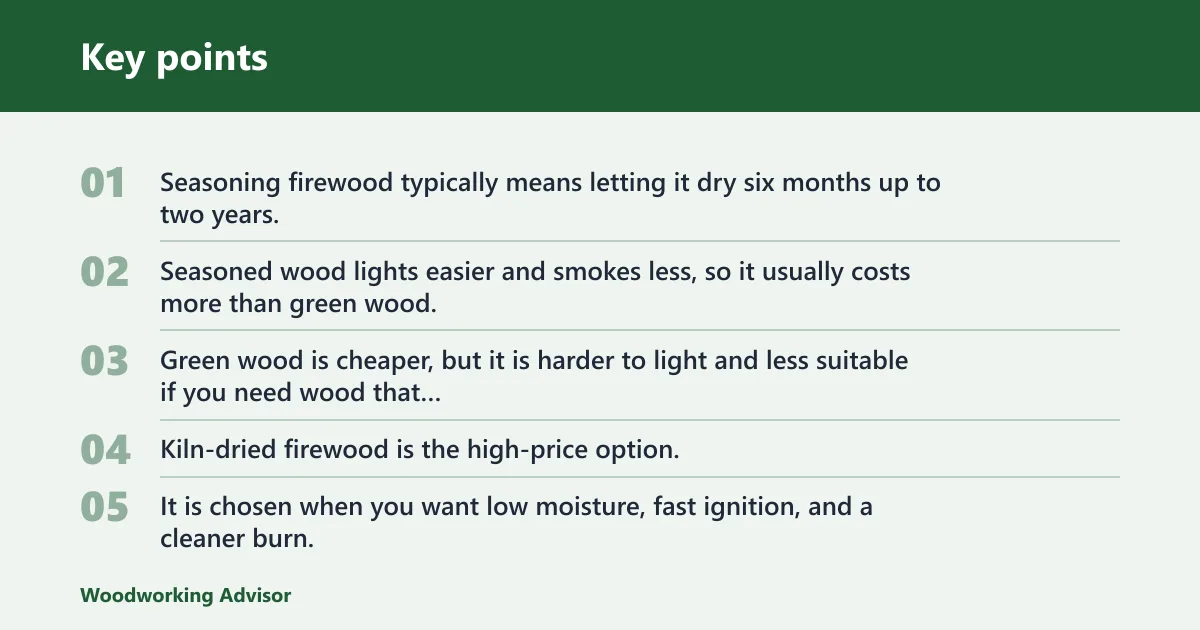
Seasoning firewood typically means letting it dry six months up to two years. Seasoned wood lights easier and smokes less, so it usually costs more than green wood. Green wood is cheaper, but it is harder to light and less suitable if you need wood that burns well right away.
Kiln-dried firewood is the high-price option. It is chosen when you want low moisture, fast ignition, and a cleaner burn. For a small indoor fireplace or a customer who wants immediate use, kiln-dried wood can make sense despite the premium.
Species: hardwood versus softwood
Hardwood species such as oak, hickory, cherry, maple, and birch usually cost more than softwood species such as pine, spruce, and cedar. Species affects heat output and market price. Hardwood generally burns longer and is preferred for home heating, while softwood may suit kindling or casual outdoor fires.
Delivery distance and site access
Delivery fee is usually added to material price and often quoted separately. It changes with distance, road conditions, and whether the seller can reach your woodpile easily. Narrow drives, steep grades, mud, stairs, or long carries all can increase the charge.
House Beautiful says delivery and stacking usually cost $25 to $75, and stacking adds another $25 to $80 per load. Those are not fixed fees. They can move up when the drop-off spot is hard to reach or when the seller must carry wood a long distance from the truck.
Stacking, splitting, and other add-ons
Stacking is labor, so it is often extra on top of delivery. Splitting may also be separate if you are buying rounds or larger pieces. If a quote says “delivered” but not “stacked,” assume stacking is excluded until the seller confirms it in writing.
Firewood quote checker
Use this table to compare any quote against a fair estimate on the same basis. Start with unit size, then add moisture level, then add delivery and stacking. That keeps a “cheap” quote from looking better than it really is.
| Quote item | What to check | Fair-price reference | What to ask for |
|---|---|---|---|
| Full cord | 128 cubic feet of stacked wood | House Beautiful says $120 to $900 | Confirm stacked volume and species mix |
| Half cord | 64 cubic feet | House Beautiful says $100 to $300 | Ask whether delivery and stacking are included |
| Face cord | About 42 cubic feet; regionally variable | House Beautiful says $75 to $200 | Ask the actual length of the logs |
| Green wood | Higher moisture, cheaper upfront | Usually below seasoned wood | Ask whether it is ready for immediate burning |
| Seasoned wood | Dried six months up to two years | Usually higher than green wood | Ask how it was dried and when it was cut |
| Kiln-dried wood | Low moisture, premium tier | Highest price tier | Ask for moisture and delivery details |
| Delivery | Distance and access can change the fee | House Beautiful says $25 to $75 | Confirm whether fuel surcharges are added |
| Stacking | Often extra labor | House Beautiful says $25 to $80 per load | Ask if stacking is included or billed on site |
| Splitting | May be separate from delivery | Varies by seller | Ask whether splits are standard or extra |
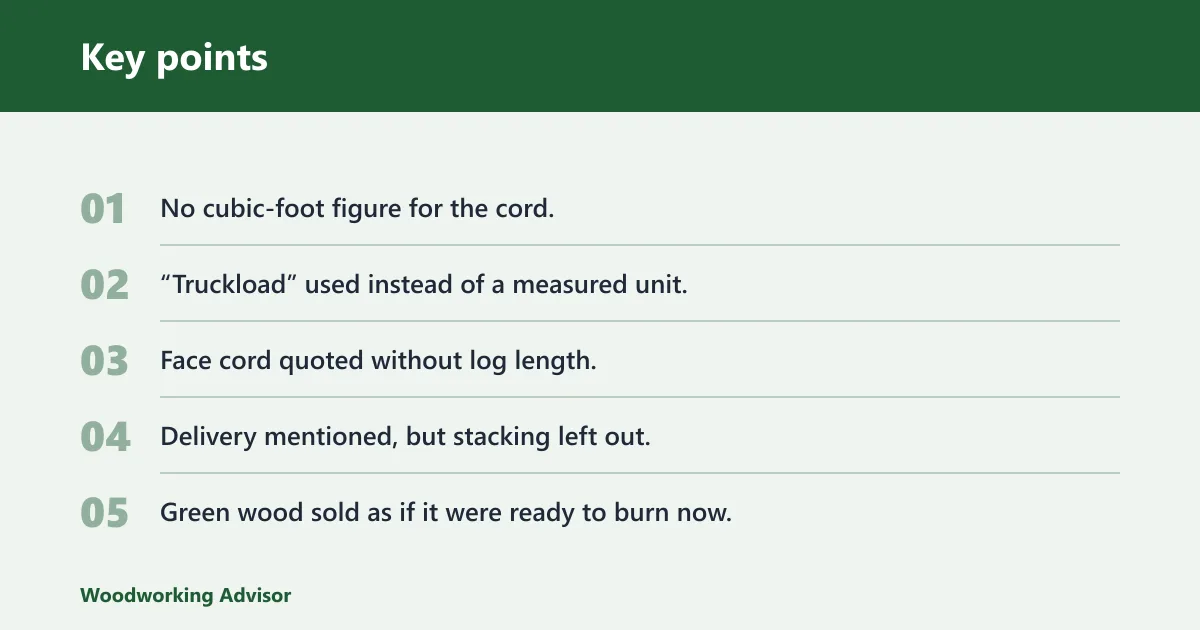
Red flags are easy to spot once you know what to look for. A common first-timer mistake is assuming a “cord” means the same thing everywhere. It does not, and a vague unit label can hide a smaller load, extra labor, or both.
- No cubic-foot figure for the cord.
- “Truckload” used instead of a measured unit.
- Face cord quoted without log length.
- Delivery mentioned, but stacking left out.
- Green wood sold as if it were ready to burn now.
- Fuel surcharge added only at delivery.
Is a cheaper green cord a good deal?
A cheaper green cord is only a good buy if you can store it long enough to dry and you do not need immediate heat. For fast use, seasoned or kiln-dried wood is usually the better value because it burns more predictably, smokes less, and wastes less time on failed starts.
When green wood works
Green wood can work for buyers who plan ahead and have dry storage. If you are buying for next season, a lower upfront price may make sense. If you need wood for this week, green wood is usually the wrong choice.
When seasoned wood is the better buy
Seasoned wood is often the best middle ground for home heating and regular fireplace use. It costs more than green wood because drying takes time, but it is much easier to use right away. For most homeowners, that tradeoff is worth it.
Kiln-dried wood makes sense when clean startup matters more than purchase price. It is especially useful for indoor fires, occasional users, or anyone who does not want the smoke and lighting problems that come with wetter wood.
Suppose you are heating with a stove every evening and your supplier offers a cheaper green cord. The lower quote looks good until you account for longer drying time, harder starts, and more smoke. In that case, the “savings” may disappear quickly.
How to compare firewood quotes by use case
Your best quote depends on how you burn. Home heating usually calls for seasoned hardwood and a clear delivered price. Occasional fireplace use can tolerate smaller quantities or kiln-dried wood. Outdoor fire-pit use often works fine with a lower-cost softwood mix if the wood is dry enough to light easily.
Home heating
For home heating, compare full cords and ask for species, moisture level, delivery, and stacking in writing. Hardwood is usually the safer buy because it burns longer. A cheap green cord is rarely a good value if you need dependable heat now.
Occasional fireplace use
For occasional fireplace use, a half cord or even smaller purchase may fit better than a full cord. A half cord is 64 cubic feet, and House Beautiful prices it at $100 to $300. If storage space is tight, ask whether the seller can deliver and stack only the amount you need.
Outdoor fire-pit use
For outdoor fire-pit use, softer species may be acceptable if they are dry enough and local rules allow burning. Face cords are common in some markets, but the term varies by region. Make sure you know the actual volume before you agree to a price.
Why do firewood prices vary by state?
Firewood prices vary by state because local supply, labor costs, transport distance, and seasonal demand are not the same everywhere. Urban areas often cost more. The Northeast and West Coast commonly sit higher than rural markets, and prices can rise later in the year when delivery demand tightens.
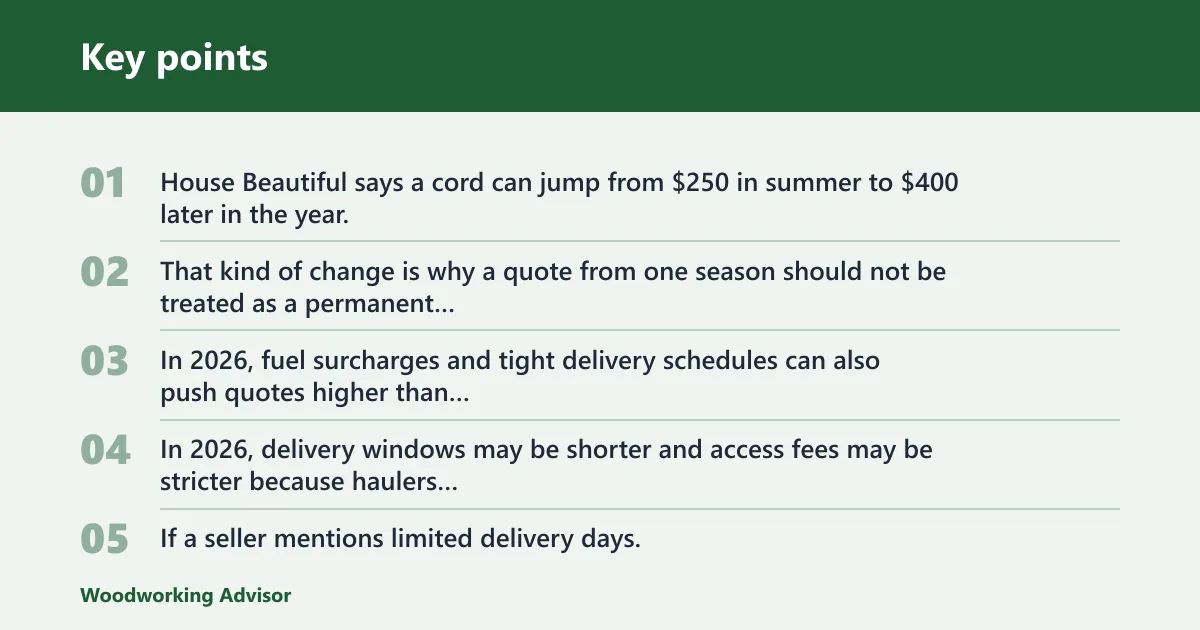
The same source says a cord can jump from $250 in summer to $400 later in the year. That kind of change is why a quote from one season should not be treated as a permanent market price. In 2026, fuel surcharges and tight delivery schedules can also push quotes higher than expected.
Recent pricing pressure to watch
In 2026, delivery windows may be shorter and access fees may be stricter because haulers are working around fuel costs and route limits. If a seller mentions limited delivery days, ask whether the price includes any surcharge for distance, narrow access, or missed drop-off windows.
Frequently asked questions
How much firewood is a cord?
A cord is 128 cubic feet of stacked firewood. That volume is the standard reference point for comparing other firewood labels. If a seller uses face cord, half cord, or truckload wording, ask for the cubic-foot basis before you decide whether the quote is fair.
How much is 1 cord of firewood?
One cord is the same as a full cord: 128 cubic feet of stacked wood. House Beautiful prices a full cord at $120 to $900. The price depends on whether the wood is green, seasoned, or kiln-dried, plus whether delivery and stacking are included.
What is included in a firewood quote?
A firewood quote should state the unit size, wood condition, species mix, delivery fee, and whether stacking is included. If splitting is needed, that should be listed too. Any quote that leaves out the unit basis or treats delivery as a surprise charge is hard to compare accurately.
How much is a face cord compared with a full cord?
A face cord is about 42 cubic feet, or about one-third of a full cord, but the term varies by region. That is why it can be misleading if the seller does not state log length. Compare face cord prices only after you know the actual dimensions and the included services.
How can I tell if a cord quote is fair?
Check the quote against the same unit, same moisture level, same species, and same services. A fair quote should say whether delivery and stacking are included and whether any fuel surcharge applies. If the seller uses vague terms like truckload or leaves out cord size, keep asking until the unit is clear.
Sponsored / affiliate links. As an Amazon Associate I earn from qualifying purchases. I may earn additional commission from eligible campaigns.
 Premium Wood Burning Kit 43PCS, Adjustable Temperature Pen With 36 Tips & Accessories, All In A Deluxe Storage Case - Complete Gift For An Effortlessly Mastering The Art Of Pyrography
 DGAGA Wood Burning Paste Wood Burning Gel for Heat Gun Heat Activated Paste for Craft Chalk Paste for Wood Burning Etching Marker Stencil Wood Working Tools and Accessories on Wood,Canvas,Denim 4 OZ