Oak vs Hickory Firewood: Which Burns Hotter?
Hickory can produce a hotter, more aggressive flame over a short burn, but oak usually gives more dependable heat per cord and a steadier coal bed, so for many buyers oak is the better all-around buy. Miss that split, and you can pay for wood that burns through too fast, smokes more than expected, or falls short in a stove or smoker. This guide compares burn behavior, heat output per cord, seasoning, splitting, smoke, and cooking use so you can choose the right wood.
This guide is part of our Wood burning guide: tools, techniques, and safety series.
Oak vs hickory at a glance
| Factor | Oak | Hickory Firewood | Winner |
|---|---|---|---|
| Heat output | Red oak: 24.6 million BTUs per cord; white oak: 29.1 million BTUs per cord; Gambel oak: 30.7 million BTUs per cord | Bitternut hickory: 29.2 million BTUs per cord; shagbark hickory: 30.6 million BTUs per cord | Hickory Firewood |
| Seasoning time | Red oak may only require 18 months; white oak should be allowed at least two years, preferably three | 12-18 months | Hickory Firewood |
| Splitting difficulty | Often easier in straight-grain pieces, though white oak can twist and knot | Usually harder to split; stringy fibers are common | Oak |
| Smoke for cooking | Milder smoke; widely used for barbecue when you want a less forceful flavor | Stronger smoke flavor; better when you want a bolder profile | Depends on recipe |
| Coal bed and burn behavior | Steady, dependable coals; good for long stove burns | Hot, lively burn with strong heat early in the cycle | Oak |
| Seasoned moisture target | Below 20% moisture | Below 20% moisture | Tie |
Heat output
Shagbark hickory is listed at 30.6 million BTUs per cord, and bitternut hickory at 29.2 million BTUs per cord. Red oak sits at 24.6 million BTUs per cord, while white oak reaches 29.1 million BTUs per cord. In this comparison, the answer depends on the species rather than the label alone.
That gap matters. A hot initial flame can look impressive, but usable heat per cord tells you how much energy you actually bought.
Seasoning time
Hickory can season in 12-18 months. Red oak may only require 18 months, while white oak should be allowed at least two years, and in some setups longer. Faster seasoning lets hickory go into service sooner, but the difference is smaller than many buyers expect once wood is cut, split, and stacked correctly.
Splitting and handling
Oak is often easier to split than hickory, especially when the oak has straight grain. Hickory often resists the maul with stringy fibers that stay connected after the first strike. White oak can still be stubborn when knots or twist show up.
Which burns hotter?
Hickory often burns hotter in the sense that it can produce a more aggressive flame and slightly higher heat output per cord than some oak species. But the answer changes with species: shagbark hickory at about 31 million BTUs per cord edges out white oak at about 29 million BTUs per cord, while red oak at about 25 million BTUs per cord sits well below both.
Peak flame temperature is not the same thing as total heat. A fire can flare hard and still leave you with less useful warmth if the load burns through too fast, which is why burn duration and coal quality matter as much as the first ten minutes.
Why burn time matters as much as temperature
A wood stove needs more than a bright flame. It needs steady output, usable coals, and enough duration to keep the box warm without constant refueling. Oak is often the smarter buy for that job because it gives dependable coaling and a slower, more controlled burn.
Say your stove runs overnight and you want heat still available at dawn. A load of oak is more likely to leave a workable coal bed than a fast, flashy fire that peaks early and drops off sooner.
How do oak and hickory compare in smoke and cooking?
Hickory gives a stronger smoke flavor, while oak is milder and easier to use when you want smoke without overpowering the meat. For barbecue, that means hickory is better when you want a bold profile and oak is the safer choice when you want more control. Neither wood should be treated as automatically superior for every recipe.
For firewood buyers who also cook, that difference matters as much as heat output. A wood that burns well in a stove may still be too assertive in a smoker if the cook wants a lighter smoke ring and less intensity.
Hickory smoke flavor
Hickory smoke is intense. It works well with cuts that can stand up to stronger wood smoke, but it can dominate more delicate food if the fire is heavy or the cook runs too much wood too soon. That makes hickory a better fit for a cook who already knows how much smoke their setup produces.
Oak smoke flavor
Oak is the middle ground many pitmasters want, with enough smoke to flavor meat without the force of hickory. It suits longer cooks and mixed fuel approaches. If you want a wood that works in both a fire pit and a smoker, oak is often the easier match.
Which is easier to split and season?
Oak is usually easier to split, while hickory usually takes more effort because of its stringy fibers. Hickory also tends to need a bit more patience during handling, especially if dirt or grit has worked into the bark or outer layers and is going to dull a chainsaw chain faster than clean wood. Both woods still need full seasoning before they burn well.
Seasoned firewood should be below 20% moisture. If you skip that target, the wood will be harder to light, create more smoke, and leave less dependable coals.
Straight grain versus stringy fibers
Many oak pieces split cleanly when the grain runs straight. Hickory is tougher because the fibers hold together after impact, so you may get long strands instead of a clean break. That is one reason buyers who process their own wood often prefer oak for volume work.
Chainsaw wear, dirt, and knot issues
Hickory can be hard on chainsaws when dirt and grit are present, especially near the base or in bark crevices. White oak can also fight back when twisted grain or knots are part of the log. A sharp chain and clean bucking practices matter with either species, but especially with rough hickory rounds.
Picture a 16-inch white oak round with a knot near the center. It may still split, but the twist can force the wedge to wander. Now compare that with a straight hickory round full of stringy fiber; the first split lands, but the halves stay connected enough to make the job feel slower.
What happens if the wood is not seasoned?
Underseasoned oak or hickory burns worse than dry wood, even if the species itself is high quality. Moisture above the practical target keeps the fire from reaching clean, stable combustion, which increases smoke and can leave unburned material in the stove or pit. That is where creosote risk rises, especially in cooler flue conditions.
Properly seasoned firewood should be below 20% moisture. When oak or hickory meets that standard, both woods are less likely to create creosote; when they do not, both can foul a chimney more quickly than expected, especially if the fire smolders or the draft is poor.
How to verify seasoning
- Split a piece open before you judge it by the bark alone.
- Use a moisture meter on the freshly exposed face, not the weathered outside.
- Check several pieces from the stack, not just one sample.
- Look for light weight, checked ends, and loose bark as supporting signs, not as proof.
- If the reading is above 20%, keep stacking and wait.
Creosote, smoke, and poor coal formation
Underseasoned wood makes more smoke because more water has to leave the log before full combustion can happen. That extra smoke can condense in cooler chimney sections. The result is a dirtier burn, weaker coals, and a less predictable stove draft. Dry wood avoids most of that problem.
Choose Oak if… / Choose Hickory Firewood if…
Choose oak if you want easier splitting, a steadier coal bed, and a more forgiving all-around wood for a stove or general firewood pile. Choose Hickory Firewood if you want slightly higher heat output from some species, stronger smoke flavor for cooking, and a hotter-feeling early burn, especially when you can wait for full seasoning.
Choose Oak if…
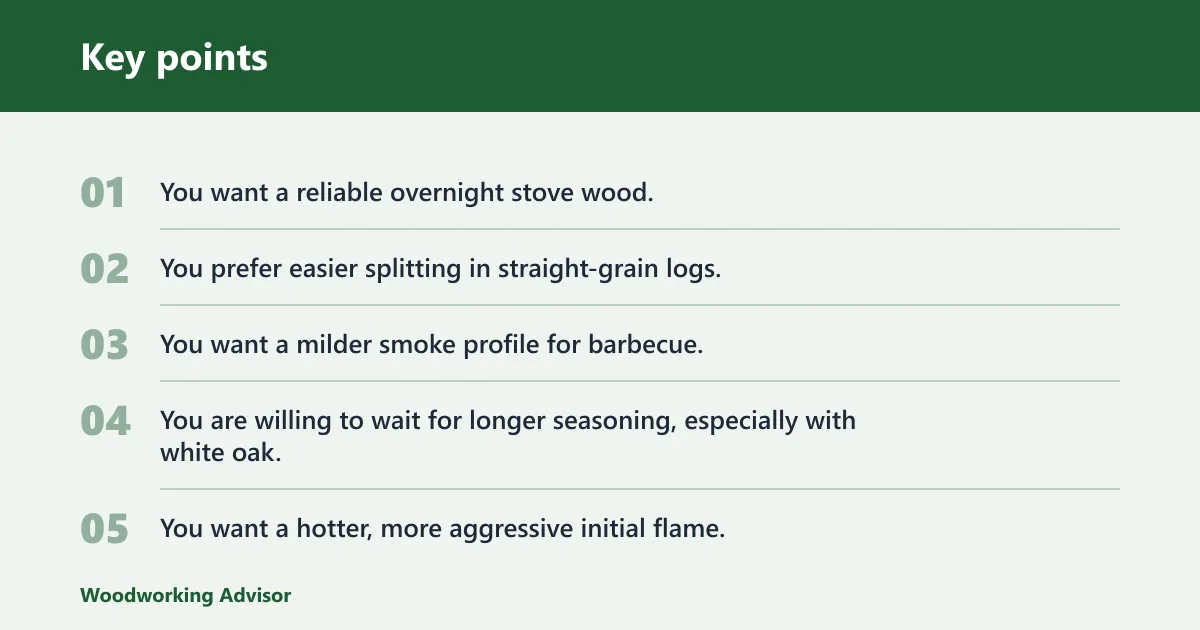
- You want a reliable overnight stove wood.
- You prefer easier splitting in straight-grain logs.
- You want a milder smoke profile for barbecue.
- You are willing to wait for longer seasoning, especially with white oak.
Choose hickory firewood if…
- You want a hotter, more aggressive initial flame.
- You cook with wood and want stronger smoke flavor.
- You can handle tougher splitting and stringier fibers.
- You are fine with 12-18 months of seasoning before burning.
Decision rule by use case
For a wood stove, oak is usually the better buy because it gives steadier heat and a better coal bed. For a fire pit, hickory is attractive if you want more lively heat and you do not mind a stronger smoke note. For cooking, start with oak for milder barbecue and choose hickory when the recipe can stand up to a bolder wood flavor.

Oak and hickory firewood comparison table
| Species | BTU per cord | Estimated seasoning time | Splitting difficulty | Smoke intensity | Best use case |
|---|---|---|---|---|---|
| Red oak | 24.6 million BTUs per cord | 18 months | Moderate; often straight grain | Mild to moderate | General stove wood, balanced smoke use |
| White oak | 29.1 million BTUs per cord | At least 2 years, preferably 3 | Moderate to difficult; twisted fibers and knots can slow splitting | Mild | Long-burning stove fuel when fully seasoned |
| Gambel oak | 30.7 million BTUs per cord | Not specified here | Varies by cut | Mild | High-heat oak option where available |
| Bitternut hickory | 29.2 million BTUs per cord | 12-18 months | Difficult; fibrous | Strong | Hot firewood and bold smoke flavor |
| Shagbark hickory | 30.6 million BTUs per cord | 12-18 months | Difficult; tough, stringy fibers | Strong | Hot stove fuel and smoking wood |
One common mistake is buying the hottest species on paper and forgetting the seasoning backlog. A cord of shagbark hickory that is still too wet will underperform a drier, well-stacked oak load every time.
Frequently asked questions
Hickory vs oak wood
Hickory can deliver very strong heat output and a stronger smoke flavor, while oak usually gives steadier heat, easier splitting, and a more forgiving burn for everyday stove use. If you want the simplest all-around firewood choice, oak usually wins. If you want bolder fire behavior and stronger smoke, hickory often fits better.
Oak vs hickory smoke
Hickory smoke is stronger and more assertive, which is useful when you want a deeper barbecue profile. Oak smoke is milder and easier to control, so it is often better for cooks who want wood flavor without overpowering the food. For mixed fuel cooking, oak is usually the safer starting point.
Does hickory make good firewood?
Yes, hickory makes excellent firewood when properly seasoned. It generally gives strong heat, good coals, and a hot burn, but it can be harder to split and slower to process than oak. It is a very good choice if you are willing to handle tougher rounds and wait for full drying.
Which is harder wood oak or hickory?
Hickory is usually the harder splitting job, even though both are hardwoods. The issue is not only density; hickory’s stringy fibers and tough handling make it more resistant to clean splits. Oak often cuts and splits more predictably, especially in straight-grain sections.
Hickory vs oak for smoking
Hickory is better when you want a stronger, more pronounced smoke flavor. Oak is better when you want a lighter touch or when you are cooking food that can be overwhelmed by heavy smoke. Many cooks use oak for the main fire and add a little hickory only when they want extra punch.
Does oak wood burn well?
Yes, oak burns very well once it is seasoned below 20% moisture. It tends to produce steady heat and dependable coals, which makes it a strong choice for stoves and long fires. White oak and Gambel oak are especially strong heat producers among the examples covered here.
Does hickory burn well?
Yes, hickory burns very well when it is dry enough to season fully. It can deliver strong heat and can burn with a more forceful flame, but it also asks more from the splitter and the seasoning rack. It is a strong firewood choice, not a carefree one.
Sponsored / affiliate links. As an Amazon Associate I earn from qualifying purchases. I may earn additional commission from eligible campaigns.