How Much Does It Cost to Build a DIY Workbench?
A DIY workbench usually costs about $80 to $350 in materials, with compact pine builds near the low end and plywood-plus-vise setups near the high end. If you underbudget, you often end up with a wobbly top, weak joinery, or no real clamping setup, which slows every project. This guide breaks down costs by size, top material, base design, and add-ons so you can budget before you buy lumber.
This guide is part of our Woodworking project ideas and plans series.
Workbench cost overview


A simple bench can stay cheap, but the total rises fast when you increase top thickness, add storage, or buy clamping hardware. A basic bench built from construction lumber and plywood can land in the low hundreds or less; a shop-ready version with a better top and vise can climb much higher.
Family Handyman prices one simple workbench at $51–100, and Woodwork Starter estimates a basic DIY workbench at $50 to $150 for materials. Those low figures fit a stripped-down build. Once you add a quality vise, thicker top material, or a shelf, the budget changes quickly. (Familyhandyman)
What changes the total most
The top drives the biggest cost in many builds. A top made from glued-up boards, LVL, or thicker plywood costs more than a light sheet-good top, and it also affects flatness and sag resistance. After that, storage, leg-frame spacing, and workholding hardware drive the next jump.
Bench height matters for comfort more than cost. Size matters more than height for the budget, because longer benches need more lumber and more sheet goods. More width can also create waste if a standard 4-by-8 sheet is not used efficiently.
📊 Family Handyman prices one simple workbench at $51–100. Source: Familyhandyman.
What you’ll need
- Basic tools: tape measure, pencil, square, saw, drill/driver, clamps, and sander
- Construction lumber for the frame, such as 2x4s from a typical lumberyard
- Plywood or another top material for the bench surface
- Fasteners: screws, washers, and wood glue
- A level or straightedge to check flatness
- Optional shelf material for storage under the bench
- Optional workbench vise, such as a Yost M7WW rapid-acting type
- Optional bench dogs for 3/4-inch-diameter holes
- Optional power strip for tools and chargers
Core materials
Construction lumber is the usual budget choice. It costs less than hardwoods, is available at typical lumberyards, and is easy to cut for a first bench. Plywood is the other core material, especially when you want a flat top without milling solid boards.
Rough-cut lumber can also work for a durable bench, but it is not always cheaper. If you need planing or flattening, the added labor and tool use can push the total above a simpler construction-lumber build.
Optional upgrades
A vise, bench dogs, and a power strip are useful add-ons, not required parts. A good vise can cost as much as the workbench itself, which is why many benches stay inexpensive until clamping hardware is added. Bench dogs pair well with hold-downs and planing stops for better workholding.
Workbench cost table
| Build tier | 2x4s | Plywood or top material | Fasteners | Shelf | Vise | Lighting | Power strip | Subtotal |
|---|---|---|---|---|---|---|---|---|
| Bare-bones | $25 | $20 | $10 | $0 | $0 | $0 | $0 | $55 |
| Midrange | $40 | $45 | $15 | $20 | $0 | $10 | $10 | $140 |
| Shop-ready | $60 | $110 | $20 | $25 | $85 | $15 | $15 | $330 |
The jump comes from the top and accessories. Bare-bones benches keep to construction lumber and simple plywood, while the shop-ready tier pays for a thicker, flatter top, a better vise, and the extras that make the bench more useful day to day.
How much should you budget?
For a small bench, budget $50 to $100 if you want the cheapest practical version and already own basic tools. For a sturdy garage bench, $125 to $250 is a safer range because it leaves room for a better top, a shelf, and hardware without forcing thin materials.
Small bench budget
A compact bench can stay low-cost if you use construction lumber, a single sheet of plywood, and simple screws. Family Handyman describes one 30 inches by 6 feet long bench as an hour-or-less project, and Woodwork Starter places a basic DIY materials budget at $50 to $150. That fits a no-frills layout.
Sturdy garage bench budget
For a garage, plan more for stiffness and storage. A shelf adds materials but not cabinet-level complexity, which keeps the project affordable while improving garage storage. A 35-inch work height can be a comfortable starting point for many users, and 35 inches is commonly cited as an example height.
When to spend more
Spend more when the bench will hold heavy tools, take hand-planing loads, or serve as a primary assembly surface. A cheap bench becomes poor value if the top sags, the frame racks, or workholding is so weak that every project needs extra clamps and temporary fixes.
What materials make it cheapest to build?
Construction lumber and plywood are usually the least expensive path to a usable bench. They keep the design simple, they are easy to find, and they reduce labor. That is why many beginner benches use 2x4s for the base and sheet goods for the top and shelf.
Construction lumber
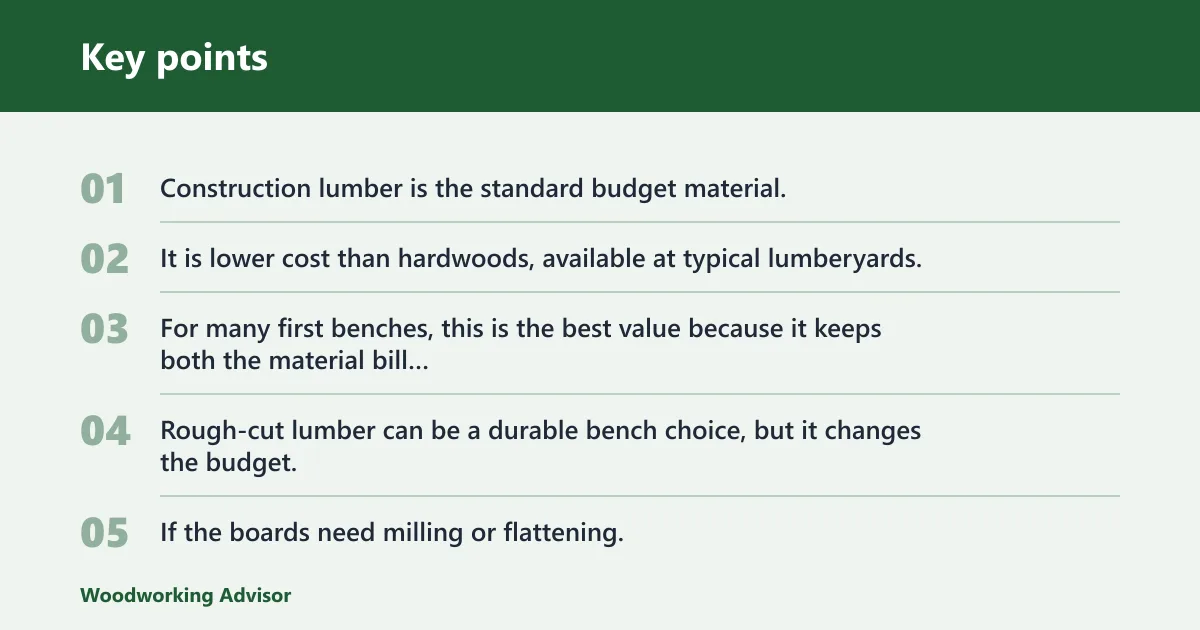
Construction lumber is the standard budget material. It is lower cost than hardwoods, available at typical lumberyards, and simple to cut into leg frames, rails, and stretchers. For many first benches, this is the best value because it keeps both the material bill and the tool list manageable.
Rough-cut lumber
Rough-cut lumber can be a durable bench choice, but it changes the budget. If the boards need milling or flattening, the cost is not just the sticker price of the lumber. That extra work can erase the savings you expected from buying rough stock.
Picture a 6-foot bench made from rough sawn boards that need flattening before assembly. The top may end up more expensive than a plywood top once time, blade wear, or shop access are counted.
Plywood and top options
Plywood is the simplest sheet-good top material. MDO plywood costs more, but its laminate surface gives a better working face and suits a higher-spec build. For a flat, durable top, thicker material generally costs more, but it also resists denting and sagging better than a thin panel.
Workbench top thickness affects durability and price. A thicker top uses more material, and a more rigid top often needs fewer repairs later. That is why the top is the main cost driver in many benches, especially once workholding and storage are added.
You can build a straightforward bench in one morning or a weekend if you keep the design simple. The usual path is to cut the lumber, assemble two leg frames, connect them with rails, fasten the top, and then add a shelf or accessories if the budget allows.
- Cut the legs and rails to the planned size, then label each part before assembly.
- Assemble the leg frames first, keeping the corners square so the bench stands true.
- Install the top and check flatness with a straightedge before driving the last fasteners.
- Add stretchers for stiffness, especially if the bench uses a lighter top material or a longer span.
- Set the bench in place and recheck height, level, and wobble before loading tools.
Leg frames and spacing
Leg frames support the bench length. Mother Earth News recommends leg-frame spacing of 24 to 48 inches, with closer spacing needed for weaker top materials. Wider spacing can save lumber, but it can also reduce stiffness if the top is thin or the span is long.
Height and layout
Workbench height should match your ergonomics, not a catalog number. A common rule of thumb is wrist height when standing upright, and 35 inches is a useful example starting point. Height changes comfort more than cost, but room layout can force you shorter or longer if the bench must fit against a wall or beside a garage door.
Suppose you have a 6-foot-long bench in a narrow garage bay. Reducing the depth or simplifying the shelf may save more money than shaving an inch off the height, because the lumber count changes more than the leg length does.
Add shelf and accessories
A shelf is one of the easiest low-cost upgrades. It adds storage for clamps, screws, and hand tools without the material and labor of building cabinets. In many garage setups, a shelf is the best value add-on after the top itself.
Storage shelf
A shelf is one of the three main workbench parts in Mother Earth News’ design approach, along with the top and leg frame. It increases utility for a modest material cost. The shelf is especially useful if the bench must also hold bins, sawhorse parts, or portable power tools.
Workbench vise
A vise adds clamping capability and cost. A Yost M7WW rapid-acting type is a common example of the category. The same source notes that a quality bench vise may cost as much as the workbench itself, so the vise can move a low-cost bench into a much higher budget band.
Bench dogs and power strip
Bench dogs fit 3/4-inch-diameter holes and work well with hold-downs and planing stops. They improve control for edge work and assembly, but they add to the final bill. A mounted power strip is another useful addition, especially if you want a charger, router, or task light at the bench.
Common mistakes
The cheapest bench is not always the best buy. A weak design can cost more later if it needs bracing, repair, or replacement. The goal is a flat, sturdy surface with enough workholding for the projects you actually plan to do.
Choosing a top that is too thin
A thin top can flex under planing, assembly pressure, or vise loads. If the bench sags, it becomes harder to keep work square. Paying more for a thicker top often prevents that problem and improves long-term value.
Making the bench too tall or too short
Height mistakes hurt comfort, not just posture. A bench that is too tall makes hand planing awkward, while one that is too low can cause stooping. Use wrist height as a starting point, then adjust for the main tasks you expect to do.
Skipping stiffness and workholding
Weak leg frames, wide spacing, and light fasteners can leave the bench shaky. That is a bad trade if the project needs handwork or joinery. Add stretchers, keep frame spacing sensible, and budget for at least one workholding method if you want the bench to earn its keep.
Frequently asked questions
How much does it cost to make a workbench?
A simple DIY workbench can cost $50 to $150 in materials, while a more complete version with a better top and accessories may reach $300 or more. The total depends most on top material, size, and whether you include a vise, shelf, or power strip.
How much does it cost to build a workbench?
For a beginner build, $80 to $350 is a practical planning range. That spans a basic 2×4-and-plywood bench through a sturdier version with storage and clamping hardware. Family Handyman’s $51–100 example sits at the lower end of that range.
What materials make a workbench cheapest to build?
Construction lumber and plywood are usually the least expensive reliable choice. They are easy to find, simple to cut, and suitable for a first bench. Rough-cut lumber can work too, but milling and flattening often reduce or erase the apparent savings.
How do size and storage affect workbench cost?
A longer or deeper bench needs more lumber and sheet goods, so size raises cost quickly. A storage shelf adds material but not much complexity, which makes it a smart upgrade. Cabinets and drawers cost more because they need more parts and more labor.
How tall should a workbench be for comfortable use?
A common starting point is wrist height when standing upright, and 35 inches is a familiar example. That height is a comfort choice rather than a major budget choice. If the bench will be used for hand planing, adjust height before you commit to cuts.
What makes a workbench expensive to build?
The main cost drivers are a thicker, flatter top, more lumber for a larger frame, and workholding hardware such as a vise and bench dogs. MDO plywood, solid-board tops, and heavier leg frames also raise the total. Accessories can turn a basic bench into a shop-ready one fast.
Sponsored / affiliate links. As an Amazon Associate I earn from qualifying purchases. I may earn additional commission from eligible campaigns.