How Much Does It Cost to Have an Oak Tree Trimmed?
Hiring a pro to trim an oak tree usually costs about $250 to $700 for a healthy, open-grown tree, about $600 to $1,500 for a house-adjacent oak, and about $1,200 to $3,500+ for a storm-damaged oak. Bad cuts can start decay, raise limb failure risk, or turn a trim into removal. This guide breaks down what moves the quote, by risk tier, so you can budget with fewer surprises.
Typical cost range
For residential oak work, a practical budget starts around $250 to $700 for a simple, accessible tree and rises quickly when the job adds height, rigging, deadwood, or difficult access. Nationally, Bob Vila lists typical tree trimming at $200 to $760, with a national average of $460, while Central Florida pricing commonly falls between $200 and $800.
Oak work often prices above generic tree trimming because hardwood limbs are heavier, slower to cut, and harder on equipment. Tall trees, tight access, or poor condition can push the quote far past routine pruning rates. Large oak projects can occasionally exceed $1,200.
Typical residential price range
Minor accessible foliage jobs can begin at $75 to $100, but that low end usually applies to light work on smaller trees with easy access. For oak, most homeowners should expect the bill to climb once the crew needs climbing gear, extra labor, or cleanup beyond simple brush removal.
National average benchmark
A national average of $460 is a useful reference point, but it is only a midpoint. An oak with open access and light shaping may sit near or below that number. An oak beside a house, driveway, or pool cage usually does not.
Why oak jobs often price higher than generic tree trimming
Oak is a hardwood. That means thicker limbs, denser wood, and more resistance at the cut. Crews spend more time making controlled cuts, lowering branches, and protecting nearby property. That adds labor, equipment use, and cost compared with a similar softwood job.
📊 This Old House says oak trees can cost $200 to $2,000 to remove. Source: Thisoldhouse.
How does tree height change the price?
Tree height changes the price because it changes equipment needs, exposure, and labor time. A tree under 30 feet is usually cheaper than one between 30 and 60 feet, and both are typically less expensive than a tree over 60 feet. Height is a major driver, but it is not the only one.
Under 30 feet
Trees 30 feet or under typically cost $80 to $450 to trim. On the oak side, that can still become a serious job if the tree sits close to a roofline, fence, or patio. Easy access keeps costs down. Tight access pushes them up.
30 to 60 feet
Trees between 30 and 60 feet can run $150 to $880. This range covers many mature yard oaks, especially when climbing is required or the canopy overhangs structures. A taller oak also creates more haul-off volume, which can affect both labor and disposal charges.
Over 60 feet
Trees taller than 60 feet can cost as much as $1,800 to trim. That upper tier is where access, rigging, and safety planning start to dominate the quote. A large oak can need more setup than a smaller tree even when the visible pruning request sounds simple.
Why oak trees cost more

Oak trimming is usually more expensive than trimming many other trees because the wood is dense, the branches are heavy, and the work often demands slower, more controlled cuts. Oak species can also vary in structure, and multi-trunk forms can complicate the job further.
Hardwood labor complexity
Hardwood trees, including oak varieties, can take longer and need extra equipment to remove or reduce. That same reality affects trimming. Cutting oak limbs cleanly and safely takes more saw time and more worker effort than trimming lighter woods, especially when the tree has large scaffold limbs.
Species and multi-trunk complexity
Not every oak grows the same way. Some have broad, open canopies, while others develop tight branch unions or multiple trunks that require careful selection cuts. Those structural differences can add time because the crew must decide what to remove without destabilizing the tree.
Heavier limbs and slower cutting
Large oak limbs are not just bigger; they are heavier and harder to control once they are cut free. That increases the need for ropes, rigging, and controlled lowering. More control means more labor, and more labor means a higher bill.
What makes an oak quote climb?
The biggest quote increases come from tree condition, site hazards, and the amount of safety work required before the first cut. Deadwood, disease, rot damage, storm damage, and nearby targets all make the job riskier. The price can rise even when the tree height stays the same.
Deadwood, disease, and rot damage
Dead, diseased, or rot-damaged trees often need extra safety precautions because weak wood can fail during the work. That can mean more careful climbing, more sectional removal, and a larger cleanup effort. A tree with obvious decay is rarely priced like a routine shaping job.
Storm damage and safety setup
Storm damage changes the job from planned pruning to hazard management. Split limbs, hanging branches, and twisted trunks can create unpredictable movement. Crews may need to stabilize the work area, remove unstable wood first, and spend more time protecting the house and surrounding hardscape.
Nearby structures, fences, and utility lines
Any tree beside a house, fence, driveway, pool cage, or overhead utility line can cost more because the margin for error is smaller. A tree that hangs over a roof or sits in a tight side yard often requires more setup than an open-yard tree of the same size. Nearby lines are a special concern and may limit who can do the work at all.
Access and cleanup costs
Access and cleanup are easy to overlook, but they often decide whether a quote looks reasonable. A bucket truck is usually faster and less costly than climbing when the site allows it. Cleanup can be included, partially included, or charged separately, depending on the crew and the amount of debris.
Bucket truck access versus climbing
Manual climbing can be 25% to 50% more expensive than bucket access. If a truck can reach the oak, the crew may work faster and with less labor. If fences, narrow gates, slopes, or landscaping block access, climbing may be the only option, and the quote rises accordingly.
A tree beside a house or pool cage often needs more careful rigging and more protection for the surrounding area. Driveways can limit equipment placement. Fences can block access routes. Each restriction adds time, and time is a direct cost factor in tree work.
Branch hauling, chipping, and debris removal
Cleanup and debris removal may be included or extra. Some quotes cover branch hauling, wood chipping, and site cleanup; others charge separately for those tasks. Ask what happens to logs, chips, and brush before approving the work. That detail can change the final bill more than many homeowners expect.
Say your oak is 45 feet tall, healthy, and in an open back yard with a clear path for a bucket truck. That job may sit near the lower end of the market because access is simple and the crew can work efficiently. The same tree beside a vinyl fence and patio chairs is a different quote.
Oak trimming quote decoder
This table helps you compare bids by job risk, not by height alone. Use it to spot why one quote is higher and to ask whether the price includes access setup, cleanup, or extra safety work.
| Tree situation | Likely price pressure | Why it changes | Questions to ask before approving the quote |
|---|---|---|---|
| Open-yard healthy oak | Lower | Good access, fewer obstacles, routine shaping or light pruning | Does the price include haul-off, chipping, and final cleanup? |
| Oak near structures | Moderate to high | More rigging, tighter clearances, more time protecting rooflines, fences, driveways, or patios | How is property protection handled, and is climbing required instead of a bucket truck? |
| Oak with deadwood or disease | High | Extra safety precautions, selective removal, and possible unstable limbs or weakened wood | What safety steps are included, and is the price for pruning, deadwood removal, or hazard reduction? |
| Oak near lines | Very high | Restricted access, higher risk, and possible utility coordination requirements | Can the crew legally and safely work near the lines, and does the quote assume utility clearance? |
Is trimming the same as pruning?
Trimming and pruning overlap, but they are not identical. Trimming often means aesthetic shaping or size control, while pruning is usually health-focused selective removal. For oaks, that difference matters because the wrong cut can create decay points or stress the tree unnecessarily.
Aesthetic shaping versus health-focused removal
Trimming may be used to reduce overgrowth, clear rooflines, or improve appearance. Pruning usually targets dead, damaged, crossing, or poorly placed limbs. A quote that says “trim” without more detail may be incomplete if the tree also needs structural correction or deadwood removal.
What a pruning cut changes
A pruning cut changes the canopy’s future growth pattern. That matters more on mature oaks, where poor cuts can leave wounds that decay or create weak attachment points. Health-focused cuts are usually more selective than cosmetic shaping and may cost more if the tree needs careful evaluation first.
Why the wording matters in a bid
If one contractor prices “trimming” and another prices “pruning and deadwood removal,” those are not the same scope. Ask what limbs are included, where the cuts will be made, and whether the job is cosmetic, corrective, or hazard-related. The wording should match the tree’s condition.
When should you schedule the work?
Timing affects price because tree crews are busier in some seasons than others. Off-season work may bring better pricing or faster scheduling, while busy periods can bring premiums. For oaks, timing also matters for tree health and regional pruning windows.
Off-season pricing
Off-season pricing can be lower when demand drops and schedules open up. If your oak is not an urgent hazard, asking for a slower-season estimate may help. The savings are not guaranteed, but timing can influence both availability and price.
After storms or during heavy growth periods, crews are often booked out. That demand can push prices higher, especially for large oaks that need climbing or rigging. If the job is not urgent, a flexible schedule may help you avoid peak pricing.
Regional timing and oak health concerns
Some regions have pruning windows that help limit disease risk or avoid stress during active growth. Oak timing can matter more than many homeowners realize, especially when the work involves open wounds or larger cuts. Ask a local arborist what season fits both the tree and the budget.
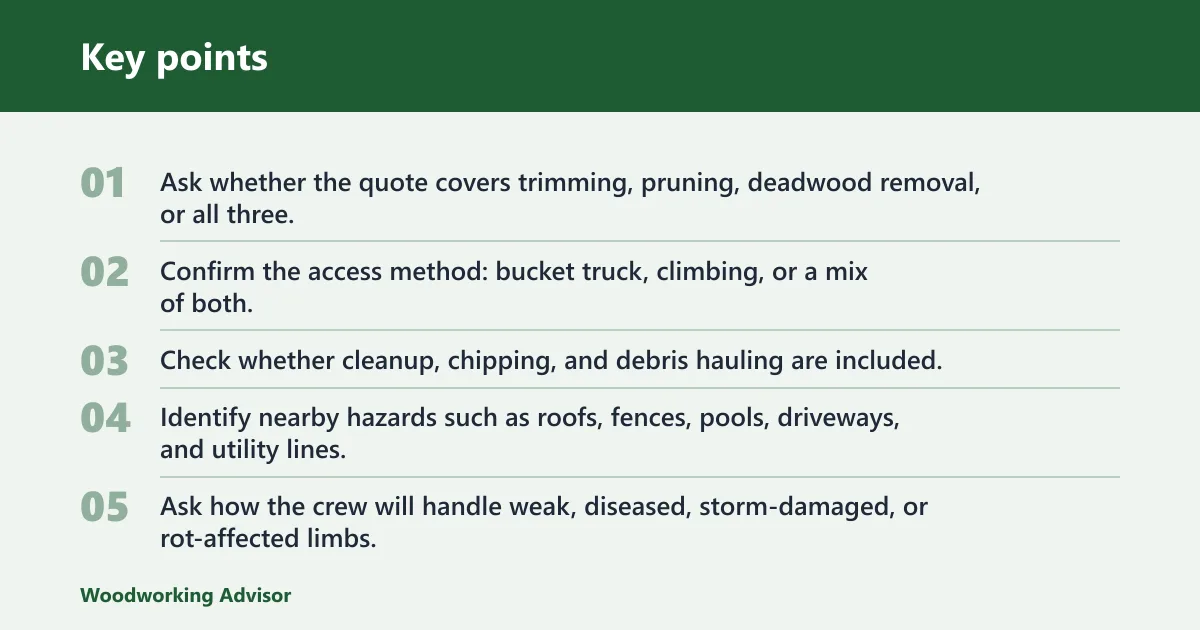
- Ask whether the quote covers trimming, pruning, deadwood removal, or all three.
- Confirm the access method: bucket truck, climbing, or a mix of both.
- Check whether cleanup, chipping, and debris hauling are included.
- Identify nearby hazards such as roofs, fences, pools, driveways, and utility lines.
- Ask how the crew will handle weak, diseased, storm-damaged, or rot-affected limbs.
- Request a written estimate that lists scope, access limits, and disposal details.
A common first-timer mistake is comparing two oak bids only by the bottom-line number. Suppose one quote assumes a clear backyard and includes chipper cleanup, while another assumes climbing, deadwood removal, and haul-off. Those are different jobs, even if the tree height is the same.
Frequently asked questions
How much does it cost to have an oak tree trimmed?
Storm-damaged oaks can go to $1,200 to $3,500+ because the work needs more safety setup, labor, and cleanup than a routine trim.
How much does it cost to have a tree trimmed?
Smaller accessible jobs may start at $75 to $100, while larger or riskier trees can move well above that. Height, access, and health usually decide the final quote.
How much do they charge to trim a tree?
Charges vary by size, access, and tree condition. Oak work often sits toward the higher end.
What factors increase oak tree trimming cost
The main cost drivers are height, hardwood density, access, tree health, and cleanup. Deadwood, disease, storm damage, climbing instead of bucket access, and work near houses or utility lines can all raise the price. Disposal of branches and chips may add more if it is not included.
Does tree height change the price to trim an oak tree?
Yes. Height affects equipment, labor, and risk. Trees under 30 feet are usually cheaper than trees between 30 and 60 feet, and trees over 60 feet cost the most. That said, a low oak beside a roof can cost more than a taller tree in an open yard.
Should I hire an arborist to trim a mature oak?
Yes, especially if the oak is large, damaged, diseased, or near structures or lines. Mature oaks need careful cuts to limit decay and future failure risk. A professional estimate is the safer choice, and DIY climbing or chainsaw work on large oaks is not a good idea.
Sponsored / affiliate links. As an Amazon Associate I earn from qualifying purchases. I may earn additional commission from eligible campaigns.