How Much Is Black Walnut Lumber Worth Per Board Foot?
Black walnut lumber commonly sells for about $6 to $12 per board foot rough and about $8 to $15 surfaced. Mispricing it can mean overpaying for low-grade stock or leaving money on the table when you sell. This guide breaks down walnut value by grade, form, width, and milling condition so you can price each board correctly.
Black walnut lumber prices by stock type
Black walnut is a high-value domestic hardwood, and it is often the highest-priced common North American lumber in retail hardwood yards. The number changes with stock form. Rough-sawn boards usually sit at the low end, surfaced stock costs more, FAS grade commands a premium, and slabs can jump much higher.
Rough-sawn walnut price range
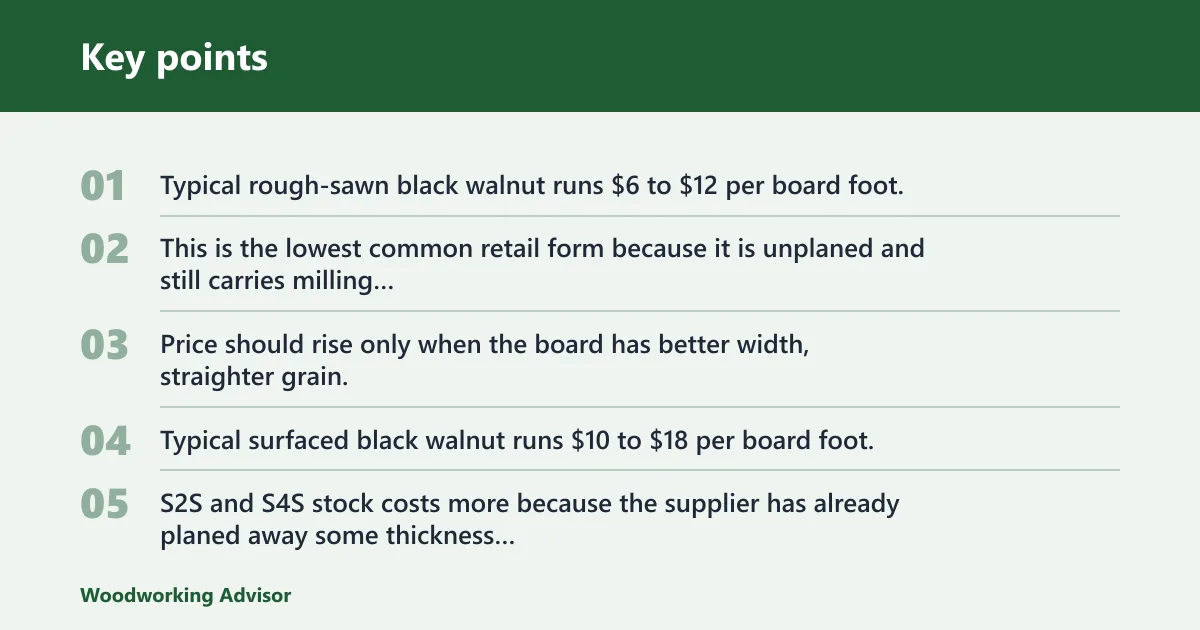
Typical rough-sawn black walnut runs $6 to $12 per board foot. This is the lowest common retail form because it is unplaned and still carries milling risk for the buyer. Price should rise only when the board has better width, straighter grain, longer clear runs, or unusually low defect content.
Surfaced S2S and S4S walnut price range
Typical surfaced black walnut runs $10 to $18 per board foot. S2S and S4S stock costs more because the supplier has already planed away some thickness and accepted yield loss. You are paying for readiness to use, not just wood volume.
FAS grade walnut price tier
FAS grade walnut is priced at $14 to $22 per board foot. That tier buys long clear runs, fewer defects, and better yield from the board. If a seller asks FAS money for short, knotty, sap-heavy stock, the price is out of line with grade.
Live-edge slab price range
Wide walnut slabs can reach $20 to $50+ per board foot. Slab pricing reflects width, figure, matchability, and drying risk, not only species. A slab with strong figure and stable moisture can be fairly priced at the top end; a cracked, uneven, or heavily bowed slab should not be.
Why walnut costs more than common hardwoods
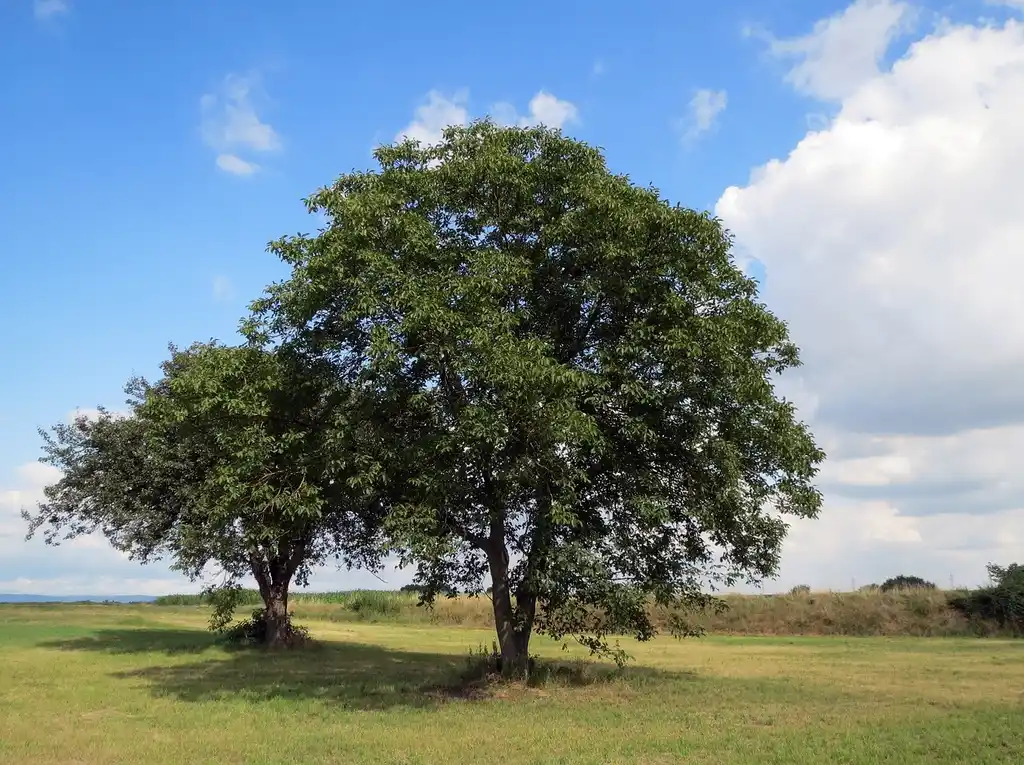
Walnut usually costs more because the supply of high-grade, furniture-ready boards is tighter than for many other domestic hardwoods. Defects, shorter clear lengths, and lower recoverable yield all push the usable board-foot count down, which raises the effective price of each good board-foot you can actually use.
Yield, defect rate, and grading
A rough board may look cheap until you subtract sapwood, checks, twist, and knots. The grading system rewards long clear runs and penalizes defects that reduce usable area. That is why the same species can land in very different price bands depending on grade and form.
Walnut versus cherry, maple, red oak, and white oak
Walnut typically sits above cherry, maple, and red oak at retail hardwood dealers. White oak can be less expensive in rough form, with rough-sawn white oak at $5 to $10 per board foot. Quarter-sawn white oak costs $12 to $20 per board foot, which is a useful comparison because it shows how figure, yield, and processing can push a common species into walnut-like pricing.
Black walnut veneer-quality logs in the Northeast can bring $2,000 to $5,000+ per MBF, and Grade 1 black walnut sawlogs in the Northeast can bring $800 to $1,500 per MBF. Those log values help explain why finished lumber carries a premium when the tree has the grain and size needed for top-grade recovery.
Quarter-sawn white oak is not priced like plain rough oak because the sawing pattern lowers recovery and produces ray-fleck figure that many buyers want. That extra processing and lower yield are the same kind of forces that raise the value of better walnut stock. Strong figure usually carries a higher price.
Board foot basics for pricing walnut
A board foot is 144 cubic inches of lumber. Use it to compare prices across thicknesses and sizes so you do not misread a thick board as “expensive” or a thin board as “cheap” when the volume is the same. Once you can price board feet, you can price a stack, a project, or a single board with much less guesswork.
Board foot definition and formula
The standard formula is: board feet = thickness in inches × width in inches × length in feet ÷ 12. A 1-inch by 12-inch by 12-inch board equals 1 board foot. A 2-inch by 6-inch by 12-inch board also equals 1 board foot.
Quick example
Suppose a walnut board is 8/4 thick, 10 inches wide, and 8 feet long. Convert 8/4 to 2 inches, then calculate 2 × 10 × 8 ÷ 12 = 13.3 board feet. If the seller quotes $12 per board foot, the board costs about $159.60 before waste allowance or freight.
Using board feet to estimate project cost
For a parts list, total the board feet for every part, then multiply by your supplier’s price. After that, add waste allowance for milling and defects. This gives a more realistic budget than multiplying only the nominal parts list by a base price.
What changes walnut value board by board
Walnut value changes board by board because width, thickness, length, grain, moisture content, and defect load all affect recovery. Two boards with the same nominal board-foot volume can have very different usable output. That is why pricing should follow form and quality, not species alone.
Width, thickness, and length
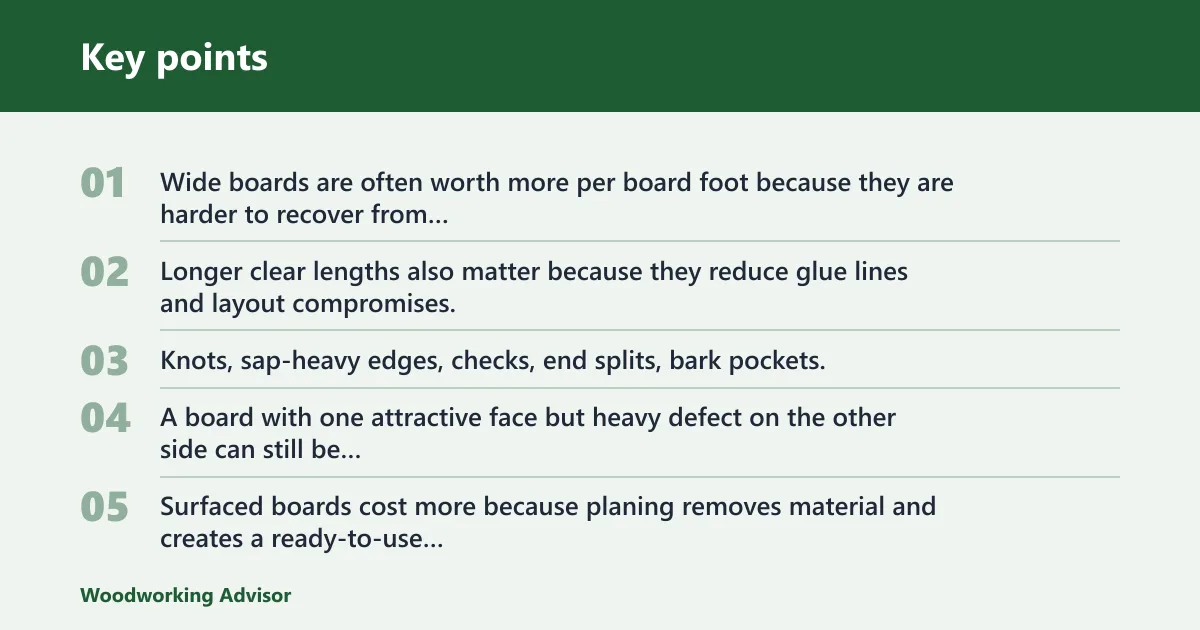
Wide boards are often worth more per board foot because they are harder to recover from a log and more useful for tabletops, case sides, and bookmatched work. Longer clear lengths also matter because they reduce glue lines and layout compromises. Short stock should rarely command FAS money.
Clear runs versus knots, sapwood, and checks
Long clear runs justify a stronger price. Knots, sap-heavy edges, checks, end splits, bark pockets, and other defects should lower the offer because they reduce usable yield. A board with one attractive face but heavy defect on the other side can still be overpriced if the buyer must remove too much wood.
Moisture content, surfacing, and milling loss
Surfaced boards cost more because planing removes material and creates a ready-to-use surface. Moisture content also matters: if a seller markets wood as dry, the buyer expects lower movement and less loss after machining. If the board is still too wet, the real project cost rises because more shrinkage and spoilage risk sit with the buyer.
When figured grain and live edges raise price
Figure, color contrast, and bookmatch potential can add value fast. Live-edge slabs cost more when the slab is wide, stable, and visually strong. A slab seller is pricing uniqueness as much as volume, so a plain, crack-prone slab should not sit in the same bracket as a clean centerpiece slab.
Say your project needs a 7-foot dining top from walnut slabs. A straight, narrow slab with checks across one end may look impressive at first glance, but the usable width after trimming can drop enough that the true cost per finished panel is far above the asking board-foot number.
Black walnut pricing decision table
Use this table to judge whether a price fits the stock form and the defects you see. The goal is not to find the cheapest board. It is to decide whether the asking price matches the usable quality you will actually take home.
| Stock form | Typical board-foot range | Quality traits that justify the price | Red-flag conditions that should lower the offer |
|---|---|---|---|
| Rough-sawn | $6 to $12 | Dry enough for milling, decent width, long clear runs, limited sapwood, sound edges | Heavy twist, bow, checks, short lengths, bark inclusions, deep sap-heavy edges |
| Surfaced | $10 to $18 | S2S or S4S, consistent thickness, usable face already prepared, lower milling work | Too much thickness lost to planing, cup that returns after surfacing, machine burns, poor face quality |
| FAS | $14 to $22 | Long clear runs, fewer defects, high recovery, board sizes suited to furniture work | Short clear section, knots near center, split ends, excessive sapwood, misgraded stock |
| Slab | $20 to $50+ | Wide width, strong figure, bookmatch potential, stable drying, attractive live edge | Major cracks, severe cupping, loose bark, unstable edge, too much waste after trimming |
At a yard or slab seller, start with the board-foot price, then ask what part of the piece is actually usable. If the answer depends on trimming away a lot of length, edge, or thickness, the listed price is probably too high for the real yield.
How much extra walnut should you buy?
Add roughly 15 to 25 percent extra walnut for waste, milling loss, and defects. Use the lower end for straight, dry, clear boards. Use the higher end for wide stock, figured stock, short pieces, or lumber that still needs surfacing. More waste allowance is safer than running short on a premium hardwood order.
When waste should be higher
Wide boards and slabs usually need more waste allowance because defects are harder to work around. Figure, twist, and short clear lengths also increase offcut loss. If the project depends on matching color and grain, expect even more layout waste.
Mini-table: 20 percent waste at three sample prices
This table shows how a 20% waste factor changes total cost. Multiply the purchase price by 1.2 to estimate the amount you should budget if you expect typical milling loss and defect trimming.
| Sample purchase price per board foot | Price with 20% waste factor | Cost increase per board foot |
|---|---|---|
| $8 | $9.60 | $1.60 |
| $12 | $14.40 | $2.40 |
| $20 | $24.00 | $4.00 |
If a project needs 40 board feet of usable walnut at $12 per board foot, the nominal lumber cost is $480. With a 20% waste factor, budget for 48 board feet and $576. That difference matters more as the board-foot price rises.
Regional pricing and freight
Regional supply changes the final number materially. Walnut prices in the central US can be lowest because most walnut grows there. Coastal buyers may pay a freight premium of $1 to $3 per board foot, which can erase part of the apparent savings from a lower base price.
Mill-direct, hardwood dealer, and slab-market pricing
Mill-direct pricing can be lower, but it often comes with more sorting, more moisture variability, and less convenience. Hardwood dealers usually price by grade and stock form with better consistency. Slab markets charge for width, appearance, and uniqueness, which makes a straight species comparison misleading.
When shipping makes a fair price look high
A board priced fairly at the yard can look overpriced after freight, crating, and handling are added. That does not mean the lumber is expensive in context. It means the delivered price reflects both wood and logistics. Always compare delivered cost, not just shelf price.
Picture a buyer in a coastal city comparing a $10 per board foot walnut quote from a central supplier with a local yard at $12. After adding $2 per board foot in freight, the lower quote is no longer cheaper. The delivered price is what matters.
Frequently asked questions
How much is black walnut lumber worth per board foot?
Black walnut usually runs $6 to $12 per board foot rough, $10 to $18 surfaced, $14 to $22 in FAS grade, and $20 to $50+ for wide slabs. The right price depends on grade, width, drying, and defect load, so a single number rarely tells the full story.
What is the difference between rough-sawn and surfaced walnut pricing?
Rough-sawn walnut is usually the lowest listed form because it is unplaned and still requires milling. Surfaced S2S or S4S stock costs more because the seller has already removed some material and delivered a board closer to finished size, which reduces your labor but raises the per-board-foot price.
Why does walnut cost more than oak or cherry?
Walnut often costs more because high-grade, furniture-ready boards are harder to recover in strong width and clear length. Cherry and red oak commonly sit lower at retail, while quarter-sawn white oak can move into a higher range because the sawing pattern lowers yield and adds desirable figure.
How much extra walnut should I buy for waste and milling loss?
Add about 15 to 25 percent for waste, defects, and milling loss. Use the lower end for straight, dry rough stock and the upper end for wide slabs, figured boards, or short pieces. If the project has matching requirements, plan for even more layout waste.
What does FAS grade walnut lumber mean?
FAS grade walnut is a premium hardwood grade with long clear runs and fewer defects. It is priced at $14 to $22 per board foot because it produces more usable furniture parts per board. If the board has short clear sections or heavy defects, it should not be priced like true FAS stock.
How do I estimate the total cost of a walnut project?
Calculate the board feet for every part, multiply by your supplier’s price, then add 15 to 25 percent for waste and milling loss. If you are comparing sources, use delivered price, not shelf price alone, because freight can add $1 to $3 per board foot for coastal buyers.
Sponsored / affiliate links. As an Amazon Associate I earn from qualifying purchases. I may earn additional commission from eligible campaigns.