How to Make MDF Doors That Actually Hold Up
The fastest, most reliable way to make an MDF door is a flat slab panel with eased or profiled edges, or a “shaker-style” build where thin MDF strips are glued onto a flat panel to fake a frame-and-panel look — not traditional mortise-and-tenon joinery, which MDF isn’t well suited for. Here’s why, and how to actually build one that holds up.
Why Joinery Choice Matters More on MDF Than Solid Wood
Best Joinery Method for MDF
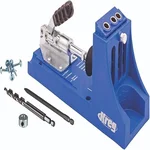 |
Kreg K4 Pocket-Hole Jig – $99.00 The joinery method that actually holds in MDF, where edge-driven screws and dowels tend to strip out.
|
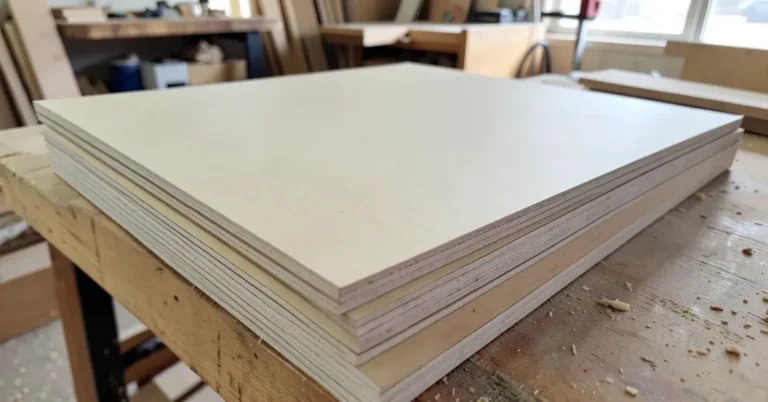
MDF has no wood grain — it’s compressed wood fiber and resin, which makes it dense and perfectly flat, but also means it has no long fibers to give a screw or dowel real mechanical grip. Screws driven into the edge of MDF (the way you’d join a traditional frame-and-panel door) can strip out or blow out the edge with surprisingly little force. That’s the real reason most cabinet shops don’t build true mortise-and-tenon MDF doors: it’s not that it’s impossible, it’s that the joint is fighting the material’s biggest weakness.
Two approaches actually work well in practice:
- Flat slab door: a single panel of 3/4″ MDF cut to size, with the edges eased or routed with a decorative profile. This is the simplest, most common approach for cabinet doors and holds up well.
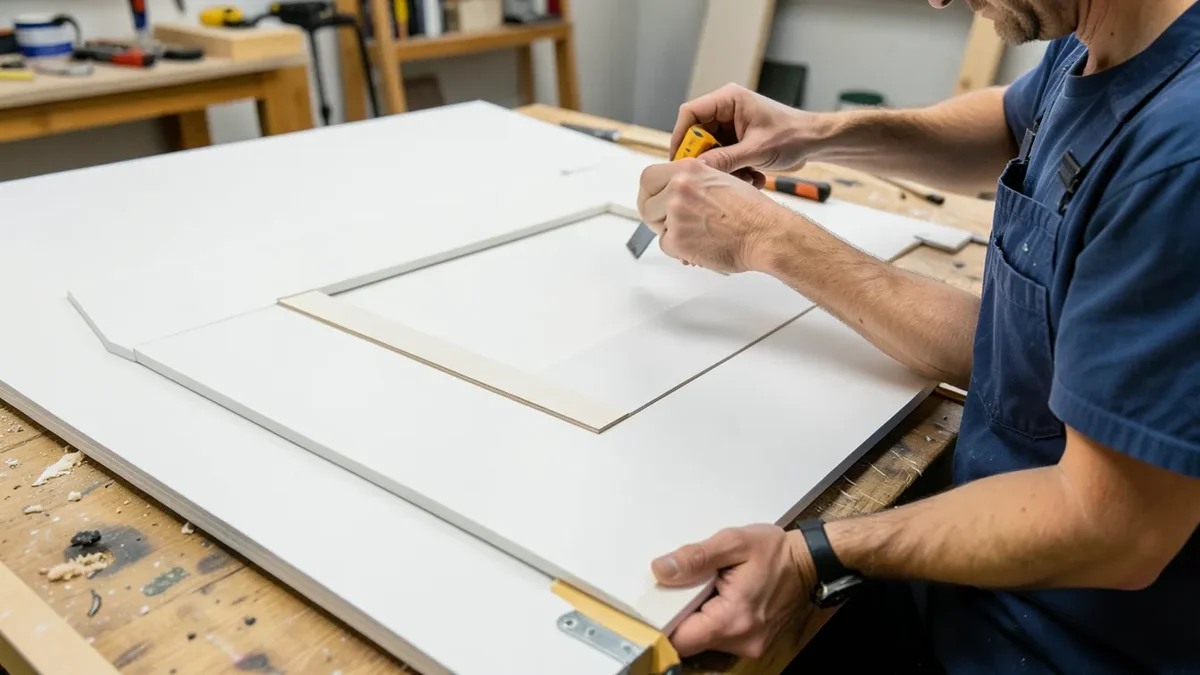
- Applied shaker-style door: a flat MDF back panel with thinner MDF strips (the “rails and stiles”) glued on top to create the look of a raised frame-and-panel door, without needing an actual mortise-and-tenon frame. This is how most affordable “shaker” cabinet doors are actually built, MDF or otherwise.
If you do need to join MDF pieces edge-to-edge or at a corner (an actual frame, not an applied panel), pocket-hole joinery works far better than edge-driven screws or dowels, because the screw goes in at a shallow angle through more material and is backed up with glue — it doesn’t rely on the edge grain grip that MDF lacks.
Materials and Tools
- 3/4″ MDF sheet (and thinner strips if building an applied shaker-style panel)
- Circular saw or table saw with a fine-tooth (60-80T) carbide blade — a standard framing blade will chip the dense surface
- Router with a roundover or chamfer bit for the edges (optional but recommended)
- Pocket-hole jig, if joining pieces at a corner
- Wood glue, MDF-specific primer, paint, hinges and pulls
- P100 or N95 respirator, not just safety glasses (see the dust note below)
The Dust Hazard Most Guides Skip
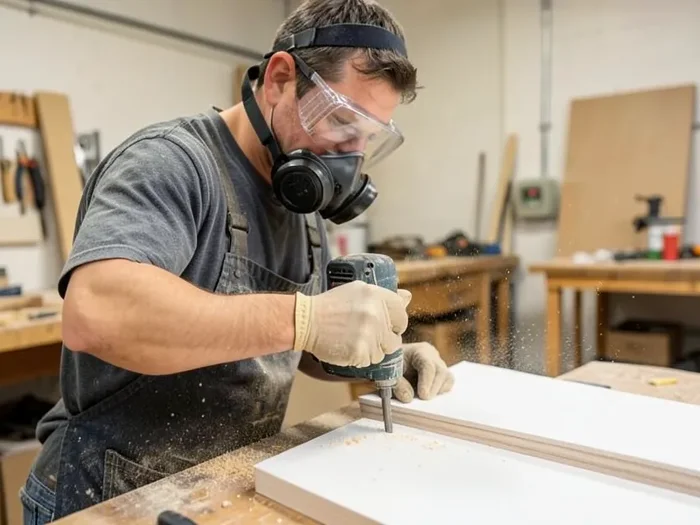
MDF dust is genuinely more hazardous to breathe than regular sawdust. The fine fiber particles are small enough to reach deep into the lungs, and MDF is bonded with urea-formaldehyde resin, so cutting and sanding it releases resin dust along with wood fiber. Safety glasses protect your eyes but do nothing for your lungs. Cut and sand MDF with dust collection running, work outdoors or in a ventilated space when possible, and wear a properly fitted N95 or P100 respirator, not just a paper dust mask.
Choosing the Right MDF
Standard interior MDF is fine for most cabinet and interior doors. For bathrooms, kitchens near sinks, or anywhere splashing is likely, use moisture-resistant MDF (MR-MDF) — usually dyed green so it’s easy to identify at the lumber yard. It uses a different resin formulation that resists swelling better, but it is still not waterproof; any MDF door needs every edge and face fully sealed with primer, because MDF’s cut edges soak up moisture and swell far more readily than its factory-sealed faces.
Step-by-Step: Building the Door
1. Measure and cut. Measure the opening twice, and cut the panel 1/16″-1/8″ undersized on each dimension to leave clearance for the hinges and door swing. Use a fine-tooth blade and support the sheet fully to avoid chip-out on the underside of the cut.
2. Ease or profile the edges. Even a simple 1/8″ roundover on a router makes a flat slab door look intentional rather than like a cut-off sheet, and it removes the sharp, chip-prone factory edge.
3. Build up the shaker look, if wanted. Cut thin MDF strips (about 2-2.5″ wide) for the rails and stiles, miter or butt-join the corners, and glue them onto the flat panel with a router-eased inner edge to fake a raised panel look. Clamp until dry.
4. Fill, prime, sand, paint. Fill any screw holes or seams with a paintable wood filler (not the caulking type — it doesn’t sand well). MDF is porous at cut edges and will soak up regular latex primer unevenly; a shellac-based or MDF-specific primer seals it in one coat and gives a much more even final finish. Sand lightly between coats with 220-grit.
5. Hang the door. Use hinges rated for the door’s actual weight — MDF is denser than most solid wood species of the same thickness, so an MDF door is often heavier than it looks. Pilot-drill every screw hole; MDF splits less than solid wood but strips out more easily if you drive a screw without a pilot hole.
Frequently Asked Questions
Can you make a door from MDF?
Yes. A flat slab panel with eased edges, or an applied shaker-style panel (thin MDF strips glued onto a flat back), are the two most reliable approaches — both hold up better than true mortise-and-tenon frame joinery in MDF.
How thick should MDF be for a door?
3/4″ (18mm) is standard for cabinet doors and most interior doors. Thicker MDF adds rigidity and sound dampening but also adds weight, which matters for hinge selection.
Is MDF suitable for exterior or bathroom doors?
Standard MDF isn’t suitable outdoors and struggles with high humidity. Moisture-resistant MDF (MR-MDF, usually green-dyed) holds up better in bathrooms and kitchens, but every edge and face still needs to be fully sealed — it is not truly waterproof.
What are the disadvantages of MDF doors?
MDF is heavier than most solid wood of the same thickness, swells at cut edges if not fully sealed, doesn’t hold edge-driven screws or dowels as well as solid wood or plywood, and its dust requires a real respirator, not just safety glasses, due to fine fiber and urea-formaldehyde resin content.
The Bottom Line
MDF makes a great paint-grade door as long as you work with the material instead of against it: skip edge-driven fasteners in favor of pocket screws or glued-on applied panels, seal every cut edge before it sees moisture, and treat the dust as seriously as the safety gear list suggests. Done that way, an MDF door holds up as well as most solid wood options for interior use, at a fraction of the cost.
Sponsored / affiliate links. As an Amazon Associate I earn from qualifying purchases. I may earn additional commission from eligible campaigns.