Repair a Rotted Wood Post Without Replacing It (And When Not To)
You can repair a rotted wood post without replacing it only when the post does not carry a roof or deck load, or when an engineer or building official approves the fix. Epoxy hardener and filler rebuild shallow, dry rot; they do not restore a post that has lost real cross-section under load. This guide covers the repair-or-replace test, how to probe for rot, the repair steps, and when to call a pro.
Repair or Replace a Rotted Post? The Load-Bearing Rule
Best Rot Repair Kit Pick
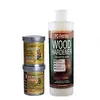 |
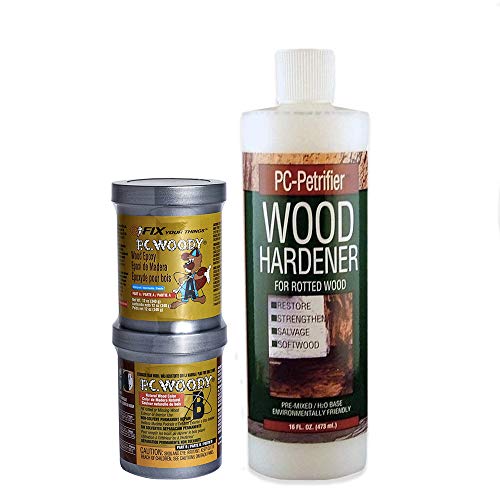
PC-Woody Epoxy Paste (12 oz) and PC-Petrifier Wood Hardener (16 oz) Kit, $23.59 A liquid hardener to soak into weak fibers plus a two-part epoxy paste to rebuild the cavity, which is the two-product sequence used in the repair steps below.
|
As an Amazon Associate we earn from qualifying purchases.
The first question is not how to repair the rot. It is what the post holds up. West System, the epoxy maker, tells users to start by inspecting the depth of the rot and the structural effect of the damage, and says a cosmetic repair suits a piece that is not structural or only shallowly damaged.
For a post under a deck beam, porch roof, or pergola, treat it as a structural member. The American Wood Council deck guide (DCA 6) requires a 6×6 nominal post or larger for the decks it covers, and its commentary notes that the 4×4 minimum in the International Residential Code would often be overstressed in those applications. A 4×4 can be sound and still be undersized, so removing rotted wood from it matters more than it looks.
| Post role and condition | Epoxy repair acceptable? | What to do |
|---|---|---|
| Fence post with no gate load, rot above ground in the outer shell, firm wood all around | Usually yes | Dry, excavate to solid wood, consolidate, fill, paint |
| Trim-type porch post or wrap that carries no roof load, shallow rot | Yes (cosmetic) | Excavate and fill, then prime and paint |
| Post carrying a deck beam, porch roof, or pergola, any real section loss | Not on your own | Shore it up and get an engineer or building official to approve repair or replacement |
| Rot at the base, at or below grade, or where the post meets the footing | No | Replace; field-treat cut ends with preservative |
| Probe breaks through to a soft or hollow core, or the post leans, shifts, or flexes | No | Replace; temporary support first if it holds a load |
You will see percentage cutoffs online, such as “under 30 percent of the cross-section” or “under 50 percent.” We could not trace any of them to a building code, the American Wood Council, or an epoxy manufacturer, so do not use them as a safety test. The practical rule: if a post carries a roof or deck load and you can see or feel any of the conditions in the bottom three rows, replace it or have it assessed.
How to Test a Post for Rot
Probe every face of the post with an awl, small screwdriver, or knife, working from the top down to the base. Probe end grain and anywhere water collects, such as joints and the ground line. Dig down a few inches at the ground line on in-ground posts,, since moisture tends to collect there.
Then do a pick test: push the awl in, pry up a splinter parallel to the grain, and watch how it breaks. USDA Forest Service research describes sound wood as breaking into long splinters with an audible crack, while decayed wood fails in a brash, brittle way across the grain with few splinters and a quieter sound.
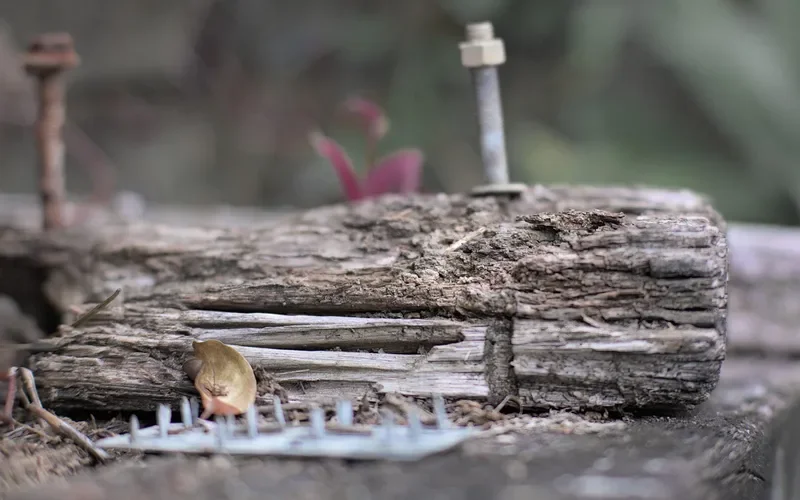
Pick test result to watch for: a brash, brittle break across the grain with few splinters means decay. Source: USDA Forest Service, 2006
Surface probing only finds decay near the surface. A post can look solid outside and be soft inside, so on any post that matters, probe from several angles and tap along its length, and treat a hollow sound as a reason to look closer. For rot on non-post pieces, our broader repair-or-replace guide for rotted wood covers the general case.
How to Repair Rot on a Non-Structural Post
“Always dry damaged wood completely before you attempt a repair.”
- Fix the water source: Find out why the post stays wet (splash-back, soil contact, a leaking gutter, trapped end grain) and correct it first, or the rot will return.
- Dry the wood completely: Let the post dry fully before any repair, and speed it up with a heat lamp or hot air gun if needed.
- Excavate the weak wood: Probe with an awl or knife to find soft wood, then chisel out all weak, crumbly wood and wire-brush until solid wood shows on every side of the cavity.
- Pick the method by cavity depth: Fill shallow cavities with epoxy and filler, bond in a shaped wooden plug for cavities deeper than 1/2 inch, and use drill-and-fill only where strength is not important.
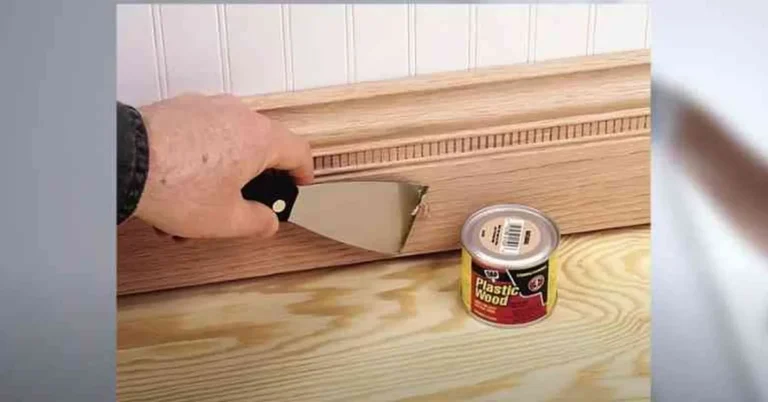
- Fill and shape: Wet out the cavity with unthickened epoxy, trowel in thickened epoxy, let it cure, then sand to the post profile.
- Prime and paint: Prime and paint the cured repair for UV protection, because exposed epoxy is not meant to be left bare.
Which method you use in step 4 depends on depth and access. These figures come from the West System household-repair guide for its standard epoxy, so check the label of whichever product you buy:
| Method | Use when | Detail from West System |
|---|---|---|
| Excavate and fill | You can reach the rot and clean it to solid wood on all sides | Fill shallow voids with epoxy and fairing filler, cure, sand to shape |
| Excavate and bond in a plug (dutchman) | Cavity is deeper than 1/2 inch | Restores strength, saves epoxy, prevents an exothermic reaction; use a long bevel on each end |
| Drill and fill | Rot is hard to reach and strength is not important | 3/16 inch holes about 1 inch apart, drilled downward at 45 degrees on vertical surfaces, dry the wood, inject epoxy until saturated |
Notice the last row. Some guides describe injecting consolidant into a post with a rotten core as rebuilding its structure. West System describes drilling and filling for repairs where strength is not important, which is the opposite of a load-bearing post. Thinning epoxy to make it soak in also costs strength: West System notes that 5 percent lacquer thinner cuts compressive strength by 35 percent, which it calls acceptable only for most non-structural uses.
When Epoxy Is Not Enough: Structural Options
If a post carries load and the rot is real, the options are a professional repair or replacement. Work on a loaded post starts with temporary support; West System notes that structural members can often be removed or relieved with temporary support to make a thorough repair easier.
- Sistering: West System describes bonding sister planks beside rot-damaged joists and rafters and carrying them well past the damage. That is a joist and rafter technique; for a post that holds a roof or deck, the size, fasteners, and bearing must be set by an engineer or the building department.
- Replacement: the American Wood Council deck guide requires lumber in contact with the ground to be preservative treated for ground contact (use category UC4A) and says all cuts must be field treated with an approved preservative such as copper naphthenate. It also requires posts to be centered on footings.
- Cut-and-splice: splicing in a new section changes how the load travels through the post. Have a qualified person specify it, and see how to connect 4×4 wood for the joint basics.
The AWC commentary also says posts meant to resist lateral loads need to be designed under the National Design Specification for Wood Construction. A wobbly deck or porch post is therefore a design question, not something to fill with epoxy.
Special Cases: Fence Posts, Porch Posts, and Cracks
Fence posts. Above-ground rot on a post with no gate load is a reasonable epoxy job. Rot at or below the ground line is not, because you cannot dry and excavate it. See fixing a rotted fence post with a repair spur for the below-grade option.
Porch posts. If the post holds up a roof, use the load-bearing rule above. If it is a trim-type wrap or a decorative post, a cosmetic repair is fine. West System suggests coating the end grain of replacement posts near moisture with epoxy, and names porch posts as an example.
Cracks versus rot. Checks and splits in sound wood are a different problem from decay, and how to fix cracked wood covers the epoxy approach for them. The same excavate-and-fill method also works on door frames and thresholds; see fixing wood rot around doors.
Finish the Repair and Keep the Rot From Returning
- Sand the cured repair and prime and paint it; West System says to paint epoxy for UV protection.
- Keep the post base from sitting in standing water, and keep soil, mulch, and plants off the wood.
- Re-probe the post once a year, starting with the repair edge, the ground line, and end grain.
- For product-level detail on consolidants and fillers, read our wood rot epoxy repair guide; to stop new posts rotting, see how to keep wood posts from rotting in the ground.
More repair and protection topics live in the wood care and maintenance guide.
Frequently Asked Questions
Can you repair a rotted wood post without replacing it?
Yes, if the post is not structural or the damage is shallow and you can dry it and excavate to solid wood. Epoxy consolidant and filler suit fence posts and trim-type porch posts. A post carrying a deck beam or porch roof is different: do not rely on a DIY epoxy repair there without an engineer or building official signing off.
How much rot is too much to repair a post?
There is no published percentage that makes a post safe. The 30 percent and 50 percent cutoffs repeated online did not trace to a building code, the American Wood Council, or an epoxy manufacturer. Use the rule instead: if the post carries a load and the probe breaks through the shell, the base is rotted, the core is soft, or the post moves, replace it or get it assessed.
Can you repair a rotted porch or deck post with epoxy?
Only as a cosmetic fix on a post that is not carrying the structure, or with sign-off from an engineer or building official. The American Wood Council deck guide sets a 6×6 nominal minimum post for the decks it covers because a 4×4 would often be overstressed, so losing wood from a load-bearing post is a structural question, not a filler question.
How do you repair a rotted fence post without replacing it?
If the rot is above ground on a post that carries no gate, dry it, chisel to solid wood, consolidate, fill, and paint. Rot at or below ground level cannot be excavated and dried the same way, so those posts are normally replaced or reinforced with a fence post spur.
How long does an epoxy rot repair on a post last?
No manufacturer or code source gives a reliable lifespan. A repair lasts as long as the wood stays dry and the paint film protects the epoxy from UV. If the water source is not fixed, the wood next to the repair keeps decaying.
Sponsored / affiliate links. As an Amazon Associate I earn from qualifying purchases. I may earn additional commission from eligible campaigns.