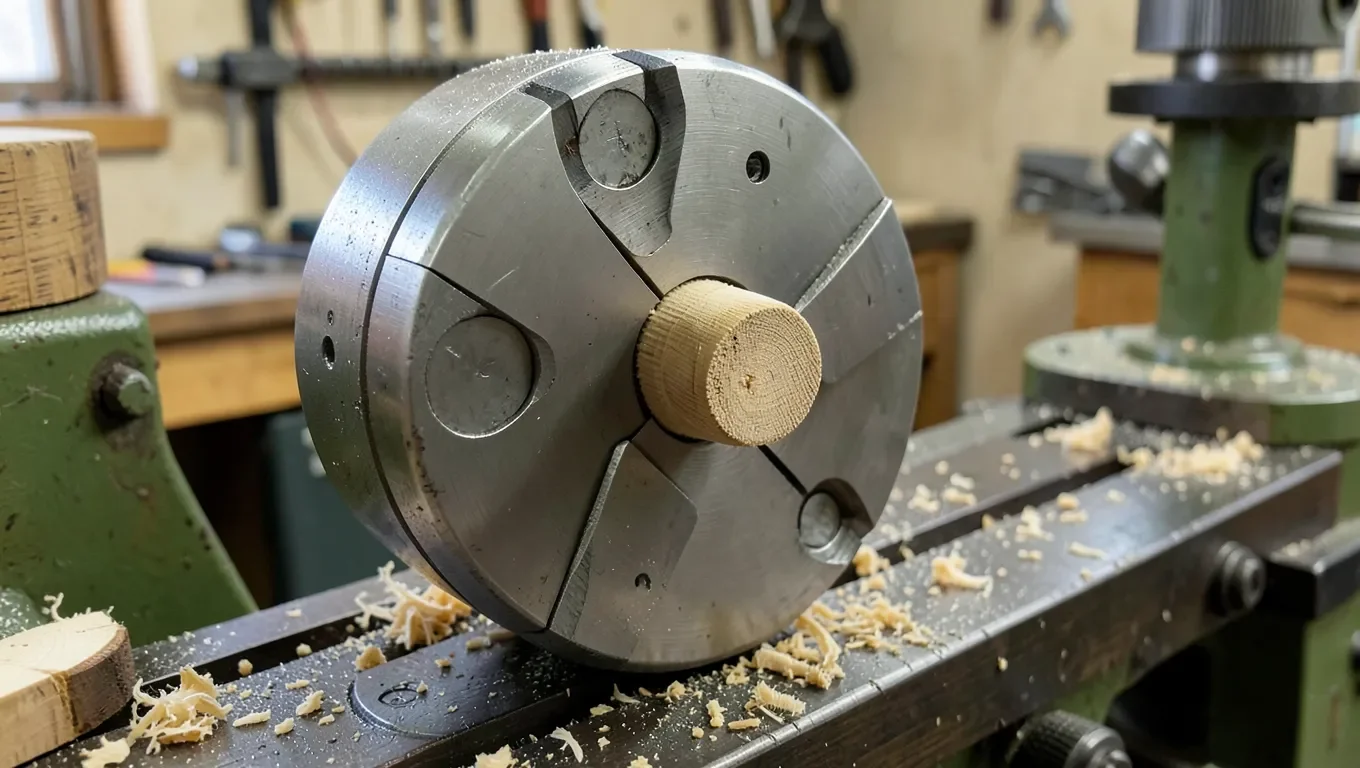
How to Use a Wood Lathe Chuck Safely: Step-by-Step Guide
To use a wood lathe chuck, mount it on the headstock spindle, open the jaws wider than your workpiece’s tenon or recess, seat the wood squarely against the jaws, then tighten evenly with the chuck key – and remove that key before you turn the lathe on.
A scroll chuck is the single upgrade that changes the most about how you turn. Instead of driving every blank between centers or screwing it to a faceplate, a four-jaw chuck lets you grip a turned tenon, hollow the inside of a bowl with nothing in the way, and remount a piece dead-center for a second operation. It is also the tool most beginners set up wrong: jaws tightened unevenly, a chuck key left in the jaws when the motor starts, or a lathe run at full speed on an unbalanced blank. None of those mistakes are exotic – they are the three most common ways a chuck-related accident happens on a home lathe.
This guide walks through picking a chuck, mounting it, cutting and seating a proper tenon, and the specific startup sequence that keeps a spinning workpiece from becoming a projectile.
Why Your Chuck Setup Determines Whether a Turning Session Is Safe
Best Beginner 4-Jaw Scroll Chuck
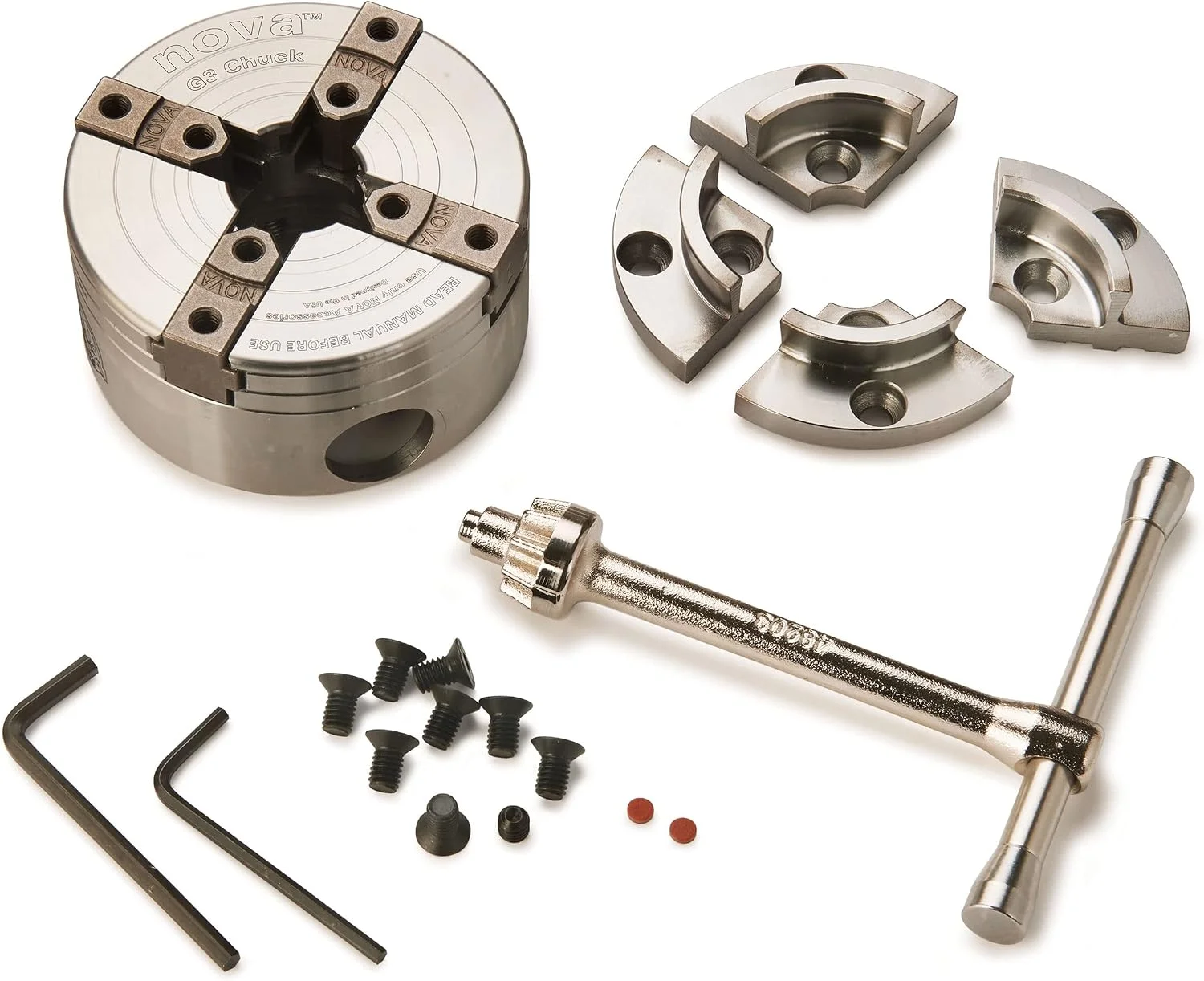 |
NOVA 48286 G3 Lite Wood Lathe Chuck – $159.99 A geared, self-centering 4-jaw chuck built for the exact tenon-and-jaw-key workflow covered in this guide, sized for mini and midi lathes up to a 14" swing.
|
A chuck holds the workpiece by clamping pressure alone – there is no center point locking it in place the way a spur drive does. That makes jaw condition and tightening technique the actual safety system, not an afterthought. Worn jaws, a tenon cut to the wrong size, or jaws tightened at only one of the four screw locations can all let a piece shift or come loose once the lathe reaches speed. Everything below is built around avoiding those failure points.
Types of Wood Lathe Chucks: Scroll, Collet, and Faceplate
Most turners eventually own more than one style of workholding, because each one solves a different problem.
| Chuck Type | How It Grips | Best Use |
|---|---|---|
| Scroll (4-jaw) chuck | Four jaws move together via an internal scroll or gear, closing evenly on a turned tenon or expanding into a recess | Bowls, hollow forms, remounting a piece for a second operation |
| Collet chuck | A collet sleeve closes uniformly around a round, pre-sized shaft | Pen blanks, small spindle work, production-consistent small parts |
| Faceplate | Screws pass through the faceplate directly into the wood – no jaws involved | Large or irregular blanks, roughing out a bowl before a tenon exists |
Choosing the Right Chuck and Jaws for Your Project
Chuck sizing is really jaw sizing – most chuck bodies accept several jaw sets, so match the jaws to the tenon you plan to cut, not just the chuck’s overall diameter.
| Jaw Set | Typical Tenon Diameter | Best For |
|---|---|---|
| Mini / pin jaws | Under 1.5 inches | Small boxes, finials, ornaments |
| Standard jaws | 1.5 – 2.5 inches | Most spindle work and small-to-medium bowls |
| Bowl jaws | 2.5 – 4+ inches | Larger bowls and platters where more surface contact reduces slip risk |
As a rule of thumb, oversized jaws on an undersized tenon reduce the contact area to just the jaw tips – that is a common cause of a piece popping loose mid-cut, not a chuck defect. Cut the tenon to the jaw set’s rated range, not to whatever is convenient.
The Chuck-Key Rule: Why You Must Remove It Before You Turn the Lathe On
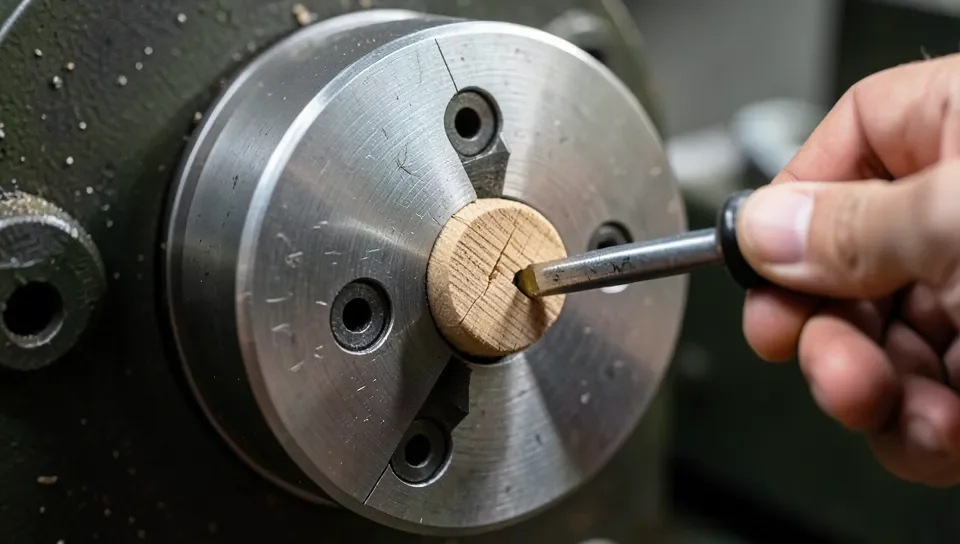
This is the one rule that has no exceptions: remove the chuck key from the chuck the moment you finish tightening or loosening the jaws, before your hand ever reaches for the power switch. If the key is still seated when the spindle spins up, it gets flung off the chuck at whatever speed the lathe is turning – a well-documented, classic cause of serious eye and hand injuries in both wood and metal turning shops. It is such a common lapse that some machinists’ chucks use a self-ejecting key specifically so the key cannot be left in by accident. A wood lathe chuck key has no such safeguard, so the habit has to be yours: tighten, remove the key, set it down in the same spot every time, then start the lathe.
Face and eye protection matter here independent of the chuck key. Wood chips and dust come off a spinning blank constantly, and if a tenon was cut slightly out of round or the blank has an internal defect, a piece can separate from the chuck under load. A full face shield, not just safety glasses, is the standard recommendation for turning specifically because of that separation risk – glasses protect against chips, a face shield also protects against a larger fragment.
Mounting the Chuck on Your Lathe Spindle
Before threading the chuck onto the spindle, wipe both mating surfaces clean – a chip of wood or a bit of grit between the chuck and the spindle shoulder is enough to throw off concentricity, which shows up later as a chuck that never quite runs true no matter how well the workpiece is centered.
- Confirm the chuck’s thread or taper matches your lathe’s spindle (1″ x 8 TPI is common on many mini and midi lathes, but always check yours – this is also why insert-type chucks like the one above need the correct insert ordered separately).
- Thread the chuck on by hand until it seats against the spindle shoulder. Do not use the chuck key or a wrench to force the last turn – a chuck that needs force to seat is not threaded correctly.
- With the lathe unplugged, rotate the chuck by hand and watch for wobble at the jaws. Any looseness here should be resolved before a workpiece ever goes in.
Cutting and Seating a Tenon in the Jaws
Most chuck jaws are machined with a dovetail profile, not a straight-sided groove, and the tenon you turn needs to match that same angle. A straight or negative-taper tenon lets the jaws lose their grip under load even when they feel tight by hand, because the dovetail is what actually locks the wood in place as the jaws close – a matching angle is what makes the connection mechanical, not just frictional.
Size the tenon so it sits just slightly larger than the closed diameter of the four jaws. Because scroll jaws are cut from a single ring split into quarters, they are not meant to close flush against each other – you want a small, even gap between each jaw when they are snugged onto the tenon, not four jaws touching with no wood between them. If the jaws bottom out against each other before they clamp the tenon, the piece is undersized and needs to be re-turned.
To seat the piece: bring the jaws in until they just touch the tenon, apply light hand pressure to the center of the workpiece so it sits square against the jaw faces, then tighten with the chuck key. On a chuck with multiple tightening points, go around and snug each one in turn rather than cranking one screw down fully first – uneven tightening pulls the tenon off-center even when the jaws appear closed.
Starting the Lathe: Low Speed First, Then Ramp Up

Once the workpiece is seated and the chuck key is off the lathe, run through the standard startup sequence:
- Set the speed dial to the lowest range before switching the lathe on – never start a newly mounted piece at the speed you plan to turn it at.
- Stand to the side of the workpiece’s rotational plane, not directly in front of or behind it, when you flip the switch. If anything does let go, this position keeps you out of its most likely path.
- Let the lathe run a few seconds at low speed and watch and listen for wobble, vibration, or an uneven hum – all three point to an unbalanced blank or an incompletely seated tenon.
- Increase speed gradually in stages, re-checking balance at each stage, rather than jumping straight to your target RPM.
An unbalanced or irregularly shaped blank (a natural-edge bowl blank, for instance) will always run better at a lower speed than a pre-turned round one – there is no fixed RPM number that is universally “safe,” which is why the gradual, watch-and-listen method matters more than any specific dial setting.
Adjusting Jaw Pressure for Precision and Balance
If a mounted piece runs slightly off-center, resist the urge to just crank the chuck key harder – that usually deforms the tenon rather than fixing the alignment. Instead, back the jaws off enough to shift the workpiece by hand, use the tailstock’s live center brought up to the far end as a temporary centering guide if the piece is long enough, then re-tighten evenly across all jaw points. For pieces without tailstock support, mark the center on the tenon face before mounting so you have a visual reference to re-align against.
Maintenance and Care
Sawdust works its way into the scroll or gear mechanism every time the chuck is used, and it is the most common cause of jaws that bind or won’t close evenly over time. Blow or brush out visible dust after each session, and periodically remove the jaws entirely to clean out the packed dust underneath them. A light machine oil on the scroll threads keeps the action smooth – avoid heavy grease, which attracts and holds dust rather than shedding it. Inspect the jaws for cracked dovetail edges or stripped tightening screws before every use; either one is a reason to replace that jaw set rather than keep tightening around the damage.
Troubleshooting Common Chuck Problems
Workpiece runs out true no matter how carefully it’s mounted: check the chuck-to-spindle mounting first, not the workpiece – debris or wear at that joint affects every piece you turn afterward.
Jaws feel tight but the piece still shifts under a cut: the tenon is very likely undersized for that jaw set or cut with the wrong taper angle – re-turn a fresh tenon rather than continuing to fight the grip.
Chuck key is hard to seat or turns roughly: stop and clean the key and the chuck’s key socket before applying more force – forcing a gritty key socket is how the socket gets rounded off and stops gripping the key reliably.
If you’re weighing whether a chuck-mounted setup is inherently riskier than turning between centers, our guide on whether lathes are dangerous breaks down where most lathe accidents actually happen. And if you’re wondering about mounting anything other than wood in that chuck, see our breakdown of whether a wood lathe can safely turn metal before trying it.
Frequently Asked Questions
How does a wood lathe chuck work?
A scroll chuck uses four jaws connected to an internal scroll or gear so that turning the chuck key moves all four jaws inward or outward together. The jaws clamp onto a turned tenon or expand outward into a recess cut in the wood, holding the piece purely by mechanical grip so it can spin true on the lathe without a center point.
What types of wood lathe chucks are available?
The three most common options are scroll (4-jaw) chucks for tenons and recesses, collet chucks for small round pre-sized stock like pen blanks, and faceplates, which skip jaws entirely and screw directly into the wood. Most turners start with a scroll chuck because it covers the widest range of project sizes.
Why do I have to remove the chuck key before starting the lathe?
A chuck key left in the jaws becomes a projectile the instant the spindle starts turning, since nothing holds it in place once the chuck is spinning. This is a standard, well-documented lathe safety rule in both wood and metal turning: tighten the jaws, remove the key immediately, and only then reach for the power switch.
What speed should I start the lathe at with a new workpiece?
Always start at the lowest speed range on the lathe, regardless of the piece’s final size, and increase gradually while checking for wobble or vibration. There is no single “correct” RPM – an irregular or unbalanced blank needs a slower ramp-up than a pre-turned round one, and the goal is to confirm balance at each stage before going faster.
Can I use a wood lathe chuck for metal?
Wood lathe chucks are built for wood-turning loads and speeds, not metal cutting forces, so using one for metal risks damaging both the chuck and the workpiece. Light-duty use on small non-ferrous stock is sometimes discussed among turners, but it is not what these chucks are designed or rated for – see our full breakdown for what is and isn’t safe to attempt.
Conclusion
A wood lathe chuck rewards careful setup: match the jaws to the tenon, tighten evenly across every jaw point, pull the chuck key before you touch the switch, and bring the lathe up to speed gradually while you watch for wobble. None of that adds much time to a turning session, and together it is what keeps a chuck-mounted piece exactly where you put it – spinning true, not flying loose.
Sponsored / affiliate links. As an Amazon Associate I earn from qualifying purchases. I may earn additional commission from eligible campaigns.