Is Lumber Cheaper in the Winter?
Yes, but mostly on commodity lumber and sheet goods. Winter can sometimes bring about 5% to 15% lower lumber prices when demand slows. Hardwoods, pressure-treated stock, and specialty species usually move less. Buying the wrong species or moisture content can erase any savings through waste, acclimation time, and movement. This guide explains when winter pricing is real, what to buy then, and how to compare true project cost.
Winter lumber pricing by type and storage tips
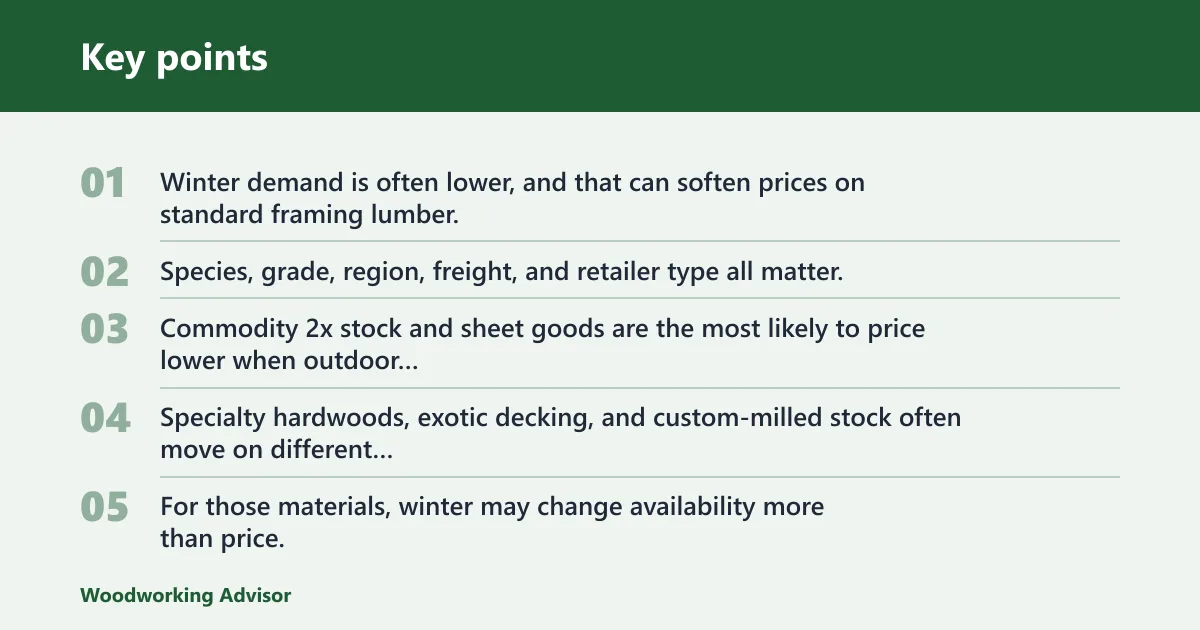

Sometimes. Winter demand is often lower, and that can soften prices on standard framing lumber, plywood, and some pressure-treated stock. The savings are uneven. Species, grade, region, freight, and retailer type all matter, so the best winter buy is usually a specific item on a local quote sheet, not lumber in general.
The short answer by lumber type
Commodity 2x stock and sheet goods are the most likely to price lower when outdoor demand cools. Specialty hardwoods, exotic decking, and custom-milled stock often move on different supply cycles. For those materials, winter may change availability more than price.
| Lumber type | Typical winter price behavior | Storage risk | Acclimation need | Buy early or wait? |
|---|---|---|---|---|
| Framing | Often softer in winter, especially standard dimensions | Low to moderate | Usually short for rough work | Wait if the project is not urgent |
| Pressure treated | Late fall through early spring often has the best pricing | Moderate; drying and warping can occur | Important before deck or outdoor assembly | Buy during clearance if storage is dry and flat |
| Plywood | Can improve when winter demand slows | Moderate; edges and stacks need care | Often needed before finish work | Buy when you have indoor storage |
| Hardwood | Often steadier than framing stock | Higher; twist and moisture change matter more | High for furniture and cabinets | Buy only after checking moisture and grade |
| Exotic | Can ignore local winter patterns | High; cost of damage is greater | High for stable joinery | Buy when inventory and grade are right |
Why winter prices move

Winter pricing usually follows demand, freight, and inventory timing. Outdoor building slows after peak construction season, so retailers and yards may cut prices to move stock. That does not mean every board gets cheaper. It means the pressure to hold high retail prices is often lower for common items.
Demand drops after peak outdoor season
Decking lumber is usually pricier in mid-summer than other times of year. That is when deck builds, fence work, and other outdoor projects peak. Pressure-treated lumber often follows the same pattern, while framing stock can soften after spring and summer building rushes.
Winter can also combine low demand with high supply for some decking lumber. One winter buying scenario is tied to low demand for Ipe, which is a reminder that species-specific supply matters. A deck board that is hard to move in January may still be expensive if the yard has little inventory.
Supply, freight, and inventory timing
Freight can move prices even when demand is calm. Regional shipping, supplier restocks, and yard inventory all change what you see on the shelf. A big box store and a local lumberyard may receive the same species at different costs, then add different margins, so their winter prices can diverge.
Board foot pricing matters most for hardwoods and specialty stock. A board foot is commonly used as a unit for lumber sold by volume, not by length alone. When supply tightens, the quoted board-foot price can swing fast. During the pandemic spike, the average lumber price reached over $1,500 per thousand board feet. Later, it hovered around $646 per thousand board feet. (Thisoldhouse)
Winter lumber buying checklist
Use this checklist before you buy. Freight, waste, storage, and the time needed for the wood to settle in your shop can erase a low sticker price. Cheap stock that arrives wet, bowed, or damaged costs more than a cleaner board at a higher starting price.
- Compare the same unit. Ask for board-foot pricing, lineal pricing, or sheet pricing on the same basis.
- Ask about delivery. A low per-board price can lose its edge once delivery is added.
- Ask about cut fees. Some yards charge for rough sizing or special cuts.
- Check storage space. You need a flat, dry place that keeps the stack from twisting.
- Inspect moisture and straightness. Look for twist, cup, checks, and edge damage before loading.
- Confirm the return policy. Clearance stock may be final sale.
- Check the cutoff date. End-of-season markdowns can disappear when winter inventory sells through.
Suppose you need 20 pressure-treated 2x8s for a spring deck. A lower winter quote helps only if you can store them flat, keep them dry, and accept that the boards may still need acclimation before fastening. If the stack sits outside on damp blocks, the savings can vanish in waste and movement.
Hidden costs that erase savings
Delivery fees are the first place winter savings disappear. Storage is next. If you need a rented trailer, a heated garage corner, or extra shop space, those costs belong in the comparison. So do waste from cupping, end checks, or rejected pieces.
Acclimation matters for indoor work. Cabinet parts, shelving, face frames, and furniture parts should settle in the environment where they will live. Buying too early can help price, but it can also create movement after milling. For shop work, the cheapest board is not always the best board.
Framing, plywood, and hardwood pricing
These materials behave differently. Standard framing lumber usually reacts fastest to demand changes. Plywood often follows sheet-good inventory and dealer stock levels. Hardwood pricing is more tied to species, grade, and board-foot availability, so winter discounts can be smaller or slower to appear.
Standard dimension stock
Framing lumber is the most likely category to show winter softness at retail. It is sold in large volume, which makes it sensitive to construction cycles and promotions. If you are planning walls, framing repair, or rough shop construction, winter can be a useful buying window when the project can wait.
Sheet goods and panel pricing
Plywood and similar panel goods can move with seasonal demand, but availability matters as much as price. A local lumberyard may stock specialty grades or thicker panels that a big box retailer does not carry. If the sheet count is high, compare the delivered price per usable sheet, not just the shelf tag.
Hardwood board foot buying
Hardwood often prices by board foot, which makes direct comparison easier but also more volatile. A plain board-foot quote does not tell you much unless you know the species, grade, width mix, moisture content, and waste rate. A lower quote on narrow, knotty stock can cost more after you cull pieces for a clean project.
Pressure treated and decking prices
Pressure-treated lumber usually has the strongest winter buy window among outdoor materials. Late fall through early spring offers the lowest pressure treated lumber prices, and November through February can show 20-30% lower pricing than peak construction season. December through February can average 25-35% savings versus summer peak pricing.
End-of-season clearance windows
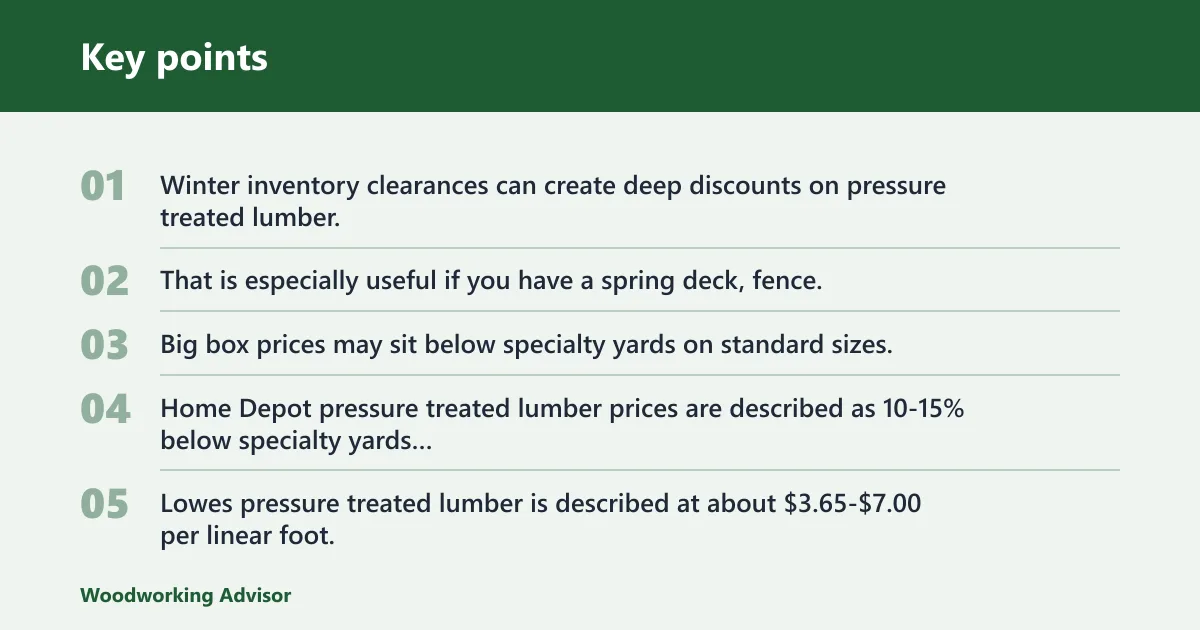
Winter inventory clearances can create deep discounts on pressure treated lumber. That is especially useful if you have a spring deck, fence, or raised-bed project and can store the material properly. Big box prices may sit below specialty yards on standard sizes, while independent yards may match or beat them on bulk orders.
Home Depot pressure treated lumber prices are described as 10-15% below specialty yards for standard sizes. Lowes pressure treated lumber is described at about $3.65-$7.00 per linear foot. Home Depot pressure treated lumber prices are described at about $3.50-$6.75 per linear foot in 2025. At independent lumber yards, contractor discounts can range from 10-25% off retail.
Bulk purchase and project timing
Bulk orders over a threshold can trigger discounts and free delivery. That matters if you are buying posts, joists, or deck boards in one load. Still, bulk only helps if the project schedule and storage plan are ready. Otherwise, you are paying to hold money in lumber that may move or stain before use.
Decking lumber is usually pricier in mid-summer than other times of year because outdoor demand is strongest then. If you are building a deck, buying in winter can help, but only if the species is available and the material is dry enough for safe storage. Exotic decking can behave differently from common softwood decking because import timing and supply are less predictable.
A common first-timer mistake is buying a full bundle of deck boards in January because the price looks low, then stacking it outdoors for months on uneven blocks. By spring, the stack can bow, stain, or pick up surface moisture, which increases waste and shortens the real savings.
Do local lumberyards beat big box stores?
Neither one always wins. Big box retailers often price standard sizes competitively and may run promotional sales or price matching on common stock. Local lumberyards are often better for specialty sizes, better grading options, custom cuts, and contractor pricing that can beat shelf tags once volume rises.
Specialty sizes versus standard sizes
For 2x material, the big box store may have the lower sticker price. For long lengths, uncommon widths, better hardwood selection, or straight-picked stock, the local yard may be the better buy. That is why winter price shopping should separate standard commodity lumber from specialty inventory.
Price matching and contractor discounts
Ask whether the store matches local advertised prices on the same grade and length. At independent yards, contractor discounts and bulk pricing can be significant, especially if you buy enough to justify load building or delivery. The key is to compare the final ticket, not the sign on the bin.
Custom cuts and service value
Service has value when the material is expensive or the cut list is long. A yard that can sort straight stock, pull a better grade, and cut accurately may save time and waste. That is worth paying for when the lumber is costly, the project is tight, or the stock will be hard to replace.
Should you buy now or wait?
Buy now if the project needs specific stock, the price is clearly below current local quotes, and you have a plan for storage and acclimation. Wait if the project is flexible, the price gap is small, or the board quality looks weak. Winter buying helps most when the wood can sit safely until you need it.
When to buy early
Buy early for pressure-treated lumber when you see a real clearance window, for standard framing when the price is below your local spring quote, and for plywood when you can store sheets flat indoors. If a yard offers bulk pricing with delivery, that can also justify early purchase for a known project.
When waiting is smarter
Wait on hardwood if you have not confirmed moisture, grade, and width mix. Wait on exotic species if the local inventory is thin or the quote is high because the next shipment has not landed. Wait on indoor furniture stock if you cannot acclimate it before milling.
When winter buying backfires
Winter buying backfires when the material is cheap but unsuitable. Wet boards can shrink after installation. Damaged bundles increase waste. Delivery can erase savings. And if the species is hard to replace, the cost of sorting bad stock can exceed any winter discount.
Picture a small shop buying 8/4 hardwood in January for cabinet doors. The quote looks better than spring pricing, but the boards arrive with mixed moisture and several short, twisted pieces. If those boards must be culled or re-milled, the lower board-foot price stops mattering.
Frequently asked questions
Is lumber cheaper in the winter?
Often, yes, but mainly for commodity lumber, pressure-treated stock, and some sheet goods. Winter demand is usually lower, which can soften retail and yard pricing. Hardwoods and specialty species do not always follow the same pattern, and delivery, storage, and waste can erase the discount.
Is wood cheaper in the winter?
Sometimes, but not across the board. Standard construction lumber is more likely to be cheaper than hardwood, exotic, or custom-milled stock. If you need project-ready material, compare the full delivered price and the expected waste before deciding that winter is the better buy.
Do lumber prices go down in the winter?
They can, especially from late fall through early spring on common products. Pressure treated lumber often has the clearest seasonal drop, while decking and outdoor stock may still reflect species shortages or freight costs. Retail promotions can also move prices even when yard pricing changes less.
What time of year is lumber the cheapest?
For many common outdoor and construction materials, late fall through winter is often the cheapest stretch. That said, the lowest price depends on the category. Pressure-treated lumber may be strongest from November through February, while decking and exotic species can follow separate shipment and demand cycles.
Why is lumber cheaper in winter?
Demand usually falls after peak construction and outdoor project season. When fewer people are building decks, fences, and additions, retailers and yards often lower prices to move stock. Freight timing, clearance inventory, and supplier restocking can deepen that effect for some items.
Do big box stores or local lumberyards have better winter prices?
Big box stores often win on standard sizes and advertised promotions. Local lumberyards can win on specialty sizes, better grading, contractor discounts, and delivery terms. The better winter price is the one that matches your species, cut list, and total landed cost.
Sponsored / affiliate links. As an Amazon Associate I earn from qualifying purchases. I may earn additional commission from eligible campaigns.