How to Put Carriage Bolts in Wood: Hole Size, Length, Steps
To put a carriage bolt in wood, drill a hole the same diameter as the bolt (a 3/8 in bolt gets a 3/8 in bit), push or tap the bolt through so the square neck bites into the wood under the round head, then add a flat washer and nut on the far side and tighten the nut, not the bolt head.
Plenty of guides tell you to drill “slightly larger than the bolt.” For a carriage bolt that advice backfires. The whole point of the square neck is that it gets pulled into a snug round hole, cuts its own square seat, and stops the bolt from spinning while you tighten the nut. Drill the hole loose and the neck just rotates in place.
This guide covers the parts most tutorials skip: exact hole sizes, a worked example of how far the square neck really bites, how to pick a bolt length for common lumber stacks, what to do in hardwood where the neck will not seat, and which coating to buy for treated or outdoor wood.
How to Install a Carriage Bolt in Wood, Step by Step
Best 3/8 Carriage Bolt Kit
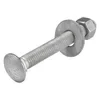 |
Makers Bolt 3/8 in x 4 in Galvanized Carriage Bolt Kit (50 pack): $48.73 A 4 in bolt fits the 2×4 + 2×4 stack from the length table above, and the kit includes the washers and nuts.
|
Clamp the two boards together in their final position first. Drilling both pieces in one pass keeps the holes aligned, which matters more than anything else for a bolt that has to slide through without force.
- Mark the hole location. Keep it well back from board ends and edges. A common minimum is about 1.5 bolt diameters from an edge, and more from an end, but anything structural should follow your local code or the plans, not a rule of thumb.
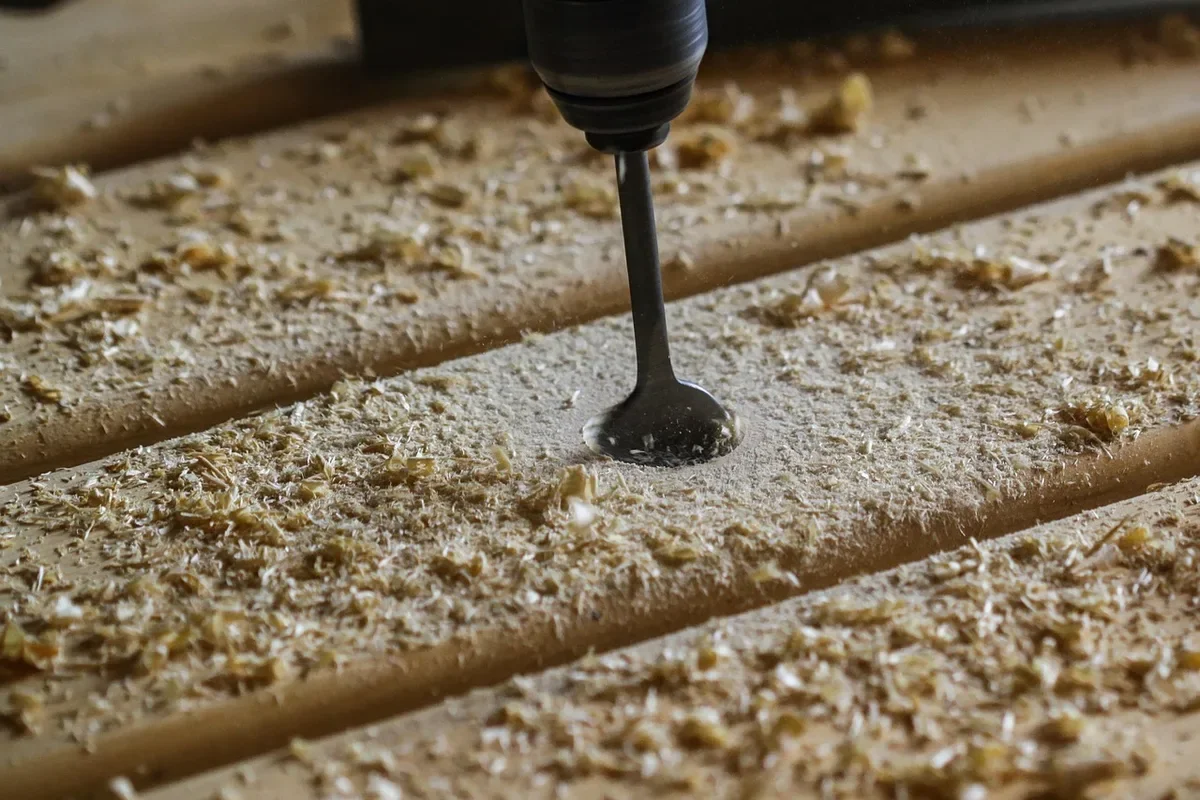
- Drill straight through both boards with a bit equal to the bolt’s nominal diameter. Use a brad-point or spade bit for clean edges, and back the exit side with a scrap block to stop tear-out. A drill guide or drill press helps keep the hole square to the face.
- Clear the sawdust. Chips packed in the hole make the bolt harder to push and can split the wood.
- Insert the bolt from the head side and tap the domed head with a mallet or hammer until the square neck starts entering the wood. It should need light taps, not pounding.
- Add a flat washer, then the nut, on the far side. The washer spreads the nut’s pressure so it does not crush the fibers.
- Tighten the nut with a wrench while the square neck holds the bolt still. As the nut pulls, the head draws down and the neck seats fully. Stop when the washer just starts to bite into the surface.
If you have to pound the bolt in with real force, the hole is too tight for that wood. Pull it back out and open the hole by 1/64 in rather than driving on, because a forced neck in dry lumber is how boards split along the grain.
Carriage Bolt Hole Size Chart
For wood, match the bit to the bolt’s round shank, not to the square neck or the head. The table shows the bit for a snug carriage-bolt fit and the wrench you need for the nut on standard coarse-thread hardware.
| Bolt diameter | Drill bit (snug fit for wood) | Nut wrench size |
|---|---|---|
| 1/4 in | 1/4 in | 7/16 in |
| 5/16 in | 5/16 in | 1/2 in |
| 3/8 in | 3/8 in | 9/16 in |
| 1/2 in | 1/2 in | 3/4 in |
You will see a different set of numbers in machinist charts, and the difference is worth understanding. For a 3/8 in bolt passing through metal, the standard close-fit clearance hole is 25/64 in and the normal fit is 13/32 in. Those sizes suit hex bolts and metal parts. A carriage bolt in wood is deliberately snugger, because it relies on friction and the neck for grip rather than a free-sliding fit.
How Far the Square Neck Actually Bites
A 3/8 in carriage bolt has a square neck about 0.388 in on each side. Measured corner to corner, that square is about 0.388 x 1.414, or roughly 0.55 in across. Your round 3/8 in (0.375 in) hole is much smaller than that diagonal, so each corner of the neck has to displace about 0.09 in of wood as it goes in. That displaced wood is what locks the bolt against rotation.
This also explains the two failure modes. Oversize the hole and the corners have little or nothing to cut, so the bolt spins. Undersize it, or work in dense hardwood, and the corners cannot displace the wood without splitting it.
Choosing the Right Bolt Length
Carriage bolt length is measured from under the head to the tip, so the domed head does not count. Add the actual thickness of your wood to about 3/4 in for a washer, a 3/8 in nut and a couple of exposed threads, then round up to the next standard length. Remember that a nominal 2x lumber is 1-1/2 in thick and a nominal 4×4 is 3-1/2 in.
| Wood stack | Actual thickness | Add about 3/4 in | Bolt length to buy |
|---|---|---|---|
| 2×4 + 2×4 | 3 in | 3-3/4 in | 4 in |
| 2×4 + 4×4 post | 5 in | 5-3/4 in | 6 in |
| 4×4 + 4×4 | 7 in | 7-3/4 in | 8 in |
Too short and the nut only catches a thread or two, which is a weak connection. Too long and the tail sticks out where it snags clothing and skin, which matters on playground equipment and benches. If you end up with a long tail, cut it with a hacksaw and file the end so the nut can still be threaded.
What to Do in Hardwood or When the Neck Will Not Seat
Oak, maple and other dense hardwoods often resist the square neck. You have two workable options. The first is to drill the round hole, then use a sharp chisel to square off the top of the hole to the neck’s size and depth so the neck drops in without wedging. The second is to switch to a hex bolt with a flat washer under both the head and the nut, which gives up the anti-spin neck but avoids splitting. The site’s guide to making a square hole in wood covers the chisel method in detail.
When you bolt wood to a metal bracket, put the square neck on the wood side. The neck can only bite into wood, and that is what stops the bolt turning while you tighten the nut on the metal side. If the head must face the metal, punch or file a square hole in the bracket instead.
Coating and Material for Outdoor and Treated Wood
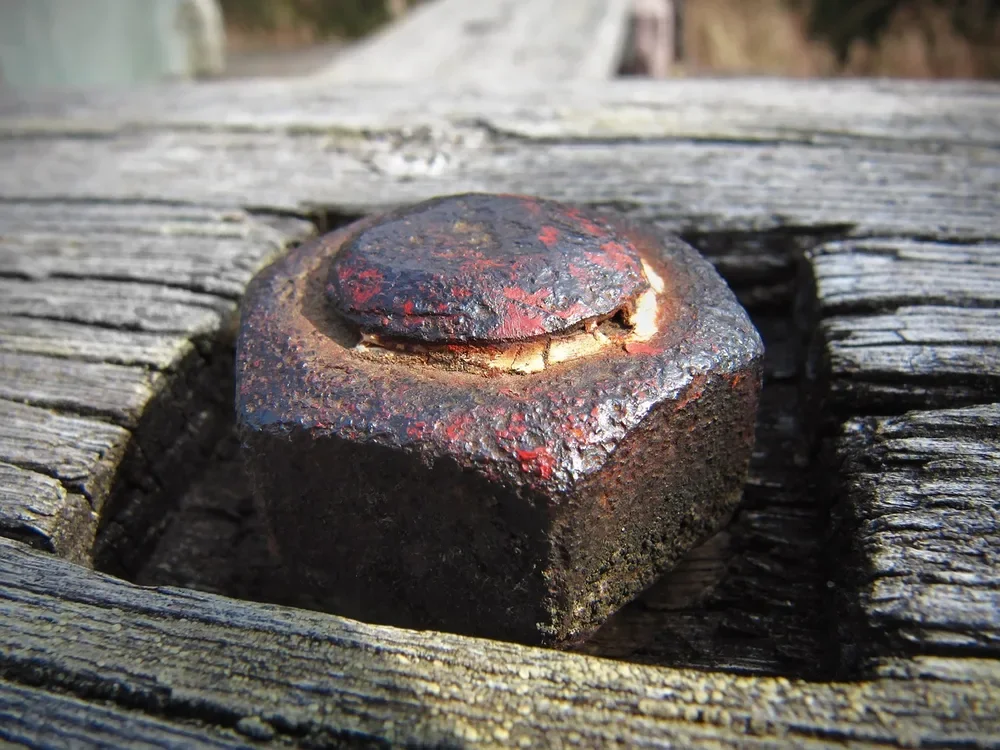
Choose the finish by where the bolt will live. Plain zinc-plated bolts are fine for dry indoor furniture. For decks, fences, pergolas, and other exterior projects, use hot-dip galvanized or stainless steel carriage bolts. Modern pressure-treated lumber holds copper-based preservatives that corrode bare steel quickly, and a thin plated coating does not last against that. Match the nut and washer to the bolt, because a plain steel washer next to a galvanized bolt becomes the weak point.
For more on fastener choices in outdoor framing, see screws or nails for deck framing.
Carriage Bolt Myths and Common Mistakes
Myth: carriage bolts are stronger than regular bolts. The head shape does not change strength. Tensile and shear strength come from the bolt’s grade, diameter, and material. The common galvanized carriage bolt is Grade 307A, a general-purpose steel grade, so a carriage bolt is no stronger than a hex bolt of the same diameter and grade. What it adds is the smooth domed head and the anti-spin neck.
Mistake: no washer under the nut. The nut has small bearing area, and without a washer it sinks into the wood as the fibers compress. A washer under the carriage head is not needed, because the domed head is already wide. On the 3/8 in kit used above the head is 0.813 in across.
Mistake: tightening once and forgetting it. Lumber shrinks as it dries, and treated lumber often goes in wet. Recheck the nuts after a few weeks and snug them up. On anything that vibrates, use a nylon-insert lock nut so the connection stays tight.
Mistake: using carriage bolts for hidden joints. The round head is meant to face out. If the head will not be visible, a hex bolt is easier to remove later.
If you are threading a fastener into the end of a leg or post instead of passing it through, that job calls for a different fastener. See how to install hanger bolts in wood. For joints that connect posts, our guide to connecting 4×4 wood compares bolts, screws and joinery.
Tools You Need
| Tool | What it does here |
|---|---|
| Drill and bit matched to bolt diameter | Makes the snug hole the neck needs |
| Mallet or hammer | Taps the head so the neck starts seating |
| Wrench or socket | Tightens the nut (9/16 in for 3/8 in hardware) |
| Chisel | Squares the hole top in hardwood |
| Scrap block and clamps | Prevents tear-out and keeps holes aligned |
Frequently Asked Questions
What size hole do you drill for a carriage bolt?
Use a drill bit the same size as the bolt’s diameter, so a 3/8 in carriage bolt gets a 3/8 in hole. The hole needs to be snug so the square neck can bite into the wood and stop the bolt from spinning. If the bolt will not go in with light taps, open the hole by 1/64 in.
Do carriage bolts need a washer?
Yes, on the nut side. A flat washer under the nut spreads the load and stops the nut from crushing the wood. The rounded carriage head is wide enough that it does not need a washer under it.
Are carriage bolts stronger than hex bolts?
No. Strength depends on the bolt’s grade, diameter and material, not the head shape. A carriage bolt and a hex bolt of the same grade and size carry about the same load. The carriage bolt’s advantage is the smooth head and the square neck that keeps it from turning.
Can you use carriage bolts in hardwood?
Yes, but the square neck often will not seat without splitting dense wood. Drill the round hole, then chisel the top of it square to fit the neck, or use a hex bolt with washers under the head and the nut instead.
Can you use carriage bolts outdoors?
Yes, if they are hot-dip galvanized or stainless steel. Plain or thinly plated steel rusts quickly outdoors and in pressure-treated lumber.
Conclusion
Get three things right and a carriage bolt joint holds for years: a snug hole the same size as the bolt, a length that clears the washer and nut by a couple of threads, and a coating that suits where the wood lives. Tighten the nut, never the head, and recheck it after the wood settles.
Sponsored / affiliate links. As an Amazon Associate I earn from qualifying purchases. I may earn additional commission from eligible campaigns.