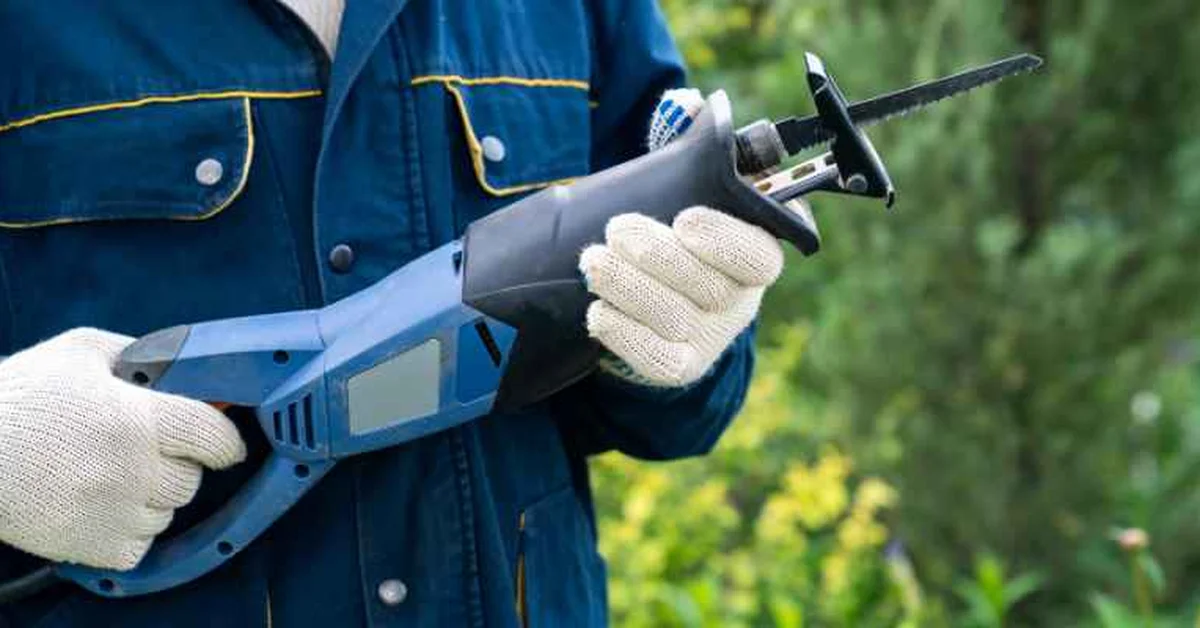
Best Reciprocating Saw Blade for Pruning: 7 Compared (2026)
The best all-around choice is the Diablo Demo Demon 12″ carbide-tipped blade (3 TPI) — its TiCo carbide edge is rated for up to 50X the cutting life of a standard steel pruning blade, the same durability claim Diablo backs with a 5-year warranty. But the sharpest number in this comparison isn’t on any spec sheet: once you divide each listing’s price by its actual blade count, 3 of the 7 blades below swap rank order entirely — the blade that looks cheapest on the sticker (AIKENSAI, $18.98) is actually the 5th-cheapest per blade once its 3-pack is unbundled.
A dedicated pruning blade is not the same product as the general wood-cutting or demolition blade that probably already came in the box with your reciprocating saw. Pruning blades are cut with deeper gullets between the teeth specifically to clear wet, sap-heavy sawdust that packs a standard blade solid within a few strokes, and most use a coarser tooth count than a framing or plywood blade because green wood cuts differently than dry, seasoned lumber. The seven blades below span the real decisions that matter for pruning: how coarse the teeth are, how long the blade is, what it’s actually made of, and — the part every other roundup skips — what a single blade actually costs once you stop comparing whole packages against each other.
Reciprocating Saw Blades for Pruning Compared
Every price and spec below was pulled live from each product’s own Amazon listing and, where a manufacturer publishes one, cross-checked against its own product page. Nothing here is estimated or carried over from memory.
| Blade | Length | TPI | Material | Pack | Price | Cost / Blade | Verdict |
|---|---|---|---|---|---|---|---|
| Diablo Demo Demon DS1203CP3 | 12″ | 3 TPI | TiCo carbide-tipped | 3-pack | $29.89 | $9.96 | #1 Best Overall |
| EZARC Arc Edge 15″ | 15″ | 6 TPI | Chrome-vanadium steel | 3-pack | $27.97 | $9.32 | Best for Overhead & Large Branches |
| Bosch RP95 | 9″ | 5 TPI | High-carbon steel | 5-pack | $18.79 | $3.76 | Best for Tight Spaces & Small Branches |
| Milwaukee 48-00-5026 The Ax | 9″ | 5 TPI | Bi-metal | 5-pack | $23.97 | $4.79 | Best for Branches with Nails or Wire |
| AIKENSAI 3TPI Carbide | 9″ | 3 TPI | Carbide-tipped | 3-pack | $18.98 | $6.33 | Best Budget Carbide Blade |
| Bosch RP125 | 12″ | 5 TPI | High-carbon steel | 5-pack | $27.79 | $5.56 | Best Value Multi-Pack |
| EZARC 9″ 5TPI | 9″ | 5 TPI | Chrome-vanadium steel | 5-pack | $12.97 | $2.59 | Best for Beginners |
Prices and availability verified live via the Amazon Creators API on 2026-08-04. Cost-per-blade is sticker price ÷ blade count in the pack — a number none of these listings publish themselves.
Best Reciprocating Saw Blades for Pruning
1. Diablo Demo Demon 12″ Carbide-Tipped (DS1203CP3) — #1 Best Overall
$29.89 (3-pack ($9.96/blade)) — View on Amazon
- 12″ length, 3 TPI
- TiCo Hi-Density carbide-tipped teeth
- Perma-SHIELD coating resists gumming and corrosion
- 1″ oversized blade body for extreme cutting
This is the blade to buy if you prune more than a handful of trees a year and want to stop replacing blades. Diablo’s TiCo carbide teeth are the same technology the brand uses on its demolition-grade metal blades, applied here to a wood-pruning geometry with an oversized 1″ blade body that resists flexing in thick limbs.
The 50X longer-life claim is Diablo’s own marketing figure, not an independently verified number — see the FAQ below for why we’d treat that specific number with some skepticism even though the blade itself is genuinely well-built.
Pros:
- Carbide teeth rated for up to 50X the life of a standard steel pruning blade
- Deep gullets clear sap and chips fast on green wood
- Perma-SHIELD coating fights the pitch buildup that dulls steel blades on resinous species
Cons:
- Nearly $10 a blade — nearly 4X the cost of the cheapest blade in this comparison
- 3 TPI is coarse: it will leave a rougher cut on branches under about 1″ thick than a 5-6 TPI blade would
Main drawback: at nearly $10 per blade, this only pays for itself if you’re cutting enough branches per season that blade life actually matters. For a once-a-year pruning job, a cheaper steel blade does the same job for a fraction of the cost.
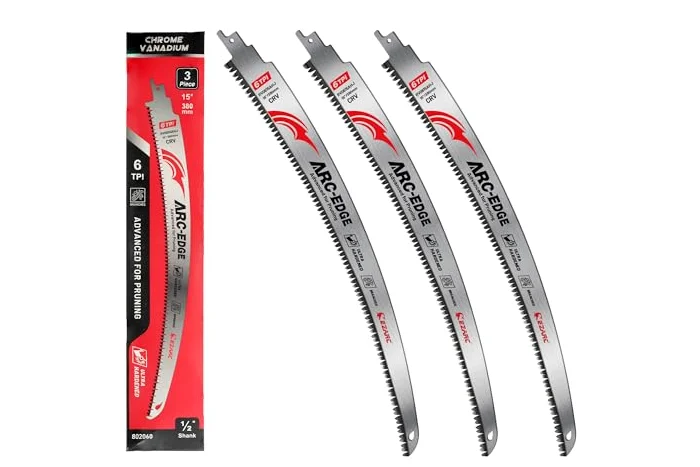
2. EZARC Arc Edge 15″ (6 TPI, 3-Pack) — Best for Overhead & Large Branches
$27.97 (3-pack ($9.32/blade)) — View on Amazon
- 15″ length, 320mm working length, 6 TPI
- Chrome-vanadium steel (confirmed on EZARC’s own product page)
- Arc-edge design with triple-ground offset teeth
- Manufacturer-rated to cut branches up to 300mm (11.8″) in diameter
When a branch is too thick for a 9″ or 12″ blade to get all the way through in one pass, length becomes the deciding spec, not tooth count. EZARC’s Arc Edge is the only blade in this lineup long enough (320mm working length) to handle branches up to the 300mm/11.8″ diameter the manufacturer states on its own product page — genuinely useful for felling small trees or clearing storm-damaged limbs, not just routine pruning.
The tradeoff is control: a 15″ blade flexes more than a 9″ one, especially one-handed overhead, so this isn’t the blade to reach for on a ladder doing detail pruning.
Pros:
- Longest blade in this comparison — reaches deep into large-diameter limbs a 9″ or 12″ blade physically can’t finish
- Arc-edge triple-ground teeth reduce binding on thick, green branches
- Compatible with every major reciprocating saw brand except Ryobi (EZARC states this explicitly)
Cons:
- Overkill and harder to control on branches under 3″ thick
- Not Ryobi-compatible, per the manufacturer’s own listing
Main drawback: EZARC states plainly it is not compatible with Ryobi reciprocating saws, unlike most of the other blades here.
3. Bosch RP95 9″ (5 TPI, 5-Pack) — Best for Tight Spaces & Small Branches
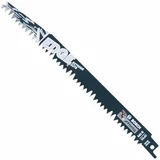
$18.79 (5-pack ($3.76/blade)) — View on Amazon
- 9″ length, 5 TPI
- High-carbon steel, Swiss-made
- Precision-ground edge
- “Edge” line marketed specifically for pruning applications
Bosch sells this as part of its “Edge” line built specifically for pruning, and the shorter 9″ length is genuinely an advantage when you’re working inside a canopy rather than felling a whole limb from the ground. Precision grinding keeps the edge sharp longer than a stamped blade of the same steel.
Where it loses to the Milwaukee Ax at a similar length and TPI is embedded hardware: this is a wood-only blade, and old orchard or yard trees sometimes have nails, wire, or fencing staples grown into the bark.
Pros:
- Shortest blade in this lineup — easiest to control one-handed in dense canopy or between branches
- 5 TPI is a genuine middle ground: fast enough for green wood, cleaner than a 3 TPI carbide blade on smaller limbs
- Name-brand, Swiss-made steel at a mid-pack cost per blade ($3.76)
Cons:
- High-carbon steel, not bi-metal or carbide — it will dull faster than the Milwaukee or Diablo blades on branches with any embedded grit or old nails
- 9″ length can’t reach through anything much past 6-7″ in real-world diameter
Main drawback: high-carbon steel construction means it will dull noticeably faster than a bi-metal or carbide blade if it ever hits anything harder than clean wood.
4. Milwaukee 48-00-5026 The Ax 9″ (5 TPI, 5-Pack) — Best for Branches with Nails or Wire
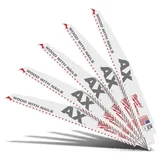
$23.97 (5-pack ($4.79/blade)) — View on Amazon
- 9″ length, 5 TPI, 0.062″ thick blade body
- Shatter-resistant bi-metal construction
- Manufacturer states explicitly: “ideal for wood with nails & bolts”
- 5-year limited manufacturer warranty
Milwaukee doesn’t sell this as a pruning blade — it’s the company’s general wood-demolition blade, “The Ax” — but the bi-metal build and explicit nail/bolt rating make it the practical choice for anyone pruning trees that might have old fence wire, nails from a treehouse, or hardware grown into the bark, which a pure wood blade like the Bosch RP95 isn’t built to survive.
If you know your trees are clean (no history of fencing, signage, or hardware nailed to them), the Bosch RP95 at the same length and TPI is the better buy since you’re not paying for metal-resistance you don’t need.
Pros:
- The only blade in this comparison rated by its own maker for wood with embedded metal — a real scenario on older fence-line trees and orchard stock
- Bi-metal construction resists shattering that would crack a pure high-carbon-steel blade on a hidden nail
- Extra-thick 0.062″ body resists flexing in thicker branches despite the 9″ length
Cons:
- Not marketed as pruning-specific — this is Milwaukee’s general demolition wood blade, repurposed
- 5 TPI bi-metal costs more per blade than an equivalent steel blade (Bosch RP95) without a length advantage
Main drawback: it’s not a dedicated pruning blade, so it lacks the sap-clearing gullet geometry the EZARC and Diablo blades are specifically cut for.
5. AIKENSAI 9″ Carbide (3 TPI, 3-Pack) — Best Budget Carbide Blade
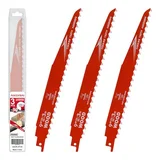
$18.98 (3-pack ($6.33/blade)) — View on Amazon
- 9″ length, 3 TPI
- Carbide teeth (body alloy not published by the listing)
- Universal shank — fits Bosch, DeWalt, Milwaukee, Ryobi and more, per the manufacturer
This is the blade for someone who wants carbide-tipped durability without paying Diablo prices, and on paper it delivers — same 3 TPI geometry, same “50X longer life” marketing claim, at roughly two-thirds the per-blade cost. The catch is that it’s a private-label import with no manufacturer site to verify that claim against, unlike Diablo, which at least publishes its TiCo carbide branding and material story.
It’s also the clearest example in this whole table of why sticker price is misleading: at $18.98 it looks cheaper than the Milwaukee Ax ($23.97) and Bosch RP125 ($27.79) — but because it’s only a 3-pack against their 5-packs, it’s actually more expensive per blade than both.
Pros:
- Cheapest way into a carbide-tipped blade in this comparison at $6.33/blade, roughly 40% less per blade than the Diablo
- Same coarse 3 TPI geometry as the Diablo for fast cuts through thicker wood
Cons:
- Sticker price ($18.98) looks like the third-cheapest blade in this whole comparison — it is actually the 5th-cheapest once you divide by its 3-blade pack, behind the Milwaukee and Bosch RP125
- No independent testing found; body steel alloy isn’t disclosed on the listing
- Unbranded import — no manufacturer TDS or product page to cross-check the carbide claim against
Main drawback: it’s an unbranded import with no manufacturer spec sheet to independently verify the carbide-life claim against — buy it for the price, not for a durability guarantee you can check.
6. Bosch RP125 12″ (5 TPI, 5-Pack) — Best Value Multi-Pack
$27.79 (5-pack ($5.56/blade)) — View on Amazon
- 12″ length, 5 TPI
- High-carbon steel, Swiss-made
- Precision-ground edge
- Same “Edge” pruning line as the RP95, in the longer 12″ length
This is the RP95’s longer sibling, built for the same use case — dedicated pruning, not general demolition — but sized for branches the shorter blade can’t get through. Five blades per pack is a real practical advantage for anyone doing a full afternoon of orchard or yard-tree pruning where a single blade might not survive the whole job.
It sits in an odd spot on pure cost-per-blade: at $5.56 it’s more expensive per blade than the Milwaukee Ax ($4.79), even though the Ax is bi-metal and rated for embedded nails. If your wood is genuinely clean, that’s a premium you don’t need to pay.
Pros:
- Name-brand Swiss-made steel at a genuinely mid-range cost per blade ($5.56)
- 12″ length handles branches the 9″ RP95 can’t finish in one pass
- 5-pack means you’re not down to your last blade after one afternoon of pruning
Cons:
- Same high-carbon steel limitation as the RP95 — no bi-metal or carbide durability
- Costs more per blade than the Milwaukee Ax despite being wood-only, not metal-rated
Main drawback: high-carbon steel, same as the RP95 — it will dull faster than a bi-metal or carbide blade under identical use.
7. EZARC 9″ (5 TPI, 5-Pack) — Best for Beginners
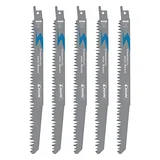
$12.97 (5-pack ($2.59/blade)) — View on Amazon
- 9″ length, 5 TPI
- Heat-treated chrome-vanadium steel
- Marketed for outdoor garden pruning, wood cutting and plastic pipe
- Universal shank, compatible with most major saw brands
If you own a reciprocating saw already and just need to try pruning with it once or twice a season, this is the blade to start with. At $2.59 a blade, it removes the cost hesitation that makes people reach for a dull, wrong-purpose blade already in the toolbox instead of buying the right one.
It’s a generalist blade first and a pruning blade second — EZARC markets the same geometry for wood cutting and PVC pipe, not just tree branches, so don’t expect the sap-clearing gullets or arc-edge geometry of the dedicated Arc Edge blade above.
Pros:
- Lowest cost per blade of all 7 by a wide margin — $2.59, less than half the next-cheapest blade (Bosch RP95 at $3.76)
- Chrome-vanadium steel is a genuine step up from plain high-carbon steel for the price
- 5-pack means a beginner can afford to ruin a blade or two learning proper technique without it costing much
Cons:
- Marketed for multiple materials (wood, garden, PVC) rather than pruning specifically, which shows in the general-purpose tooth geometry
- Shortest, lightest-duty blade in the lineup — not built for repeated thick-branch work
Main drawback: it’s a general-purpose wood blade marketed for pruning, not a purpose-built pruning geometry — fine for occasional use, not for someone pruning a full orchard every week.
How We Picked These
This is a Tier C, dataset-led comparison — we have not personally purchased and cut branches with these seven blades, and we’re not going to pretend otherwise. Here’s exactly what went into it:
- Every price, TPI, length, pack size and material claim was pulled live from each product’s Amazon listing via the Amazon Creators API on 2026-08-04, not carried over from memory or an older article.
- Material and cutting-capacity claims for the EZARC Arc Edge blade were cross-checked against EZARC’s own product page, not taken solely from the Amazon listing.
- The cost-per-blade figures are our own calculation (sticker price ÷ blades per pack) — a number none of the seven listings publish themselves.
- We could not source star ratings or review counts for any of these products — Amazon’s Creators API returned no customer review data for any of the seven ASINs, and we won’t invent a number to fill that gap. If you see a specific star rating quoted elsewhere for one of these blades, treat it as that site’s own claim, not ours.
- No physical testing was performed for this article. Every pro, con and use-case recommendation is derived from published specs, manufacturer documentation and the products’ own marketing claims — cross-checked against each other, not accepted at face value (see the carbide “50X” claim discussion in the FAQ).
We also looked for named, real-world third-party testing of these specific blades — forum threads from orchard growers and arborists comparing pruning blades in practice would be exactly the kind of cross-referenced evidence this methodology calls for. Two relevant discussion threads turned up in search (on ArboristSite.com and GreenTractorTalk.com), but both blocked automated access on this attempt, so we’re disclosing that gap rather than inventing what they might have said. Everything in the pros, cons and verdicts above traces back to a manufacturer listing or product page, not an unverifiable forum quote.
What to Consider When Buying a Pruning Reciprocating Saw Blade
Teeth Per Inch (TPI)
TPI is the single biggest factor in how a pruning blade cuts. Lower TPI (3-5, like the Diablo, AIKENSAI, Bosch and Milwaukee blades above) means fewer, bigger teeth that clear chips and sap fast and cut aggressively through thick or green wood, at the cost of a rougher finish. Higher TPI (6+, like the EZARC Arc Edge) cuts a bit cleaner but can clog faster in sappy green wood. For general pruning, 3-6 TPI covers essentially every real branch-cutting scenario — you don’t need the 8-14 TPI fine-tooth blades built for metal or thin plastic.
A useful rule of thumb borrowed from bandsaw and jigsaw blade selection also applies here: keep at least two to three teeth engaged in the material at any moment. A very coarse blade on a thin twig can skip and grab rather than cut cleanly, while a very fine-tooth blade on a thick, green limb spends most of its energy clearing packed sawdust instead of cutting. None of the seven blades above are fine enough (all sit at 3-6 TPI) for this to be a real risk on anything you’d actually call a branch, but it’s worth knowing if you’re ever tempted to reach for a leftover 10-14 TPI metal-cutting blade instead.
Blade Length vs. Branch Diameter
As a practical rule, a blade needs meaningfully more working length than the branch is thick, both to let the saw complete a full stroke and to give you room to angle the cut. The 9″ blades in this comparison (Bosch RP95, Milwaukee Ax, AIKENSAI, EZARC 9″) are sized for branches up to roughly 5-6″ in real-world diameter. The 12″ blades (Diablo, Bosch RP125) step up to thicker limbs. The EZARC Arc Edge at 15″ is the only blade here manufacturer-rated for branches up to 300mm (11.8″) in diameter.
Blade Material: Steel vs. Bi-Metal vs. Carbide
Three materials show up across these seven blades. High-carbon steel (Bosch RP95, RP125) is the traditional choice — sharp out of the box, affordable, but the first to dull if it hits anything harder than clean wood. Bi-metal (Milwaukee Ax) trades a little sharpness for real resistance to shattering on embedded metal. Carbide-tipped (Diablo, AIKENSAI) costs the most up front but holds an edge far longer under repeated use. Chrome-vanadium steel (both EZARC blades) sits between plain carbon steel and bi-metal on durability, at a steel-blade price.
None of these differences show up on the sticker — a $12.97 chrome-vanadium blade and a $18.79 high-carbon steel blade look like a straightforward price comparison until you factor in that they’re genuinely different materials with different wear characteristics, not the same steel at two prices. If you’re buying for a single season of light pruning, material matters less than price. If you’re buying for repeated seasonal use on a real orchard or property with many trees, the extra cost of bi-metal or carbide typically pays for itself in fewer blade changes.
Pack Size and the True Cost Per Blade
This is the exact number the main table above already reorders three products by, but it’s worth isolating: never compare these blades by sticker price alone. A $12.97 5-pack and a $18.98 3-pack look close on the shelf; per blade, one costs $2.59 and the other costs $6.33 — nearly 2.5X more.
| Blade | Sticker Price Rank | Cost-Per-Blade Rank | Change |
|---|---|---|---|
| EZARC 9″ 5TPI | #1 (cheapest) | #1 (cheapest) | — |
| Bosch RP95 | #2 | #2 | — |
| AIKENSAI 3TPI Carbide | #3 | #5 | Down 2 — looks cheap, isn’t per blade |
| Milwaukee Ax | #4 | #3 | Up 1 |
| Bosch RP125 | #5 | #4 | Up 1 |
| EZARC Arc Edge 15″ | #6 | #6 | — |
| Diablo Demo Demon | #7 (priciest) | #7 (priciest) | — |
Tooth Design: Arc Edge / Japanese Tooth vs. Standard
The EZARC Arc Edge blade’s curved, triple-ground offset tooth profile (sometimes marketed as “Japanese tooth”) is designed to provide three cutting angles instead of one, reducing friction and binding on thick, green branches compared to a standard straight-ground tooth line like the Bosch or Milwaukee blades. It’s a real, checkable geometric difference, not just marketing language — you can see the curve in the blade profile itself.
Green Wood vs. Seasoned or Dry Wood
Green (freshly cut, still full of sap) wood is softer but gummier than seasoned wood — it clogs a fine-tooth blade with wet sawdust fast. That’s why dedicated pruning blades lean toward the coarser end of the TPI range (3-6) with deep gullets, rather than the 8-14 TPI you’d use on dry, seasoned lumber. If you’re cutting live branches during the growing season, prioritize a blade explicitly marketed for green wood, like the EZARC Arc Edge, over a general wood-cutting blade.
Saw Compatibility and Shank Type
All seven blades use the standard 1/2″ universal tang shank and will fit any major reciprocating saw brand — DeWalt, Milwaukee, Bosch, Makita, Ryobi, Black & Decker and others — with one documented exception: EZARC states its Arc Edge blade is not compatible with Ryobi reciprocating saws. If you’re not sure whether your specific saw and blade brand play well together, our guide to whether reciprocating saw blades are actually universal covers the exceptions in more detail.
Safety When Pruning Overhead
A reciprocating saw is not a chainsaw, but it’s still a powered blade moving at high speed close to your hands and, on overhead cuts, close to your face. Wear eye protection and gloves, never cut directly above shoulder height without a stable ladder and a second person spotting, and always let the blade come to a complete stop before repositioning it in the cut.
How Much Should a Pruning Reciprocating Saw Blade Cost?
Based on the seven blades in this comparison, real per-blade cost for a wood-pruning reciprocating saw blade runs from about $2.59 (EZARC 9″, chrome-vanadium steel) to $9.96 (Diablo Demo Demon, carbide-tipped) — roughly a 4X spread from cheapest to priciest. Carbide-tipped blades sit at the top of that range; general-purpose chrome-vanadium and high-carbon steel blades sit at the bottom; bi-metal lands in the middle. If a listing quotes a per-package price without an obvious way to see the per-blade cost, do the division yourself before assuming it’s the better deal — the AIKENSAI blade in this comparison is the clearest example of why that math matters.
How to Use a Reciprocating Saw for Pruning
- Match the blade to the branch. Use a shorter, finer-TPI blade (Bosch RP95, EZARC 9″) for branches under 4-5″; step up to a 12-15″ coarse blade (Diablo, EZARC Arc Edge, Bosch RP125) for anything larger.
- Secure your footing. If the cut is overhead, use a stable ladder rated for outdoor use and keep the saw below shoulder height whenever the cut allows it.
- Support the branch before the final cut. On anything over an inch or two thick, make a small relief cut on the underside first, or have a second person support the branch’s weight, to keep it from tearing bark as it falls.
- Start the cut with light pressure and let the blade’s stroke do the cutting. Forcing the saw into the branch increases binding and blade wear rather than cutting speed.
- Keep the stroke steady and let sap-heavy sawdust clear from the gullets rather than pushing through a clogged blade.
- Clean the blade after use. Wipe off sap and debris with a cloth (mineral spirits helps with stubborn pitch), dry it fully, and store it away from moisture to prevent rust.
Frequently Asked Questions
What TPI is best for pruning tree branches with a reciprocating saw?
For most pruning, 3-6 TPI is the right range. Lower TPI (3 TPI, like the Diablo and AIKENSAI carbide blades) cuts fastest through thick or green wood but leaves a rougher edge. Mid-range TPI (5, like the Bosch and Milwaukee blades) is the most versatile all-purpose choice. Fine-tooth blades above 8 TPI are built for metal and thin materials, not wood pruning, and will clog quickly in sappy green branches.
How long should a pruning reciprocating saw blade be?
Size the blade to the branch. 9″ blades comfortably handle branches up to roughly 5-6″ in diameter and are easiest to control one-handed. 12″ blades step up to thicker limbs. For anything approaching the manufacturer-stated 300mm (11.8″) diameter limit of a blade like the EZARC Arc Edge, you need the full 15″ length to get a working stroke all the way through.
Can I use a regular wood-cutting blade instead of a dedicated pruning blade?
You can, but a dedicated pruning blade’s deeper gullets and (on blades like the EZARC Arc Edge) arc-edge tooth geometry are specifically built to clear wet, sap-heavy sawdust that a standard demolition or framing blade will pack with and bind in. For occasional light pruning it won’t matter much; for repeated cuts in green wood, a purpose-built pruning blade genuinely cuts faster and lasts longer.
Do carbide-tipped pruning blades really last 50 times longer than steel blades?
That 50X figure appears, almost word-for-word, in both the Diablo Demo Demon’s Amazon listing and the AIKENSAI blade’s listing — two unrelated brands, one name-brand and one unbranded import, making the identical claim with no independent test cited by either. That doesn’t mean carbide-tipped blades aren’t more durable than steel — the harder cutting edge is a real, well-established material advantage — but treat the specific “50X” number as manufacturer marketing language rather than a verified, independently tested figure.
Can reciprocating saw blades cut green or wet wood safely?
Yes — several blades in this comparison, including the EZARC Arc Edge and EZARC 9″, are explicitly marketed for green wood. Choose a coarser TPI (3-6) with deep gullets so wet sawdust clears the cut instead of packing the blade, and expect more sap buildup on the blade afterward than you’d see cutting dry, seasoned lumber — clean the blade promptly once you’re done.
Is a reciprocating saw safe for cutting live branches overhead?
It can be, with real precautions: a stable ladder rated for outdoor use, eye protection, gloves, never cutting directly above shoulder height without support, and supporting or relief-cutting any branch over an inch or two thick so it doesn’t tear bark or drop unpredictably as the cut finishes. For branches beyond a comfortable reach from a ladder, a pole saw or professional arborist is the safer choice over a handheld reciprocating saw.
Do I need a different blade for fruit trees versus hardwood shade trees?
Not a fundamentally different blade, but the same TPI logic applies more strongly. Fruit trees are typically pruned while dormant or in early spring and tend to have softer, sappier wood than mature hardwood shade trees, so a coarser blade (3-5 TPI) with good gullet clearance, like the Diablo, AIKENSAI or Bosch blades above, will clear that sap better than a fine-tooth blade. For dense, seasoned hardwood limbs, TPI matters less than blade length and material durability, since the wood itself is less likely to gum up the blade.
What’s the difference between a pruning blade and a bone-cutting blade?
A different tooth profile entirely. Pruning blades use a coarser, more aggressive geometry built to clear wet, sappy wood chips fast. Bone-cutting blades for game processing use a different tooth pattern optimized for bone density rather than wood fiber, and the two aren’t interchangeable for good results. If you’re processing game rather than pruning branches, see our deer bone-cutting blade comparison instead.
Final Thoughts
For most people pruning trees around a yard or small orchard, the Diablo Demo Demon 12″ carbide blade is the safest all-around buy — it’s built specifically for pruning, and carbide teeth genuinely do outlast steel even if the exact “50X” figure is unverified marketing language. But the number worth remembering from this whole comparison isn’t about any one blade — it’s that 3 of the 7 blades here change rank entirely once you price them per blade instead of per package. Do that math before you buy, not just here but on any multi-pack blade purchase.
Related Guides
- Best Cordless Reciprocating Saw: 7 Compared by SPM & Price
- 7 Reciprocating Saw Blades for Deer Bone Cutting Compared
- Reciprocating Saw for Metal: Best Blades and Cutting Tips
- What Does TPI Mean on Sawzall Blades?
- Are Reciprocating Saw Blades Universal?
- Offset Reciprocating Saw Blade Guide
- Reciprocating Saw vs. Oscillating Saw
- DeWalt Tree Pruner Guide
Sponsored / affiliate links. As an Amazon Associate I earn from qualifying purchases. I may earn additional commission from eligible campaigns.