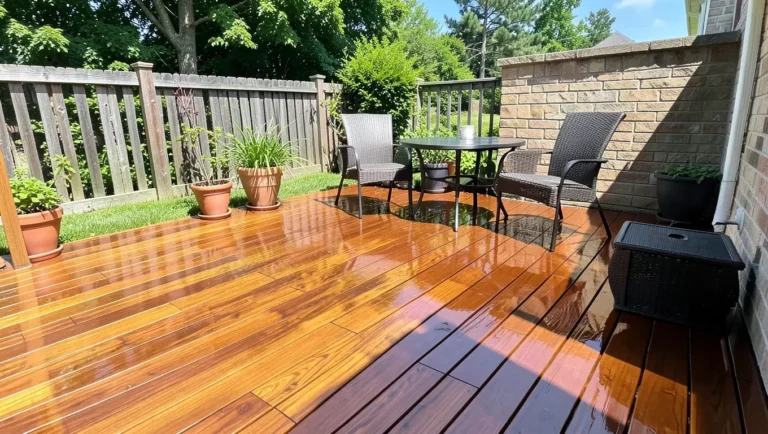
Redwood Deck vs Cedar Deck: Which Weathers Better?
For weathering, Cedar Deck usually wins on shaded or damp decks because it sheds moisture and takes stain more evenly, while Redwood Deck can come out ahead in dry, low-maintenance settings; for heavy traffic, neither wood stays in good shape without regular finishing. Match the board grade and site exposure, or you can get faster graying, cupping, checks, and higher upkeep costs.
| Factor | Redwood Deck | Cedar Deck | Winner |
|---|---|---|---|
| Hardness and dent resistance | Sequoia sempervirens; typical Janka hardness around 420–450 lbf | Thuja plicata; typical Janka hardness around 350 lbf | Redwood Deck |
| Color retention when unfinished | Holds color longer before it turns silver-gray | Grays predictably and often a bit sooner | Redwood Deck |
| Maintenance burden | Needs cleaning and periodic sealing or stain maintenance every few years | Needs cleaning and periodic sealing or stain maintenance every few years | Tie |
| Cost and availability | Often higher priced outside producing regions | Usually lower cost and widely available in many U.S. and Canadian markets | Cedar Deck |
| Best fit for wet or humid sites | Works well when heartwood grades are selected and boards dry quickly | Works well when heartwood grades are selected and boards dry quickly | Tie |
Which weathers better by deck condition?
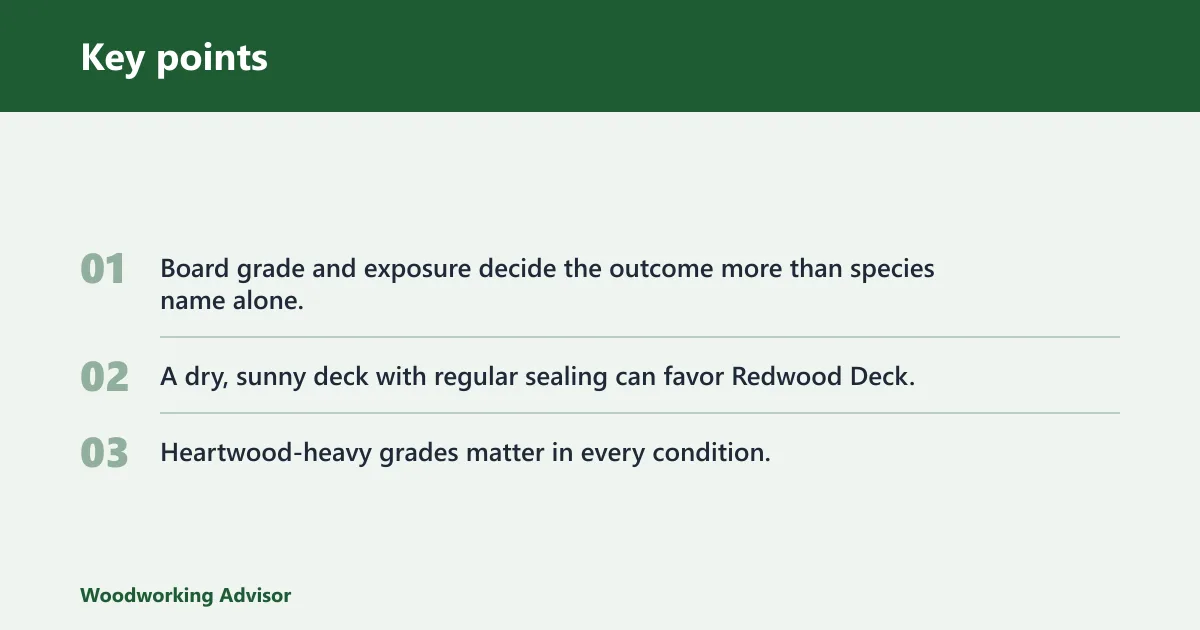
Board grade and exposure decide the outcome more than species name alone. A dry, sunny deck with regular sealing can favor Redwood Deck, while a shaded or damp deck often favors Cedar Deck if you keep the boards clean and let them dry. Heartwood-heavy grades matter in every condition.
| Deck condition | Cedar Deck | Redwood Deck | Expected weathering behavior | Likely failure mode | Maintenance interval |
|---|---|---|---|---|---|
| Sun | Good color shift, faster silver-gray patina | Usually holds color longer | Both dry quickly, but UV fades exposed surfaces | Checking and surface fade | Clean often; reseal or restain every few years |
| Shade | Better moisture shedding on well-ventilated boards | Can stay attractive if airflow is good | Slow drying raises stain and mildew pressure | Checking, mildew staining, end-grain breakdown | Clean regularly; inspect after wet seasons |
| Coastal humidity | Works best with heartwood and prompt washing | Can perform well if grading is strict | Salt, humidity, and repeated wetting slow dry-out | End-grain wear and cupping in splash zones | Wash often; refresh finish before it fails |
| High traffic | More prone to dents and wear paths | Better impact resistance | Foot traffic wears finish first on paths and landings | Denting, finish loss, edge wear | Inspect seasonally; touch up finish as needed |
| Low-maintenance goals | Acceptable if you are fine with faster graying | Better if you want longer color retention | Neither stays pristine without upkeep | Cosmetic graying and uneven weathering | Clean and seal every few years |
Which weathers better, redwood or cedar decking?
Redwood Deck usually weathers better when you want longer color retention and better dent resistance. Cedar Deck often weathers more predictably in damp or shaded layouts, especially when boards dry well and you do not mind a faster move to silver-gray.
The real divider is grade. A heartwood-heavy board in either species outperforms a mixed board with pale sapwood edges, because sapwood is less moisture-resistant and more rot-prone.
Redwood in sun, cedar in shade
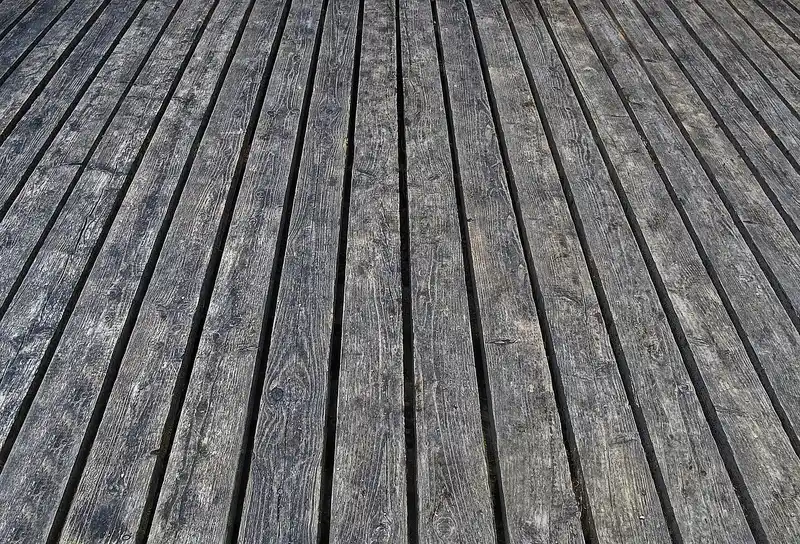
Sun exposure pushes both woods toward gray. Redwood usually keeps its reddish-brown tone longer, while cedar often fades sooner, especially on wide faces that see direct afternoon light. In shade, the better question is how fast the boards dry after rain.
Suppose a rear deck stays shaded by a tall fence and nearby trees. If water lingers on the surface, the board edges and end grain become the first trouble spots, and finish failure often appears there before the field of the board looks worn.
Does redwood last longer than cedar on a deck?

Yes, redwood usually lasts longer than cedar on a deck when you compare similar heartwood grades and similar upkeep. Redwood’s higher density gives it an edge in durability over cedar, and the page’s summary puts cedar at 15–20 years with maintenance and redwood at 20–30 years with maintenance.
That does not mean every redwood board outlasts every cedar board. Clear All Heart or other heartwood-heavy boards matter more than a species label when the deck sees splash, shade, or neglected finish.
Heartwood beats mixed-grade boards
Heartwood is the durable inner wood. You should favor it for exterior exposure because it resists decay better than sapwood. Sapwood often appears pale or creamy white at the board edge, and that color break is a clue that the less durable portion is present.
Common grade names such as Clear All Heart, Heart Clear, Deck Heart, Construction Heart, Select Knotty, and Architect Clear do not all mean the same amount of heartwood. The more heartwood the board contains, the better it is likely to weather at the deck surface, especially near cut ends.
Which deck wood needs less maintenance, cedar or redwood?
Neither one is low-maintenance in the true sense. Cedar Deck and Redwood Deck both need regular cleaning and periodic sealing or stain maintenance every few years if you want the color to stay closer to the original tone. If you skip finish work, both will gray.
Redwood has an appearance edge because it holds color longer. Cedar may be a little easier to accept as it turns gray, since the shift often looks even and familiar on many outdoor decks.
Maintenance is about failure mode, not just color
Maintenance is not only about keeping the wood pretty. It also slows checking, helps limit end-grain breakdown, and reduces the chance that splash zones wear unevenly. On steps and landings, the finish usually fails before the wood does, so those areas need closer inspection.
A common first-timer mistake is to seal the deck once and assume the job is done for years. On a sunny or coastal deck, water and UV work together, so a finish schedule needs to follow exposure rather than a fixed calendar guess.
Is cedar cheaper than redwood for decking?
Cedar is often priced at about $5 to $9 per square foot. Cedar is generally lower priced and more widely available in many U.S. and Canadian markets, while redwood is often higher priced outside producing regions. The page’s material figures place cedar at $5 to $9 per square foot and redwood at $8 to $12 per square foot.
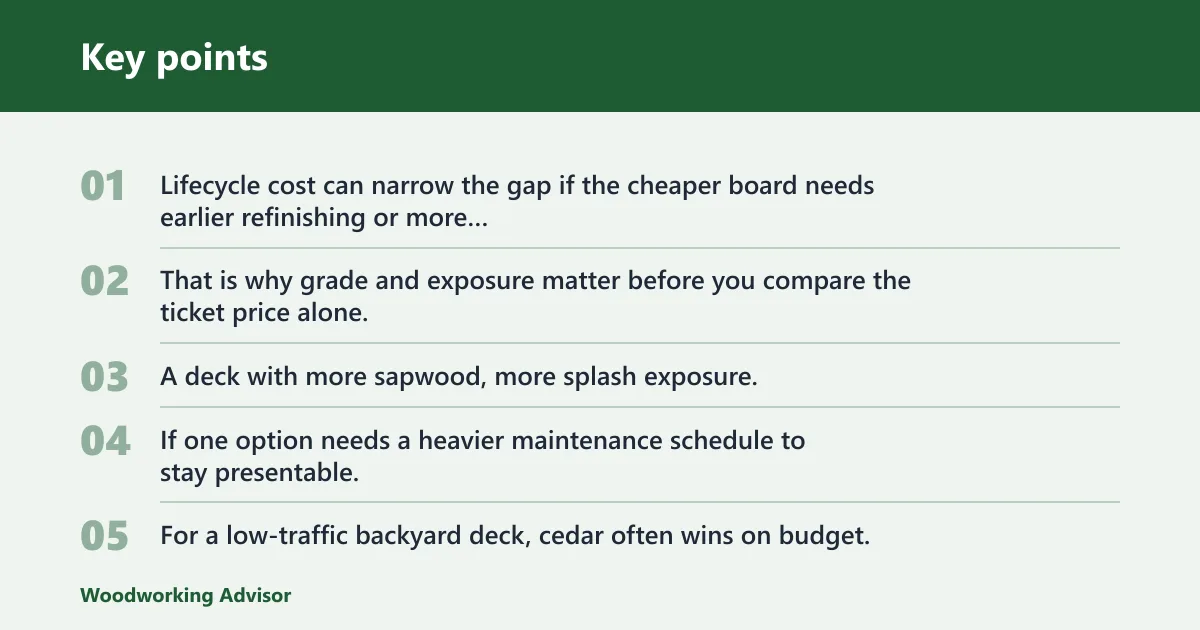
Lifecycle cost can narrow the gap if the cheaper board needs earlier refinishing or more frequent replacement in harsh exposure. That is why grade and exposure matter before you compare the ticket price alone.
Initial price is not the full bill
A deck with more sapwood, more splash exposure, or more foot traffic can need earlier board replacement, even if the wood looked economical at purchase. If one option needs a heavier maintenance schedule to stay presentable, the lower upfront price can disappear over time.
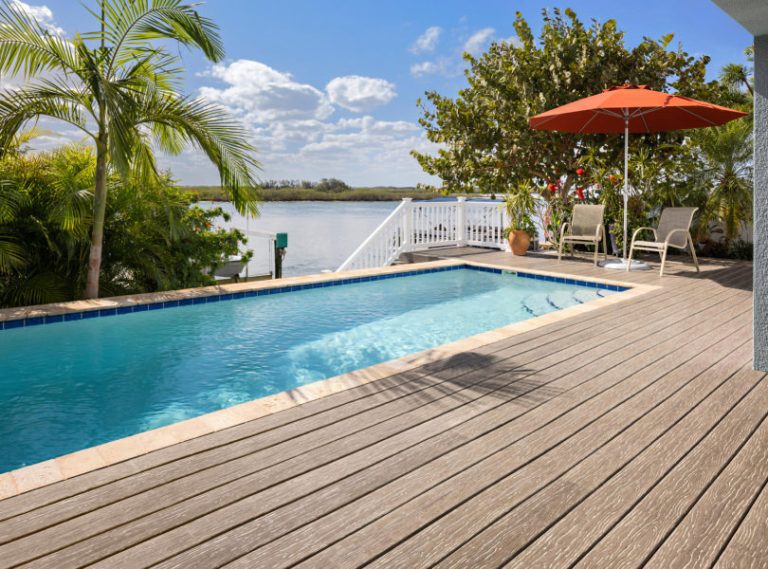
For a low-traffic backyard deck, cedar often wins on budget. For a front landing or a pool-adjacent deck, redwood may repay some of its higher price through better dent resistance and longer appearance retention.
Which wood holds up better in high-traffic areas, cedar or redwood?
Redwood Deck holds up better in high-traffic areas because it is denser and more impact-resistant. Cedar Deck has a typical Janka hardness around 350 lbf, while redwood is around 420–450 lbf, so redwood resists denting better on steps, landings, and main walking paths.
That said, traffic also strips finish. On a busy deck, you can expect wear to show first where shoes pivot, furniture drags, or water collects at the top of stairs.
Where wear shows first
Traffic does not wear a deck evenly. High-use paths, chair legs, grill stations, and the first board at a doorway take more abuse than the rest of the surface. In those zones, redwood’s density helps, but periodic finish touch-ups still matter.
Say your deck includes a 4-foot-wide path from the kitchen door to the stairs. That strip will gray and lose finish faster than the outer perimeter, no matter which species you choose, because abrasion and moisture both concentrate there.
How do grade and heartwood change performance?
Grade changes performance more than many shoppers expect. Clear All Heart, Heart Clear, and Deck Heart are often reported to weather better because they contain more durable inner wood. Select Knotty and Architect Clear can still perform well, but the sapwood content and board mix matter more.
Look for pale, creamy white board edges. Those edges are sapwood, and sapwood is less resistant to moisture and insects than heartwood. On an exterior deck, that usually means more risk at cut ends and more uneven weathering.
- Check every board edge for pale sapwood bands.
- Choose heartwood-heavy grades for visible and wet areas.
- Use the better grades for stairs, landings, and splash zones.
- Keep the finish schedule tighter where water sits longest.
Choose Redwood Deck if… / Choose Cedar Deck if…
Choose Redwood Deck if you want better dent resistance, longer color retention, and a deck that can stay attractive a little longer between finish cycles. It also makes sense when you can buy a heartwood-heavy grade and do not mind paying more upfront.
Choose Cedar Deck if budget and availability matter most, you want lighter material that is easier to handle, or the deck will get regular cleaning and sealing anyway. Cedar also fits well when you are comfortable with a faster move to a silver-gray patina.
For wet, shaded, or coastal sites, the better pick is the board with more heartwood and fewer sapwood edges. For sunny, high-traffic decks, Redwood Deck has the stronger case.
Frequently asked questions
Will cedar and redwood both turn gray outdoors?
Yes. Both woods naturally weather to a silver-gray patina when left unfinished, and that color change does not mean the deck has failed. Redwood generally holds its original color longer, but both will gray if you do not maintain the surface finish.
Which is better for a wet or humid climate: cedar or redwood?
Neither has a universal advantage in wet or humid climates. Heartwood selection matters more than species, because sapwood is more rot-prone and more vulnerable to moisture. In damp sites, the best-performing boards are the ones that dry fastest and show the least pale sapwood at the edges.
Do I need to seal cedar or redwood decking?
A periodic seal or stain schedule every few years is a practical way to help slow graying, checking, and uneven wear on both Cedar Deck and Redwood Deck. Cleaning alone will not hold the original color for long. A periodic seal or stain schedule every few years is the practical way to manage graying, checking, and uneven wear on both Cedar Deck and Redwood Deck.
Sponsored / affiliate links. As an Amazon Associate I earn from qualifying purchases. I may earn additional commission from eligible campaigns.