Ipe Decking: Pros, Cons and Cost Compared to Composite
Choose ipe if you want a dense hardwood that wears slowly and you are willing to oil it or let it gray. Choose composite if you want less upkeep and steadier costs. Pick the wrong material, and maintenance, staining, or early replacement can cost more than the board price. This guide compares ipe and composite on cost, upkeep, climate fit, and appearance.
Ipe is a Brazilian walnut hardwood, usually sold as 1×6 decking boards. It is very dense, has strong natural decay resistance, and is usually installed with predrilling and stainless steel fasteners. Composite decking is a wood-plastic product sold in capped and uncapped forms, usually paired with hidden clips, and its fade and stain resistance varies by brand.
Ipe vs composite: the main trade-off
The main difference is not board price alone. It is the cost over time: waste, cutting effort, fasteners, cleaning, oiling, repairs, and how the deck behaves in your climate.
Ipe decking table
The table below uses a 200-square-foot deck and shows a transparent 10-year budget method. The base installed cost includes material, waste, fasteners or hidden hardware, and labor. The maintenance line adds annual cleaning plus ipe recoating. The replacement-risk allowance is a repair reserve: base installed cost multiplied by a climate scenario percentage for board swaps, fastener issues, or localized repairs.
| Cost item | Ipe | Capped composite |
|---|---|---|
| Deck size used for math | 200 sq ft | 200 sq ft |
| Base material price | $7.50/sq ft | $4.75/sq ft |
| Waste factor | 15% | 7% |
| Fasteners / hidden hardware | $1.10/sq ft | $1.50/sq ft |
| Labor | $12.00/sq ft | $8.00/sq ft |
| Annual cleaning | $0.25/sq ft/year | $0.15/sq ft/year |
| Recoating / oiling | $1.25/sq ft every 2 years | $0 |
| Base installed cost formula | (200 × 7.50 × 1.15) + (200 × 1.10) + (200 × 12.00) = $3,240 | (200 × 4.75 × 1.07) + (200 × 1.50) + (200 × 8.00) = $2,536.50 |
| 10-year cleaning | 200 × 0.25 × 10 = $500 | 200 × 0.15 × 10 = $300 |
| 10-year recoating / oiling | 200 × 1.25 × 4 = $1,000 | $0 |
| Mild inland repair reserve | 2% of base installed cost = $64.80 | 3% of base installed cost = $76.10 |
| Coastal repair reserve | 4% of base installed cost = $129.60 | 4% of base installed cost = $101.46 |
| Freeze-thaw repair reserve | 3% of base installed cost = $97.20 | 6% of base installed cost = $152.19 |
| 10-year total | Mild inland | Coastal / salt air | Freeze-thaw / snow belt |
|---|---|---|---|
| Ipe | $4,804.80 | $4,869.60 | $4,837.20 |
| Capped composite | $2,912.60 | $2,937.96 | $3,064.69 |
These totals are reproducible from the figures above. For example, ipe in a mild inland setting is $3,240 base installed cost + $500 cleaning + $1,000 oiling + $64.80 repair reserve = $4,804.80. The composite total in the same setting is $2,536.50 + $300 cleaning + $76.10 repair reserve = $2,912.60.
How much do ipe and composite cost?
Ipe usually costs more to buy and more to install, and the gap widens when you include waste, predrilling, stainless fasteners, and labor. Composite usually starts lower on material cost, but capped boards can still land above cheap wood alternatives once hidden clips and labor are included.
Material cost per square foot
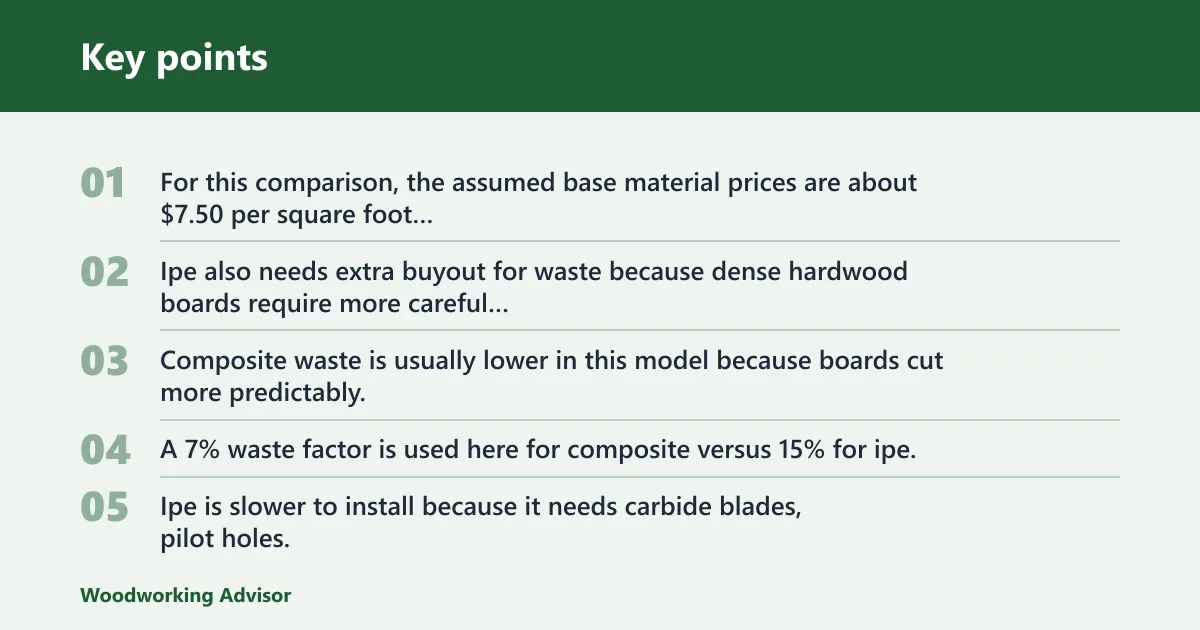
For this comparison, the assumed base material prices are about $7.50 per square foot for ipe and about $4.75 per square foot for capped composite. Ipe also needs extra buyout for waste because dense hardwood boards require more careful cutting and sorting around defects, layout, and end trimming.
Composite waste is usually lower in this model because boards cut more predictably, though you still need an allowance for offcuts. A 7% waste factor is used here for composite versus 15% for ipe.
Installed cost, waste, and labor
Labor is the largest spread in the table. Ipe is slower to install because it needs carbide blades, pilot holes, and careful screw placement. Composite is generally faster because hidden-clip systems are common and the material is easier to cut.
That difference matters more than board price on larger decks. On the 200-square-foot example, labor adds $12.00 per square foot for ipe and $8.00 per square foot for composite. The base installed cost comes out to $3,240 for ipe and $2,536.50 for capped composite before maintenance.
Ipe is commonly fastened with stainless steel screws because its density can shear cheaper fasteners and because corrosion resistance matters near coastal environments. Pre-drilling pilot holes is standard practice. Hidden fasteners are possible on some systems, but face-screw installation remains common for ipe.
Composite is often installed with hidden clips, especially capped boards. That simplifies the finished look and helps control thermal movement, but the clip system is another line item and it is not always interchangeable across brands.
How do they perform outdoors?
Ipe has a harder surface and stronger natural decay resistance than most wood species, while composite offers a low-maintenance surface with more uniform color and texture. Wet traction, heat, fading, and movement are where the practical differences show up first.
Wet slip risk and surface feel
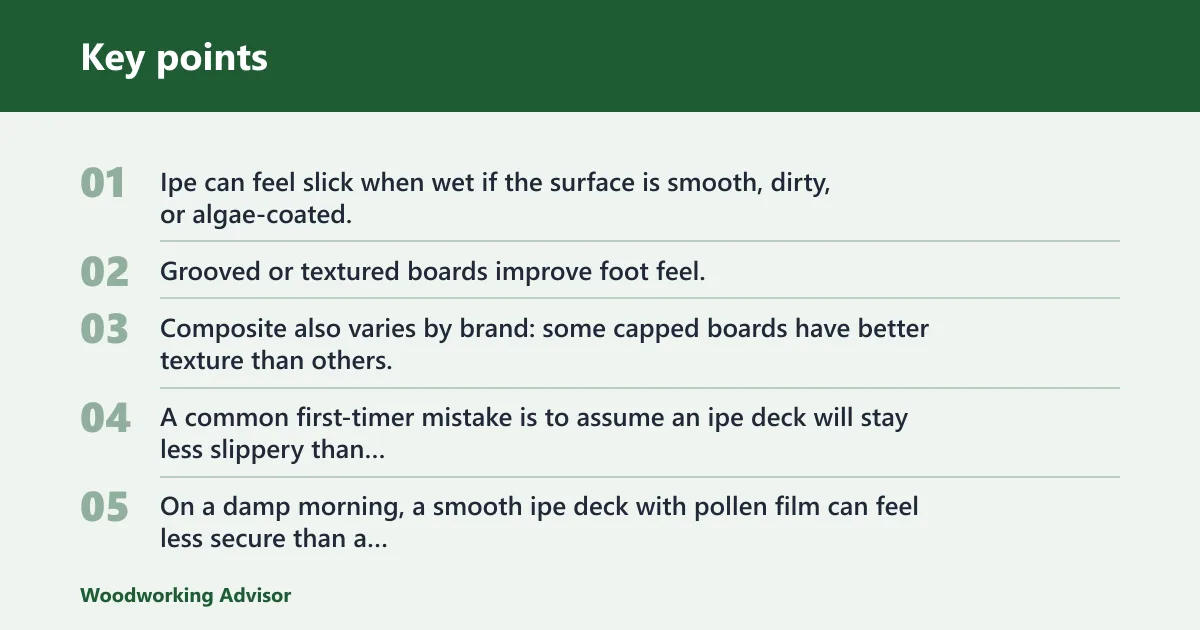
Ipe can feel slick when wet if the surface is smooth, dirty, or algae-coated. Grooved or textured boards improve foot feel, but there is no universal traction number that fits every product. Composite also varies by brand: some capped boards have better texture than others, and some uncapped boards can lose surface grip as they wear.
A common first-timer mistake is to assume an ipe deck will stay less slippery than composite just because it feels denser underfoot. On a damp morning, a smooth ipe deck with pollen film can feel less secure than a properly textured composite deck that has been cleaned on schedule.
Heat in full sun
Both materials can run hot in direct sun. Darker colors hold more heat, and capped composite often gets criticized for this because the surface temperature can rise quickly on exposed decks. Ipe also heats up, though its color, finish, and board orientation affect the result.
For barefoot use, shade and color choice matter more than the material label alone. A lighter composite color may be easier on feet than a dark ipe finish, but a lighter ipe board still needs maintenance if you want to keep its color.
Fading, graying, and stain resistance
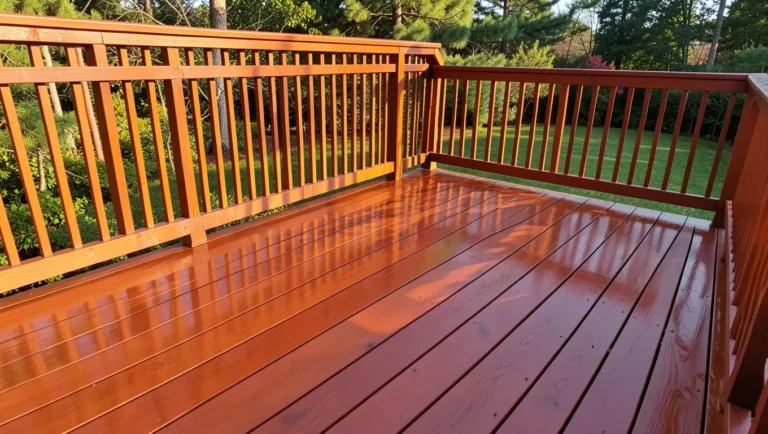
Ipe will gray naturally if you do not oil it. That weathering is cosmetic, not a sign of immediate failure, but it changes the look. If color retention matters, penetrating hardwood oil is part of the upkeep cycle.
Composite boards do not gray like wood, but they can fade or stain depending on the cap layer and brand. Capped composite is usually better at resisting stains than uncapped composite, while uncapped products can absorb more dirt and moisture over time.
What maintenance does each deck need?
Ipe needs more planned care if you want to keep its brown color. Composite needs less routine upkeep, but it still needs washing, stain control, and occasional hardware checks. The difference is less about “maintenance or no maintenance” and more about whether you want recurring finish work.
Cleaning frequency and washing methods
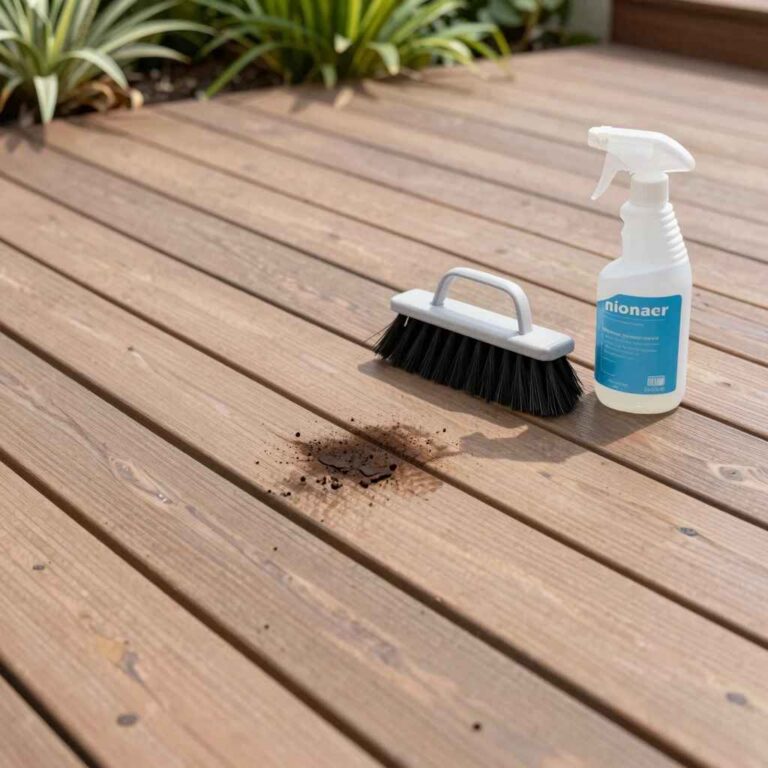
Both materials benefit from periodic cleaning with a soft brush, water, and a mild deck cleaner suited to the surface. For this cost model, annual cleaning is priced at $0.25 per square foot for ipe and $0.15 for composite. In practice, a shaded, debris-prone deck may need more frequent rinsing.
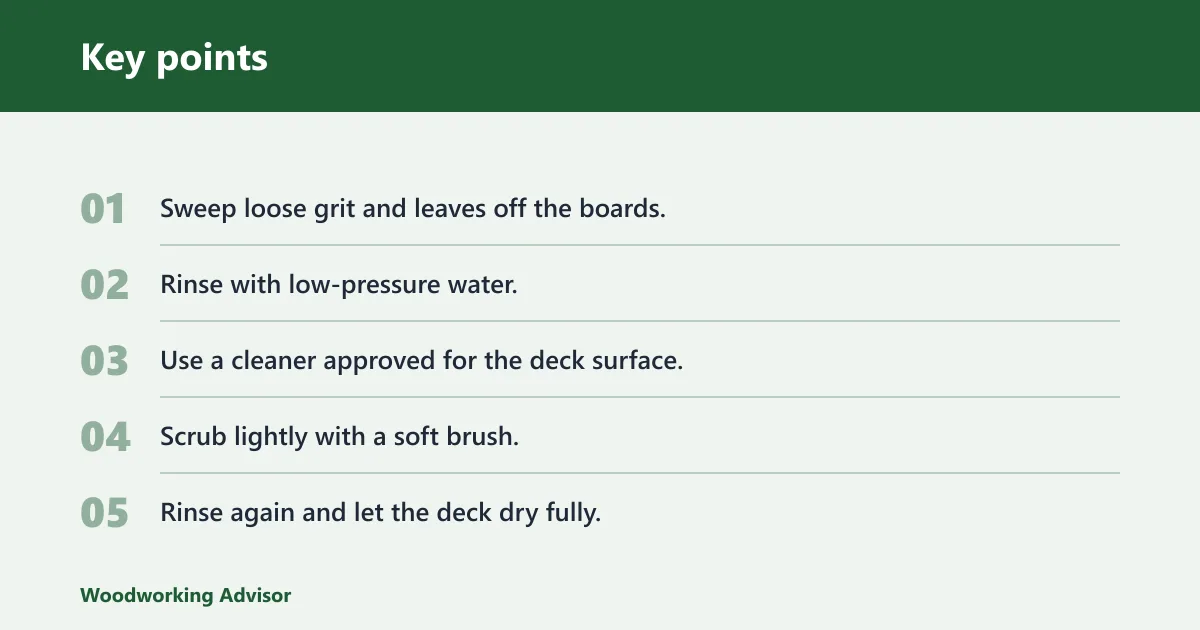
- Sweep loose grit and leaves off the boards.
- Rinse with low-pressure water.
- Use a cleaner approved for the deck surface.
- Scrub lightly with a soft brush.
- Rinse again and let the deck dry fully.
Oiling, sealing, and UV protection for ipe
Ipe does not need oiling to survive outdoors, but it does need oiling if color retention matters. A penetrating hardwood oil with UV protection can slow graying and keep the board color closer to the original brown. In this model, recoating is assumed every two years at $1.25 per square foot.
That is the main trade-off many buyers miss. Ipe may last a long time, yet a bright, even finish means recurring labor and material cost. If you let it weather naturally, the upkeep drops, but the appearance changes.
Recoat intervals and finish upkeep
Composite does not need oiling. Some products may still need spot cleaning for tannins, grease, or mildew films on the surface, and a few brands specify cleaners that should be avoided. If you buy uncapped composite, check the maker’s care instructions carefully because stain behavior is less forgiving than with capped boards.
Suppose a 16-by-12-foot deck sits in full afternoon sun behind a pool. If you want the dark wood look to hold, ipe will need regular finish work. If you want lower upkeep and can accept a uniform manufactured surface, capped composite is the easier long-term choice.
What about lifespan and repair?
Ipe can last a long time outdoors because it is dense, naturally decay resistant, and resistant to insect damage. Composite also has long service potential, but its performance depends more on the cap layer, fastener system, and exposure to heat and moisture. Neither material should be judged by board price alone.
Rot, insects, and movement
Ipe’s natural resistance to rot and insects is one of its biggest advantages. Its density also makes it more stable in service than many softwoods, but movement and cupping can still happen if water is trapped, fastening is poor, or board ends are not detailed correctly.
Composite does not rot in the same way wood does, but it can move with temperature changes. In freeze-thaw climates, that movement can stress fasteners and joints. Brand quality matters here, and capped boards usually hold up better than uncapped boards in messy exposure.
Board replacement and refinishing
Ipe boards can be refinished, sanded, and replaced one at a time if the layout allows it. That repairability is useful on premium decks, especially if a board is stained or damaged near a stair or railing post. Stainless fasteners make future service easier than corroded screws do.
Composite boards are also replaceable, but hidden-clip systems can make single-board swaps more tedious. Some products integrate better with clip removal than others. If repair access matters, ask how the specific system handles mid-span board replacement before you buy.
End-of-life disposal or recycling
Ipe is wood, so end-of-life handling is closer to lumber disposal, though local rules may limit reuse if the board has been sealed or fastened with mixed hardware. Composite disposal varies by product and region. Some boards can be recycled, but many still go to landfill because take-back options are limited.
Choose ipe if… / Choose composite if…
Choose ipe if you want a hardwood deck with strong wear resistance and you are willing to oil the deck if you want the original color. Choose composite if you want lower upkeep, more predictable annual cost, and a board surface that does not require finish renewal to stay usable.
Choose ipe if…
- You want a dense hardwood deck with strong natural rot and insect resistance.
- You are comfortable with predrilling, stainless steel fasteners, and slower installation.
- You care about refinishing and board-by-board repair more than low upkeep.
- You are willing to oil every couple of years if color retention matters.
Choose composite if…
- You want lower routine maintenance and no periodic oiling.
- You prefer hidden fasteners and a more uniform finished look.
- You want a lower 10-year ownership cost in most scenarios shown here.
- You are okay with brand-dependent fade and stain performance.
For climate fit, ipe is strongest when you want a wear-resistant hardwood and can manage finish upkeep. Composite is better when coastal corrosion, sun exposure, and annual labor all matter, because the lower maintenance burden often matters more than the board’s exact species or texture.
Frequently asked questions
Is ipe decking better than composite decking?
Ipe is better if you want a dense hardwood, stronger repairability, and a premium wood appearance. Composite is better if you want less upkeep and more predictable annual cost. The right choice depends on whether you value finish retention and refinishing more than low maintenance and simpler cleaning.
How much do ipe and composite cost per square foot compared to each other?
Using the cost model in this article, ipe material is $7.50 per square foot and capped composite is $4.75 per square foot. Installed, the example deck comes to $16.20 per square foot for ipe and $12.68 per square foot for capped composite before the 10-year maintenance and repair allowance.
How long does ipe decking last outdoors?
Ipe can last a long time outdoors because it is very dense and naturally resistant to rot and insects. Exact service life depends on fastening, drainage, climate, and maintenance. A well-detailed deck can perform for decades, but board replacement and finish care still matter over time.
Does ipe decking need oiling or sealing?
Ipe does not need oiling to survive outdoors, but it does need oiling if you want to keep the brown color instead of letting it gray. A penetrating hardwood oil with UV protection is the usual maintenance choice. Sealing is less common than periodic oiling for color retention.
What are the downsides of ipe decking?
The main downsides are cost, installation difficulty, and finish upkeep. Ipe needs predrilling, stainless fasteners, and careful cutting. It can gray without oil, and wet boards can feel slick if the surface is not kept clean. It also costs more to install than most composite decks.
Yes, some ipe systems can use hidden fasteners, but many installers still use face-screwed stainless steel fasteners because the wood is dense and the fastening method must suit the board profile. Check the manufacturer’s listing for your specific board and clip system before you commit.
How does ipe compare to composite for heat, fading, and rot resistance?
Both materials can get hot in full sun, and darker colors usually run hotter. Ipe has strong natural rot and insect resistance, while composite does not rot in the same way but can fade or stain depending on whether it is capped or uncapped. Ipe grays unless you oil it.
What maintenance does ipe decking need each year?
Plan on sweeping, rinsing, and cleaning at least once a year, with more frequent cleaning in shaded or debris-heavy areas. If you want to preserve color, add penetrating oil on a two-year cycle in this cost model. Stainless hardware and tight drainage also help reduce future repair work.
Sponsored / affiliate links. As an Amazon Associate I earn from qualifying purchases. I may earn additional commission from eligible campaigns.