5/4 Deck Boards Actual Size: 1 x 5-1/2 In, With Coverage Math
A 5/4 deck board is 1 inch thick in real life, and a 5/4×6 is 5-1/2 inches wide. The “5/4” name (five-quarter) is the rough thickness of 1.25 inches before the board is dried and planed, so it is not the size you measure on the lumber yard floor. A 5/4×4 is 1 x 3-1/2 inches and a 5/4×8 is 1 x 7-1/4 inches. Below you get the sourced size table, the math behind the numbers, how many boards a 12×16 ft deck takes, and the joist spacing the code allows for 5/4 decking.
5/4 Deck Board Actual Size at a Glance
Best 5/4 Deck Screw Pick
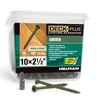 |
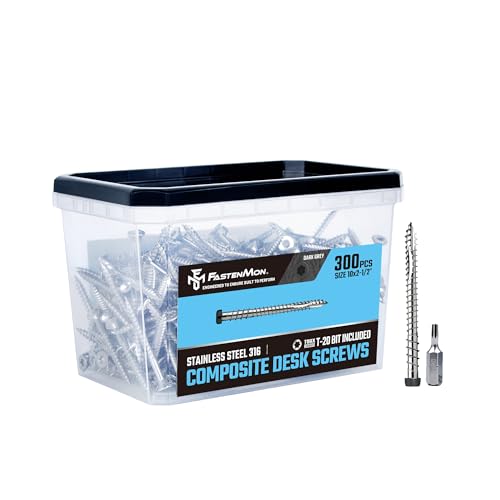
Deck Plus #10 x 2-1/2 in Deck Screws, 365 Pieces – $32.98 A 1 inch thick 5/4 board needs a screw long enough to bite into the joist. At 2-1/2 inches this one leaves 1-1/2 inches in the joist, and two 365-piece boxes cover a 12 x 16 ft deck (math below).
|
As an Amazon Associate we earn from qualifying purchases.
| Nominal size | Actual size (in) | Actual size (mm) | Note |
|---|---|---|---|
| 5/4 x 4 | 1 x 3-1/2 | 25.4 x 88.9 | Narrow boards, stair risers, trim |
| 5/4 x 6 | 1 x 5-1/2 | 25.4 x 139.7 | The standard deck board |
| 5/4 x 8 | 1 x 7-1/4 | 25.4 x 184.2 | Less common for decking |
| 2 x 6 | 1-1/2 x 5-1/2 | 38.1 x 139.7 | Heavier decking, 24 in joist spacing |
| Trex Enhance 1 in composite | 0.94 x 5.5 | 23.9 x 139.7 | Composite, not wood: slightly thinner |
The wood sizes follow the American Softwood Lumber Standard (PS 20-15, published by NIST). Its Table 3 lists a 1-1/4 inch nominal board as a minimum 1 inch dressed thickness when dry (1-1/32 inch when still green), and its widths for 4, 6 and 8 inch nominal boards are 3-1/2, 5-1/2 and 7-1/4 inches dry. These are minimums, so a tape measure can read a hair over on an individual board, but never under. The composite row comes from the manufacturer: Trex lists its 1 inch Enhance board at .94 x 5.5 inches.
Why a 5/4 Board Is Not 1.25 Inches Thick (The Math)
Five-quarters means 5 x 1/4 = 1.25 inches. That is the thickness the board is cut at in the mill. Drying and surfacing both sides takes it down to 1 inch, so you lose 0.25 inch, which is 0.25 / 1.25 = 20% of the nominal thickness. The width loses 6 – 5.5 = 0.5 inch, or 0.5 / 6 = 8.3%.
| Measurement | Nominal 5/4 x 6 | Actual 5/4 x 6 | Difference |
|---|---|---|---|
| Thickness | 1.25 in | 1.00 in | -0.25 in (20%) |
| Width | 6.00 in | 5.50 in | -0.50 in (8.3%) |
| Cross-section | 1.25 x 6 = 7.5 sq in | 1.00 x 5.5 = 5.5 sq in | -2.0 sq in (26.7%) |
So a real 5/4×6 has about 27% less wood in its cross-section than the name suggests. For comparison, a 2×6 (1.5 x 5.5 = 8.25 sq in) has 50% more material than the 5/4. For other lumber sizes see our nominal vs actual lumber size chart, and for a 2x lumber price breakdown see the 2×4 cost guide.
One myth to clear up: “5/4” is not “5 by 4 inches” and it is not 5 feet 4 inches. It is only a thickness, read as “five-quarter”, and it is always followed by a width: 5/4×6 means 5/4 thick by 6 inches wide (nominal). If you price it by the board foot, as many lumber yards do for hardwood, the nominal size is used: 1.25 x 6 x 16 ft / 12 = 10 board feet for a 16 ft 5/4×6.
5/4 vs 6/4 vs 2x Decking: How Much Thickness You Actually Get
Every thickness loses material between the nominal name and the finished board, but not by the same amount. PS 20 Table 3 gives a 1-1/2 inch nominal (6/4) board a minimum dry thickness of 1-1/4 inches, and a 2 inch thick board is sold at 1-1/2 inches.
| Decking thickness | Nominal | Actual (dry) | Thickness lost |
|---|---|---|---|
| 5/4 | 1.25 in | 1.00 in | 0.25 in (20%) |
| 6/4 | 1.50 in | 1.25 in | 0.25 in (16.7%) |
| 2x | 2.00 in | 1.50 in | 0.50 in (25%) |
Notice that 5/4 and 6/4 both lose a flat quarter inch. A 6/4 board is only 0.25 inch thicker than a 5/4, and the joist-spacing table in the next section lists only 1-1/4 inch and 2 inch decking, so 6/4 is not covered by it. If your deck frame is already built at 24 inches on center, the code table points you to 2x decking rather than 5/4.
How Many 5/4×6 Boards Cover a 12 x 16 ft Deck
Because each board is 5-1/2 inches wide, not 6, you need more boards than a 6 inch assumption gives. Each board plus its gap covers 5.5 + gap inches. Take a 12 ft (144 inch) wide deck with boards running the 16 ft length:
| Gap between boards | Coverage per board | Boards across 144 in | Linear feet per 100 sq ft |
|---|---|---|---|
| 1/8 in (0.125) | 5.625 in | (144 + 0.125) / 5.625 = 25.6, so 26 | 12 / 5.625 x 100 = 213 |
| 3/16 in (0.1875) | 5.6875 in | (144 + 0.1875) / 5.6875 = 25.4, so 26 | 12 / 5.6875 x 100 = 211 |
| No gap | 5.5 in | 144 / 5.5 = 26.2, so 27 | 12 / 5.5 x 100 = 218 |
For the 12 x 16 ft deck that is 26 boards x 16 ft = 416 linear feet. Add 10% for cutoffs and bad boards: 416 x 1.10 = 457.6 ft, which is 28.6, so buy 29 boards of 16 ft. If your yard stocks other lengths, see our guide to long deck boards and the 12 ft 5/4 board build for how those lengths work in practice.
Joist Spacing for 5/4 Decking (IRC Table R507.7)
Thickness decides how far a deck board can span. The 2021 International Residential Code, Table R507.7, sets the maximum on-center joist spacing for wood decking:
| Decking | Perpendicular, single span | Perpendicular, multiple span | Diagonal, single span | Diagonal, multiple span |
|---|---|---|---|---|
| 1-1/4 in thick wood (5/4) | 12 in | 16 in | 8 in | 12 in |
| 2 in thick wood (2x) | 24 in | 24 in | 18 in | 24 in |
The practical reading: a 5/4 board laid straight across standard 16 inch joists is allowed only in the multiple-span case, and a diagonal pattern needs joists at 12 inches or closer. If you want to frame at 24 inches, use 2x decking instead. The same table requires each board to be fastened to every joist with at least two 8d threaded nails or two No. 8 wood screws. Local codes can differ, so confirm with your building department.
Screws for a 1 Inch Thick Board
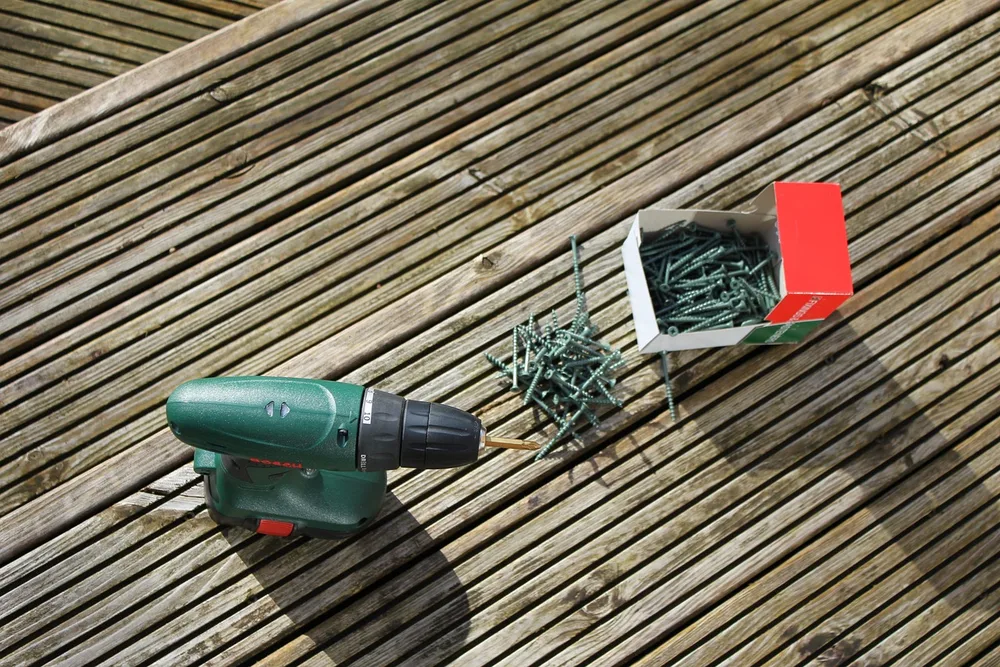
The 1 inch actual thickness drives screw length. A 2-1/2 inch screw through a 1 inch board leaves 2.5 – 1.0 = 1.5 inches in the joist. A 1 inch screw would not even pass through the board, which is why the 1-inch deck screws article explains what those are really for. If you are weighing deck screws against general wood screws, see deck screws vs wood screws.
Quantity for the 12 x 16 ft example: 16 ft of joist run at 16 inches on center is 192 / 16 + 1 = 13 joists. With 26 boards and two screws per joist, that is 26 x 13 x 2 = 676 screws. A 365-piece box is not enough, but two boxes (730) cover it with a few spares.
Composite 5/4 Boards Are Not the Same Size
Composite boards sold as “1 inch” can be a little thinner than wood. Trex lists its Enhance board at .94 inch thick, versus a 1 inch minimum for dry 5/4 lumber. Composite also has its own joist spacing, fastener and gap rules from the manufacturer, covered in our Trex fastener guide. Allow for the thickness difference if you ever meet wood and composite boards at a transition.
After You Build: Protecting the Boards
Once the boards are down, pressure-treated 5/4 decking needs sealing after it dries. Our pressure-treated deck sealing guide covers timing and product choice, and the DIY wood deck build guide walks through the full framing and decking sequence.
Frequently Asked Questions
What is the actual size of a 5/4×6 deck board?
A 5/4×6 deck board is 1 inch thick by 5-1/2 inches wide (25.4 x 139.7 mm). PS 20 sets 1 inch as the minimum dry dressed thickness for a 1-1/4 inch nominal board and 5-1/2 inches for a 6 inch nominal width.
Is 5/4 decking really 1.25 inches thick?
No. 5/4 means five-quarters of an inch, or 1.25 inches, but that is the rough nominal thickness. After drying and planing the board is 1 inch thick, which is 20% thinner than the name suggests.
How many 5/4×6 boards cover a 12×16 ft deck?
With boards running the 16 ft length and a 3/16 inch gap, each board covers 5.6875 inches, so a 144 inch wide deck takes 26 boards (416 linear feet). Adding 10% for waste gives 457.6 feet, or 29 boards of 16 ft.
What joist spacing does 5/4 decking need?
Under IRC Table R507.7, 1-1/4 inch thick wood decking can be laid perpendicular on joists up to 16 inches on center for multiple spans and 12 inches for a single span, or diagonally on joists up to 12 inches on center for multiple spans. 2 inch decking allows 24 inches.
Sources
- NIST, American Softwood Lumber Standard PS 20-15, Table 3 (boards, dimension and timbers) and Table 1
- Anne Arundel County deck construction guide, reproducing 2021 IRC Table R507.7 (maximum joist spacing for wood decking)
- Trex Enhance product specifications (.94 x 5.5 inch actual dimensions)
Sponsored / affiliate links. As an Amazon Associate I earn from qualifying purchases. I may earn additional commission from eligible campaigns.