How Much Does Redwood Lumber Cost Per Board Foot?
Redwood lumber usually costs about $6 to $20 per board foot, with common decking and fence grades often landing near $8 to $14 depending on grade, thickness, and supplier. If you guess wrong, you can overspend fast or come up short on a deck or fence order. This guide breaks down redwood board-foot pricing and shows how to convert yard quotes into real totals for common sizes and grades.
Redwood lumber prices at a glance
Redwood sits in the upper-middle to premium outdoor lumber tier. A common decking price table lists redwood at $8 to $15 per board foot, western red cedar at $3.50 to $6.50, pressure-treated pine at $1.50 to $3.50, Douglas fir at $3 to $5.50, and ipe at $15 to $25. Your local yard can price above or below those bands.
New-growth versus old-growth pricing
Old-growth redwood usually costs more than new-growth redwood because older stock is scarcer and often selected for tighter grain and a cleaner look. For a buyer, that often means paying more for clearer boards, fewer defects, and a more even appearance. New-growth material is usually the lower-cost choice for outdoor work when appearance is not the main goal.
Where redwood sits beside cedar and pine
Western red cedar is the closest comparison for many deck and fence buyers. It is also a premium outdoor wood, but its listed price range is lower than redwood, and it is known for weathering to a consistent silver-grey. Pressure-treated pine is the budget benchmark, while Douglas fir is mainly a framing benchmark rather than a finish-decking comparison.
A common first-timer mistake is comparing redwood board-foot pricing to a big-box store sticker without checking whether the store is quoting per piece. That can make one quote look cheaper until you convert it to the same unit.
What is a board foot?
A board foot is a volume unit for lumber. The standard formula is thickness × width × length ÷ 12 when dimensions are in inches and length is in feet. One board foot equals 144 cubic inches of wood, so the number helps you compare lumber by volume instead of by piece count.
Nominal dimensions versus actual dimensions
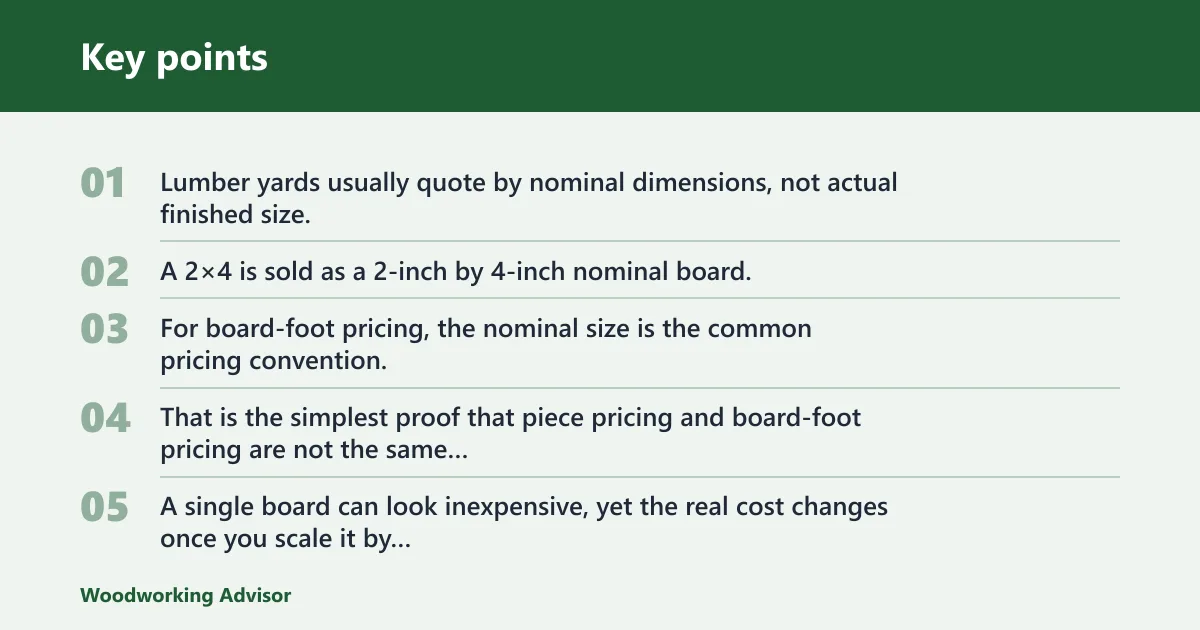
Lumber yards usually quote by nominal dimensions, not actual finished size. A 2×4 is sold as a 2-inch by 4-inch nominal board, even though its actual size is smaller after milling. For board-foot pricing, the nominal size is the common pricing convention, which is why the formula and the yard quote need the same basis.
A 2×4×8 board equals 5.33 board feet. That is the simplest proof that piece pricing and board-foot pricing are not the same thing. A single board can look inexpensive, yet the real cost changes once you scale it by volume and grade.
Why lumber yards use board feet
Lumber yards use board feet because it lets them price boards of different widths, lengths, and thicknesses on a common basis. Many yards also quote in other units, including per 1,000 board feet. Big-box stores may quote by piece, which is easier to read but less useful if you need to compare species or grades line by line.
How much does redwood cost by board size?
For planning, use the board-foot formula first, then multiply by a local redwood price. Common redwood sizes can be compared cleanly that way: a 1×6 board, a 2×4, a 2×6, and a 5/4 decking board all convert to board feet before you estimate the bill. Local quotes can still move the total.
How to read the cost table
The table below uses three redwood price bands so you can sanity-check a quote before you buy. The low band is $8 per board foot, the mid band is $11.50, and the high band is $15. If your quote lands far outside those figures, ask the yard to restate the basis and grade.
| Board size | Board feet | Low band at $8/bf | Mid band at $11.50/bf | High band at $15/bf |
|---|---|---|---|---|
| 1×6×8 | 4.00 | $32.00 | $46.00 | $60.00 |
| 1×6×12 | 6.00 | $48.00 | $69.00 | $90.00 |
| 2×4×8 | 5.33 | $42.64 | $61.30 | $79.95 |
| 2×6×8 | 8.00 | $64.00 | $92.00 | $120.00 |
| 5/4×6×8 | 5.00 | $40.00 | $57.50 | $75.00 |
| 5/4×6×12 | 7.50 | $60.00 | $86.25 | $112.50 |
Say your yard quotes 5/4×6 decking at $12 per board foot and you need twelve 12-foot boards. The math is 7.5 board feet per board × 12 boards = 90 board feet, then 90 × $12 = $1,080 before tax and waste. That is the kind of calculation that keeps a quote honest.
Redwood pricing sanity-check table
Use this table to verify the yard’s line items against the board-foot calculation. The numbers below are not a local quote; they are example totals built from the formula so you can check the math. If the yard uses a different grade or a special stock length, the total can move.
| Common size | Formula result | Example board-foot note | Low total | Mid total | High total |
|---|---|---|---|---|---|
| 1×6×8 | 1 × 6 × 8 ÷ 12 | 4.00 board feet | $32.00 | $46.00 | $60.00 |
| 2×4×8 | 2 × 4 × 8 ÷ 12 | 5.33 board feet | $42.64 | $61.30 | $79.95 |
| 2×6×8 | 2 × 6 × 8 ÷ 12 | 8.00 board feet | $64.00 | $92.00 | $120.00 |
| 5/4×6×12 | 1.25 × 6 × 12 ÷ 12 | 7.50 board feet | $60.00 | $86.25 | $112.50 |
Quote line items to verify
- Check the species name. It should say redwood, not a generic “cedar-like” outdoor board.
- Check the grade. Clearer grades cost more than common construction grades.
- Check the unit price. Confirm whether the yard is quoting per board foot or per piece.
- Check the nominal dimensions and length. A longer or wider board adds board feet fast.
- Check whether the quote includes waste, sorting, trim loss, or special handling.
Why does redwood cost more than cedar?
Redwood often costs more than western red cedar because it is priced in a different supply tier and is frequently selected for a narrower visual target. Cedar is also a premium outdoor wood, but its listed board-foot range is lower. In practical terms, redwood usually asks for more money per volume than cedar does.
Outdoor-use value and appearance
Both woods are common outdoor choices for decks and fences because buyers want appearance and weather resistance, not just low purchase price. Western red cedar is often chosen for its predictable weathering to a consistent silver-grey. Redwood is often chosen for its color, straight grain, and appearance in visible work.
Suppose you are choosing between a front-yard fence in redwood and one in pressure-treated pine. The pine may cost less up front, but the material price is only one part of the decision. If the fence is highly visible, redwood’s higher board-foot price may be easier to justify than in a hidden side yard.
Where western red cedar fits as a benchmark
Cedar is the cleanest benchmark for a redwood buyer because the use case is often the same. Cedar at $3.50 to $6.50 per board foot is lower than redwood’s $8 to $15 band, so a yard quote for redwood should be clearly higher before you compare finish, grade, and stock length.
What changes redwood lumber prices at the yard?

Grade, size, and source move redwood prices the most. A yard may charge more for clear or appearance-grade stock, for wider boards, for long lengths, or for better-matched material. Regional supply matters too, because freight, inventory depth, and mill source all affect what reaches the rack.
Grade and appearance
The cheapest redwood for outdoor projects is usually the lower appearance grade that still meets the job. For decking, fencing, and general exterior trim, buyers often start with standard or common grades before moving up to clearer stock. Higher grades cost more because fewer boards qualify and more are rejected for knots or color variation.
Thickness, width, and length
Thickness and width both raise the board-foot count, so bigger pieces cost more even before the grade premium is added. Length matters too. A 12-foot board contains more volume than an 8-foot board of the same nominal size, which means the yard’s total rises even when the unit price stays the same.
Region, supply, and mill source
Redwood pricing varies by region and grade, which is why local quotes matter. A nearby mill, a yard with strong stock on hand, or a shortage in a specific length can move the number quickly. If a quote looks unusually low, confirm whether it is second-growth, a lower grade, or a short-length special.
How much does old-growth redwood cost compared to new-growth? Old-growth usually costs more because it is harder to source and often carries a clearer, more desirable look. New-growth is the better budget route for most outdoor framing, fencing, and decking jobs where the board only needs to perform well, not look archival.
How do you estimate waste and order enough?
Add 10% for typical projects where you are cutting stock to fit, and use 15% for more complex cuts or mixed-length orders. That buffer covers trim loss, defects, sorting, and the odd board that is too short, cupped, or scarred for a visible run. Waste becomes expensive when redwood is priced by volume.
Board feet versus linear feet
Board feet measure volume. Linear feet measure length. A lumber calculator can convert both, but only if you enter the board-foot price and the board dimensions correctly. If you know you need 60 linear feet of 1×6 decking, you still need the width and thickness before you can price the order.
For example, a 1×6×12 board gives you 12 linear feet but 6 board feet. That gap matters. Linear feet help you plan coverage, while board feet help you price the lumber itself.
Using a lumber calculator before you buy
A lumber calculator is useful when you are comparing yard quotes, because it can turn board feet into total cost and can also convert a list of board sizes into a total volume. Start with the nominal dimensions, enter the length, then add your waste allowance before you compare suppliers.
Is redwood worth it for decks and fencing?
Redwood is worth it when you want a premium outdoor look and are willing to pay more than pressure-treated pine for the material. It is also a common choice when the project is visible enough that color, grain, and finish matter. For hidden structure or pure budget work, treated pine usually stays cheaper.
Material-only cost versus installed cost
Do not mix the board-foot price with installed pricing unless you label the difference clearly. Material-only redwood is one number; installed deck cost is another. A redwood deck installation is shown at $25 to $50 per square foot installed, compared with $20 to $38 for cedar and $15 to $25 for pressure-treated pine. Those totals include labor and other project costs.
Material-only redwood can make sense even when installed redwood is a stretch. If the deck is small, fence boards are the main cost, and you are doing the labor yourself, the lumber price may be the part that decides the project.
Frequently asked questions
How much does redwood lumber cost per board foot?
Redwood lumber commonly lists at $8 to $15 per board foot in decking price tables, though local quotes can run outside that band. Grade, length, thickness, and region all matter. For a quick buying check, use the yard’s unit price, then multiply it by the board-foot total for each size.
What grade of redwood is cheapest for outdoor projects?
The cheapest redwood for outdoor projects is usually the lower appearance or common grade that still works for exterior use. Those boards are less selective on color and knot count, so they cost less than clear stock. If the project is a fence, utility deck edge, or hidden trim, lower grade often makes sense.
How much of old-growth redwood costs compared to new-growth?
Old-growth redwood usually costs more than new-growth redwood because it is scarcer and often sold in better-looking stock. The exact gap depends on the yard and the grade, but buyers should expect old-growth to sit above standard new-growth pricing. Ask the yard which stock they are quoting before comparing totals.
How do I calculate board feet for redwood boards?
Use thickness × width × length ÷ 12, with dimensions in inches and length in feet. For a nominal 2×4×8, the result is 5.33 board feet. For pricing, use nominal dimensions unless the yard specifically tells you to use actual dimensions for a special stock line.
What is the difference between board feet and linear feet?
Linear feet measure length only. Board feet measure volume. A 12-foot redwood board can have the same linear feet as another board, yet a very different board-foot total if the thickness or width changes. Use linear feet for layout and board feet for pricing and quote checks.
How much extra redwood should I buy for waste?
Add 10% for a typical cut list and 15% for more complex work, sorting, or defect allowance. That buffer helps cover trim loss and boards that are not suitable after you inspect them. If the order uses many short pieces or odd angles, the higher buffer is safer.
Sponsored / affiliate links. As an Amazon Associate I earn from qualifying purchases. I may earn additional commission from eligible campaigns.