Seasoned Firewood Left in the Rain: Is It Ruined?
Seasoned firewood that gets rained on is usually still usable if only the outer layer got wet; if the inside stays damp after a few dry days, stack it to dry again or set it aside. Left alone, wet wood can raise stack moisture, invite mold, and weaken your best supply. This guide shows how to judge surface wetness, tell when more drying is needed, and remove bad pieces before they spread problems.
Short answer: is it ruined?
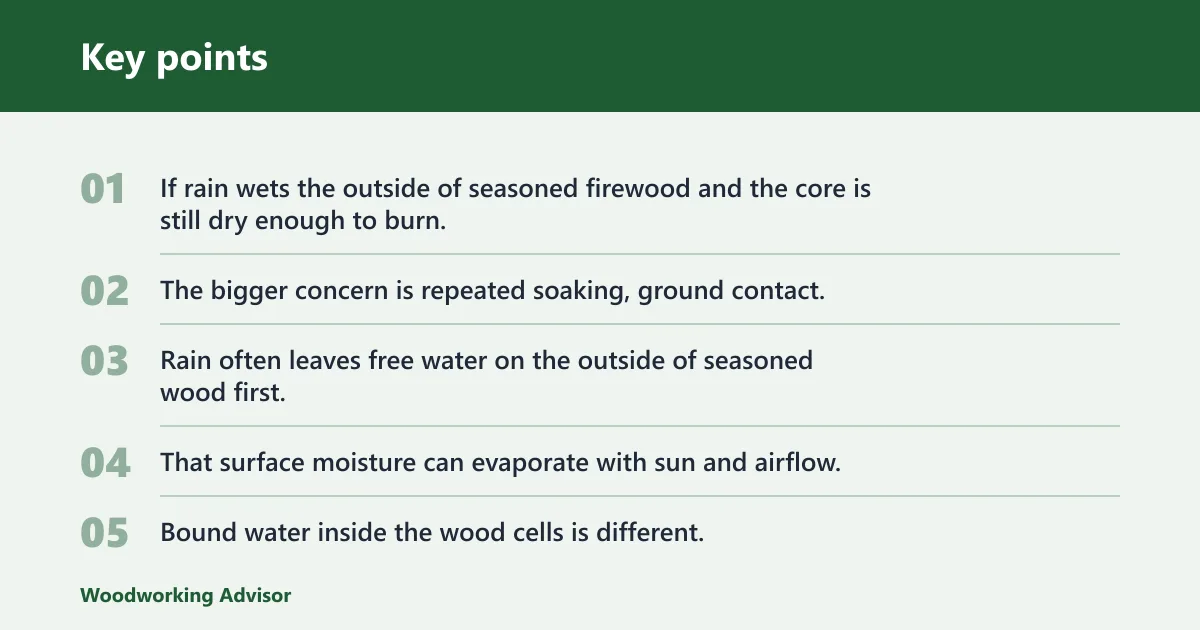


Usually, no. If rain wets the outside of seasoned firewood and the core is still dry enough to burn, it is not ruined. The bigger concern is repeated soaking, ground contact, or a stack that stays damp long enough for decay to start. Short wetting is annoying. Persistent wetting changes the decision.
Surface wetness versus core moisture
Rain often leaves free water on the outside of seasoned wood first. That surface moisture can evaporate with sun and airflow. Bound water inside the wood cells is different. It takes much longer to leave and is the problem when wood is still too wet to burn cleanly.
Seasoned firewood is typically dried to about 15% to 20% moisture content. Properly dried firewood should measure 20% moisture content or less, and that is the practical cutoff for burn readiness. If the core is still above that range, the piece may still need more drying even if the outside feels dry.
When rain is annoying, not fatal
Rain is usually a surface problem when the stack has open sides, elevated storage, and a top cover. Seasoned firewood can get wet without becoming unusable. Properly seasoned firewood can be left outside with rain and still burn after drying.
Suppose a stack gets a brief summer shower and the top layer is damp for a day. That is usually a dry-back problem, not a loss problem. If the same pile sits through repeated rain or snowmelt, the odds shift toward deeper wetting and more risk in the lower layers.
When to stop calling it seasoned
If a piece stays damp inside after several dry days, it may no longer behave like dependable seasoned fuel. At that point, treat it as wood that needs more drying, or remove it if rot has started. Constant contact with moisture can cause wood to start rotting rather than dry out.
Seasoned firewood moisture basics
Seasoned wood is not the same as dry-as-a-bone wood. It usually sits in the 15% to 20% range, which is dry enough for efficient burning but still able to pick up moisture on the surface after rain. A dry core matters more than a wet shell.
Free water and bound water
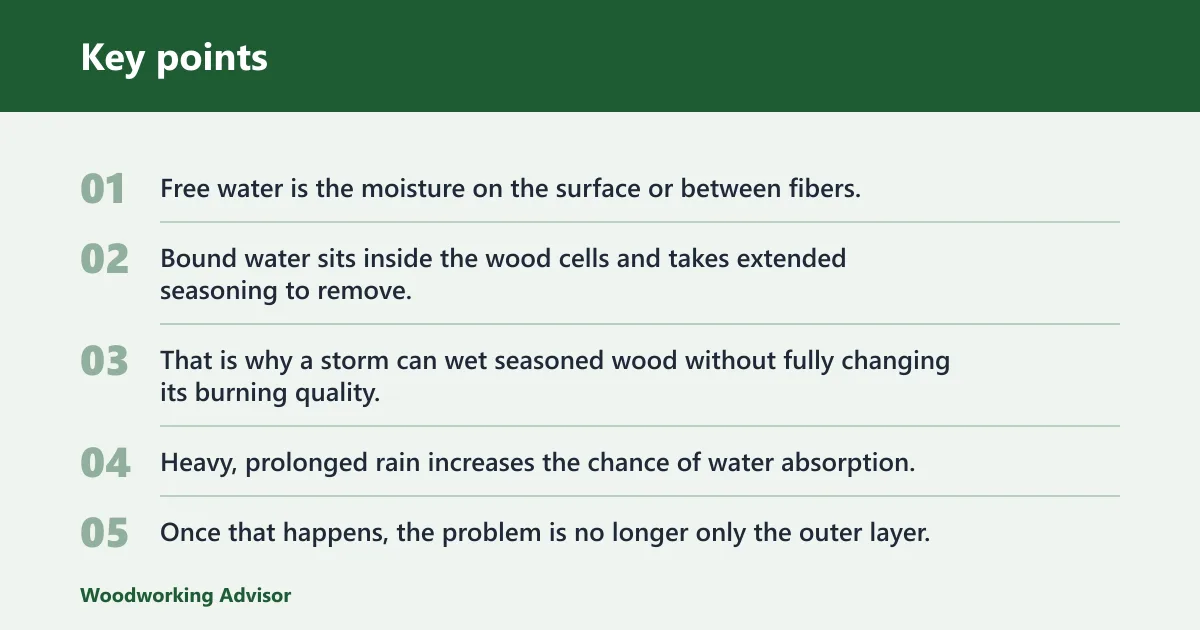
Free water is the moisture on the surface or between fibers. It can leave with sun and airflow. Bound water sits inside the wood cells and takes extended seasoning to remove. That is why a storm can wet seasoned wood without fully changing its burning quality.
Heavy, prolonged rain increases the chance of water absorption. Once that happens, the problem is no longer only the outer layer. Wetting can move inward, especially at end grain, checks, and any piece tucked into a soggy lower row.
Why a dry core matters more than a wet shell
A dry core lights more easily and burns hotter. A wet shell slows ignition, but if the interior stays near the burn-ready range, the piece can still be useful after a short re-dry. That is why the correct question is not “Did it get wet?” but “How wet is the inside now?”
| Exposure scenario | Likely condition | Action |
|---|---|---|
| Light rain | Outer surface damp; core often unchanged | Leave in open air, then recheck after drying |
| All-day rain | Outer layers soaked; some pieces may absorb moisture deeper | Move to better airflow and test a split face before burning |
| Several wet days | Higher chance of deeper wetting and slow drying | Re-dry for a few days to a week, then meter-test again |
| Snowmelt | Surface wetting plus cold, slow evaporation | Separate the driest pieces and allow extra airflow and sun |
| Bottom-layer ground contact | Higher moisture, possible decay in the lowest rows | Remove from the stack, keep off the ground, and inspect closely |
| Visible rot or mold | Decay present; may spread to nearby pieces | Discard or isolate the affected wood |
How to check firewood with a moisture meter
Use a moisture meter on a freshly split face, not on bark or end grain alone. A representative split log gives the best reading because it shows the interior condition that matters for burning. If the meter reads 20% moisture content or less, the wood is generally ready for efficient burning.
Split a representative log first
Choose a piece from the part of the stack you plan to burn next. Split it, then test the newly exposed face. Do not rely on the outside skin, because rain can leave the shell damp while the center remains dry enough to burn well.
Where to place the meter probes
Press the probes into the freshly split face, preferably across the grain and into the interior wood. Avoid measuring only bark, cracked ends, or a patch that was exposed to sun for a few minutes while the rest stayed damp. That can give a reading that looks better than the actual core.
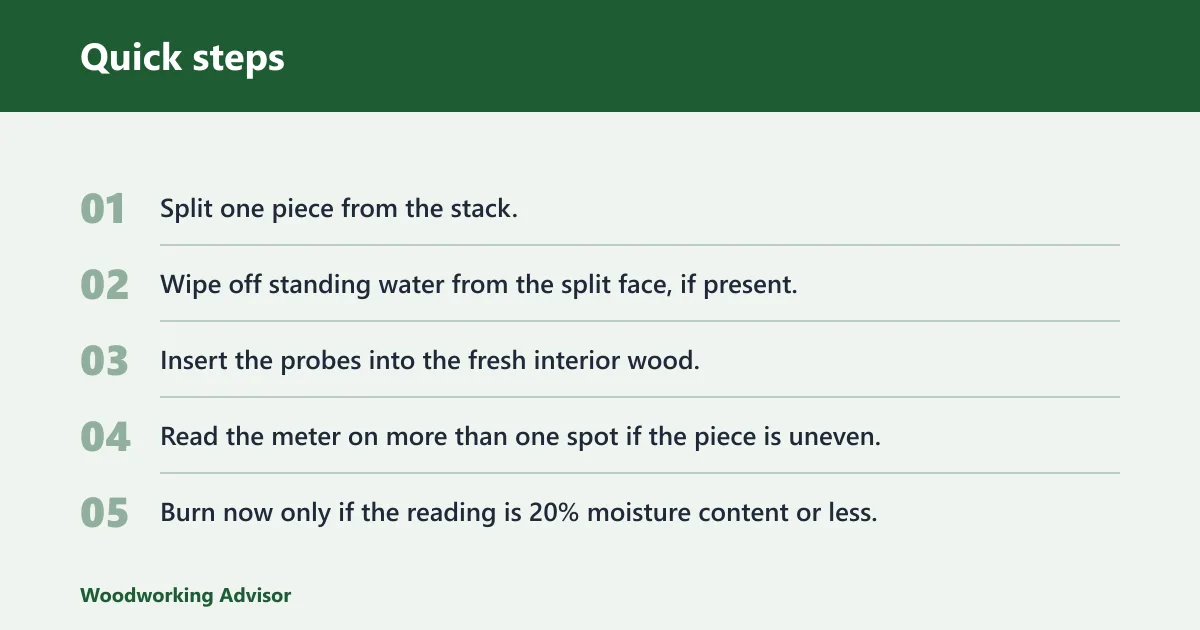
- Split one piece from the stack.
- Wipe off standing water from the split face, if present.
- Insert the probes into the fresh interior wood.
- Read the meter on more than one spot if the piece is uneven.
- Burn now only if the reading is 20% moisture content or less.
- If the reading is higher, set the piece aside to dry again.
What reading means burn-ready versus not ready
At 20% moisture content or less, the wood is in the range most people use for efficient burning. Above that, expect harder lighting, more smoke, and more wasted heat. A meter reading is more reliable than judging by color, feel, or weight alone.
A common first-timer mistake is assuming a piece is ready because the outside feels dry after an hour in the sun. A freshly split meter check avoids that guesswork. It also catches pieces that were soaked from the bottom of the pile but still look fine on top.
How long does wet seasoned firewood take to dry?
Wet seasoned firewood can take about one sunny day if the rain was brief and the stack has strong airflow. More often, it takes a couple of days to a week to dry out again. The exact time depends on how much water it picked up, how dense the stack is, and whether the pile stays elevated.
What sun and airflow can fix quickly
Sun heats the surface, and airflow carries moisture away. That combination can dry surface wetness fast, especially on split wood with open grain. If the pile is stacked loosely and not sealed on all sides, rainwater and snowmelt are easier to shed.
What repeated soaking slows down
Repeated wetting slows drying because each new rain resets the process. Heavy, prolonged rain increases the chance of water absorption, and a tarp that traps moisture can make matters worse. If moisture gets trapped in a firewood pile, it will rot.
Picture a stack under a tarp with the sides tied shut. The top stays dry, but the lower rows stay damp because air cannot move through the pile. That is a drying failure, not protection. Open sides matter as much as a covered top.
Signs the stack needs more time before burning
If the freshly split center still reads above 20% moisture content, the wood needs more drying. Other warning signs are stubbornly cool ignition, dark steam at the start of the fire, or pieces that hiss and smoke more than expected. Those symptoms usually mean the core still holds too much water.
How should you dry and store the stack now?
Dry the stack with top cover only, open sides, and elevation off the ground. Keep the pile in sun if possible and let air move through it. That is the fastest way to push off free water without trapping it back inside the pile.
Top cover only
A tarp should cover the top of the stack, not fully wrap the pile. A tarp that covers the top while allowing airflow on the sides protects wood from rain. If the tarp seals the sides, it can trap moisture and slow drying.
Keep the pile off the ground
Ground contact encourages moisture absorption and decay. Set the stack on racks, pallets, or boards so the bottom row stays above mud, puddles, and snowmelt. The lowest pieces are the first ones to fail when storage is poor.
Leave the sides open for airflow
Airflow is needed for drying and seasoning. Keep the sides open, even if the top is covered. Tight wrapping blocks that airflow, holds humidity in the pile, and gives the bottom layer more time to absorb water.
Suppose the top row is dry enough to burn but the bottom row feels soft and cool. Pull the lower pieces out first, restack them above ground, and give them time alone. Do not keep mixing damp wood back into a supply that is already ready.
What happens if wet wood stays wet?
If wet wood stays wet, the problem shifts from drying to decay. Bottom layers are the first to rot, mold can spread across nearby pieces, and the whole stack becomes harder to burn cleanly. Damp wood also burns cooler and smokier, which raises creosote risk in the chimney.
Rot in bottom layers
Ground contact raises the moisture risk in the lowest row. If the base stays wet, the wood starts to soften and lose structure before it dries out. That is where culling matters most, because rot in one corner can move outward through a stack.
Mold and surface decay
Mold on the surface is a warning sign, especially if it comes with a musty smell, soft fibers, or dark patches that do not dry out. Some surface discoloration can be cosmetic, but visible rot is different. Do not keep visibly rotted pieces in the burn pile.
Higher smoke and creosote risk
Damp wood leads to cooler flue gases, greater smoke production, and more creosote. That matters for indoor stoves and inserts, where creosote is a chimney safety concern. If you want cleaner heat, keep the burn supply at or below the 20% moisture content cutoff.
Moisture triage for wet firewood
Use this checklist to decide whether to burn now, re-dry, or discard. The key threshold is simple: if a freshly split face reads 20% moisture content or less, the piece is usually burn-ready. If it reads higher, re-dry it. If it is rotten or moldy, remove it.
- Burn now: fresh split reads 20% moisture content or less, no rot, no mold, no soft spots.
- Re-dry: surface wetness only, or a recent rain with no decay, but the split face reads above 20%.
- Discard or isolate: visible rot, active mold, soft fibers, or wood that sat in ground moisture for a long time.
- Inspect closely: any piece from the bottom layer, especially if the base of the stack stayed wet.
Frequently asked questions
Is seasoned firewood ruined if it gets rained on?
No, not if the rain only wet the outside. Seasoned firewood can get wet without becoming unusable. The real test is the interior: if a freshly split face still reads 20% moisture content or less, it is usually fine after a short re-dry.
Can you burn firewood that got wet in the rain?
Yes, if the core is still dry enough and the wood has dried back to 20% moisture content or less. Do not judge by the outside alone. A freshly split meter reading is the better check, especially after all-day rain or snowmelt.
What happens if firewood stays wet for several days?
Several wet days raise the chance of deeper absorption, mold, and decay, especially in the bottom layers. The stack dries more slowly, and some pieces may stop being good burn stock. If moisture gets trapped in the pile, it can rot rather than recover.
How do you dry firewood after rain?
Move it to a sunny, airy spot, keep it off the ground, and cover only the top of the stack. Leave the sides open so air can move through the pile. If the wood still reads above 20% after drying, give it more time before burning.
Does a tarp keep firewood dry without trapping moisture?
Yes, if it covers only the top and the sides stay open. A tarp that wraps the whole pile can trap moisture and slow drying. The goal is to shed rain from above while preserving airflow through the stack.
Sponsored / affiliate links. As an Amazon Associate I earn from qualifying purchases. I may earn additional commission from eligible campaigns.