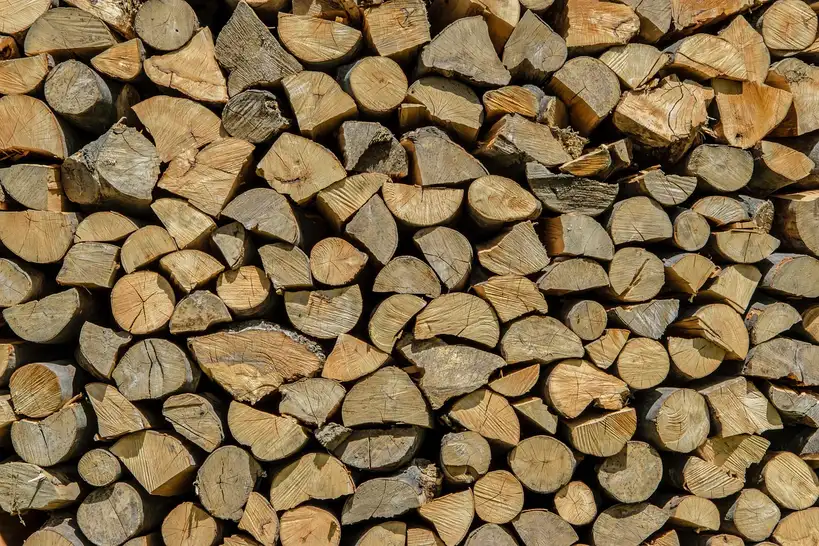
Do You Need a Permit to Cut Firewood?
You need permission before cutting firewood on most public land. Many agencies also require a free or paid firewood permit. On private land, you need the landowner’s okay, and transport may need a load tag or local paperwork. Cutting without the right permission can bring fines, seizure of wood, or a trespass citation. This guide separates private-land rules, public-land permits, and transport requirements so you can check the right rule fast.
Do you need a permit?
The short answer is: sometimes. Private land usually depends on owner permission, while public land often requires a permit from the land manager before you cut or collect anything. The difference between cutting live timber and taking dead and down wood matters too, because those rules are often written separately.
Private land with owner permission
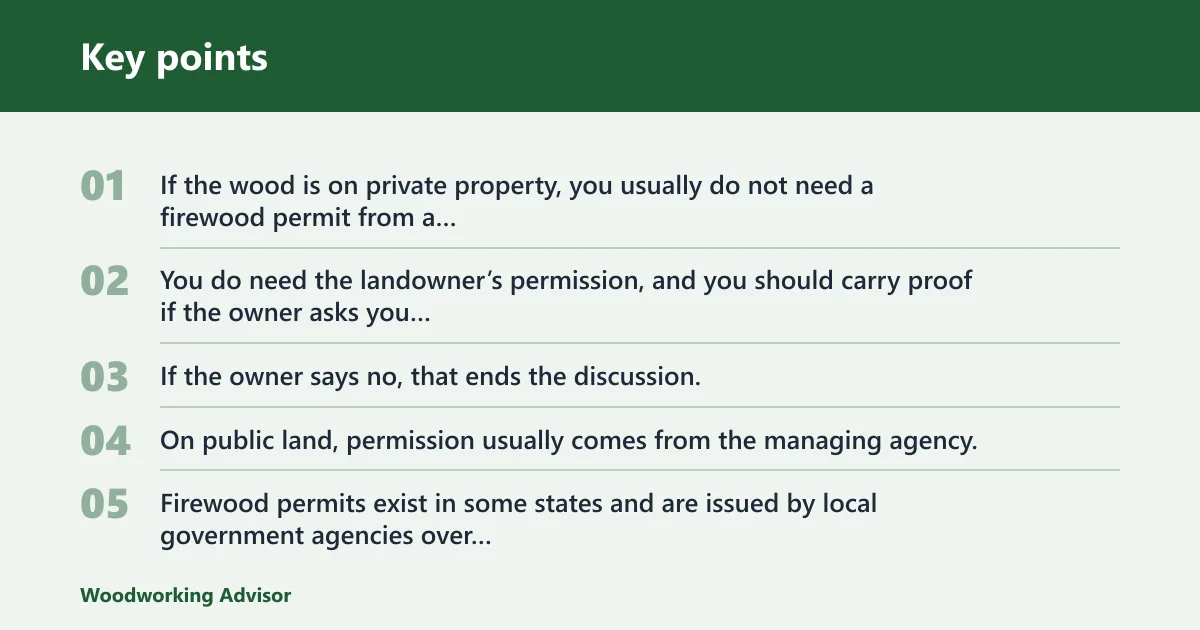
If the wood is on private property, you usually do not need a firewood permit from a government office. You do need the landowner’s permission, and you should carry proof if the owner asks you to show it. If the owner says no, that ends the discussion.
Public land and agency permits
On public land, permission usually comes from the managing agency. Firewood permits exist in some states and are issued by local government agencies over public lands. Michigan agencies mentioned in public guidance include the Department of Natural Resources and USDA Forest Service, but the same basic idea applies elsewhere: check the local office before cutting.
Roadside and deadfall collection
Do not assume that roadside wood, blowdown, or deadfall is free for the taking. Dead and down wood rules can differ from dead standing tree rules, and some areas prohibit collection near roads, trail corridors, or developed sites. A permit or written okay may still be required even when the wood is already on the ground.
Cross-border transport
Cutting rules and hauling rules are separate. Even if you harvested legally, moving firewood across a state or provincial line can trigger quarantine rules, especially for untreated wood. In many places, certified or heat-treated firewood is treated differently from untreated wood, and some lines cannot be crossed with raw firewood at all.
Firewood permit decision checklist
Use this checklist before you cut, collect, or haul. It keeps the permission question tied to the land type first, then the transport rule. That order matters because a legal cut can still become a problem if the wood crosses a restricted boundary later.
| Branch | One-line action step | Likely issuing authority |
|---|---|---|
| Private land with owner permission | Get the owner’s permission in writing if possible, and keep it with you. | Landowner or property manager; no public permit office unless local rules say otherwise. |
| Public land with personal-use permit | Buy or request the permit for the exact cutting area before you cut. | Ranger district, BLM field office, or state forestry office. |
| Roadside or deadfall collection | Confirm whether dead and down wood can be taken and whether roadside collection is allowed. | Local forest authority, ranger district, or state forestry office. |
| Cross-border transport | Check quarantine rules before hauling wood across a state or provincial line. | State agriculture or forestry agency, province, or border-side land manager. |
Private land: ask the owner
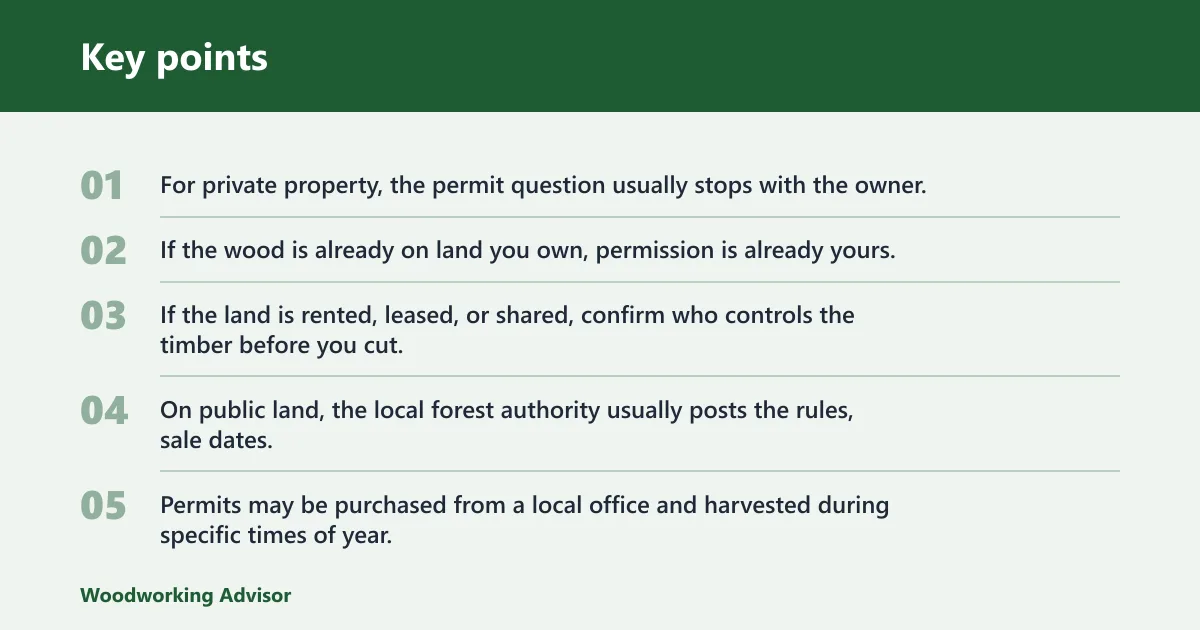
For private property, the permit question usually stops with the owner. If the wood is already on land you own, permission is already yours. If the land is rented, leased, or shared, confirm who controls the timber before you cut.
Public land: check the local office
On public land, the local forest authority usually posts the rules, sale dates, and area limits. Permits may be purchased from a local office and harvested during specific times of year. Some areas set a volume cap in cords and restrict exactly where cutting is allowed.
Deadfall and roadside wood: confirm the rule
Do not confuse “already down” with “free to take.” Some forests allow dead and down wood only, while others restrict all removal except under permit conditions. Roadside wood can also be blocked by safety rules, travel limits, or access closures.
Before hauling: check transport limits
Transport checks come after the cutting check. A load can be legal at the stump and still violate quarantine rules at the county line or state border. That is why many agencies want the permit or load tag carried in the vehicle while you move the wood.
Where permits come
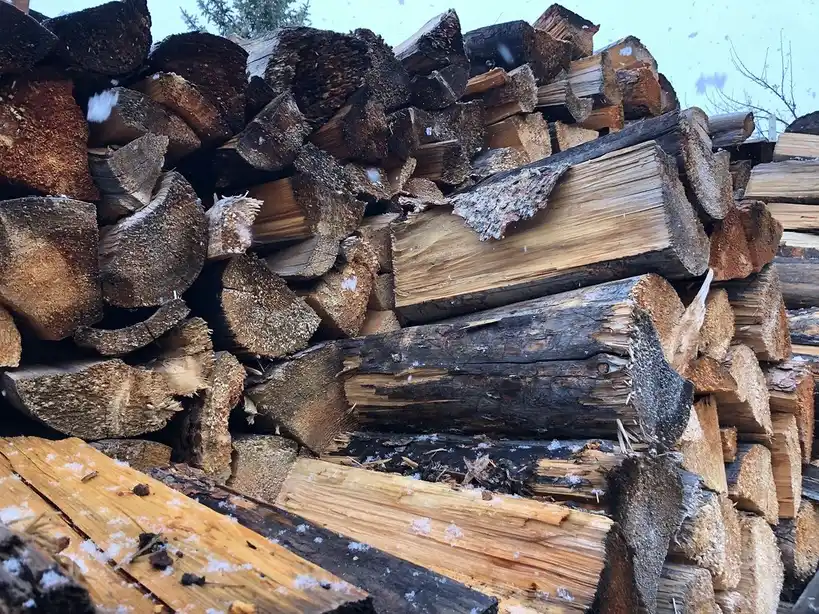
Firewood permits are usually issued by the land manager for the area where you plan to cut. Common issuing offices include ranger districts, BLM field offices, state forestry offices, DNRs, and local forest authority offices or websites. The correct office depends on who controls the land.
Ranger districts and national forests
National forest permits are often handled by a ranger district office. The permit can be tied to a specific cutting area, a season date, and a stated volume limit. You may also need to follow gate rules, road restrictions, and map boundaries printed on the permit. (ECFR)
BLM field offices
On Bureau of Land Management land, the field office is often the place to ask about firewood. Rules can differ by district, and some permits are limited to personal use rather than commercial hauling. Ask which species, size, and collection zone are included.
State forestry offices and DNRs
State forestry offices and departments of natural resources often run local wood sales or firewood permits. Firewood permit types include free personal use, personal use paid, ceremonial, green wood, and commercial permits. Personal use paid permits are not allowed for commercial firewood collection.
Many agencies let you start online and finish in person, or issue the permit at a local office after you pick an area. That office can explain seasonal dates, minimum purchases, road access, and whether load tickets are required. Bring the exact details they ask for, not guesses.
What a permit can require
A permit is usually a rule sheet, not a blank pass. It can name the cutting area, set a limit in cords, mark the season dates, and require load tickets or other proof before wood moves. Some permits also require the permit holder to be present during cutting and hauling.
Area maps and cutting boundaries
Many permits include a map or a written legal description of the cutting zone. Stay inside that area. Leaving the boundary can turn an allowed cut into an unauthorized one, even if the wood type would otherwise be allowed.
Volume limits in cords
A cord of wood measures 4 feet high, 4 feet deep, and 8 feet long, or 128 cubic feet. Agencies often sell or issue wood in cord-based limits, and some areas use quarter-cord or per-cord accounting. One common rule is that the permit tells you the maximum volume you may remove.
Season dates and access limits
Permits can be seasonal. Some are sold only during certain times of year, and some cutting areas close when roads soften, fire danger rises, or habitat protections apply. Access limits can be just as important as the cutting limit.
Load tickets and permit-holder presence
Load tickets are used to document harvested wood, often one per quarter cord or one per cord, and they may need to be attached before the wood moves. Permit holders should carry permits and maps at all times while harvesting firewood. Some agencies also require the permit holder to stay with the load.
Do you need a permit on public land?
Usually, yes. Public land commonly requires a personal-use permit before you cut, even if the wood is dead or already down. The exact answer depends on the land manager, the wood type, and if you are collecting for household use or for sale. Check the local office first.
Dead and down wood rules
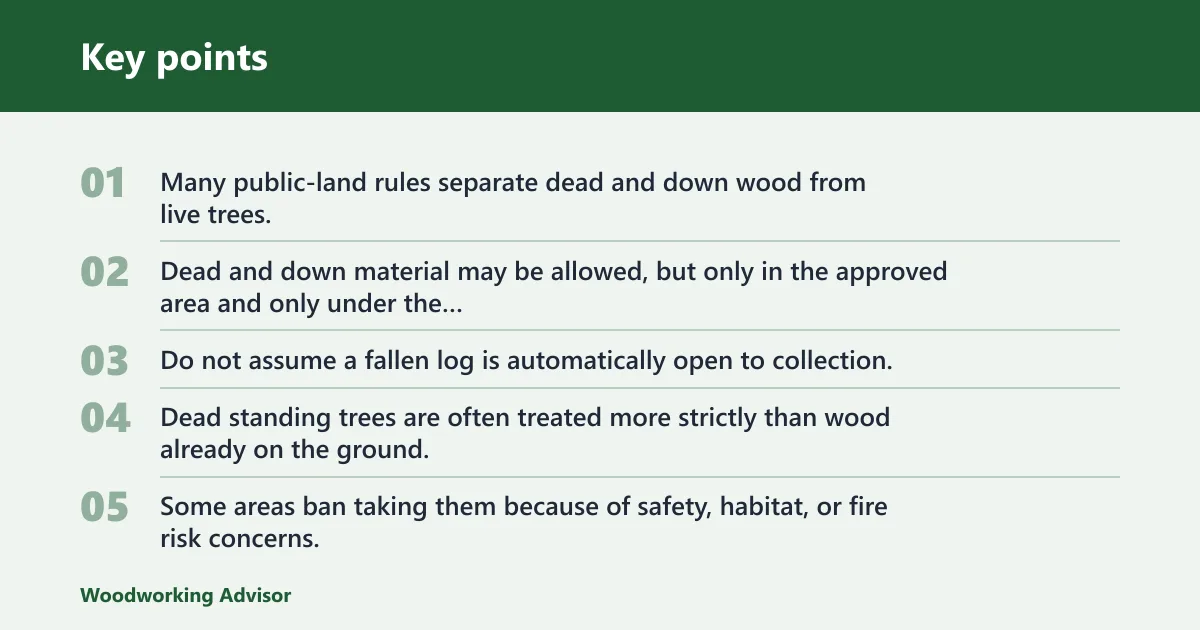
Many public-land rules separate dead and down wood from live trees. Dead and down material may be allowed, but only in the approved area and only under the permit’s conditions. Do not assume a fallen log is automatically open to collection.
Dead standing tree rules
Dead standing trees are often treated more strictly than wood already on the ground. Some areas ban taking them because of safety, habitat, or fire risk concerns. If the permit or site notice does not clearly allow it, leave it standing.
Personal use versus commercial use
Personal use permits are usually for household use only. They are often low cost or free, though some areas set a price or a minimum purchase. Commercial permits are separate and are meant for harvesting wood for profit, resale, or regular business use.
Say your county forest allows a two-cord personal-use permit for dead and down wood only. That permit does not let you take a standing dead oak from the same tract, and it does not turn into a commercial permit just because you plan to sell split wood later.
When collection is not allowed
Collection may be blocked near roads, in campground zones, on closed trails, or in posted no-cut areas. Some agencies also limit travel distance, vehicle type, or the exact species you can remove. If the map does not show the area, do not assume access.
The safest approach is to contact the local forest authority before you cut. Ask which office controls the area, whether the permit is free or paid, what volume limit applies, and if there are seasonal openings. Bring the details they need so the office can place you in the right cutting zone.
- Find the correct local office or website for the land you want to use.
- Confirm whether you need a personal-use or commercial permit.
- Choose the approved cutting area and check the map.
- Bring ID, payment if required, and vehicle details if the office asks for them.
- Keep the permit with you while cutting and hauling.
Bring the right documents
Most offices will want enough detail to match you to the permit and the load. That can include ID, vehicle information, payment, and the cutting area you selected. If the office issues a load ticket, keep it with the permit and attach it before the wood moves.
Ask about minimum purchases and fees
Some permits have a minimum purchase requirement, commonly four cords. Others are free or low cost. MyWild reports personal-use permits can cost $1 to $30 per cord across states, but prices vary by agency and location.
Firewood permit conditions to follow
Read the permit conditions closely. They usually control how the wood is used, where you may cut, and how you may haul it out. The permit is not a general pass to cut any wood in the forest.
Household use only
Personal use firewood permit rules usually limit the wood to household use only. That means the wood is for your own home, not for resale. If you plan to sell it, you need the right commercial permit.
No resale without the right permit
Personal use paid permits are not allowed for commercial firewood collection. If you remove wood under a personal-use permit and then sell it, you can violate the permit terms even if the cut itself was legal. Commercial collection needs a separate permit path.
Follow posted maps and gate rules
Maps, gates, roads, and seasonal closures are part of the permit. If a gate is locked, a route is closed, or a road is marked off-limits, do not bypass it. Those limits are part of the authorization you received.
Watch for minimum purchase requirements
Some agencies require a minimum volume purchase, often four cords. That rule can matter more than the price per cord, especially for a one-time user who only needs a small amount. Ask before you pay.
A common first-timer mistake is buying a permit for the right forest but the wrong unit. Suppose the permit covers Unit 3 and the road ends at Unit 7; a valid tag does not fix a cut made in the wrong zone.
Firewood transport rules
Hauling rules are separate from cutting rules. You can have a legal permit and still break the law by crossing a quarantine boundary with untreated wood. Check both the permit area rules and the transport rule for your route.
State and provincial quarantine limits
The same source says 35 states have a quarantine or certified wood rule on the books, and untreated firewood may be barred from crossing a state line. That means the wood you cut in one place may not be legal to carry into another without the right documentation or treatment.
Certified or heat-treated exceptions
The same source says heat-treated or certified firewood is allowed in many quarantine states. If the source wood is certified or treated, keep the paperwork with the load. The exception usually applies to the material, not to every route or destination.
Why moving wood spreads pests
Moving firewood can spread pests and diseases. That is why many states and provinces tell you to buy it where you burn it. Quarantine rules are aimed at untreated wood that can carry insects or disease organisms from one area to another.
Buy it where you burn it
If you plan to camp, heat a cabin, or stock a local pile, the easiest route is often to source wood near the place of use. That avoids cross-border questions and reduces the chance that the load is stopped or rejected.
Frequently asked questions
Do you need a permit to cut firewood?
On most public land, yes. On private land, no public permit is usually needed if you have the owner’s permission. The exact rule depends on who manages the land, if the wood is dead and down or standing timber, and if you are cutting for household use or resale.
Do you need a permit to collect firewood?
Often, yes on public land. Collecting deadfall is not the same as taking wood from private property, and many forests require a permit even for downed wood. On private land, the owner’s okay is usually the key permission, though local rules can still apply.
Where do I get a permit to cut firewood?
Start with the land manager for the area. That is usually a ranger district, BLM field office, state forestry office, DNR, or local forest authority office or website. They can tell you the approved cutting area, season dates, volume limit, and whether the permit is free or paid.
How do I get a permit to cut firewood?
Find the office that manages the land, choose the approved cutting area, and ask what paperwork is needed. Bring ID, payment if required, and any vehicle details the office requests. Keep the permit and maps with you while cutting, and attach any load ticket before hauling the wood.
Do you need a permit to cut firewood in BC?
British Columbia has its own forestry and transport rules, so do not assume U.S. rules apply. Check the local provincial office or land manager before cutting, and confirm whether the wood can be moved across district or border lines. The safe answer is area-specific, not universal.
Can you move firewood across state lines?
Sometimes, but not always. Quarantine rules can prohibit untreated firewood from crossing a state line, while certified or heat-treated wood may be allowed in many places. Check the source area permit conditions and the destination state’s quarantine rule before you load the truck.
What happens if you cut firewood without a permit?
Possible results include fines, confiscation of the wood, loss of access, or a trespass citation. The exact penalty depends on the jurisdiction and the land manager. If the area requires a permit, cutting first and asking later is a bad bet.
Do I need a permit to cut firewood in Victoria?
Victoria-area rules depend on if you mean Victoria, British Columbia, or another Victoria jurisdiction entirely. Check the local council, provincial, or park authority before cutting. Do not rely on a rule from another province, state, or country for this one.
Sponsored / affiliate links. As an Amazon Associate I earn from qualifying purchases. I may earn additional commission from eligible campaigns.
 DGAGA Wood Burning Paste Wood Burning Gel for Heat Gun Heat Activated Paste for Craft Chalk Paste for Wood Burning Etching Marker Stencil Wood Working Tools and Accessories on Wood,Canvas,Denim 4 OZ
 Wood Burning Paste Wood Burning Gel for Heat Gun with Mini Squeegees Heat Activated Paints for Craft Chalk Paste for Wooden Burner Etching Marker Stencil Woods Working Tools and Accessories on Wooden