Oil Based Deck Stain Temperature: Overnight Low Rules
Use the stain label’s minimum air and surface temperature. Do not start if the overnight low is within about 5°F of that limit or if dew may form before the coating sets. If you ignore that, oil-based deck stain can stay tacky, blush, trap moisture, or fail early. This guide shows how to read the label, check board temperature, and judge overnight dew risk before you stain.
This guide is part of our Cold Weather Wood Finishing: What Works Below 50°F series.
Reading the label minimum against the forecast overnight low
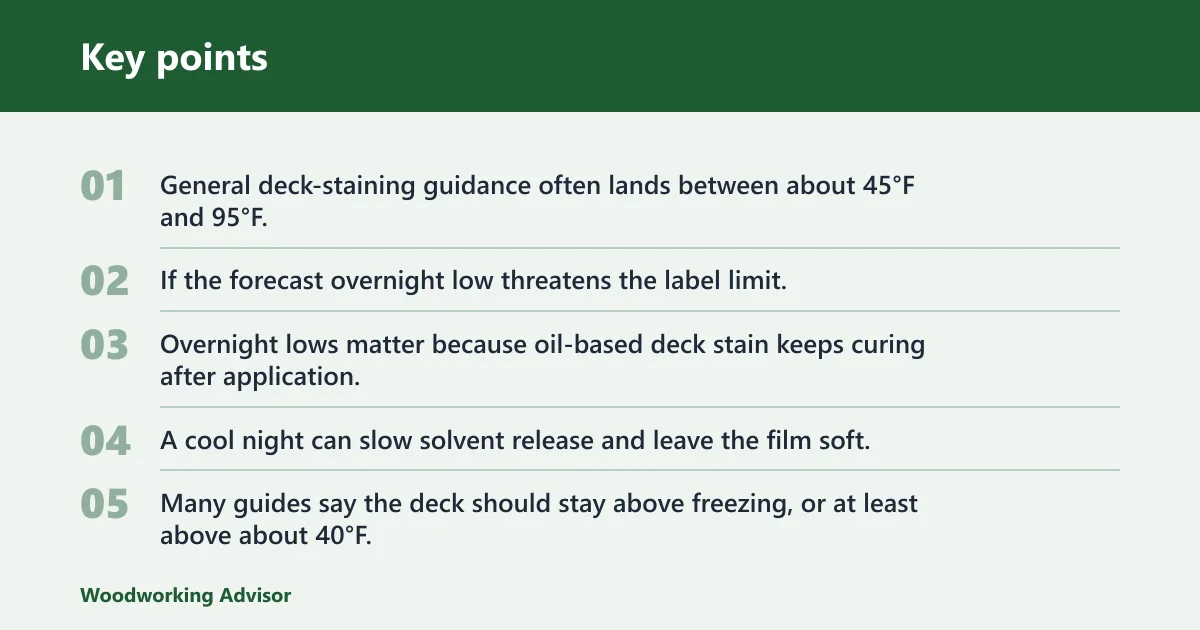


The label comes first. General deck-staining guidance often lands between about 45°F and 95°F, but many products narrow that to 50°F to 90°F, and some require a 60°F minimum. If the forecast overnight low threatens the label limit, treat that as a stop sign unless the product sheet says otherwise.
Overnight lows matter because oil-based deck stain keeps curing after application. A cool night can slow solvent release and leave the film soft. Many guides say the deck should stay above freezing, or at least above about 40°F, for 8 to 12 hours after staining. Many also recommend 24 to 48 hours of warm, dry weather for safer cure.
When a cool night is still acceptable
A cool night can work if the label minimum is met, the wood surface stays in range, and the air stays well above dew risk. The forecast low should clear the minimum by more than a sliver, with enough margin for the deck to dry before nighttime moisture forms.
For many oil-based products, a forecast low in the low 50s is more forgiving than a forecast low near 40°F. That gap matters. It changes how fast the stain penetrates, how long it stays open, and how likely it is to tack up before the night turns damp.
When you should stop and wait
Postpone if the label minimum is higher than the expected overnight low, if the low will sit close to the minimum, or if dew is likely before the stain has set. Also stop if the deck boards are damp, cold, or still shaded and chilled from an earlier rain or dew cycle.
A common first-timer mistake is to trust a mild afternoon and ignore the night that follows. That can leave a sticky surface that holds dirt and footprints, or a weak cure that marks easily at dawn.
What product labels require
Oil-based deck stain is not one fixed formula. One product may allow a low-40s application window, another may call for 50°F to 90°F, and another may require 60°F minimum. If the label is stricter than general advice, the label wins.
Common minimums on oil-based deck stain labels
Many products list a working range around 50°F to 90°F. That range fits the broader professional guidance for wood-surface application, which is also commonly placed around 50°F to 90°F. A more comfortable working zone is about 60°F to 80°F, and experienced contractors often prefer about 70°F to 75°F.
Some labels are tighter than that. If a can says 60°F minimum, do not treat 55°F as close enough just because the forecast sounds mild. Penetrating stains still need time to soak in and cure, and cool wood slows both steps.
Why some products need 60°F minimums
Stricter minimums usually reflect how the formula cures, not just how it applies. Penetrating stain can look fine during the afternoon and still cure poorly if the surface chills too fast at night. That is where soft cure, tackiness, dirt pickup, and dew marking show up.
If the label says 60°F, plan as though 60°F is the floor for both the surface and the forecast, not a suggestion. A small miss can matter more than many DIYers expect.
Why the label can override general weather advice
General weather advice gives a broad safety band. The label gives the product-specific limit. When those conflict, the label controls because it is tied to that exact formula, vehicle, pigment load, and drying behavior. Do not average the numbers together.
Does the deck surface temperature matter more than the air temperature?
Yes, often it does. Air temperature helps, but the board itself is what the stain touches. Sun-exposed boards can run 20–30°F hotter than the air, while shaded boards can stay much cooler than the forecast suggests. That difference can change penetration, open time, and lap-mark risk.
How sun can warm boards above the forecast
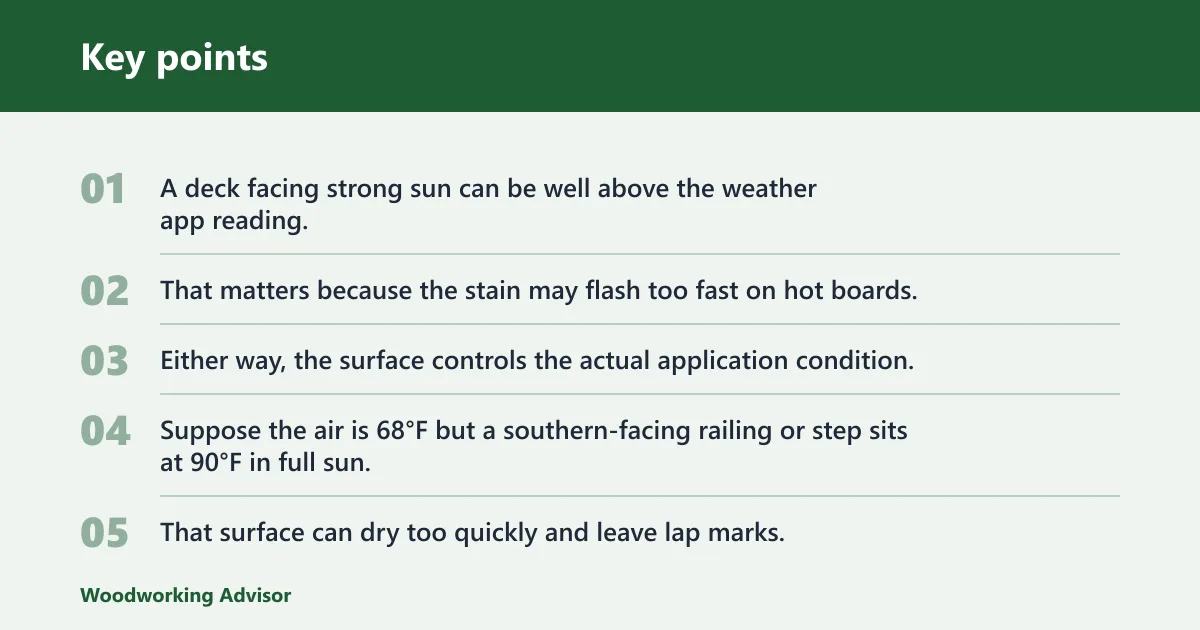
A deck facing strong sun can be well above the weather app reading. That matters because the stain may flash too fast on hot boards, or stay workable longer on a cool shaded section. Either way, the surface controls the actual application condition.
Suppose the air is 68°F but a southern-facing railing or step sits at 90°F in full sun. That surface can dry too quickly and leave lap marks, even though the forecast looks ideal. Flip the situation, and a shaded board can stay near 55°F when the air says 65°F.
How to check board temperature with a thermometer
Use an infrared thermometer for fast spot checks, or a contact surface thermometer for a direct reading. Check several boards: sunny areas, shaded areas, stairs, and rail caps. The board temperature that matters is the coldest spot you plan to stain.
If the deck has mixed exposure, let the coolest board decide the timing. A warm reading on one side does not cancel a cold board on the other.
When surface temperature should decide the call
Surface temperature should override the air forecast when the boards are much hotter or cooler than the surrounding air. That happens most often in direct sun, on dark-colored wood, near walls that trap heat, or after a cool night that leaves the deck boards cold even as the air warms.
Dew point and moisture checks
Dew point matters because it tells you when moisture may condense on the deck. Use it with humidity, not instead of it. If the air temperature gets within about 5°F of the dew point, overnight moisture can become a real risk, and fresh stain can blush, mark, or cure unevenly.
How dew point affects overnight drying
Oil-based deck stain needs time to set before nighttime moisture lands on it. If the air cools toward the dew point before the coating firms up, dew can form on the stain or the wood surface. That can leave a dull film, marks from water droplets, or a slower cure.
How humidity changes the risk
Humidity does not give you a simple yes or no answer. High humidity with a falling temperature raises dew risk. Moderate humidity with a wider gap between air temperature and dew point is safer. Check both numbers together before you start.
Do not treat a dry afternoon as proof that the night will stay dry. The air can cool quickly after sunset, and a deck that looked fine at 4 p.m. can be wet by dawn.
How to check wood moisture content before staining
Use a pin moisture meter and aim for roughly 12% to 15% moisture content before staining. That check matters because wet wood absorbs stain poorly and can lead to peeling or blotchy cure. Do not rely on appearance alone if the deck was recently washed or rained on.
Use the meter on multiple boards and in more than one area. Readings can vary between sun and shade, between edge boards and field boards, and near knots or end grain.
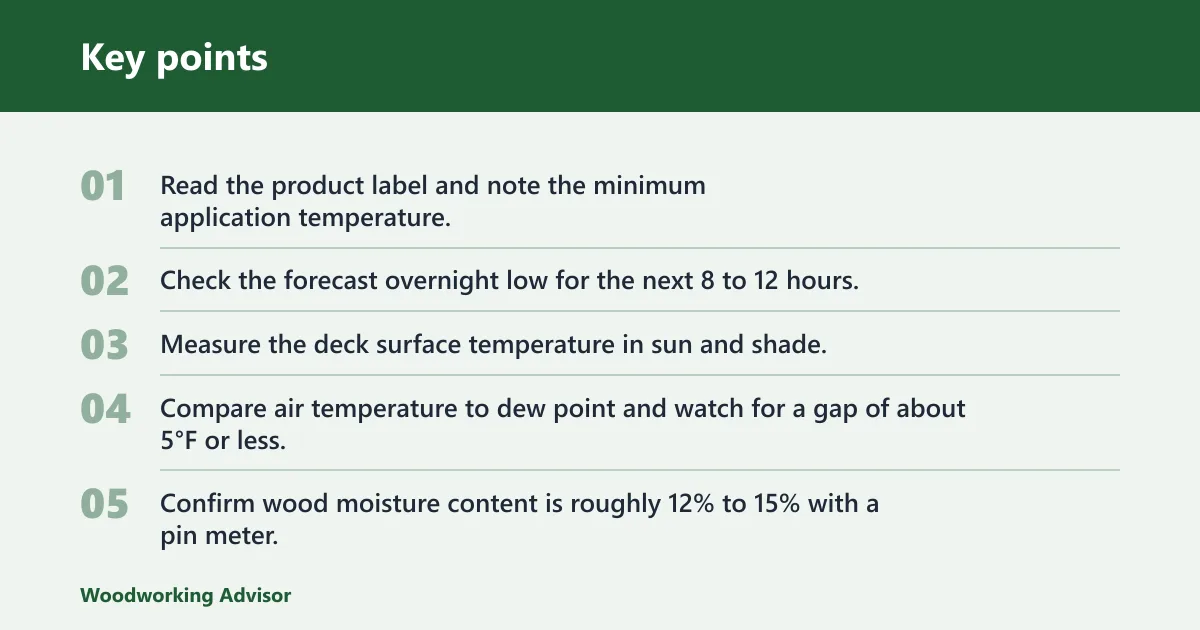
- Read the product label and note the minimum application temperature.
- Check the forecast overnight low for the next 8 to 12 hours.
- Measure the deck surface temperature in sun and shade.
- Compare air temperature to dew point and watch for a gap of about 5°F or less.
- Confirm wood moisture content is roughly 12% to 15% with a pin meter.
- Aim for at least about 24 hours without rain, with 24 to 48 hours often preferred.
Overnight low decision table
| Product label minimum | Forecast overnight low | Go/no-go outcome | Notes |
|---|---|---|---|
| 35–40°F | 35–40°F | No-go unless the label explicitly allows it | Postpone if dew is likely, if the deck is shaded and cold, or if the surface temperature falls below the label minimum. |
| 35–40°F | 40–49°F | Caution | Watch dew point closely and confirm 8 to 12 hours above the product floor. Surface temperature can still override the air forecast. |
| 40–49°F | 35–40°F | No-go for most products | The forecast is below the listed floor. Wait for a warmer night and a dry wood reading. |
| 40–49°F | 40–49°F | Borderline | Only proceed if the label allows it, the boards stay above the minimum, and the air remains well above dew point overnight. |
| 40–49°F | 50–59°F | Usually go | Still check board temperature, dew point, and a 24-hour dry window. Shade can leave boards colder than the air. |
| 50–59°F | 40–49°F | Usually no-go | Too close to the limit for many oil-based stains. Soft cure and dew marking become more likely. |
| 50–59°F | 50–59°F | Go with checks | Good for many products if the wood is dry, the surface is in range, and rain is not expected within 24 hours. |
| 50–59°F | 60°F+ | Go | Usually the safest cool-weather bracket, especially if the boards are near 60°F to 80°F and the dew point gap stays healthy. |
| 60°F+ | Any forecast that stays above the label minimum | Go, if dry | Surface temperature, dew risk, and rain-free cure time still matter. High heat can also cause lap marks if boards run too hot in direct sun. |
Can you stain if rain is coming later tonight?
Usually no. If rain is in the forecast later tonight, the safer choice is to postpone, even if the afternoon looks ideal. Many products need at least 24 hours without rain, and many guides recommend 24 to 48 hours of warm, dry weather after staining.
Why a 24-hour dry window matters
Oil-based deck stain needs time to set into the wood and cure on the surface. Rain can wash, streak, or spot the fresh coating before it has settled. Even light rain can cause problems if it lands during the first hours of cure.
How rain and dew can disrupt curing
Rain is not the only wetting risk. Dew can form overnight when the air cools near the dew point, and that moisture can mark the finish before it firms up. Keep rain risk and dew risk separate. A night can be rain-free and still too wet for a fresh stain.
Picture a deck stained at 2 p.m. with a forecast low of 47°F and a dew point only a few degrees lower. If the surface is still curing when the air cools after sunset, overnight moisture may leave a dull or tacky patch by morning.
Best conditions for cool-weather staining
The best temperature range for oil-based deck stain is often within the label minimum and about 50°F to 90°F, with a more comfortable zone around 60°F to 80°F. For cool weather, apply during the warmest part of the day so the wood has time to absorb and set before evening cooling.
Best time of day to stain in cool weather
The forecast tool’s work window between 9 a.m. and 2 p.m. fits the general idea: stain when the deck and air are warming, not when they are falling. Early afternoon is often better than late day because the stain gets more cure time before the temperature drops.
Practical timing for stain and cure
Plan backward from nightfall. If the deck needs 8 to 12 hours above the product floor, a late-day start can be risky in cool seasons. Start only when you can reasonably expect the board temperature to stay in range through the evening and into the next morning.
Frequently asked questions
What overnight low is too cold for oil based deck stain?
Anything below the label minimum is too cold. For many products that means below 50°F, while some allow lower and some require 60°F. As a practical rule, if the forecast low is within about 5°F of the minimum, wait for a warmer night and a drier cure window.
Can I stain a deck if the temperature drops below 40°F overnight?
Usually no. Many products need the temperature to stay above about 40°F for 8 to 12 hours after application, and some need 60°F minimum. If the deck will dip below 40°F, the risk of tackiness, slow cure, and dew marking climbs fast.
How long should the temperature stay above freezing after staining?
After application, conditions should generally stay above freezing or at least above about 40°F for roughly 8 to 12 hours. That gives the stain time to set before nighttime moisture or a cold snap slows the cure. Many guides also favor 24 to 48 hours of dry weather overall.
What is the best temperature range for oil based deck stain?
The common application range is about 50°F to 90°F, with a more comfortable working zone around 60°F to 80°F. For the wood surface, that range is especially useful because it supports better penetration and a steadier cure. Some manufacturers specify a higher minimum.
Should I use a moisture meter before staining a deck?
Yes. A pin moisture meter is the clearest way to check whether the wood is ready. Aim for roughly 12% to 15% moisture content. If the wood is wetter than that, stain may absorb poorly, dry unevenly, or fail early.
Sponsored / affiliate links. As an Amazon Associate I earn from qualifying purchases. I may earn additional commission from eligible campaigns.