Thompson’s Water Seal Review: Does It Really Protect Wood?
Thompson’s WaterSeal repels water on exposed wood, but it is a short-life choice: expect months, not years, on most decks, and use a different finish for heavy wear or horizontal surfaces. Poor prep or the wrong product can leave water in the wood, speed graying, and force early recoats or stripping. This review breaks down how Thompson’s WaterSeal performs by wood type, failure mode, and where another exterior finish is the smarter buy.
Verdict

Based on published product details and buyer feedback, the strongest case for Thompson’s WaterSeal is simple protection on clean, dry outdoor wood where you want a finish that is easy to apply with a sprayer or pad and a natural look. The weakest case is full-sun deck boards and any surface that sees constant traffic. The clear formula is the easiest route to a near-natural appearance, but it gives limited UV defense; the transparent wood stain and sealer is the better pick when you want some color and a bit more help against graying.
Specs at a glance
| Product | Finish | Primary use | Coverage / timing notes | Cleanup |
|---|---|---|---|---|
| Thompson’s WaterSeal Clear Wood Sealer | Clear | Decks, fences, and other outdoor wood | About 200 to 300 square feet per gallon; annual checks are smart because fade can show in 6 to 12 months | Soap-and-water cleanup |
| Thompson’s WaterSeal Transparent Waterproofing Wood Stain and Sealer | Transparent / tinted; Natural Cedar shown in testing | Outdoor wood protection with visible grain | Coverage varies with surface texture and prep; waterproofing is the claim to verify against your wood type | Soap-and-water cleanup |
| Thompson’s WaterSeal Multi-Surface Waterproofer Stain | Clear multi-surface formula | Wood, concrete, masonry, and brick; interior/exterior versatility | Best used where a single waterproofer is needed across multiple materials | Soap-and-water cleanup |
The manufacturer cites ASTM D-4446 for waterproofing wood on the transparent stain and sealer. That reference matters because it points to a recognized waterproofing standard, not a vague “weatherproof” claim. It does not mean the finish will resist sun, foot traffic, or mildew equally well on every surface.
Who it
Thompson’s WaterSeal fits homeowners who want a basic water-repelling finish on outdoor wood without complicated tooling. It is most reasonable on fences, lightly used patio furniture, and sheltered wood that is not getting blasted by sun every afternoon. It is also a fair choice when you want soap-and-water cleanup and lower tooling complexity.
It is a weaker buy for exposed deck boards, south-facing rails, and any surface where UV damage is the main problem. Clear versions preserve the natural look better than solid coatings, but that tradeoff comes with weaker UV defense. On sunny wood, the finish can let graying show up long before the water repellency is gone.
Say your 12-foot fence section sits under a tree line and only gets splash exposure from rain. A clear or transparent Thompson’s WaterSeal can make sense there because the wear pattern is slower and the job is mostly moisture control, not constant sun defense.
Suppose a 10-by-12-foot deck has bare, warm-season boards in full sun. That is a different problem. On that surface, water repellency alone is not enough; you need better UV handling and a finish that can survive foot traffic without fading patchy.
What works
The main strength is initial water beading. On a properly prepared surface, Thompson’s WaterSeal can shed water at first, and that is the behavior most homeowners notice right away. The practical check is simple: after the finish cures, a light splash test should bead instead of soaking in quickly.
Application is also straightforward. The clear formula can go on with a sprayer or pad, and the line generally supports common tools such as a brush, roller, or sprayer with back brushing to work product into grain. Keeping a wet edge matters, especially on larger deck sections, because lap marks can show where one pass dries before the next starts.
The clear version keeps the wood looking close to bare lumber, which is the main reason some people choose it. The transparent stain and sealer gives more color and still lets the grain show, which is useful if you want a little more visual depth without moving to a solid coating.
Application basics
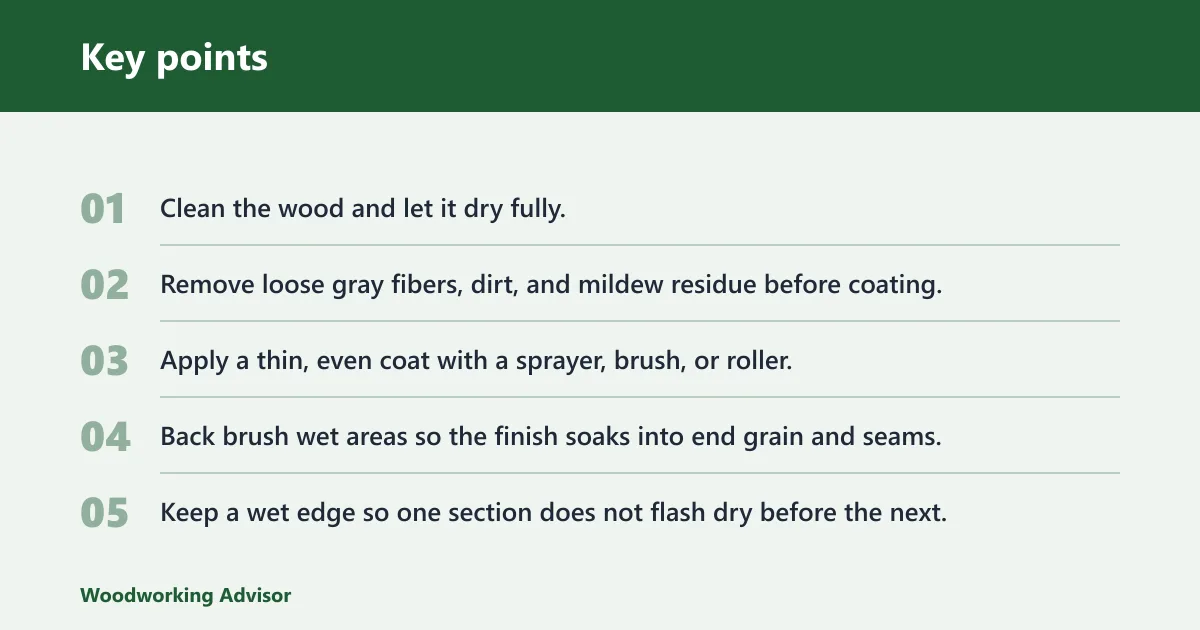
- Clean the wood and let it dry fully.
- Remove loose gray fibers, dirt, and mildew residue before coating.
- Apply a thin, even coat with a sprayer, brush, or roller.
- Back brush wet areas so the finish soaks into end grain and seams.
- Keep a wet edge so one section does not flash dry before the next.
- Let the surface cure before rain or heavy use.
Coverage is usually discussed at about 200 to 300 square feet per gallon, but that is only a starting point. Rough sawn boards, thirsty end grain, and poorly cleaned wood all reduce real coverage. A gallon that looks economical on paper can become less attractive if you need a second coat or a faster recoat cycle.
What does not work well?
The biggest weakness is UV protection. Clear versions have limited UV defense, and the review data cited here describes zero UV protection in full-sun testing. That is why clear Thompson’s WaterSeal can keep water out for a while but still let wood gray fast on exposed decks.
Water repellency also fades. In the cited test review, repellency failed within 6 to 12 months. That does not mean every board fails on the same date, but it does mean you should plan on annual checks and not treat the product like a long-service coating.
Mold and mildew resistance is limited by surface conditions. On damp, shaded wood, black mold can return because the finish is not a cure for persistent moisture. If the wood stays wet from shade, sprinklers, or poor drainage, the coating can buy time but not solve the source of the problem.
Peeling and flaking are less common with penetrating-style behavior than with thick film finishes, but uneven wear can still happen. If the surface was dirty, overapplied, or coated over old residue, some areas can shed water while others look dull or blotchy. That patchy fade is often the first sign that recoating is due.
Failure checklist
| Symptom | What it usually means | Next step |
|---|---|---|
| Graying | UV has outpaced the finish, especially on clear formula surfaces | Clean, lighten the weathered fibers if needed, then recoat with a more UV-resistant finish |
| Mold | Moisture is lingering on the surface or in shaded areas | Wash the surface, improve drainage or airflow, and recoat only after it dries |
| Peeling or flaking | Wrong prep, too much product, or coating failure on a badly weathered surface | Strip loose material, prep again, and consider a different finish if wear is heavy |
Thompson’s WaterSeal decision matrix
| Wood type | Exposure level | Expected real-world lifespan | Recommend / not-recommend |
|---|---|---|---|
| Deck boards | High wear, often full sun | Short; plan on 6 to 12 month fade risk and annual checks | Not-recommend for busy decks; better for light-use sections only |
| Fence boards | Moderate exposure, mostly vertical runoff | Better than decks; often practical for 1 maintenance season before recheck | Recommend if you want natural look and basic water repellency |
| Patio furniture | Variable exposure, lower wear than floors | Moderate; depends on shade, storage, and cleaning | Recommend for occasional-use furniture; not for sun-baked pieces left out year-round |
| Shaded wood | Lower UV, higher mold risk | Reasonable if kept dry between storms | Recommend with caution; clean often and watch for mildew |
| Full-sun wood | Highest UV exposure | Shortest service life for clear formulas | Not-recommend for clear formula; choose a better UV-focused stain instead |
Alternatives
When the surface is a deck board, a premium penetrating stain makes more sense than a basic waterproofer. That is especially true if you care about UV resistance, slower color fade, and longer maintenance intervals. You pay more up front, but you may spend less over several seasons because you avoid repeated strip-and-recoat cycles.
If the job includes concrete, brick, masonry, and wood in one area, the multi-surface waterproofer is useful only when you need one product for several materials. It is the wrong pick for a sunny wooden deck that needs stronger color retention. A product that can cross over to masonry is not automatically the best wood finish.
Thompson’s WaterSeal Transparent Waterproofing Wood Stain and Sealer is the better Thompson’s option when you want a little more color and grain visibility than the clear formula gives. Natural Cedar was the tested color reference, and the brand positions it for decks, fences, patios, and other outdoor surfaces. The tradeoff is that transparent color does not erase UV limits; it only improves the odds compared with clear.
Should you buy it?
Buy Thompson’s WaterSeal if your priority is easy water repellency on clean outdoor wood, you want a clear or lightly tinted look, and the surface is not a high-wear, full-sun deck. It is also a sensible buy for fences, sheltered patio furniture, and surfaces where soap-and-water cleanup matters.
Skip it if you need long UV life, if the wood sits in constant sun, or if the surface already shows patchy weathering and coating failure. In those cases, a better penetrating stain is usually the smarter buy, even if the upfront price is higher than the tested gallon price of about $39.99.
Choose the clear formula if you want the most natural look and can accept more visible graying. Choose the transparent stain and sealer if you want visible grain with a little more color and a more practical appearance on exterior wood. For both, plan on annual checks and expect maintenance sooner on horizontal surfaces than on vertical ones.
Frequently asked questions
Does Thompson’s WaterSeal really protect wood?
Yes, but only in a limited sense. Thompson’s WaterSeal can repel water and slow moisture uptake on properly prepared wood, which helps protect against wetting and some surface damage. It is not a rot repair product, and it does not replace stronger UV protection or regular maintenance on exposed outdoor surfaces.
How long does Thompson’s WaterSeal last on a deck?
On a deck, the realistic answer is short. The cited test review found water repellency failed within 6 to 12 months, and full-sun deck boards are the most demanding surface. Light-use or shaded decks may last longer, but you should still check annually and expect recoating sooner than with premium penetrating stains.
Does Thompson’s WaterSeal stop UV damage and graying?
Not well in clear form. The cited full-sun testing described zero UV protection, which is why graying can appear even when water still beads. Transparent versions can look better than clear ones because they add color, but they still are not a strong answer for hard sun exposure.
Will Thompson’s WaterSeal peel or flake off wood?
It can, especially if the surface was not cleaned well, if too much product was applied, or if the wood already had uneven weathering. Even when it does not peel in sheets, it can wear in blotches. That patchy fade is often a sign that the surface needs cleaning and recoat planning.
Is Thompson’s WaterSeal good for fences and outdoor furniture?
Yes, more so than for deck boards. Fences and patio furniture usually see less abrasion, so the finish has an easier job. The transparent and clear formulas can work well there if you want to preserve grain and keep maintenance simple, but full-sun furniture still needs close rechecking.
How often do you need to reapply Thompson’s WaterSeal?
Annual checks are the safest plan. The cited review showed 6 to 12 month fade risk, while some product claims point to 1 to 2 year maintenance windows depending on formula and exposure. Use water beading, graying, and patchy wear as your practical signals, not the calendar alone.
Does Thompson’s WaterSeal help with mold and mildew?
It can help keep water out, which may reduce the conditions mold likes, but it is not a strong mildew cure. Damp shade, poor airflow, and dirty wood still create black mold risk over months or years. Wash the surface first, keep runoff moving, and do not expect the finish to solve a moisture problem by itself.
What is the difference between clear and transparent Thompson’s WaterSeal?
The clear formula is meant to preserve the natural look as much as possible, while the transparent wood stain and sealer adds color and still lets grain show through. Clear is better for minimal color change; transparent is better if you want more visual warmth and slightly better appearance on weathered outdoor wood.
Sponsored / affiliate links. As an Amazon Associate I earn from qualifying purchases. I may earn additional commission from eligible campaigns.