What Are Step Drill Bits Used For? (Metal, Wood & Hole Sizes)
Step drill bits (unibits) cut a range of clean, burr-free hole sizes with one cone-shaped tool — but only in thin sheet stock, not solid lumber. Using one on material it isn’t rated for tears the hole oversize or snaps a step. This guide covers the real hole-size range these bits cover, which materials they’re actually built for, and when to reach for a twist bit instead.
As an Amazon Associate, woodworkingadvisor.com earns from qualifying purchases.
Quick Answer
Step drill bits (unibits) are used to drill and enlarge holes from about 1/8″ up to 1-3/8″ in one tool, without swapping bits. They excel on sheet metal, thin plastic, and thin plywood — but they’re only rated for material up to roughly 1/4″ (about 4–6mm) thick, so use a twist or brad-point bit for solid hardwood.
Different Types Of Step Drill Bits
Step drill bits come in three main designs, each suited to slightly different jobs. Knowing which one you’re holding tells you what it’s actually good for.
Straight Fluted Step Drill Bits
Straight fluted step bits guide smoothly through the material with less friction and heat buildup. They’re the standard choice for thin sheet metal, plastic, and laminate, where a single straight cutting edge per step keeps the hole round instead of tearing it oval.
Spiral Fluted Step Drill Bits
Spiral fluted step bits clear chips more aggressively, which prevents clogging and keeps the cut cooler. They handle metal, wood, and PVC well and generally drill faster than a straight-fluted bit of the same size.
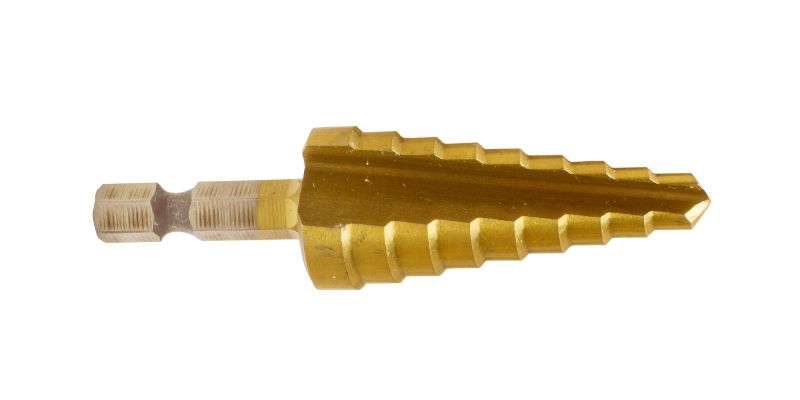
Cone-Shaped Step Drill Bits
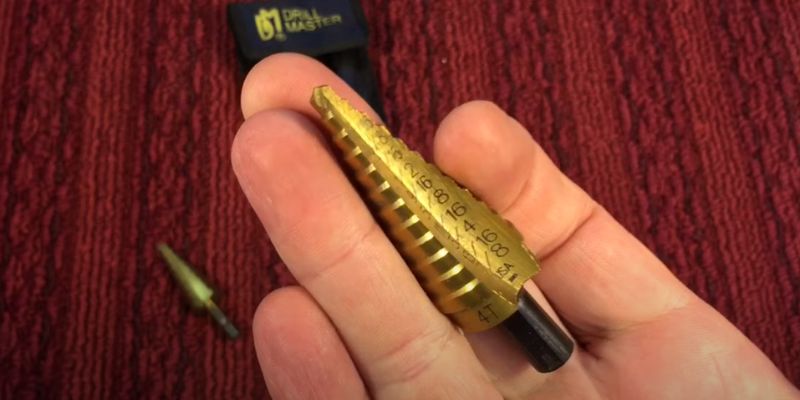
Cone-shaped step bits are built mainly for enlarging an existing hole rather than starting a new one from solid material. The graduated cone lets you step up to a larger diameter in stages instead of forcing an oversized bit through in one pass — useful when a pilot hole needs to grow to fit a larger bolt or fitting.
Applications And Uses Of Step Drill Bits
Step drill bits earn their keep anywhere you need several hole sizes in thin material without stopping to change bits.
Metalworking And Fabrication
This is where step bits do their best work: aluminum, mild steel, brass, and copper sheet up to about 1/4″ thick. Electricians rely on them for junction boxes and conduit knockouts because one bit replaces a whole set of twist bits for panel work.
Woodworking
In the shop, a step bit is handiest for drilling clean holes on wooden surfaces and enlarging an existing pilot hole a size or two — swapping a hinge screw for a slightly larger one, or opening up a hole for a threaded insert — without splitting the surrounding wood grain the way jumping straight to an oversized twist bit can. It is not a substitute for a brad-point or Forstner bit on solid lumber; save it for thin plywood, veneer, or hardware clearance holes.
Can You Use Step Drill Bits On Wood?
Yes, but only on thin stock — step bits are rated for material up to about 1/4″ (roughly 4–6mm) thick, the same limit that applies to sheet metal. On plywood, thin veneer, or MDF panels under that thickness, they cut clean, splinter-free holes. On solid hardwood boards or anything thicker, the cone shape tends to wander off-center and burn the wood instead of cutting it — use a brad-point, Forstner, or twist bit for full-thickness lumber instead.
Plastic Drilling
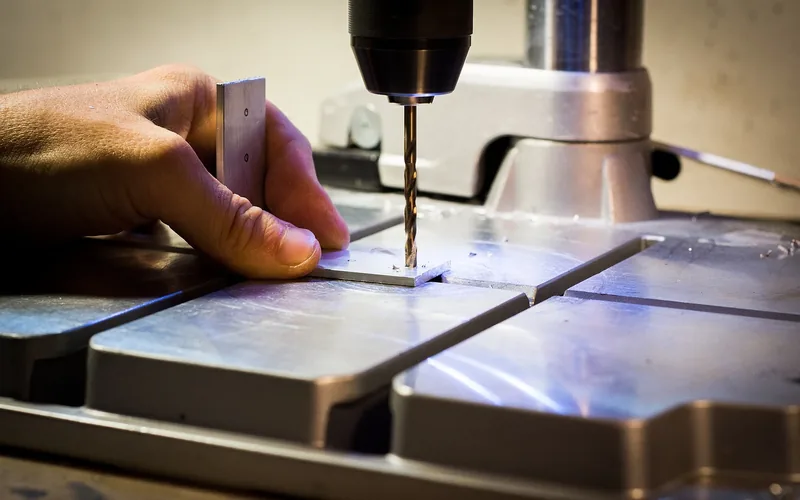
On acrylic, PVC, and other rigid plastics, step bits leave a smooth edge instead of the cracks or chip-out a regular drill bit can cause, since each step removes only a small amount of material at a time.
Automotive Repairs
In auto body and DIY repair work, step bits enlarge existing holes for wiring or fittings and deburr sharp metal edges in one pass — handy for anyone doing their own wiring or panel modifications.
Step Drill Bit Hole Size Range (And Drilling Speed)
Most step bit sets are sold by their total diameter range and number of steps. Knowing the spread helps you pick a set that actually covers the sizes you drill most, instead of paying for steps you’ll never use.
| Set Type | Typical Range | Steps | Best For |
|---|---|---|---|
| Compact single bit | 1/8″ – 1/2″ (4–12mm) | 6–9 | Electrical boxes, small hardware clearance holes |
| Standard single bit | 3/16″ – 7/8″ (4–20mm) | 9–12 | General sheet metal and plastic work |
| Large single bit | 1/4″ – 1-3/8″ (6–32mm) | 12–13 | Enlarging holes for conduit, plumbing fittings |
| Multi-bit set (e.g. DEWALT 3-piece) | 1/8″ – 7/8″ combined, 31 sizes | 3 bits | Covering the widest range without gaps |
📊 Drilling speed: Set the drill to the speed for the largest step you’ll engage, not the smallest — a good rule of thumb from standard drill-speed reference charts is around 1,200–1,500 RPM for a 1/4″ step in mild steel, dropping to 600–800 RPM as you approach 1/2″. Wood and thin plastic can run faster, but slow down as soon as you feel the bit start to grab.
Best Step Drill Bit Set Pick
DEWALT Step Drill Bit Set, 3-Piece (DWA1790IR)
Titanium nitride coating across 31 hole sizes from 1/8″ to 7/8″, split over 3 bits so no single bit gets overworked.
- Best for: Electricians and metalworkers who need the widest size range without gaps
- Why we picked it: Splitting the range across 3 bits keeps each one sharper longer than a single do-it-all bit
- Main drawback: Costs more than a basic single-bit or 5-piece import set
Compare more step drill bit options
 Option 1 IRONANT 5-Piece Titanium Step Drill Bit Set
|
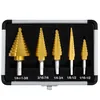 Option 2 5-Piece Titanium Step Bit Set, 1/16″–1-3/8″
|
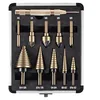 Option 3 AIMLENTOOL Step Bit + Countersink Combo (10pc)
|
As an Amazon Associate we earn from qualifying purchases.
Advantages Of Step Drill Bits Over Regular Drill Bits
Step drill bits solve a few specific problems that a set of individual twist bits doesn’t.
Multiple Hole Sizes In One Tool
Each step on the bit is a different diameter, so you drill to depth and stop at whichever step gives you the hole size you need — one bit does the job of several twist bits.
Clean And Precise Drilling
High-speed steel or cobalt cutting edges leave burr-free holes, cutting down on the deburring and finishing work a twist bit often leaves behind on thin metal.
Reduced Chance Of Drill Bit Breakage
The gradual step-up spreads the cutting load instead of concentrating it at one point, so the bit is less likely to snap or wander off-path mid-hole.
Reduced Drilling Time
Not stopping to swap bits between hole sizes adds up fast on a job with a dozen holes of varying diameter.
Factors To Consider When Choosing Step Drill Bits
A few specs matter more than brand name when picking a set.
Material And Coating
High-speed steel (HSS) bits, uncoated or titanium-coated, handle wood, plastic, and most metals. For stainless steel or cast iron, step up to a cobalt-alloy bit — it holds an edge through much more heat before dulling.
Number Of Steps
More steps means more hole sizes from one bit, but also a longer, more fragile taper. Match the step count to the range you actually drill — see the size-range table above.
Compatibility With Power Tools
Check the shank size against your drill’s chuck — most step bits use a 1/4″ or 3/8″ shank, both standard for power drills and drill presses.
Budget Considerations
A higher-quality bit costs more upfront but holds its edge through far more holes, which usually beats replacing a cheap bit repeatedly — see our drill bit price guide for what different grades typically run.
Step Drill Bit Maintenance And Tips
Properly Sharpening Step Drill Bits
A dull step bit drills slower and leaves rougher holes. Clamp the bit firmly, hold it at the original bevel angle against a bench grinder or rotary tool with a grinding wheel, and use light, even passes — overheating the edge during sharpening removes its hardness just as fast as normal wear does.
Cleaning And Lubricating Step Drill Bits
Clear metal chips and dust from the flutes after every use with a stiff brush or compressed air. Add a drop of cutting oil before drilling metal — it cuts friction, improves chip evacuation, and keeps the bit from overheating mid-hole.
Step Drill Bits Vs Twist Drill Bits
Twist bits and step bits solve different problems. A twist bit’s spiral flute clears material efficiently across wood, metal, and plastic at a fixed diameter. A step bit trades that single-diameter focus for a range of sizes in one tool, at the cost of only working reliably in thin material.
| Twist Drill Bits | Step Drill Bits |
|---|---|
| General-purpose drilling in wood, metal, plastic | Multiple hole sizes from one bit, no swapping |
| Fixed diameter per bit | Best on sheet metal, thin plastic, thin plywood |
| Works through thick material | Limited to roughly 1/4″ material thickness |
| Precision drilling in solid stock | Enlarging existing holes, electrical/plumbing work |
Tips For Safe And Effective Use Of Step Drill Bits
Wearing Protective Gear
Wear ANSI-rated safety glasses to protect against flying metal shavings, plus a dust mask when drilling dusty material and gloves for a firmer grip on the workpiece.
Securing Workpieces Properly
Clamp the material to a bench or vise before drilling. An unsecured workpiece can spin with the bit the moment it catches, which is how thin sheet metal causes cuts.
Common Mistakes To Avoid When Using Step Drill Bits
Using Excessive Force
Pushing harder doesn’t drill faster — it dulls the edges early and raises the odds of the bit binding or snapping. Let the bit’s own cutting action do the work at a steady, moderate feed.
Failing To Use Lubrication
Skipping cutting oil on metal is the single fastest way to overheat and dull a step bit — see the maintenance section above for how much to use.
Ignoring Signs Of Wear
A dull, chipped, or inconsistently cutting step bit won’t get sharper on its own. Replace or resharpen it at the first sign of rough holes rather than fighting through a full project on a worn edge.
Frequently Asked Questions About Step Drill Bits
What Are The Disadvantages Of Step Drill Bits?
The main disadvantages are a limited material-thickness range, a higher chance of breakage on hard materials, and less precision than a dedicated bit for a single hole size. They aren’t a full replacement for a twist bit set on thick or hard stock.
Are Step Bits Worth It?
Yes for anyone who regularly drills sheet metal, electrical boxes, or thin plastic in multiple sizes — one bit replacing several saves both money and drawer space, and it can even drill through engineered material in a pinch. If you mostly drill solid wood or thick material, a good twist bit set is the better first purchase.
What Is The Application Of A Step Drill?
Step drills create holes of different diameters in thin materials, most often used in metalworking and electrical work to enlarge existing holes or drill several hole sizes without switching bits.
How Thick Can You Drill With A Step Bit?
Most step bits are rated for material up to about 1/4″ thick. Past that thickness, the cone shape doesn’t fully engage and the hole comes out rough or oversized — see our guide on the best way to drill through metal for thicker stock.
Can You Use A Step Drill Bit On Wood?
Yes, but only on thin stock under about 1/4″ — plywood, veneer, or thin panel material. On solid hardwood or anything thicker, the bit tends to wander and burn the wood instead of cutting cleanly; use a brad-point or Forstner bit there instead.
Conclusion
Step drill bits earn their spot in the toolbox for one job in particular: drilling or enlarging multiple hole sizes in thin sheet metal, plastic, or panel stock without switching bits. Keep them off solid hardwood and material thicker than about 1/4″, match the set’s size range to what you actually drill, and a single quality bit will outlast a whole drawer of mismatched twist bits for that job. For more drill and drill-bit guides, see our drilling hub.