MDF vs Hardboard: Density, Strength and Best Uses (2026)
MDF and hardboard are both pressed wood fiber, but they are not interchangeable: MDF comes thick (1/4 to 1 in at one major maker) and holds a routed edge, while hardboard is a thin, dense sheet best used as a skin on a frame. The standards also define them differently, by resin and process as much as density. This guide covers the numbers, the five hardboard classes, sheet weights and which board fits each job.
MDF vs Hardboard at a Glance
| BEST HARDBOARD PANEL PICK | |
 |
Ampersand Hardbord Panel, 12 x 24 in, 1/8 in
|
Short version: choose hardboard for thin, hard-wearing sheets such as cabinet backs, drawer bottoms, pegboard and templates. Choose MDF when you need thickness, a paintable face or an edge you can profile. The table puts the main differences side by side, using figures from manufacturer and standards documents.
| Property | MDF | Hardboard |
|---|---|---|
| Density | Grade 130: 700-745 kg/m3; Grade 155: 740-770 kg/m3 (ANSI A208.2, per Uniboard) | 59 lb/ft3 (about 945 kg/m3) on a maker’s standard sheet; the standard only requires 500 kg/m3 or more |
| Binder | Synthetic resin, most commonly urea-formaldehyde (CPA) | Wet process, or dry process with phenolic or no-added-formaldehyde resin (ANSI A135.4 definition) |
| Thickness | 1/4 to 1 in (6.35-25.4 mm) in one maker’s range | 1/12 to 3/8 in for Tempered and Standard classes; up to 5/8 in for Service and Industrialite |
| Faces | Smooth both sides | One smooth side (S1S) or two (S2S) |
| Edge | Machines cleanly; can be routed into profiles | Edges are thin; used flat, rarely profiled |
| Typical jobs | Cabinet boxes, shelves, painted doors, mouldings, jigs | Cabinet backs, drawer bottoms, pegboard, templates, underlayment |
Sources: the Uniboard MDF specification sheet, the Stimson hardboard data sheet and the ANSI A135.4-2012 Basic Hardboard standard. For the MDF side in more depth, see our guides to what MDF is and MDF properties and swell numbers.
What the Two Standards Actually Say
Most comparisons stop at density. The standards draw the line somewhere else. Under ANSI A135.4, hardboard is a panel of fibers pressed under heat to 500 kg/m3 (31 lb/ft3) or more, made either by a wet process or by a dry process that uses phenolic resin or a resin with no added formaldehyde. That low density floor means the density ranges of the two boards overlap on paper. What separates them in the definition is the process and the resin, not a clean density cutoff.
Two myths follow from this. The first is that hardboard is always paper-thin: the same standard lists thicknesses up to 5/8 in (15.9 mm) for its Service and Industrialite classes, even though most hardboard sold at home centers is 1/8 or 1/4 in. The second is that hardboard is one product. It is five, with very different strength and water limits.
The five ANSI A135.4 hardboard classes (limits for a 1/4 in panel, from the standard’s Table 1):
| Class | Min. bending strength (MOR) | Min. tensile perpendicular to surface | Max. 24-hour water absorption | Max. 24-hour thickness swell |
|---|---|---|---|---|
| 1 Tempered | 6,000 psi (41.4 MPa) | 130 psi | 20% | 15% |
| 2 Standard | 4,500 psi (31.0 MPa) | 90 psi | 25% | 20% |
| 3 Service-Tempered | 4,500 psi (31.0 MPa) | 75 psi | 30% | 25% |
| 4 Service | 3,000 psi (20.7 MPa) | 50 psi | 40% | 30% |
| 5 Industrialite | 2,000 psi (13.8 MPa) | 25 psi | 50% | 30% |
The standard’s own numbers for Tempered versus Standard are confirmed on the Stimson hardboard data sheet: a 1/4 in Standard sheet is listed at 25% water absorption and 20% swell, a Tempered sheet at 20% and 15%. The practical meaning: two hardboard sheets that look identical can differ in bending strength by a third (a Tempered minimum of 6,000 psi against 4,500 for Standard), and by a factor of three between the top and bottom class. Ask which class you are buying, or check the maker’s data sheet. MDF is covered by a separate standard (ANSI A208.2) with its own grade tables, so compare spec sheets from the same maker rather than mixing numbers across the two.
Sheet Weight and Thickness: A Number Competitors Skip
Density sounds abstract until you lift a sheet. Using the maker figures above, here is what a 4 x 8 ft sheet weighs. The hardboard weights come straight from the data sheet (0.70 lb/ft2 at 1/8 in and 1.20 lb/ft2 at 1/4 in, times 32 ft2). The MDF weights are our calculation from the 700-770 kg/m3 density range, so treat them as estimates.
| 4 x 8 ft sheet | Weight | Source |
|---|---|---|
| Hardboard, 1/8 in | about 22 lb | Stimson: 0.70 lb/ft2 x 32 ft2 |
| Hardboard, 1/4 in | about 38 lb | Stimson: 1.20 lb/ft2 x 32 ft2 |
| MDF, 1/4 in | about 29-32 lb | Calculated from 700-770 kg/m3 |
| MDF, 3/4 in | about 87-96 lb | Calculated from 700-770 kg/m3 |
Two takeaways. At the same nominal 1/4 in thickness, the hardboard sheet is roughly 20 to 30 percent heavier than MDF, which fits its higher density. And a full 3/4 in MDF sheet weighs about as much as two and a half 1/4 in hardboard sheets, so plan to cut it down or get help moving it. For a wider look at where the two boards sit among panel options, see HDF vs MDF, what plywood is and MDF alternatives.
Surface, Primer and Paint
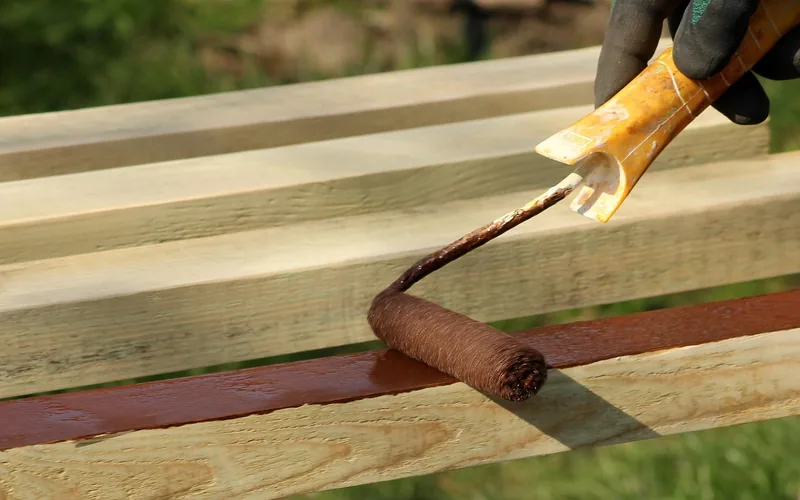
MDF is smooth on both faces and uniform, which is why most trim and millwork is made from it. The Composite Panel Association (CPA) technical bulletin notes that most MDF moulding comes pre-primed, that surfaces should be cleaned and nail holes filled before the top coat, and that satin or semi-gloss acrylic or alkyd paints work well. It also advises against latex paint or lacquer when the temperature is below 55 F or relative humidity is above 65 percent. Lacquer needs a lacquer primer over the factory prime coat.
Hardboard is sold with one or two smooth sides, so check which you are buying. On a one-sided sheet, put the smooth face where it shows and the rough face against the frame. Both boards take primer and paint well on the smooth face. On raw MDF, seal the cut edges first, because the fiber core absorbs far more finish than the face does (our guide to painting MDF shows the full sequence).
Moisture: Neither Board Is Waterproof
The common shorthand that hardboard handles water and MDF does not is too simple. The hardboard standard allows even its best class (Tempered) to take on up to 20 percent of its weight in water over 24 hours at 1/4 in, and the weakest class 50 percent. MDF is the same story in a different form: the CPA says standard MDF is for interior use, but that special adhesives and additives can be used to reduce thickness swell, and that MDF made with special adhesives is available for exterior trim. One maker lists a no-added-formaldehyde MDF that passed a 24-hour water submersion test.
The honest rule: for a damp garage or basement, choose a moisture-rated MDF or a Tempered hardboard and seal every face and edge. For anything that sees weather or standing water, move to exterior plywood. If an MDF panel has already swollen, read how to dry out MDF before you decide it is salvageable.
Cutting, Screws and Dust Safety
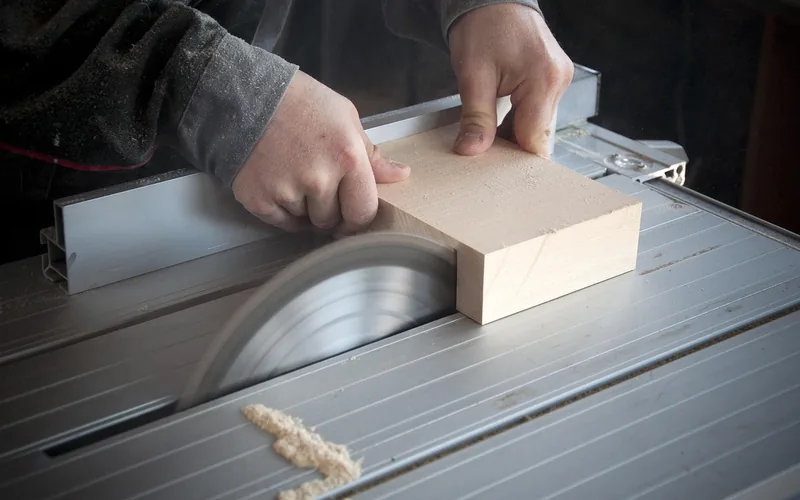
The CPA recommends a sharp carbide-tipped blade for sawing MDF. Both boards are glue-bonded and dull steel quickly, so carbide pays off. Hardboard sheets are thin enough to cut with a utility knife, jigsaw or fine-tooth blade, while thick MDF needs a table saw or track saw.
Screws are where MDF punishes shortcuts. The CPA says predrilled pilot holes are strongly recommended and should be 85 to 90 percent of the screw’s root diameter, drilled to a depth equal to or slightly more than the screw length, with a slight countersink and no overtightening. It also notes that screws designed for particleboard hold better than standard wood screws. Our MDF joinery comparison covers pocket screws, biscuits and glue. Hardboard is too thin to hold a screw by itself, which is why it is normally glued or nailed to a frame.
Dust is the safety item people skip. Sawing MDF makes very fine dust, and the CPA tells users to connect saws to a vacuum and, at minimum, wear a NIOSH-approved half-mask respirator with a HEPA-rated filter, side-shielded safety glasses, a long-sleeve shirt and gloves. Manufacturers also limit formaldehyde: one maker’s MDF meets the CARB Phase 2 limits of 0.11 ppm for panels thicker than 8 mm and 0.13 ppm for 8 mm and thinner. That is a limit on emissions from the finished panel, not a reason to relax about the dust you create when you cut it. Read how to sand MDF safely and why MDF dust is dangerous before your first cut.
Which Board for Which Job
- Cabinet backs and drawer bottoms: hardboard. It is thin, flat and light, and the cabinet frame supplies the stiffness.
- Shelves, cabinet boxes and workbench tops: MDF at 3/4 in. A hardboard sheet cannot carry load across a span without a frame behind it.
- Pegboard: hardboard. Lumber suppliers list tempered pegboard in 1/8 and 1/4 in thicknesses, and the thicker panel is the better choice for heavy tools.
- Painted doors, panels and trim: MDF, with sealed edges and primer. Its uniform face has no grain or knots to telegraph through paint.
- Molded interior door skins: molded fiberboard rather than flat sheet, but the same family of material. JELD-WEN describes its molded interior doors as wood fiber molded under heat and pressure into a high-density fiberboard.
- Jigs and router templates: either. 1/4 to 3/4 in MDF machines cleanly, while 1/8 in hardboard is quick to cut for a simple template.
- Floor underlayment and shop protection: hardboard, because its hard surface resists dents and scuffs.
If your real question is about cost, see our MDF vs Masonite vs plywood price breakdown, and if you plan to glue wood to a hardboard panel, read the best glue for Masonite guide. For a balanced look at the board itself, see MDF advantages and disadvantages.
Common Mistakes When Choosing Between Them
- Assuming all hardboard is the same. The five A135.4 classes differ by three times in minimum strength and by 2.5 times in allowed water absorption.
- Using 1/8 in hardboard as a shelf. It bows under books, so use 3/4 in MDF or plywood.
- Skipping pilot holes in MDF, then wondering why the edge split.
- Leaving raw MDF edges unsealed under paint, which soaks up finish and leaves a rough, fuzzy edge.
- Putting the rough face of a one-sided hardboard sheet where it shows.
- Cutting either board without a respirator or dust collection because the dust looks like ordinary sawdust.
Frequently Asked Questions
Is hardboard the same as Masonite?
Masonite began as the brand name of one maker’s hardboard and is now used as a generic word for it. Hardboard is the general product, defined in ANSI A135.4. It is not MDF, which is a different panel with its own standard, ANSI A208.2.
Is MDF a hardwood or a softwood?
Neither. MDF is an engineered panel made of wood fibers and synthetic resin pressed together under heat, so it has no species, grain or growth rings. That is why it cuts and routes the same in every direction, and why it does not behave like solid hardwood or softwood.
Is hardboard stronger than MDF?
Hardboard is denser (a maker’s 1/8 in sheet is 59 lb/ft3, about 945 kg/m3, against 700 to 770 kg/m3 for MDF grades 130 and 155) and its standard sets bending minimums of 2,000 to 6,000 psi by class. But a thin sheet flexes, so a 3/4 in MDF shelf carries far more load than any hardboard sheet.
Is hardboard waterproof?
No. Even the best class, Tempered, is allowed to soak up 20 percent of its weight in water over 24 hours at 1/4 in thickness, and the lowest class up to 50 percent. Seal every face and edge if the panel will see damp, or choose exterior plywood for real wet exposure.
Can you use MDF outdoors?
Standard MDF is for interior use. The CPA says MDF mouldings are intended for interior use unless the manufacturer recommends otherwise, and that special adhesives make exterior-rated MDF for trim such as brick moulding and window sills. Check the label before using any MDF outside.
What is hardboard used for?
Common uses are cabinet and furniture backs, drawer bottoms, pegboard, templates, underlayment and painting panels. Thin sheets are glued or nailed to a frame that supplies the stiffness. Molded door skins are a related use, since molded interior doors are pressed wood-fiber panels.
Conclusion
Pick hardboard when you need a thin, dense, hard-wearing sheet and a frame to back it, and pick MDF when you need thickness, a paintable face or a machined edge. The details that cause real problems are rarely the board choice itself: which hardboard class you buy, sealed edges, pilot holes and a proper respirator matter more. Check the maker’s data sheet for the exact density, class and moisture rating before you buy.
Sponsored / affiliate links. As an Amazon Associate I earn from qualifying purchases. I may earn additional commission from eligible campaigns.