Best Way to Put MDF Together: Step-by-Step Assembly Order
The best way to put MDF together is to cut and dry-fit every part, drill pilot holes, then glue and screw the joints in a fixed order inside the glue’s working time, and check the box square by its diagonals before the glue sets. Skip a step and MDF edges split or the box racks. This guide walks through that order for a 24 in cabinet carcass. For joint types, see our guide to joining MDF.
Best Way to Put MDF Together: The Assembly Order
Best Box Squaring Clamp Pick | |
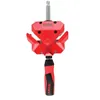 |
BESSEY WS-3+2K-CB Angle Clamp, $33.97 Holds a side panel at 90 degrees to the top or bottom while you drive the screws, which is the exact moment in the glue-up clock below where a corner tends to slip.
|
As an Amazon Associate we earn from qualifying purchases. | |
Joint choice and assembly sequence are two different decisions. Which joint to cut (butt, dado, pocket hole, biscuit, confirmat) is covered in our MDF joinery comparison. This page assumes you picked a screwed and glued butt joint, the simplest casework joint, and covers what happens after: the order you work in, the clock you work against, and how you prove the box is square before it cures.
Fine Woodworking says butt joints with screws are enough for most casework because it rarely has to carry heavy loads. The same article says to use plenty of glue and screws when a cabinet will carry stress, such as a heavy television or a stone countertop. The sequence this page follows:
- Cut every part and label it with a pencil mark (inside face, top edge).
- Dry-fit the whole box with no glue and no screws.
- Drill and countersink pilot holes while the parts are still dry.
- Pre-set your clamps and lay out screws, driver and a damp rag.
- Glue and screw the joints in two stages, inside the glue’s working time.
- Measure both diagonals and correct any racking before the clock runs out.
- Apply the back panel, which locks the box square.
- Fill and seal the edges after the glue has set.
Cut List for a 24 in Cabinet Carcass (Our Example Design)
The numbers below are our own example design, not a standard. Every later figure on this page (screw counts, diagonals, glue-up clock) is worked from these dimensions so you can check the arithmetic and swap in your own. The carcass is 24 in wide, 30 in tall and 21 in deep, built from 3/4 in MDF, with a 1/4 in back applied to the rear edges.
| Part | Qty | Size (in) | How it is worked out |
|---|---|---|---|
| Side | 2 | 30 x 21 | Full height, full depth |
| Top and bottom | 2 | 22.5 x 21 | 24 in overall minus two 3/4 in sides = 22.5 in |
| Back (1/4 in) | 1 | 24 x 30 | Covers all four carcass edges, so it also squares the box |
The four 3/4 in parts add up to 2,205.0 sq in of MDF (2 x 30 x 21 plus 2 x 22.5 x 21), about 48 percent of one 4 x 8 sheet by area, before kerf and layout. If the box will live somewhere humid, read our notes on how much MDF swells with humidity first, and see our properties of MDF page for density and swell numbers.
Dry-Fit First, Then Drill the Pilot Holes
Assemble the carcass with no glue and no screws. You are checking that every edge meets flat, that top and bottom are really the same length, and that your clamps reach. A dry-fit is also the cleanest moment to drill pilot holes, because the parts lie flat and nothing is wet.
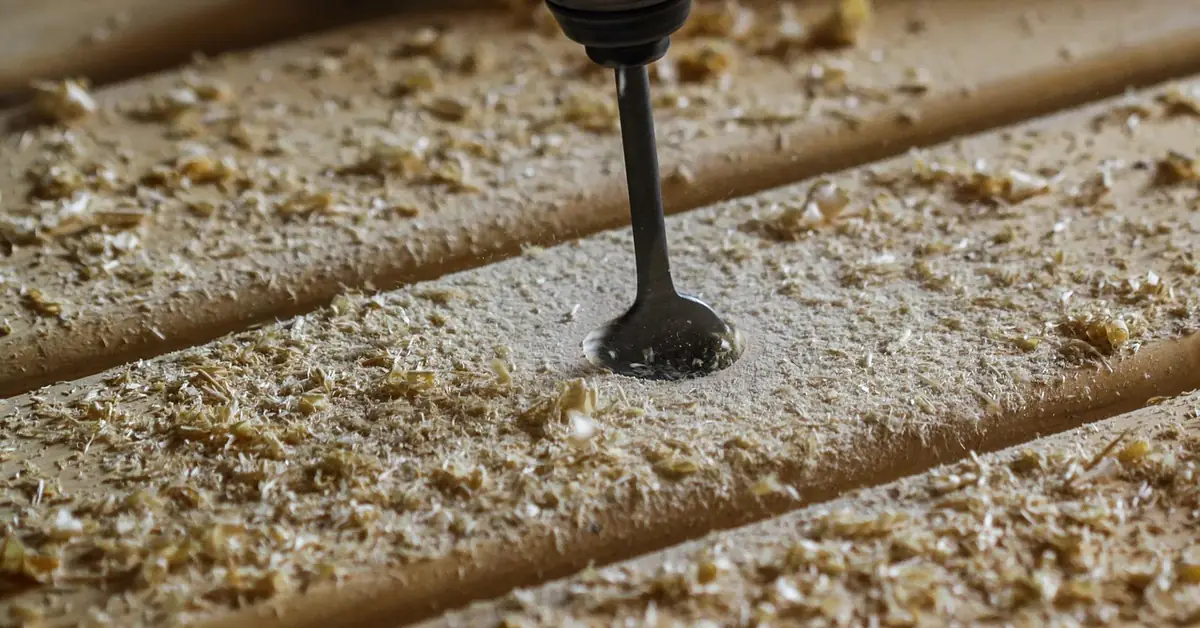
Pilot holes are not optional. Woodworkers Journal advises enlarging the pilot hole if a screw is exploding the MDF and swelling it as it enters, and suggests staying a couple of inches away from the corner when you drive screws into an edge so a crack cannot run to the corner. The same source points to Hi-Lo (double-pitch) screws, which push out less material than conventional screws and are made for MDF, melamine and particleboard. Fine Woodworking makes the same point: a screw driven into an MDF edge without a properly sized pilot hole splits the board.
Size the pilot to the screw you actually bought, using the maker’s drill-size chart on the box. If you strip a hole anyway, our page on repairing MDF and stripped screw holes covers the fix. For a frame-style build instead of a sheet carcass, see how to build a strong wooden box frame.
The Glue-Up Clock: Two Stages Inside the Working Time
The most useful number on a glue bottle is the working time, and most people never plan around it. Titebond’s Original Wood Glue page lists an open assembly time of 4 to 6 minutes and a total assembly time of 10 to 15 minutes at 70F and 50 percent relative humidity, with an application temperature above 50F. That page does not give a clamp or full cure time, so follow the instructions on your own bottle for those.
The table converts those figures into a plan for the example carcass. The minute marks are our own planning budget derived from the 4 to 6 and 10 to 15 minute windows, not a Titebond schedule. A warm, dry shop will run faster, so treat them as upper limits.
| Minute | Action | Why this timing |
|---|---|---|
| Before 0 | Dry-fit done, pilot holes drilled, clamps pre-set, screws and driver laid out | Nothing gets searched for once glue is open |
| 0 to 4 | Stage 1: glue and screw top and bottom to side A (2 joints) | Stays inside the low end of the 4 to 6 minute open time |
| 4 to 9 | Stage 2: glue the other ends, fit side B, screw those 2 joints | Second set of joints is closed by minute 9 |
| 9 to 12 | Measure both diagonals and correct racking | Still inside the 10 to 15 minute total assembly window |
| 12 to 15 | Wipe squeeze-out, set the box on a flat surface, stop adjusting | After minute 15 you are working against setting glue |
MDF edges drink glue. Fine Woodworking notes that edge glue is not very effective because the edges are porous, and recommends plenty of glue on porous edges. Our page on the best glue for MDF covers edge sizing, and our notes on gluing wood corners so they stay square cover corner technique. Titebond’s page also says Original is not intended for exterior use or where moisture is likely; if the project will sit outdoors, read whether MDF can be used outside first.
Clamping and Screw Schedule
Clamps hold the joint in place while the screw pulls it tight. Kreg’s pocket-hole FAQ says clamps stop a joint shifting as the screw enters the mating piece, recommends a right-angle or 90 degree corner clamp for box joints, and says to set the drill clutch low because over-tightening can make MDF bulge or break.
For plain butt joints we use one repeatable rule so you never eyeball spacing: keep the first and last screw 2 in from each end of the joint (Woodworkers Journal’s couple of inches from the corner) and never space screws more than 8 in apart. The 8 in cap is our choice, set at the top of the 6 to 8 in range Kreg gives for pocket holes. It is a planning rule, not a load rating.
| Joint length | Screws | Spacing between screws |
|---|---|---|
| 12 in | 2 | 8.00 in |
| 21 in | 4 | 5.67 in |
| 24 in | 4 | 6.67 in |
| 30 in | 5 | 6.50 in |
| 36 in | 5 | 8.00 in |
| 48 in | 7 | 7.33 in |
Our 21 in deep example joints need 4 screws each, at 2, 7.67, 13.33 and 19 in from the front edge. With four top and bottom joints that is 16 screws. We would use a 2 in screw through the 3/4 in side, which leaves about 1 1/4 in of thread in the panel edge; that length is our own arithmetic, so match it to your screw type. The 1/4 in back goes on with glue and brad nails about every 6 in around the perimeter, which is (24 + 30) x 2 / 6 = 18 brads. Woodworkers Journal lists glue plus long brad nails as an alternative to screws for MDF edges.
If a joint slips under the screw, our guide to gluing pocket-hole joints explains why glue matters, and if glue is pooling out of every seam, see clamps squeezing out too much glue.
Square the Box by Its Diagonals
A tape measure beats a try square for a carcass this size, because a small square only checks one corner at a time. Measure corner to opposite corner both ways. If the two diagonals match, the box is square. The absolute length does not matter, only that the two readings agree.

For our example the outside face is 24 x 30 in, so each diagonal should read about 38.42 in (the square root of 24 squared plus 30 squared). The inside opening is 22.5 x 28.5 in, so its diagonals should read about 36.31 in.
Here is how to read a mismatch. When the top of a 24 x 30 box has shifted sideways by x inches, the two diagonals differ by about 2 x 24 x x / 38.42. A 1/8 in difference between the diagonals therefore means the top is about 0.10 in out of line with the bottom. That is small enough to hide until you hang a door, and easy to fix while the glue is open and impossible to fix once it sets.
- Longer diagonal: that is the pair of corners being pushed apart, so clamp across them or tap them gently together.
- Shorter diagonal: leave it alone, the correction goes on the long one.
- Re-measure after every adjustment and stop at a difference of 1/16 in or less.
Once the diagonals agree, fix the back panel. Because it covers all four edges, it holds the squareness you just measured. Do not remove the corner clamps until the back is on.
Edge Sealing and Finishing After Assembly
Do the filling and sealing after the glue has set, and keep sealer and primer off any face that still needs glue. Fine Woodworking fills MDF edges with drywall compound for painted pieces, whether the edge is square-cut or shaped with a router bit, then sands smooth. Our guide on sealing particle board edges and faces covers the primer step, and the same logic applies to MDF edges because both materials soak up finish at the cut edge. You will find more in our MDF category.
MDF Dust and Formaldehyde: Safety Before You Cut
MDF assembly means cutting, drilling and eventually sanding, and all three make dust. The eLCOSH guide MDF Safety for Carpenters says local exhaust ventilation that pulls dust and gas away at the point of generation works best, and warns that a filter built to trap wood dust will not necessarily capture gases like formaldehyde. It recommends a respirator with cartridges approved for dust and formaldehyde, notes that respirator use needs a proper program with training and fit-testing, and says never to clean the work area or your clothes with compressed air because it throws dust back into the air. It also notes that sanding produces more formaldehyde emission than sawing.
Reported measurement: the same eLCOSH guide reports formaldehyde of 0.01 to 0.14 ppm when sawing and sanding MDF under ventilated conditions. Source: eLCOSH, MDF Safety for Carpenters.
When you buy sheets, the guide points to boards labeled NAF, ULEF, Phase 1 or Phase 2, which indicate lower formaldehyde emissions under California Air Resources Board rules. Check the stamp on the panel before you buy. Treat this as general information, not occupational health advice.
Common Mistakes When Assembling MDF
- Gluing before the dry-fit, then discovering a part is a quarter inch short.
- Driving screws into an edge with no pilot hole, or placing the first screw right at the corner.
- Over-driving screws so the MDF bulges around the head.
- Trusting a small square at one corner instead of measuring both diagonals.
- Sanding the box in a closed garage with no dust collection or respirator.
Frequently Asked Questions
Should you glue MDF together or just use screws?
Use both on anything that will carry weight. Fine Woodworking says butt joints with screws are enough for most casework, but to use plenty of glue and screws when a cabinet will see stress. Glue alone is weak on raw MDF edges because they are porous, so the screws hold the joint while the glue works.
How long should MDF stay clamped after gluing?
Follow the clamp and cure time printed on your own glue bottle. The Titebond Original page we read gives an open assembly time of 4 to 6 minutes and a total assembly time of 10 to 15 minutes at 70F and 50 percent relative humidity, but no clamp time, so we do not quote one.
How do you keep an MDF box square while assembling it?
Measure both diagonals before the glue sets. If the readings match, the box is square, and if they differ, clamp across the longer diagonal until they agree. A 1/8 in difference on a 24 x 30 in box means the top is about 0.10 in out of line. Then fix the back panel to lock it.
Can you screw into the edge of MDF?
Yes, but drill a properly sized pilot hole and stay about two inches from the corner, as Woodworkers Journal advises. Hi-Lo double-pitch screws displace less material than conventional screws. If the screw swells the board as it enters, enlarge the pilot hole.
Do you need to seal MDF edges before painting?
Yes. Cut MDF edges are porous, so fill them first. Fine Woodworking uses drywall compound on the edges, then sands smooth. Do the filling and sealing after the glue has set and keep sealer off any face that still needs glue.
Conclusion
Put MDF together in this order: dry-fit, pilot holes, a two-stage glue-up inside the glue’s working time, a screw schedule with a 2 in end margin and 8 in cap, then diagonal squaring and the back panel. Joint selection lives in our MDF joinery guide. Wear a respirator rated for dust and formaldehyde while you work.
Sponsored / affiliate links. As an Amazon Associate I earn from qualifying purchases. I may earn additional commission from eligible campaigns.