What Is 4/4 Wood? Rough vs. 13/16 in. Surfaced Thickness
4/4 wood (say "four-quarter") is hardwood lumber sold as 1 inch thick in its rough, unplaned state, but a 4/4 board that has been surfaced on both faces measures about 13/16 inch. That gap is the detail most explainers skip, and it is the one that decides whether your project comes out at the thickness you planned.
Below you will find the full quarter-system chart with rough and surfaced thicknesses, a worked example of what a 4/4 board really costs per usable inch, and a quick check to run before you buy.
What 4/4 Actually Means
Best Thickness Check Pick
 |
HARDELL Digital Caliper, 6 Inch, $19.98 A 4/4 board is rarely exactly 1 inch or exactly 13/16 inch. A caliper tells you what you actually have before you pay for it or plane it.
|
As an Amazon Associate we earn from qualifying purchases.
The quarter system is how hardwood lumber thickness is named in the United States. The top number counts quarters of an inch: 4/4 is four quarters (1 inch), 5/4 is five quarters (1-1/4 inches), 8/4 is eight quarters (2 inches), and so on. The number below the line is always 4, which is why lumber yards say "four-quarter" or "eight-quarter" out loud.
Two details make the label easy to misread. First, the number describes the board as it comes off the saw, before any planing. Second, it only applies to hardwood. Softwood construction lumber such as a 2×4 uses nominal names instead, and the surfacing terms are explained in our guide to S4S lumber sizes.
It is also unrelated to quarter sawing. A quarter-sawn board describes how the log was cut to expose vertical grain, while 4/4 describes thickness. You can buy quarter-sawn oak in 4/4, and you can buy plain-sawn oak in 4/4. If you are curious about the cut, see what quarter-sawn oak is.
Rough vs. Surfaced Thickness Chart
Here is the chart most people are really looking for. Rough is the thickness you are billed for. S2S (surfaced two sides) is what you typically get after the mill flattens and smooths both faces. The decimal column is what a caliper will read.
| Quarter call | Rough (nominal) | Typical S2S | S2S in decimals | Removed by milling |
|---|---|---|---|---|
| 4/4 | 1 in | 13/16 in | 0.812 in | about 3/16 in |
| 5/4 | 1-1/4 in | 1-1/16 in | 1.062 in | about 3/16 in |
| 6/4 | 1-1/2 in | 1-5/16 in | 1.312 in | about 3/16 in |
| 8/4 | 2 in | 1-3/4 in | 1.750 in | about 1/4 in |
| 10/4 | 2-1/2 in | 2-1/4 in | 2.250 in | about 1/4 in |
| 12/4 | 3 in | 2-3/4 in | 2.750 in | about 1/4 in |
Suppliers differ, and some sell 4/4 S2S at a flat 3/4 inch, so treat the S2S column as a typical figure rather than a guarantee. For the thick end of the chart, see our guide to 8/4 wood.
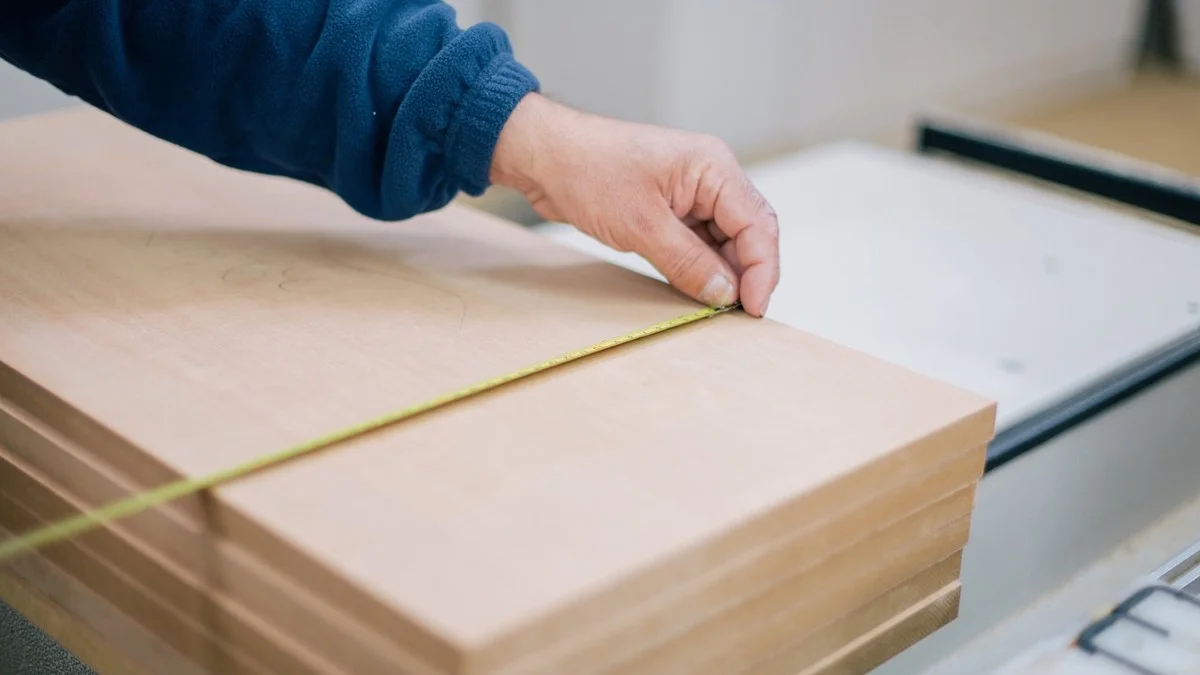
What a 4/4 Board Really Costs Per Usable Inch
Hardwood is priced by the board foot, and the price is based on the rough thickness, even when the boards are surfaced. That creates a cost most beginners never calculate.
Start with the board foot formula: thickness in inches times width in inches times length in feet, divided by 12. A 4/4 board that is 6 inches wide and 8 feet long is 1 x 6 x 8 / 12 = 4 board feet.
Now use an illustrative price of $8 per board foot (not a quoted price). That board costs $32. If you finish it at 3/4 inch thick, you are paying for 1 inch but keeping 0.75 inch, so the effective price is $8 / 0.75 = about $10.67 per board foot of finished 3/4-inch material. That is before you lose anything to width trimming, length trimming and defects.
This is why experienced buyers plan project stock in advance rather than eyeballing a board. Add extra material for milling loss and mistakes. A cushion of around 20 to 30 percent is a common rule of thumb for rough stock, not an industry standard, and it grows with warped or defect-heavy boards. Our guide to whether rough cut lumber is cheaper walks through that trade-off in more detail.
From Rough 4/4 to a Flat 3/4-Inch Board
The thickness you lose is not waste for its own sake. Rough boards are seldom flat. As lumber dries it can cup, bow or twist, and the saw leaves ridges on the faces. The extra thickness in a 4/4 board is the margin that lets you remove all of that and still end up with a flat, even piece.
- Joint one face flat. Run the cupped or twisted face over a jointer, or use a sled on a planer, until it is flat along its whole length.
- Plane the second face parallel. With the flat face down, take light passes in a thickness planer until the opposite face is smooth and the board is the same thickness everywhere.
- Stop at your target. Rough 1-inch stock leaves roughly 1/8 inch per face of margin if you are aiming for 3/4 inch (1 minus 0.75 leaves 0.25 inch total). A badly cupped board can eat that margin quickly.
- Check with a caliper. Measure both ends and the middle before the final pass so you do not plane below the thickness the project needs.
If a board is cupped by more than the margin, you either accept a thinner finished board or move up to the next quarter call. That is the practical reason 5/4 exists: it is the safe pick when you need a full 1 inch or more after flattening.
Common Myths About 4/4 Lumber
- Myth: a 4/4 board is 1 inch thick. It is 1 inch as a nominal rough call. National Hardwood Lumber Association rules allow the thinnest spot of kiln-dried rough 4/4 to run 1/16 inch under, so 15/16 inch can still qualify.
- Myth: 4/4 and a 1x board are the same. A softwood 1x board measures 3/4 inch thick and is sized by a different system.
- Myth: 4/4 is the same as a 4×4. A 4×4 post actually measures 3-1/2 by 3-1/2 inches. The two names have nothing in common.
- Myth: you can get 1-inch thick finished boards from 4/4. After surfacing, 4/4 is about 13/16 inch. To finish at 1 inch you need 5/4.
Which Quarter Thickness Fits Which Project
| If you want to finish at | Buy | Typical uses |
|---|---|---|
| About 5/8 to 3/4 in | 4/4 | Cabinet doors and face frames, drawer sides, shelves, boxes, panels |
| About 15/16 to 1 in | 5/4 | Thicker tabletops, shelves that must not sag, benches |
| About 1-1/4 in | 6/4 | Heavy tops, thick frames and rails |
| About 1-1/2 to 1-3/4 in | 8/4 | Table legs, workbench tops, thick furniture parts |
These are practical suggestions, not rules. 4/4 is the most common and usually the cheapest per board foot, so it is where most furniture and cabinet projects start. If you are still shopping around, our guides to buying hardwood and buying rough cut lumber cover grades and red flags.
Check Thickness Before You Buy
- Ask whether the boards are rough or surfaced, and whether the yard sells S2S at 13/16 inch or a flat 3/4 inch.
- Measure at several points along the board with a caliper, not just one end.
- Compare your thickest and thinnest readings. A board that varies by more than 1/16 inch may need extra planing to come out flat.
- Work backward from the finished thickness you want, then choose the quarter call that leaves enough material to mill flat.
- If you buy online, look for a stated thickness in inches, not only the 4/4 label. See what to check when you buy wood online.
Frequently Asked Questions
What does 4/4 mean in lumber?
4/4 (said "four-quarter") is the hardwood quarter-system name for lumber that is 1 inch thick as rough-sawn stock. The top number counts quarters of an inch, so 4/4 is four quarters, or 1 inch. 5/4 is 1-1/4 inches, 6/4 is 1-1/2 inches and 8/4 is 2 inches.
How thick is 4/4 lumber after it is surfaced?
Surfaced on two sides (S2S), 4/4 lumber is typically 13/16 inch (about 0.81 inch) thick. Milling removes roughly 3/16 inch from a 1-inch rough board. If you plane it further to a 3/4-inch finished thickness, you remove another 1/16 inch.
Is 4/4 lumber the same as a 1x board or a 4×4?
No to both. A softwood 1x board is a nominal size that actually measures 3/4 inch thick, and a 4×4 post is a different system entirely that measures 3-1/2 by 3-1/2 inches. 4/4 is a hardwood thickness call based on rough thickness.
Is 4/4 lumber really 1 inch thick?
Only roughly. It is the nominal rough thickness, and actual boards vary. National Hardwood Lumber Association rules allow the thinnest spot on kiln-dried rough 4/4 to run 1/16 inch under, so a board can measure 15/16 inch in places and still be 4/4.
Should I buy 4/4 or 5/4 for a 3/4-inch or 1-inch finished board?
Buy 4/4 if you want a finished thickness of 3/4 inch or a little more. Buy 5/4 if you want to finish at 1 inch, because 4/4 will not have enough thickness left after flattening and smoothing both faces.
Bottom Line
4/4 means 1 inch of rough thickness, and in practice a surfaced 4/4 board runs about 13/16 inch. Buy 4/4 for finished thicknesses up to about 3/4 inch, step up to 5/4 if you want to finish at 1 inch, and always remember you pay for the rough thickness even when you keep less of it.
Sponsored / affiliate links. As an Amazon Associate I earn from qualifying purchases. I may earn additional commission from eligible campaigns.