What Is a Backsaw Used For? (Types, TPI & Uses Explained)
A backsaw is a short, stiff handsaw with a folded steel or brass spine along its top edge – the reinforcement that keeps its thin blade from bending, unlike a flexible panel saw. That rigidity limits cutting depth to roughly 1-1/2 to 4 inches, but it buys the dead-straight control needed for dovetails, tenon shoulders, and miters. This guide covers the three main backsaw types, the blade length and TPI (teeth per inch) that separate them, and how to pick, use, and maintain one.
What Is a Backsaw?
Best Dovetail Backsaw Pick
 |
IVY Classic 10″ Dovetail Saw, Hardwood Handle – $15.48 A 10-inch carcass-length backsaw at 12 PPI (about 12–13 TPI) – the mid-size range this guide’s comparison table lists as the sweet spot for dovetails and small tenon cheeks in 1/2″–1″ stock.
|
As an Amazon Associate we earn from qualifying purchases.
A backsaw is a category of handsaw defined by one feature: a metal spine, usually folded steel or brass, running along the back edge of the blade opposite the teeth. That rib works like a stiffening rail – it stops a thin blade from buckling or wandering off a cut line the way an unsupported panel-saw blade would if it were ground that thin. The trade-off is depth of cut. Because the spine caps how far the blade can travel into the wood, a backsaw is built for accuracy over reach, not for ripping full boards.
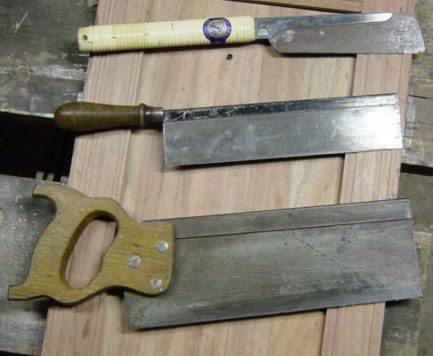
The name covers several specific saws – dovetail saw, carcass saw, tenon saw, and gent’s saw – each sized for a different scale of joint. All of them are sometimes still called by the older name tenon saw, even when a woodworker means the smaller dovetail-cutting version, which is why “backsaw” is the more precise umbrella term.
Types of Backsaws: Dovetail, Carcass & Tenon Compared
The three backsaws below all share the same reinforced-spine design, but their blade length and tooth count are scaled to completely different jobs. Using a tenon saw’s coarse teeth on a 1/2-inch-thick dovetail will tear the fibers; using a dovetail saw on a 2-inch tenon cheek will take forever and drift off line.
| Saw Type | Blade Length | Teeth Per Inch (TPI) | Best For |
|---|---|---|---|
| Dovetail saw | 6″–9″ (1-1/2″–2″ usable depth) | 13–22 TPI | Fine joinery on 1/2″–1″ stock – dovetails, small tenon cheeks |
| Carcass saw | 10″–12″ (2-1/2″–3″ usable depth) | 12–14 TPI | Mid-thickness stock, 1″–2″ – crosscuts on cabinet carcasses |
| Tenon saw | 14″–19″ (3-1/2″–4″ usable depth) | 9–12 TPI | Heavier joinery – tenon cheeks and shoulders on table and chair frames |
A fourth variant, the gent’s saw, skips the closed pistol-grip handle for a plain straight one. It’s light, thin-bladed, and mainly suited to small-scale work like model making rather than structural joinery. For a deeper side-by-side on the two largest types, see our carcass saw vs. tenon saw comparison, or the back saw vs tenon saw breakdown if you are still sorting out the names.
📊 Fine joinery saws run at high tooth counts. Samuel Colchamiro of Highland Woodworking notes that his Lie-Nielsen dovetail saw has 15 teeth per inch and that fine tooth patterns leave exposed joinery cuts with little blowout, at the cost of cutting more slowly. Source: Highland Woodworking, “Using Backsaws for Accurate Sawing”
What Is a Backsaw Used For?
A backsaw is used for precision joinery cuts that have to land exactly on a marked line – work where a wandering blade ruins the joint. The most common uses are:
- Dovetail joints – cutting the angled pins and tails that lock drawer sides and box corners together without nails (our hand-cut dovetail guide walks through the full sequence).
- Tenon shoulders and cheeks – sawing the tongue that fits into a mortise on table legs, chair rails, and door frames.
- Miter cuts – paired with a miter box, a backsaw holds the same angle across dozens of repeat cuts for picture frames and molding.
- Trimming plugs and dowels flush – the thin kerf and fine teeth let a backsaw cut a protruding plug level with the surrounding surface without gouging it.
- Small notches and stopped cuts – where a notch needs a clean shoulder that a jigsaw or circular saw can’t start precisely.
Because it’s a fully manual tool with no cord, battery, or blade guard to manage, a backsaw is also the safer, quieter option for cutting on a workbench indoors – a real advantage over a corded jigsaw or circular saw for one-off joinery cuts in a home shop or apartment.
Key Features of a Backsaw
The stiffening spine sits folded over the top edge of the blade, opposite the teeth. Besides preventing buckling, its extra mass adds a bit of weight that helps the saw track straight under its own momentum instead of needing heavy downward pressure from the user.
The teeth are small and closely spaced compared to a general carpentry handsaw, which is what makes the cut smooth enough for exposed joinery like fine panel work. Backsaw teeth are typically filed in one of two patterns: rip teeth (for cutting along the wood grain, as in a tenon cheek) or crosscut teeth (for cutting across the grain, as in a tenon shoulder or dovetail baseline).
The handle is usually a closed, pistol-grip style made of hardwood or molded polymer, which locks the hand in a consistent grip and reduces fatigue on repeated strokes. Western backsaws cut on the push stroke, because their teeth are set (angled) to bite forward – pulling the saw back simply skates the teeth over the wood without cutting.
Japanese Backsaws (Dozuki): Same Spine, Opposite Stroke
One common claim, that a backsaw always cuts on the push stroke, is only true of Western saws. The Japanese dozuki is also a backsaw: it has the same steel spine along the top edge, but its teeth are set to cut on the pull stroke. Pulling puts the thin blade in tension instead of compression, so it is much less likely to buckle, and makers can grind the plate far thinner than a Western dovetail saw. That thinner plate means a narrower kerf and less material removed, which is why many woodworkers reach for a dozuki on small joinery.
The trade-offs are practical rather than absolute. A dozuki is usually lighter and has a straight handle, so it relies more on your grip and stroke to stay square, and many models use replaceable blades instead of resharpening. A Western backsaw gives you a heavier, more forgiving feel and teeth you can resharpen. If you already own a Western saw, the techniques below carry over, you simply reverse the cutting direction and keep light pressure.
How to Use a Backsaw for a Straight, Square Cut
Technique matters more with a backsaw than with a power saw, since there’s no fence or guide doing the straightening for you. These steps follow the same start-to-finish sequence experienced hand-tool woodworkers use to keep a cut square:
- Mark the line on all visible faces: Score the cut line with a marking knife or gauge on the face, and wrap the line around the edge, so you have a groove to register the saw teeth against, not just a pencil mark.
- Grip with the index finger extended: Point your index finger forward along the handle instead of wrapping it around the grip – this improves directional control of the blade.
- Start the kerf at a shallow angle: Angle the saw up and take light strokes so the teeth just “kiss” the near edge of the line before you level the saw out and lengthen your strokes.
- Push, don’t pull: A Western backsaw’s teeth are set to cut on the forward (push) stroke. Use the full length of the blade with steady, even pressure, and let the teeth do the cutting.
- Check square using the blade’s reflection: On a polished-plate saw, the wood grain reflected in the steel should appear to run straight through into the actual grain when the cut is truly vertical and square.
- Correct drift immediately: If the cut pulls to one side, stop, back the blade out slightly, and restart the stroke rather than forcing it straight, which just widens the kerf. A saw that always drifts the same direction usually has uneven tooth set (more set on one side of the plate), which a saw set or a sharpening service can correct.
Reading the plate: Highland Woodworking’s guide to backsaws describes watching the mirror image of the board in the saw plate. When the grain appears to continue straight through the blade as if it were glass, the cut is square and plumb. The trick only works on a highly polished plate, so a dull or satin-finish saw will not show it.
Choosing the Right Backsaw
Match the saw to your typical stock thickness before anything else. If you mostly build small boxes and drawers from 1/2-inch to 1-inch stock, a dovetail saw with 13–22 TPI is the right starting point. If you’re building furniture frames from 1-1/2-inch to 2-inch stock, a tenon saw with 9–12 TPI cuts faster without the excess drag a fine-toothed saw would create in thicker wood.
Blade length should roughly match the stock’s width, not just its thickness – a longer blade lets you use full strokes without running out of blade mid-cut on wider boards. Handle shape is a matter of preference: a closed pistol grip suits most users, while an open or straight gent’s-saw handle can be easier to control for very small, delicate work.
Maintaining Your Backsaw
Wipe the blade with a soft, dry cloth after every use to remove resin and sawdust, and dry it fully before storing – a damp blade left overnight is enough to start surface rust on carbon steel. For stubborn residue, a mild solvent on a cloth works better than water, which invites rust.
Sharpening a backsaw’s fine teeth is a specialist job best left to a saw-sharpening service or done with a dedicated saw vise and needle files, since the tight TPI on a dovetail saw leaves very little margin for error compared to sharpening a coarse-toothed panel saw.
Store the saw hanging, not stacked flat under other tools – the weight of tools piled on top of a thin backsaw blade can bend it over time, which is exactly the kind of damage the stiffening spine is designed to prevent during use, not while it sits in a drawer.
Safety Tips
- Clamp the workpiece rather than holding it freehand when possible – a steadier board makes a straighter cut and keeps your off-hand clear of the blade path.
- Always cut away from your body, starting with light strokes to establish the kerf before applying full-length strokes.
- Wear safety glasses; even a hand saw throws sawdust and the occasional wood chip toward your face on a push stroke.
- Keep your guiding hand’s fingers well clear of the blade path, especially when starting a cut at a shallow angle.
Common Mistakes to Avoid
Rushing the start of the cut is the single most common mistake – forcing the saw before the kerf is established causes it to skip off the line or splinter the wood’s face. Take the first few strokes slow and light, then build up speed once the kerf is tracking true.
Using the wrong saw for the stock thickness is the second-biggest issue: a dovetail saw dragged through a 2-inch tenon cheek will bind and wander, while a coarse tenon saw on 1/2-inch dovetail stock will tear the fibers instead of slicing them cleanly. Match TPI and blade length to the job using the comparison table above.
Frequently Asked Questions
What is a backsaw used for?
A backsaw is used for precision joinery cuts that must follow an exact marked line, including dovetail joints, tenon shoulders and cheeks, miter cuts, and trimming plugs or dowels flush. Its stiffened spine keeps the thin blade from bending off-line.
How is a backsaw different from a regular handsaw?
A backsaw has a reinforced metal spine along its top edge that a standard panel handsaw doesn’t have. That spine limits cutting depth to a few inches but gives far better control and straightness, while a panel saw cuts deeper but flexes more under pressure.
What materials can a backsaw cut?
A backsaw is built for wood and other soft materials such as plastic laminate or thin plywood veneer. It is not designed for metal, masonry, or dense composite materials – those require saws with hardened or specialty-ground teeth.
Can beginners use a backsaw?
Yes. A backsaw is easier to control than a full-size panel saw because the spine keeps the blade straight for you. Beginners should start with a mid-range 10–12 TPI carcass saw, which is forgiving on common project stock, before moving to a fine dovetail saw.
Is a backsaw the same as a tenon saw?
A tenon saw is one specific type of backsaw, not a synonym for the whole category. “Backsaw” is the umbrella term for any spine-reinforced handsaw; tenon saw refers specifically to the largest of the group, sized for cutting tenon cheeks and shoulders, with usable depth of about 3-1/2 to 4 inches.
Do you need a miter box to use a backsaw?
No, a miter box is optional. Freehand backsaw cuts are standard for joinery like dovetails and tenons, where the woodworker follows a marked line by eye and hand. A miter box is only needed when you must repeat the same angle across multiple cuts, such as picture frame molding.
Is a dozuki saw a backsaw?
Yes. A dozuki is a Japanese backsaw with a stiff spine along the top of a very thin blade. The main difference from a Western backsaw is that it cuts on the pull stroke instead of the push stroke.
Conclusion
A backsaw earns its place in a woodworking toolbox on precision, not speed. The reinforced spine is what separates it from every other handsaw – it trades depth of cut for a straight, controlled line, which is exactly what dovetails, tenons, and miters demand. Match the blade length and TPI to your stock thickness, keep the blade clean and dry between uses, and a good backsaw will outlast most of the power tools in the same shop.
Sponsored / affiliate links. As an Amazon Associate I earn from qualifying purchases. I may earn additional commission from eligible campaigns.