Is a Brushless Motor Worth the Extra Cost?
A brushless motor is worth the extra cost only if the tool’s longer runtime, higher duty cycle, and lower wear save you more than the price gap; for occasional use, a brushed tool is usually the better buy if it costs about 25% less. Skip that math and you can pay extra for a feature your woodworking workload never uses. This guide shows how to judge brushless drills and similar cordless tools by payback, not hype.
Brushless vs brushed: the real trade-off
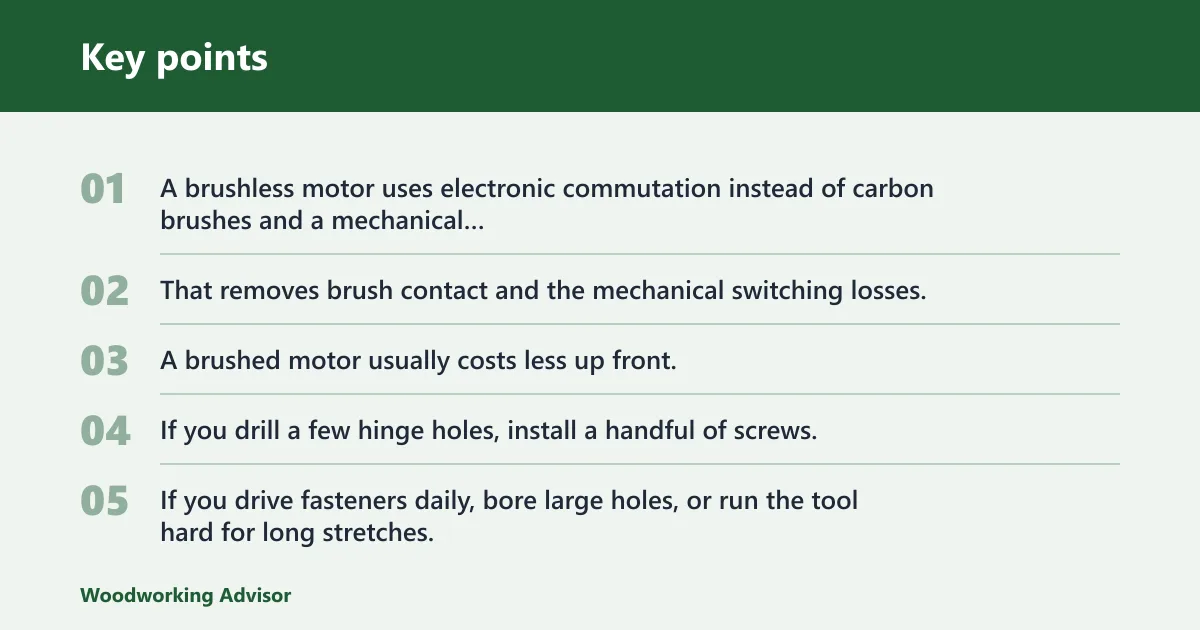


A brushless motor uses electronic commutation instead of carbon brushes and a mechanical commutator. That removes brush contact and the mechanical switching losses, which can improve runtime and cut maintenance. A brushed motor usually costs less up front, but the brushes wear and the extra friction wastes some battery energy as heat.
The right answer depends on how you work. If you drill a few hinge holes, install a handful of screws, and put the tool back on the shelf, the savings may never recover the premium. If you drive fasteners daily, bore large holes, or run the tool hard for long stretches, brushless value shows up faster.
What changes inside the motor
Brushed motors route power through carbon brushes that press against a commutator. That contact wears, sparks a little, and adds friction. Brushless motors move the switching work into electronics, so the motor itself has fewer wear parts and usually loses less energy as heat.
That efficiency matters most in a cordless drill or driver because battery energy is limited. More of each charge reaches the bit, and less disappears inside the motor. The gain is not free, though, because the tool now depends on an electronic speed controller and, in many cases, more complex software.
Where the extra cost comes
Brushless tools cost more because the motor is only part of the system. The controller electronics, more complex motor control logic, and often tighter internal packaging add cost. Tool makers also tend to pair brushless motors with higher-tier housings, better electronics, and battery platforms meant for heavier use.
That means the price gap is not just “motor versus motor.” It is usually motor plus control board plus the rest of the tool package. If you compare a bare brushed model with a brushless kit that includes a better battery, the motor itself is not the only thing you are paying for.
Why the answer depends on workload
Brushless pays back through runtime, duty cycle, and reduced wear. If you use a drill for occasional shelf assembly, the premium may sit unused. If you run a driver all day or push a saw through dense stock, the motor can save enough battery swaps and downtime to matter.
Picture a homeowner driving a few dozen cabinet screws every month. A brushed drill with a lower purchase price may be enough. Now picture repeated 3/8-inch hole drilling through hardwood, or long screw runs into structural lumber. In that case, the extra runtime and cooler operation become much easier to justify.
Brushless motor payoff table
| User type | Upfront price premium | Expected runtime gain | Maintenance savings | Simple verdict |
|---|---|---|---|---|
| Occasional DIY | About 25% to 40% more | About 10% to 20% per charge | Low, because the tool sees light use | Usually not worth it unless the price gap is small |
| Weekend woodworker | About 20% to 35% more | About 15% to 30% per charge | Moderate, especially over several years | Worth it if you drill or drive often and keep the tool |
| Frequent home-shop user | About 15% to 30% more | About 20% to 35% per charge | Meaningful, because wear and downtime add up | Usually worth it for serious cordless work |
| Pro | Often less important than uptime | About 25% to 40% per charge | High, because service time costs money | Usually worth it unless the tool is very lightly used |
This table is a break-even guide, not a promise. The payback window shortens when you use one battery platform across several tools, because the cost of replacement batteries and chargers gets spread across more work. It stretches when the tool sits idle most of the year.
Why are brushless motors more expensive?
Brushless motors are more expensive because the motor needs electronics to do the job that brushes and a commutator handle in a simpler motor. Those electronics add parts, software, testing, and design time. The tool often also needs better thermal management and a stronger battery platform to make the most of the motor.
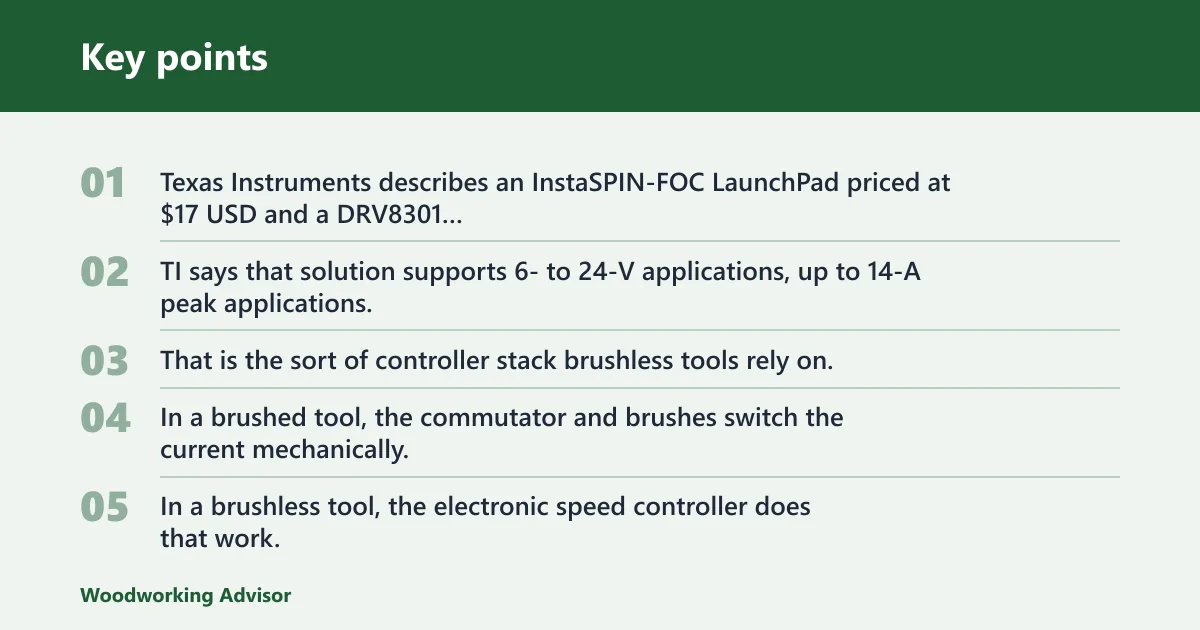
A practical example helps. Texas Instruments describes an InstaSPIN-FOC LaunchPad priced at $17 USD and a DRV8301 BoosterPack priced at $49 USD, for a combined motor control system cost of $66 USD. TI says that solution supports 6- to 24-V applications, up to 14-A peak applications, and uses a 48-pin Piccolo F28027F microcontroller with 64 KB of Flash memory. That is the sort of controller stack brushless tools rely on.
Electronic commutation and controller cost
In a brushed tool, the commutator and brushes switch the current mechanically. In a brushless tool, the electronic speed controller does that work. The controller is not a minor add-on. It is central to the tool’s operation, which is why it can account for a noticeable part of the price premium.
Sensorless operation adds more complexity. The controller has to infer rotor position instead of reading it directly. The same source describes its solution as a complete 3-phase brushless DC sensorless motor control solution, and says the embedded FAST observer estimates rotor flux, angle, speed, and torque. That level of control helps the tool run efficiently, but it costs more to build.
Sensorless control and FOC complexity
Field-oriented control, or FOC, is a way to manage motor current so the controller can optimize torque and efficiency instead of simply blasting power into the motor. In practical terms, it helps a brushless tool stay smooth under load and use battery power more carefully.
That matters in woodworking because load changes fast. A driver goes from free spinning to burying screws. A saw goes from air cutting to pushing through hardwood. Better motor control helps the tool respond cleanly across those changes.
How tool build quality and battery platform affect price
Battery platform matters as much as motor type. An 18V class platform and a 20V max class platform often sit in the same broad cordless category, but the real cost difference is usually in the shared battery ecosystem, charger compatibility, and replacement battery price. A cheap bare tool can become an expensive system if replacement batteries cost too much.
Tool build quality matters too. A brushless tool from a better line may include better bearings, a stronger chuck, or a more durable housing. Those features affect value, but they are separate from the motor itself.
Cordless drill performance: what changes?
Brushless usually improves runtime first, torque control second, and compactness only sometimes. The motor can be smaller for the same output, but the controller and surrounding electronics take space too. In a cordless drill, the real gains show up in how long the tool works between charges and how steadily it holds speed under load.
Runtime and battery voltage
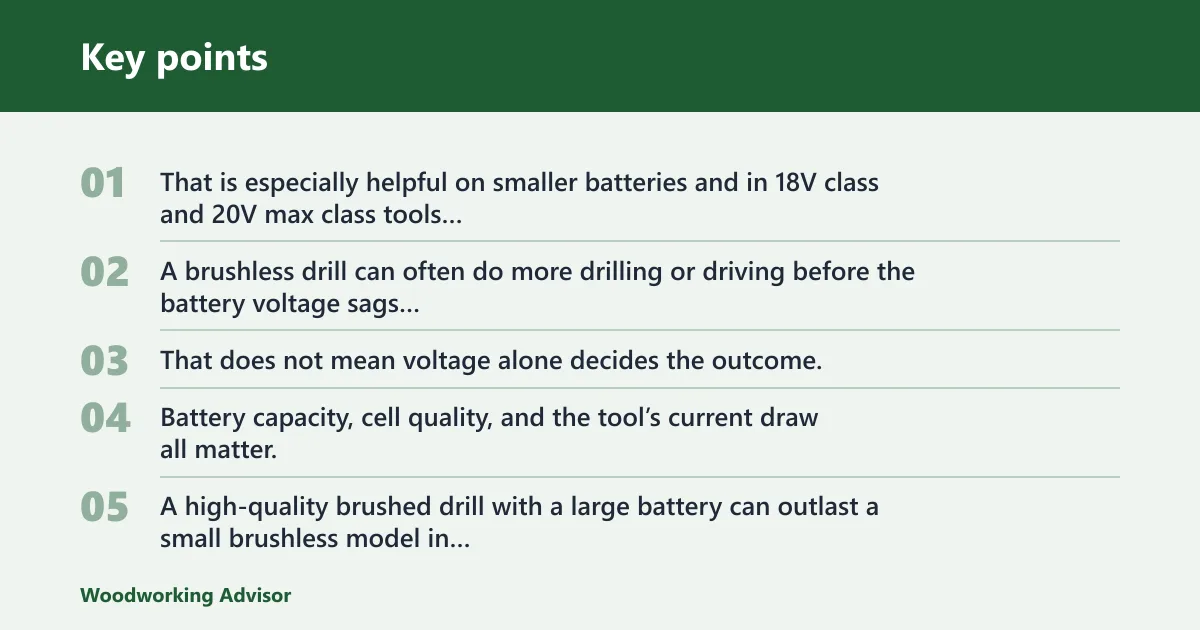
More efficient motors stretch each charge. That is especially helpful on smaller batteries and in 18V class and 20V max class tools where total energy is limited. A brushless drill can often do more drilling or driving before the battery voltage sags enough to slow the tool down.
That does not mean voltage alone decides the outcome. Battery capacity, cell quality, and the tool’s current draw all matter. A high-quality brushed drill with a large battery can outlast a small brushless model in light work.
Torque delivery and compactness
Brushless motors can deliver torque more efficiently because less energy is lost to friction and heat. That helps with start-up control and with maintaining speed in tougher cuts or fastener runs. It can also make the tool feel more consistent under load.
Compactness is a mixed benefit. Some brushless tools are shorter because the motor is more efficient. Others are not much smaller because the controller and cooling space offset part of the gain.
Duty cycle in drilling and driving
Duty cycle is where brushless matters most in woodworking. If you drill a few holes and stop, the advantage is small. If you bore repeatedly through hardwood, drive long structural screws, or use the tool in long bursts, a cooler motor and lower energy loss can keep the tool working longer before it needs a rest or a battery swap.
Do brushless motors really run cooler?
Yes, they usually do, because there is no brush friction and less energy wasted in the motor itself. That lower heat can help runtime and may reduce stress on surrounding parts. But cooler does not mean immune to overheating, especially when the tool is overloaded, blocked, or run in hot conditions.
Heat and friction losses in brushed motors
Brushed motors lose energy in the brush contact and commutator interface. That creates heat and adds wear. Heat is not just a comfort issue. It can shorten the life of nearby electronics, soften plastics, and make the tool less consistent over a long work session.
Efficiency gains in real woodworking use
In drilling and driving, the heat benefit shows up as longer runtime and less heat buildup during sustained use. In saw work, it can help the tool maintain speed with less battery drain. In sanding, where the tool can run for long periods, lower heat can be especially useful.
Say your drill starts getting uncomfortably warm after a dozen 3/8-inch holes in pine and the battery drops faster than expected. A brushless model doing the same job may still warm up, but it is less likely to waste as much energy as heat while it works.
When heat still matters even with brushless
Brushless tools still overheat if you push them too hard. High current, blocked airflow, dull blades, and long continuous runs all raise temperature. Moisture can also create problems when it reaches the electronics or motor connections.
So the cooler-running claim is real, but it is not a warranty against abuse. It is one factor in a larger system.
What actually fails on a brushless tool?
The motor itself may wear slowly, but the controller becomes part of the risk. A brushless tool can fail from damaged electronics, moisture exposure, bad wiring, or overheating. The upside is lower brush wear. The downside is that electronic faults are often less forgiving than simple mechanical wear.
Controller and sensorless electronics
The electronic speed controller is the most important extra failure point. It handles commutation, speed control, and protection logic. If it fails, the tool may not run at all, or it may start, stutter, or shut down under load.
Sensorless systems add another layer. If the controller cannot estimate rotor position properly, the tool may lose smooth startup or refuse to deliver full torque when needed.
Moisture, overload, and overheating
Moisture can damage boards, connectors, or sealed components. Overload and overheating can cook the controller or shorten the life of surrounding parts even if the motor windings survive. A brushless tool that lives in dusty, damp, or poorly stored conditions can lose some of its advantage quickly.
Repair cost versus brushed wear parts
Brushed tools have a simpler wear pattern. Brushes eventually need replacement, and that is a known maintenance item. With brushless tools, repairs can become more expensive because the controller or motor electronics may be harder to replace economically.
That is one reason the premium only makes sense when you expect enough use to recover it. If a tool sees light service, a cheaper brushed model can be the smarter financial choice.
Choose brushed if… / Choose brushless if…
Choose brushed if your workload is light, your budget is tight, and you do not mind replacing the tool sooner. Choose brushless if your work is frequent, your cuts or drilling are demanding, or you want longer runtime from each battery and less wear over time.
- Choose brushed if you use the tool occasionally and the price gap is about 25% or more.
- Choose brushed if you only need a drill for light fastening, furniture assembly, or small home repairs.
- Choose brushless if you drill, drive, sand, or saw often enough that battery swaps and downtime matter.
- Choose brushless if you already own a battery platform and can spread the higher upfront cost across several tools.
- Choose brushless if you expect high-load work, longer duty cycles, or daily use.
Battery platform can swing the decision. If you already own several batteries and chargers in one ecosystem, a brushless bare tool may look more attractive. If a new platform forces you to buy batteries again, the replacement battery cost can erase the motor savings quickly.
A common first-timer mistake is comparing only the upfront tool price and ignoring battery life, maintenance, and runtime. The real comparison is the full system price over time: tool, batteries, charger, and expected repairs or replacements.
Frequently asked questions
Are brushless motors worth the extra money?
They are worth the extra money when the tool’s runtime, cooler running, and lower wear save you more than the premium. For frequent woodworking use, that can happen quickly. For light, occasional use, the savings often are not large enough to justify the higher price.
How much longer does a brushless tool last?
There is no guaranteed lifetime figure because tool quality, battery care, load, and storage matter too. Brushless tools usually avoid brush wear, which can extend service life, but controller failure can become the limiting factor. So the gain is real, but not unlimited.
When does a brushed motor still make sense?
A brushed motor still makes sense when you need a lower upfront price and only use the tool occasionally. It is also sensible if the tool will see light duty, short run times, and low annual wear. In that case, the simpler design can be the better buy.
Is brushless worth it for occasional home-shop use?
Usually not, unless the price difference is small or you already live in the same battery platform. Occasional home-shop use rarely creates enough runtime savings or maintenance savings to pay back a large premium. For light drilling and driving, brushed tools often remain the better value.
Sponsored / affiliate links. As an Amazon Associate I earn from qualifying purchases. I may earn additional commission from eligible campaigns.